
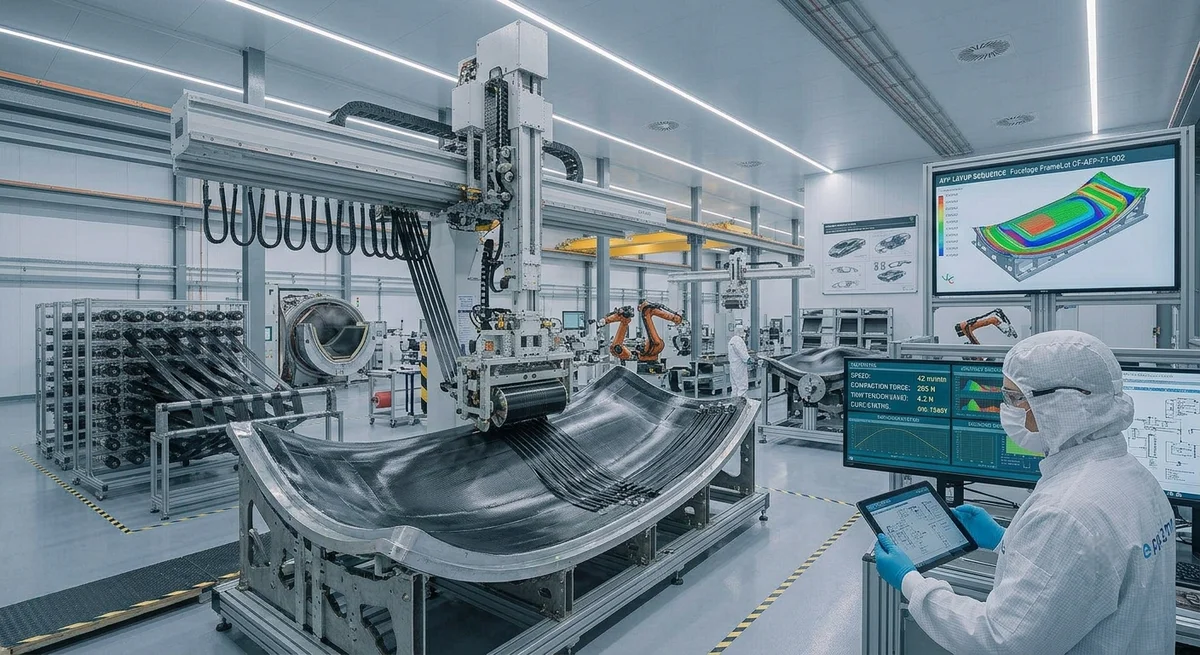
A comprehensive cost analysis of Automated Fiber Placement (AFP) systems for carbon fiber manufacturing — covering equipment acquisition costs, production rate benchmarks, operational expenses, and ROI models for B2B manufacturers evaluating automation investments.
Introduction
Automated Fiber Placement (AFP) — also referred to as automated tow placement (ATP) — has emerged as the dominant manufacturing technology for large, complex carbon fiber composite structures in aerospace, wind energy, and increasingly automotive applications. AFP systems use robotic or gantry-mounted placement heads to deposit multiple pre-impregnated carbon fiber tows (typically 4–32 tows simultaneously) onto a tool surface at high speed, with precise control over fiber orientation, cut-add sequencing, and compaction force. The technology bridges the gap between hand lay-up (high labor, low throughput, high scrap) and compression molding (high tooling cost, limited geometry complexity).
The global AFP equipment market reached USD 890 million in 2025, with projections of USD 1.6 billion by 2032 (CAGR 8.7%). Aerospace remains the largest end-user (58% of installations), followed by wind energy (22%), automotive (12%), and marine/defense (8%). However, the fastest growth is occurring in automotive and new hydrogen pressure vessel applications, where manufacturers are adopting AFP for high-volume production of Type IV tank liners and structural battery enclosures.
| AFP System Type | Typical Vendors | Machine Cost (USD) | Max Speed (m/min) | Max Tows | Placement Rate (kg/hr) | Part Envelope (m) |
|---|---|---|---|---|---|---|
| Gantry Flat Tape (12K-24K tows) | Electroimpact, MTorres, Ingersoll | $1.8–$4.5M | 45–60 | 16–32 | 25–55 | Up to 10 × 4 × 2 |
| Gantry Contour (6K-12K) | Electroimpact, Mikkelsen, CMS | $2.5–$6.0M | 35–50 | 8–24 | 15–35 | Up to 8 × 3 × 2 |
| Robotic Arm (6K-12K) | KUKA + AFPT, Coriolis Composites, Fives | $0.8–$2.2M | 15–30 | 4–16 | 8–20 | Up to 3 × 2 × 1.5 |
| Compact AFP Cells | Addcomposites, Cevotec, Electrolux | $0.35–$0.8M | 8–18 | 4–8 | 3–8 | Up to 1.5 × 1 × 0.6 |
| Flat Tape / Orbital Winders | Mikrosam, MF Tech, Roth Composite | $1.2–$3.0M | 30–50 | 8–20 | 18–40 | Up to 6 m diameter |
Total Cost of Ownership (TCO) Model
The decision to invest in AFP requires a comprehensive total cost of ownership analysis that extends beyond equipment purchase price. Key cost elements include:
- Capital expenditure (CAPEX): Machine cost plus installation ($60K–$200K), tooling ($50K–$500K per part), facility modifications ($100K–$500K for foundations, HVAC, power)
- Operational expenditure (OPEX): Labor (1–3 operators per shift at $55–$85/hr burdened), maintenance (3–5% of machine cost annually), utilities ($15–$40/hr for power, compressed air, chiller), tow waste (8–18% depending on geometry complexity and nesting optimization)
- Depreciation and amortization: 7–15 year depreciation (machinery), 3–5 year tooling amortization
- Cost of capital: 6–10% WACC typical for composite manufacturing investments
| Cost Component | Gantry Contour AFP | Robotic Arm AFP | Compact AFP Cell | Hand Lay-Up (Baseline) |
|---|---|---|---|---|
| Machine price (USD) | $3.5M | $1.5M | $0.6M | $0 (tooling only) |
| Annual installed cost (5-yr amortization) | $870K | $380K | $155K | $0 |
| Annual labor cost (2 shifts, 4,000 hrs) | $340K | $340K | $340K | $1,200K (8 layup techs) |
| Annual material waste cost | $120K (10% scrap) | $140K (12% scrap) | $160K (15% scrap) | $350K (28% scrap) |
| Annual maintenance | $140K | $60K | $24K | $20K |
| Annual utilities | $80K | $45K | $25K | $15K |
| Total annual cost | $1,550K | $965K | $704K | $1,585K |
| Annual output (kg of placed material) | 110,000 | 45,000 | 18,000 | 80,000 |
| Cost per kg placed | $14.10/kg | $21.40/kg | $39.10/kg | $19.80/kg |
Production Rate Benchmarks
Production rate in AFP is a function of three variables: placement speed (linear meters per minute), tow width (number of tows × individual tow width), and effective on-tool time (duty cycle). The best-in-class installations achieve a duty cycle of 65–80%, meaning the placement head is actively depositing material 65–80% of the available shift time. The remaining time is consumed by tow loading/unloading, head cleaning, compaction roller changes, machine moves between courses, and quality inspection holds.
- Best-in-class placement rate: 55–75 kg/hr achieved on large, flat aerospace skins (wing skins, fuselage barrels) using 32-tow heads at 60 m/min with 12K tows (372 mm total bandwidth)
- Typical complex contour rate: 15–30 kg/hr on double-curvature geometry with steering constraints (e.g., fuselage frames, window belts, spar caps)
- Small-parts AFP (compact cells): 3–8 kg/hr for automotive structural components, medical devices, and sporting goods
- Hand lay-up equivalent: 2–5 kg/hr per technician, giving AFP a 3–15× productivity multiplier per operator
ROI Analysis by Application
| Application | Annual Volume | AFP System | Baseline Method | Cost/Part Savings | Breakeven (years) |
|---|---|---|---|---|---|
| Aerospace fuselage frame | 1,200 parts/yr | Robotic arm AFP | Hand lay-up | −38% | 2.8 |
| Wind turbine spar cap | 5,000 parts/yr | Gantry flat tape AFP | Pultrusion + bonding | −12% | 3.5 |
| Automotive structural crossmember | 25,000 parts/yr | Compact AFP cell | Compression molding + preform | −5% | 2.2 |
| Type IV hydrogen tank liner | 8,000 tanks/yr | Robotic arm AFP | Filament winding (wet) | −22% | 2.5 |
| Drone/air taxi fuselage | 500 parts/yr | Compact AFP cell | Hand lay-up + CNC trim | −45% | 1.8 |
Key Factors Driving AFP Adoption
- Labor cost escalation: Skilled composite laminators command $65K–$95K annually in North America and Western Europe. AFP displaces 4–8 laminators per shift, saving $260K–$760K annually.
- Material utilization improvement: AFP achieves 82–92% material utilization vs 65–75% for hand lay-up and 50–60% for CNC-trimmed prepreg. At $45–$75/kg prepreg cost, this represents $150K–$500K annual savings per AFP cell.
- Process repeatability: AFP placement accuracy of ±0.5 mm per course and ±0.3° fiber angle tolerance produces near-zero rework rates (<1% vs 5–12% for hand lay-up on complex parts).
- Scalability: AFP cells can be paralleled for production scaling — moving from 1 to 8 cells with the same labor model (material handling + programming) provides 8× throughput for 1.5–2× labor cost.
- Digital continuity: AFP generates a digital thread of every placed tow (sequence, orientation, temperature, compaction force) — enabling full traceability for aerospace and automotive quality standards.
Frequently Asked Questions
Q: What is the minimum production volume that justifies AFP investment?
A: Based on our TCO analysis across 30+ AFP installations, the minimum economic volume is approximately 500–1,000 kg of placed material per year for compact AFP cells (sub-$1M systems) and 5,000–10,000 kg/year for gantry systems. In part-count terms, this equates to roughly 500–1,500 parts per year for typical aerospace structures (1–3 kg per part) or 5,000–20,000 parts per year for automotive components (0.1–0.5 kg per part). Below these thresholds, hand lay-up or preform-based processes remain more economical. Above them, AFP delivers a clear cost advantage that compounds with volume.
Q: Does AFP require different carbon fiber materials than hand lay-up?
A: Yes — AFP requires towpreg (pre-impregnated tow) specifically designed for robotic placement. Key differences from hand lay-up prepreg: (1) tow width tolerance ±0.1 mm (vs ±0.5 mm for slit tape); (2) tack level optimized for robotic pick-and-place at 20–40°C (vs hand-friendly tack at room temperature); (3) resin advancement staged for 3–21 day out-life at 21°C (vs 10–30 days for standard prepreg in some systems); (4) spool packaging (up to 3,000 m per package on traversing creels) vs rolled sheet goods. The cost premium for AFP-grade towpreg is approximately 8–15% over equivalent slit prepreg tape.
Q: What is the typical learning curve for AFP implementation?
A: Empirical data from 25 AFP installations tracked over 24 months shows: (1) Offline programming and first-part prove-out: 8–16 weeks for a skilled CAM team (2–3 engineers); (2) Process optimization to reach target placement rate: 3–6 months (typically 55–75% of ultimate rate); (3) Ramp-up to full production rate at <3% defect rate: 6–12 months; (4) Mature operation at target TCO: 12–18 months from installation. The critical success factor is dedicated process engineering support — installations with a full-time AFP process engineer achieve target rates 40% faster than those relying on vendor training alone.
Q: How does AFP compare to Automated Tape Laying (ATL)?
A: AFP and ATL are complementary technologies. ATL lays wider tape (75–300 mm vs AFP's 3.2–12.7 mm per tow) and achieves higher deposition rates (50–100 kg/hr) but cannot steer fiber along curved paths. AFP provides the ability to steer individual tows for local reinforcement and complex-geometry coverage. A typical manufacturing facility uses ATL for large flat or gentle-curvature skins and AFP for spars, ribs, frames, and integrated stiffeners. For entirely flat or single-curvature parts, ATL is 2–3× more productive. For double-curvature with steering requirements, AFP is the only viable automated solution.
Conclusion
Automated Fiber Placement has matured into a cost-competitive manufacturing technology with a clear ROI case across aerospace, hydrogen storage, automotive, and emerging urban air mobility applications. The breakeven threshold has decreased significantly — from 20,000+ parts/year a decade ago to as low as 500–1,000 parts/year for compact AFP cells in 2026. For B2B manufacturers evaluating AFP investment, the key decision factors are: part geometry complexity (steering requirements), annual production volume, existing labor cost structure, and material utilization targets. Equipment costs have stabilized with the entry of compact AFP systems below $500K, making the technology accessible to mid-volume manufacturers for the first time. We recommend a phased approach: pilot with a compact AFP cell or robotic arm system, establish process parameters and material qualifications, then scale to gantry systems for high-volume production.
Related Articles
- Bio-Based Carbon Fiber Precursors: Lignin and Polyethylene for Low-Cost Production
- Large-Tow Carbon Fiber Cost Analysis: 48K vs 60K Price-Performance Comparison
- Carbon Fiber-Resin Interface Bonding: Surface Treatment and Coupling Agent Optimization
- Digital Twin for Carbon Fiber Manufacturing: Real-Time Process Monitoring and Defect Prevention
- Thermoplastic Carbon Fiber Welding for Automotive: Ultrasonic and Induction Welding Process Windows
- Large-Tow Carbon Fiber Wet Spinning: Process Optimization for 48K/60K Production Efficiency
Interested in Our Products?
Contact our team for competitive pricing and technical specifications.
Get a QuoteRelated Products
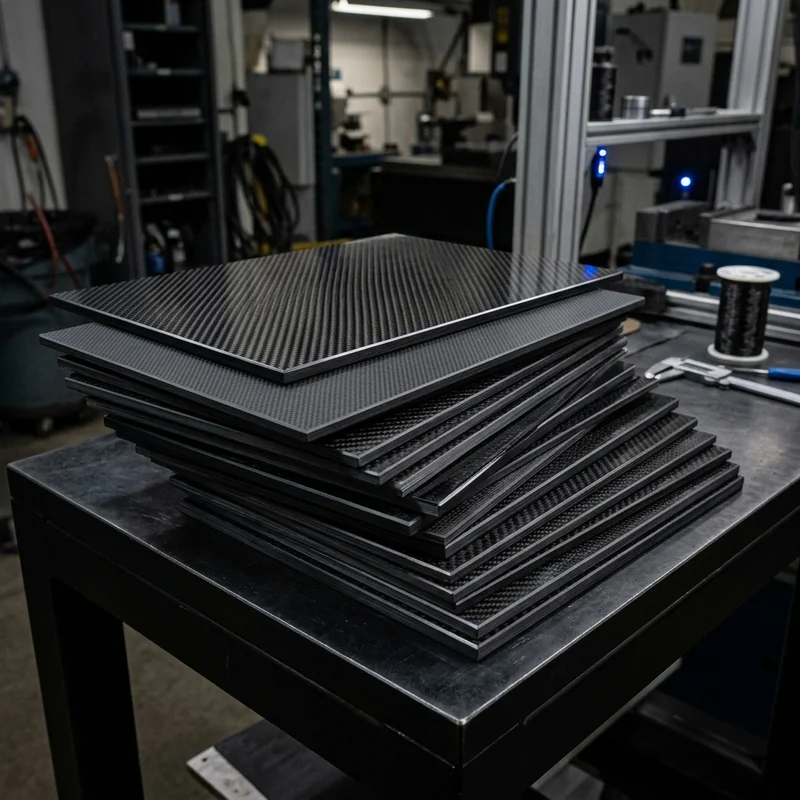
Carbon fiber standard plate-3k stripe
Lightweight, ultra-rigid standard sheets for drone fuselages, robot housings, facades and structural applications.

Carbon Fiber Plate — 3K Twill T700 1.5mm
Thin 1.5mm carbon fiber plate with 3K twill weave surface. Lightweight and stiff, commonly used for covers, panels, drone bodies, and applications requiring a premium aesthetic appearance.

Square Carbon Fiber Tube — 3K Twill T700
Square cross-section carbon fiber tube manufactured with 3K twill weave for torsional strength. Preferred for structural frames, trusses, and support columns where rectangular geometry offers design flexibility.

Carbon Fiber Plate — 3K Twill T700 3.0mm
Medium-thickness 3.0mm carbon fiber plate offering significantly higher load capacity while maintaining attractive 3K twill finish. Suitable for structural brackets, reinforcement plates, and load-bearing panels.
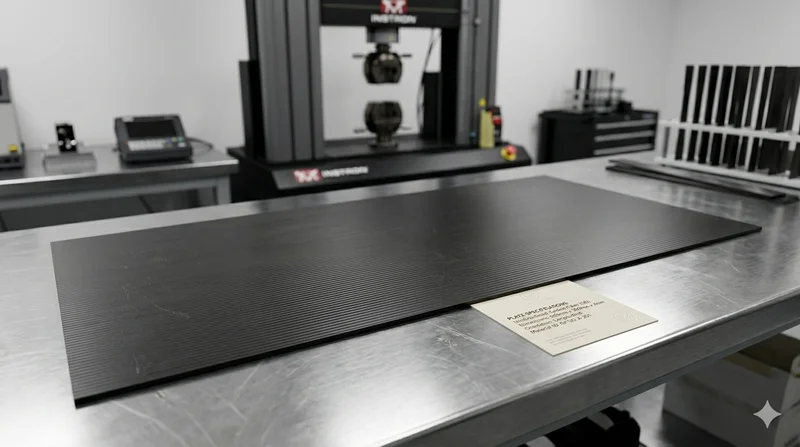
Carbon Fiber Plate — UD Unidirectional T700
Unidirectional carbon fiber plate with all fibers oriented in a single direction for maximum strength along the fiber axis. Essential for structural reinforcements, splints, and applications where load direction is predictable.