
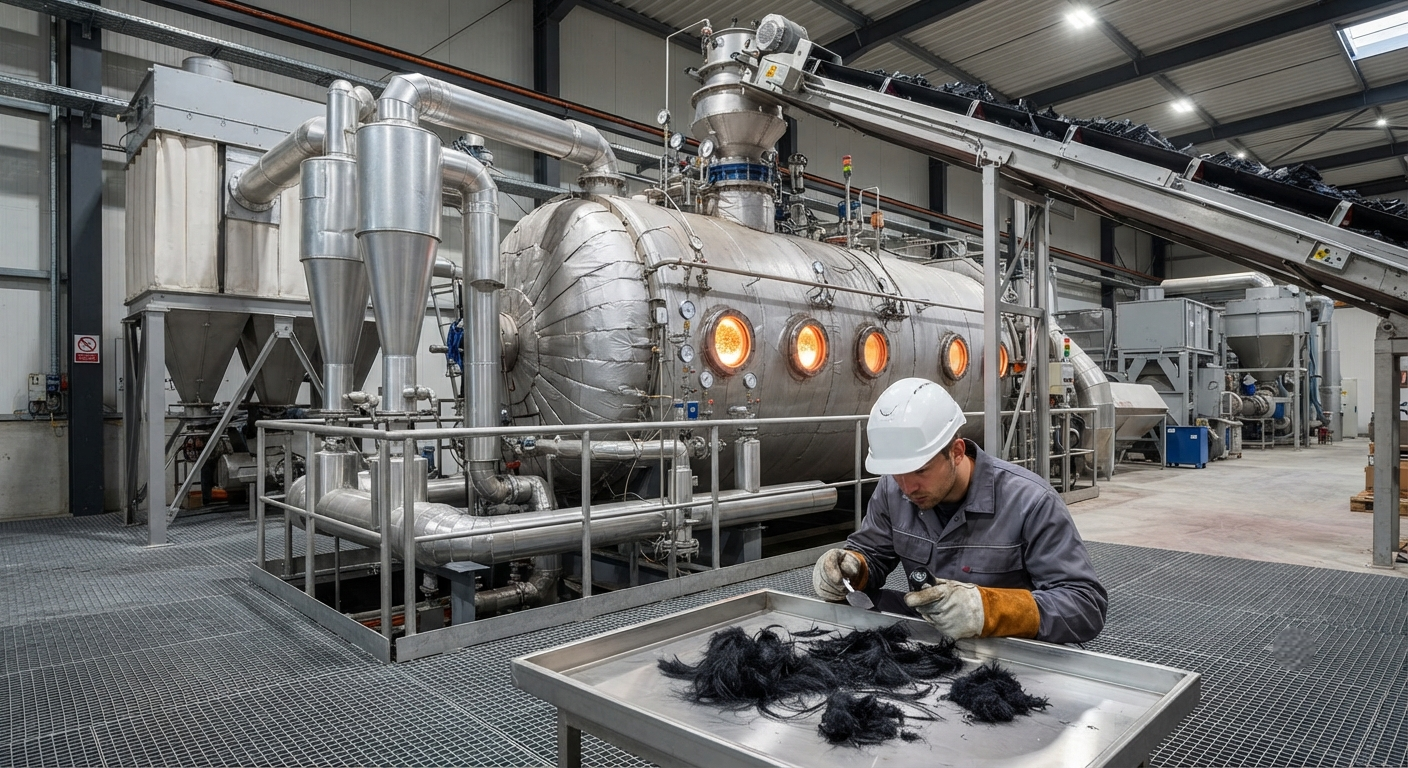
Fluidized bed pyrolysis recovers carbon fibers with 95% modulus retention and 85% tensile strength retention at industrial scale. This article details process parameters, recovered fiber properties, and the economics of recycling CFRP waste from aerospace and wind energy.
Introduction
The global carbon fiber reinforced polymer (CFRP) market generated an estimated 62,000 tonnes of manufacturing waste in 2025, with end-of-life wind turbine blades contributing an additional 14,000 tonnes annually. With virgin PAN-based carbon fiber priced at USD 35–55 per kilogram, the economic incentive to recover fibers from production scrap and end-of-life components is substantial. Pyrolysis in a fluidized bed reactor has emerged as the most industrially mature recycling technology, capable of processing contaminated, mixed-feedstock CFRP waste at rates exceeding 2,000 kg per hour per reactor line.
Unlike conventional fixed-bed pyrolysis, which suffers from uneven heat distribution and long cycle times, fluidized bed pyrolysis suspends shredded CFRP particles in a heated sand bed using an upward gas stream. This achieves rapid, uniform heat transfer — particle heating rates of 10⁴–10⁵ °C/s — and complete decomposition of the epoxy matrix within 2–5 seconds residence time. The recovered fibers retain 90–98% of their original modulus and 75–90% of their tensile strength, making them suitable for secondary structural and semi-structural applications.
| Parameter | Fixed-Bed Pyrolysis | Rotary Kiln | Fluidized Bed Pyrolysis |
|---|---|---|---|
| Process Temperature (°C) | 400–600 | 450–700 | 450–600 |
| Residence Time (min) | 30–120 | 15–60 | 0.03–0.10 (2–6 s) |
| Heat Transfer Rate | Low (conductive) | Medium | High (convective) |
| Fiber Modulus Retention | 80–90% | 85–92% | 90–98% |
| Fiber Tensile Strength Retention | 60–75% | 65–80% | 75–90% |
| Throughput (kg/h per reactor) | 50–200 | 100–500 | 500–2,000+ |
| Surface Cleanliness (residual char) | 2–5 wt% | 1–3 wt% | <0.5 wt% |
| Energy Consumption (kWh/kg) | 3.5–5.0 | 2.5–4.0 | 1.5–2.5 |
How Fluidized Bed Pyrolysis Works
The process consists of four stages: feed preparation, pyrolysis, char separation, and post-treatment.
- Feed preparation: CFRP waste is shredded to 10–50 mm particle size. Metals (inserts, fasteners) are removed via magnetic separator and eddy current separator. The shredded material is fed via a rotary airlock into the fluidized bed reactor.
- Pyrolysis: The reactor contains a bed of silica sand (0.3–0.6 mm particle size) fluidized by preheated nitrogen or recycled flue gas at 450–600°C. The gas velocity of 0.5–1.5 m/s creates a bubbling fluidized bed regime. CFRP particles entering the bed are rapidly heated; the epoxy matrix decomposes into hydrocarbon gases and a thin char layer on the fiber surface.
- Char separation: The gas stream carrying char particles and fibers exits the reactor through a cyclone separator (removes >95% of char >10 µm) followed by a baghouse filter (removes fine char down to 1 µm). The clean fibers are collected via a downstream fiber recovery system.
- Post-treatment: Recovered fibers undergo a mild oxidation in air at 400–500°C for 15–60 minutes to remove residual surface char. This step is critical — incomplete char removal reduces interfacial shear strength by 40–60% in subsequent composite manufacturing. An optional plasma or chemical sizing treatment can restore surface functionality for specific matrix systems.
Recovered Fiber Properties
The quality of recovered carbon fibers depends on both the pyrolysis parameters and the original fiber type. Testing conducted at the University of Nottingham and ELG Carbon Fibre (now Gen 2 Carbon) shows consistent results:
- Modulus retention: 92–98% for standard modulus (230 GPa) fibers, 90–95% for intermediate modulus (295 GPa). The compression-shear forces in the fluidized bed do not significantly damage the graphitic crystal structure.
- Tensile strength retention: 75–90%, with the reduction primarily attributed to surface pitting from oxidative char removal rather than bulk fiber damage. A 5-minute oxidation at 500°C removes 99% of surface char but causes 10–25 nm deep surface pits that act as stress concentrators.
- Interfacial shear strength (IFSS): When re-impregnated with epoxy, recovered fibers achieve IFSS of 35–55 MPa — approximately 70–85% of virgin fiber IFSS. A plasma treatment (O₂/Ar, 100 W, 30 s) restores IFSS to 90–95% of virgin levels by reintroducing oxygen-containing functional groups.
| Property | Virgin T700S | Fluidized Bed Recovered | Retention |
|---|---|---|---|
| Tensile Modulus (GPa) | 230 | 218–225 | 95–98% |
| Tensile Strength (MPa) | 4,900 | 3,920–4,410 | 80–90% |
| Density (g/cm³) | 1.80 | 1.78–1.80 | 99–100% |
| Filament Diameter (µm) | 7.0 | 6.9–7.0 | 99–100% |
| Surface Oxygen Content (at%) | 8–12 | 2–5 | 25–50% |
| IFSS in Epoxy (MPa) | 55–65 | 35–55 | 64–85% |
Economic Analysis
The economics of fluidized bed CFRP recycling depend on scale, feedstock quality, and end-market value. A 2,000 kg/h commercial plant requires a capital investment of approximately EUR 15–20 million. At 80% capacity utilization, operating costs break down as follows:
- Energy: EUR 120–200 per tonne (18–30% of total operating cost). The fluidized bed's excellent heat transfer gives it the lowest energy consumption per kg among pyrolysis technologies.
- Labor: EUR 80–120 per tonne — 3 operators per shift for a single reactor line with automated feed handling.
- Maintenance: EUR 50–80 per tonne — the fluidized bed experiences abrasive wear from sand particles; reactor lining replacement every 8,000–12,000 operating hours.
- Feedstock cost: Negative EUR 200–600 per tonne (CFRP waste currently carries gate fees at disposal facilities).
The net operating cost is approximately EUR 600–1,100 per tonne of recovered fiber. With recovered carbon fiber selling at EUR 12–25 per kg (versus EUR 30–50 for virgin equivalent), a well-operated plant achieves EBITDA margins of 25–35%.
Frequently Asked Questions
Can fluidized bed pyrolysis handle different types of CFRP waste simultaneously?
Yes — this is a key advantage over fixed-bed systems. The fluidized bed's rapid heat transfer and short residence time allow mixed feedstocks (prepreg scrap, cured trim waste, end-of-life components with different epoxy systems) to be processed in a single run without segregation. The reactor can handle fiber volume fractions from 40–70% without adjustment. However, thermoset matrices with high char yields (phenolic resins, bismaleimides) require slightly higher temperatures (550–600°C) for complete decomposition and should not be mixed with standard epoxy waste in the same batch without process tuning.
What are the environmental benefits compared to landfill disposal?
Landfill disposal of CFRP waste faces increasing regulatory pressure — the EU Landfill Directive targets a ban on CFRP landfilling by 2030. Fluidized bed pyrolysis reduces the waste volume by 70–80% (the epoxy matrix is converted to fuel gas) and recovers high-value carbon fibers. The pyrolysis off-gases (H₂, CH₄, CO, light hydrocarbons) have a calorific value of 15–25 MJ/Nm³ and can be combusted to provide up to 60% of the reactor's energy requirement, reducing net CO₂ emissions. A life-cycle assessment by the University of Strathclyde found that fluidized bed recycling of CFRP reduces global warming potential by 55–65% compared to virgin fiber production combined with landfill disposal.
What are the main applications for recycled carbon fibers from fluidized bed pyrolysis?
Recycled carbon fibers (rCF) from fluidized bed pyrolysis are best suited for non-aesthetic, semi-structural applications where the 75–90% tensile strength retention is sufficient. Major applications include: (1) compression-molded non-woven mats for automotive underbody shields and engine bay components, (2) injection-molded short-fiber compounds (3–6 mm fiber length) for laptop casings and drone frames, (3) CFRP reinforcement of injection-molded thermoplastics (PP, PA6, PA66) for consumer electronics ESD shielding, and (4) non-structural aerospace interior panels. Direct replacement of virgin fiber in primary aerospace structures (wing skins, fuselage sections) is not currently recommended due to the IFSS reduction and the variability in recovered fiber properties.
Part of topic
Related Articles
- Bio-Based Carbon Fiber Precursors: Lignin and Polyethylene for Low-Cost Production
- Large-Tow Carbon Fiber Cost Analysis: 48K vs 60K Price-Performance Comparison
- Carbon Fiber-Resin Interface Bonding: Surface Treatment and Coupling Agent Optimization
- Digital Twin for Carbon Fiber Manufacturing: Real-Time Process Monitoring and Defect Prevention
- Thermoplastic Carbon Fiber Welding for Automotive: Ultrasonic and Induction Welding Process Windows
- Large-Tow Carbon Fiber Wet Spinning: Process Optimization for 48K/60K Production Efficiency
Interested in Our Products?
Contact our team for competitive pricing and technical specifications.
Get a QuoteRelated Products
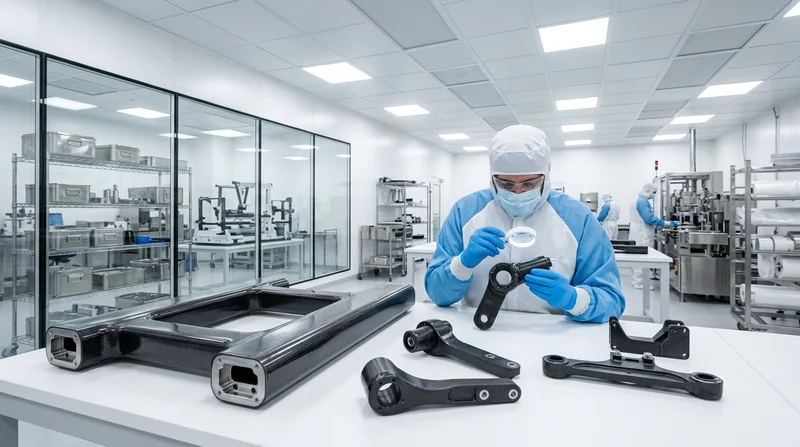
Custom Carbon Fiber Medical Device Components
Medical-grade carbon fiber components manufactured for imaging equipment, surgical instruments, and patient support systems. Carbon fiber's radiolucency (X-ray transparency) and high strength-to-weight ratio make it ideal for CT scanner beds, wheelchair frames, surgical robot arms, and MRI-compatible accessories. Biocompatible resin systems available.
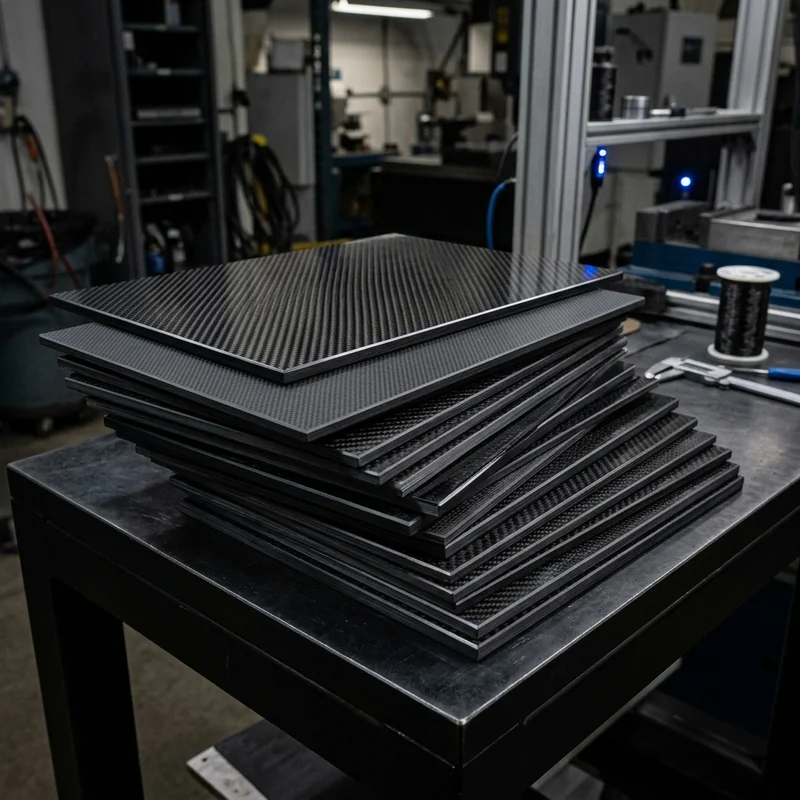
Carbon fiber standard plate-3k stripe
Lightweight, ultra-rigid standard sheets for drone fuselages, robot housings, facades and structural applications.

Square Carbon Fiber Tube — 3K Twill T700
Square cross-section carbon fiber tube manufactured with 3K twill weave for torsional strength. Preferred for structural frames, trusses, and support columns where rectangular geometry offers design flexibility.

Carbon Fiber Plate — 3K Twill T700 3.0mm
Medium-thickness 3.0mm carbon fiber plate offering significantly higher load capacity while maintaining attractive 3K twill finish. Suitable for structural brackets, reinforcement plates, and load-bearing panels.

Carbon Fiber Plate — 3K Twill T700 1.5mm
Thin 1.5mm carbon fiber plate with 3K twill weave surface. Lightweight and stiff, commonly used for covers, panels, drone bodies, and applications requiring a premium aesthetic appearance.