
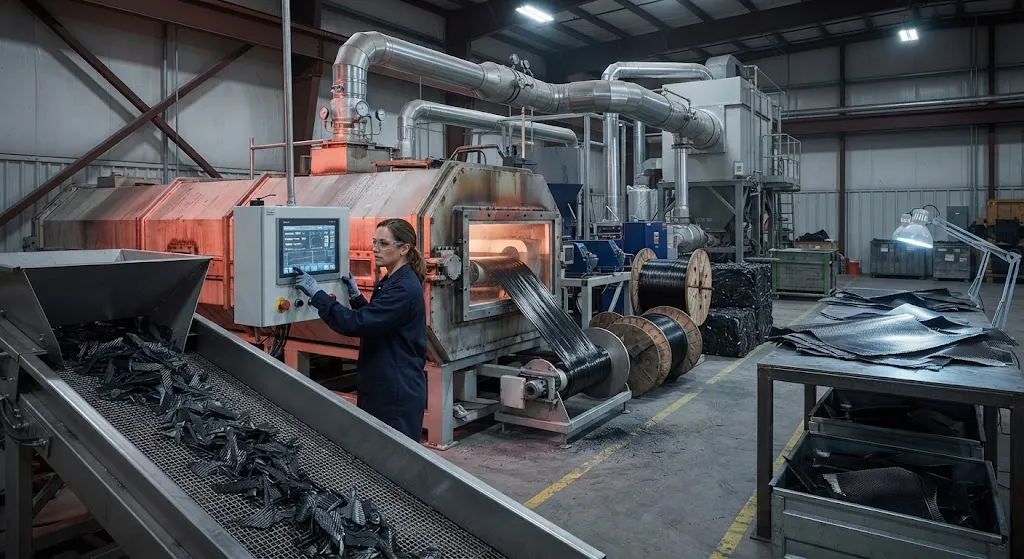
Recycling carbon fiber composites has moved from a laboratory curiosity to an industrial-scale operation, driven by tightening environmental regulation, rising virgin fiber prices, and brand commitments to circular supply chains. For a procurement or sustainability engineer, the decisiv
Introduction
Recycling carbon fiber composites has moved from a laboratory curiosity to an industrial-scale operation, driven by tightening environmental regulation, rising virgin fiber prices, and brand commitments to circular supply chains. For a procurement or sustainability engineer, the decisive question is rarely "can it be recycled" but "at what energy and environmental cost." The two dominant technologies are pyrolysis, which thermally decomposes the resin matrix in an oxygen-free environment, and solvolysis, which dissolves the matrix in solvents under heat and pressure. Both recover carbon fiber, but their life-cycle energy intensity differs markedly at scale.
Understanding this difference matters for real purchasing decisions. Virgin carbon fiber carries a substantial embodied energy, typically 165-200 megajoules per kilogram (MJ/kg) for standard tow. If recycling consumes most of that energy again, the environmental case collapses; if it consumes a fraction, recycled fiber becomes an attractive low-carbon feedstock. This article quantifies the energy intensity of pyrolysis and solvolysis using published life-cycle assessment (LCA) data, examines how recovered fiber quality changes the equation, and outlines what the 2026 regulatory landscape means for composite buyers.
How the Two Processes Work at Scale
Pyrolysis and solvolysis recover fiber in fundamentally different ways, and the differences cascade into their energy footprints.
- Pyrolysis: Scrap or end-of-life composite is heated to 400-600°C in an oxygen-free atmosphere. The resin matrix decomposes into volatile gases and a small char residue, leaving clean carbon fiber. Continuous tube furnaces process several tonnes per day, and the off-gas can be combusted to recover heat, offsetting part of the furnace energy demand.
- Solvolysis: Matrix breakdown is achieved chemically in a pressurized reactor using solvents — often supercritical water, alcohols, or acid mixtures — at 250-450°C. The solvent dissolves the polymer, and the fiber is washed, filtered and dried. Solvolysis preserves more of the fiber surface chemistry and sizing, which matters for resin bonding in the remanufactured composite.
At commercial scale, pyrolysis is more mature and cheaper per tonne; solvolysis claims higher recovered-fiber quality but carries a heavier energy and solvent-handling burden. The LCA comparison therefore becomes a mapping between energy input and the practical value of the output fiber.
Energy Intensity Comparison at Industrial Scale
The table below summarizes the main energy contributions of both routes as reported across recent LCAs, normalized to one kilogram of recovered fiber:
| Life-cycle stage | Pyrolysis | Solvolysis |
|---|---|---|
| Shredding and pre-processing (MJ/kg) | 0.5-1.5 | 0.5-1.5 |
| Core decomposition energy (MJ/kg) | 12-22 | 30-70 |
| Solvent make-up and circulation (MJ/kg) | not applicable | 8-20 |
| Fiber washing and drying (MJ/kg) | 1-3 | 4-10 |
| Heat recovery credit (MJ/kg) | -5 to -12 | not applicable |
| Net life-cycle energy (MJ/kg) | 12-32 | 45-100 |
At industrial scale, pyrolysis consumes roughly 12-32 MJ per kilogram of recovered fiber, while solvolysis — depending on whether the solvent loop is recycled — lands between 45 and 100 MJ/kg. In both cases this is a fraction of the 165-200 MJ/kg embodied in virgin fiber, but the gap between the two processes is substantial: solvolysis is typically three to five times more energy-intensive at current scale.
Why Recovered Fiber Quality Changes the Equation
Energy intensity alone does not decide the process; the usable value of the recovered fiber does. Pyrolysis tends to strip the fiber's surface sizing and can reduce tensile strength by 5-20% depending on process severity, so recovered fiber is often recycled into non-structural or secondary applications. Solvolysis preserves more of the surface chemistry and typically retains higher tensile strength, allowing a larger share of fiber to be reused in structural-grade compounds and nonwovens.
The practical consequence is a quality-adjusted energy comparison. If solvolysis fiber can replace virgin fiber in a higher-value application, its larger energy debt can be repaid through the avoided virgin production. LCA practitioners express this with a substitution factor: at a substitution rate above roughly 60-70%, solvolysis can outperform pyrolysis on net avoided greenhouse-gas impact, despite its higher direct energy load. Buyers selecting a recycling route therefore need both the energy number and the fiber-quality yield, not the energy number alone.
2026 Compliance and Procurement Implications
The regulatory picture is sharpening the business case for low-energy recycling. The European Union's revised End-of-Life Vehicles directive and the Carbon Border Adjustment Mechanism both reward materials with credible, low-carbon recycling footprints, and several OEMs now require recycled-content declarations from Tier 1 composite suppliers. For procurement teams, the practical implications are threefold:
- Ask for LCA-backed numbers: Require suppliers to disclose the life-cycle energy and greenhouse-gas intensity of their recycled fiber, not just a recycled-content percentage.
- Match fiber quality to application: Use pyrolysis fiber for cost-sensitive secondary parts and solvolysis fiber where structural properties justify the energy premium.
- Track the substitution factor: The environmental benefit depends on how much virgin fiber the recycled output actually replaces — tied to quality, not process type alone.
Frequently Asked Questions
Is recycling carbon fiber cheaper than making virgin fiber?
In energy and cost terms, recycling is generally cheaper at the material level. Recovered carbon fiber carries an embodied energy of roughly 12-32 MJ/kg (pyrolysis) versus 165-200 MJ/kg for virgin fiber, and recycled fiber prices typically sit 30-60% below virgin equivalents. However, recycling costs include collection, sorting, shredding and logistics, which are not always reflected in simple price comparisons. At industrial scale, the energy and cost advantage of recycling is real but narrows on a kilometre-by-kilometre basis for low-value, contaminated scrap.
Why is solvolysis more energy-intensive than pyrolysis?
Solvolysis must heat a solvent system — often supercritical water or alcohol — to high temperature and pressure, which demands substantially more energy per kilogram than the direct thermal treatment of pyrolysis. It also carries continuous solvent circulation, pressurization and recovery loads. The fuel becomes a concentrated chemical-engineering problem: managing water or solvent heating, recovery and disposal. Pyrolysis benefits from burning its own off-gas to offset furnace demand, giving it a natural heat-recovery advantage that solvolysis lacks at current scale.
Which recycling route produces higher-quality carbon fiber?
In general, solvolysis preserves more of the fiber's surface chemistry and sizing, producing fiber with higher retained tensile strength and better resin adhesion — suitable for structural-grade compounds. Pyrolysis often strips surface treatments and can reduce strength by 5-20%, so the output is more commonly directed to non-structural and secondary applications. The quality gap closes as pyrolysis process control improves, but solvolysis retains the edge for applications that need the fiber to bond strongly into a new resin matrix.
Conclusion
Pyrolysis and solvolysis both recover carbon fiber at far lower energy intensity than virgin production, but they are not interchangeable. Pyrolysis is the leaner process today, consuming 12-32 MJ/kg against solvolysis's 45-100 MJ/kg, while solvolysis buys that extra energy with higher recovered-fiber quality that can replace virgin fiber in more demanding applications. The right answer for a specific purchasing decision depends on the substitution factor — how much of the recovered output actually displaces virgin material — and on the application's structural requirements.
For teams building a low-carbon composite supply chain, pairing recycled fiber with the right process is only half the equation; selecting reinforcement with a well-characterized recycling footprint closes it. Browse our carbon fiber and reinforcement product range, or contact our engineering team to discuss recycled-content options and material qualification for your program.
Part of topic
Related Articles
- Bio-Based Carbon Fiber Precursors: Lignin and Polyethylene for Low-Cost Production
- Large-Tow Carbon Fiber Cost Analysis: 48K vs 60K Price-Performance Comparison
- Carbon Fiber-Resin Interface Bonding: Surface Treatment and Coupling Agent Optimization
- Digital Twin for Carbon Fiber Manufacturing: Real-Time Process Monitoring and Defect Prevention
- Thermoplastic Carbon Fiber Welding for Automotive: Ultrasonic and Induction Welding Process Windows
- Large-Tow Carbon Fiber Wet Spinning: Process Optimization for 48K/60K Production Efficiency
Interested in Our Products?
Contact our team for competitive pricing and technical specifications.
Get a QuoteRelated Products
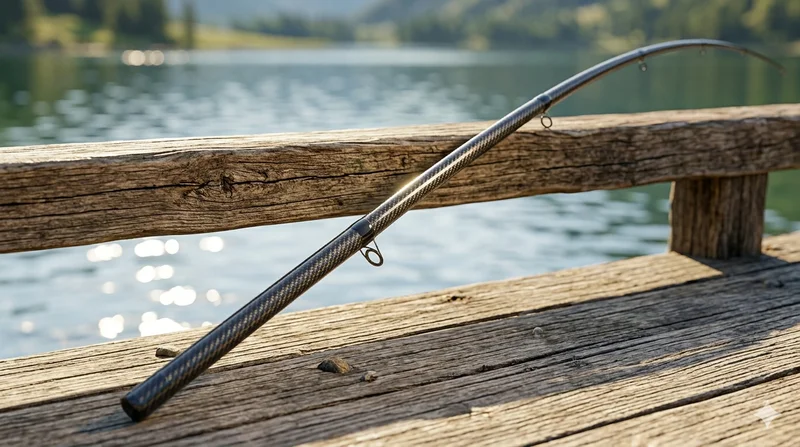
Carbon Fiber Fishing Rod Blank
High-quality carbon fiber fishing rod blank manufactured from multiple grades of Toray carbon fiber cloth. Available in a wide range of lengths, powers, and actions for freshwater and saltwater applications. Suitable for OEM rod building.
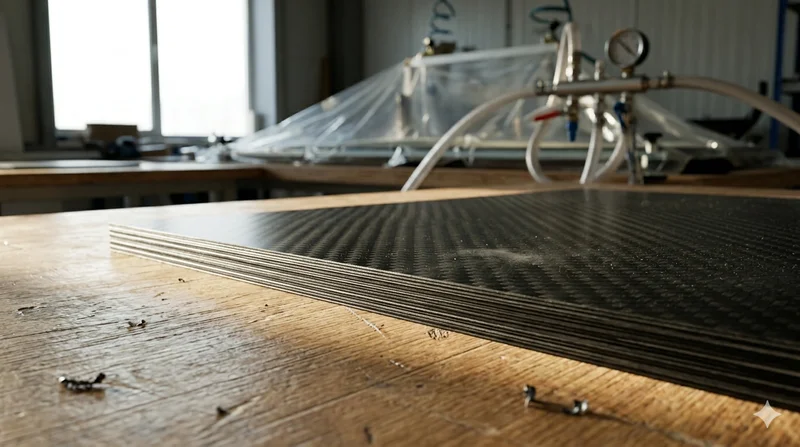
Carbon Fiber Plate — 3K Twill T700 3.0mm
Medium-thickness 3.0mm carbon fiber plate offering significantly higher load capacity while maintaining attractive 3K twill finish. Suitable for structural brackets, reinforcement plates, and load-bearing panels.
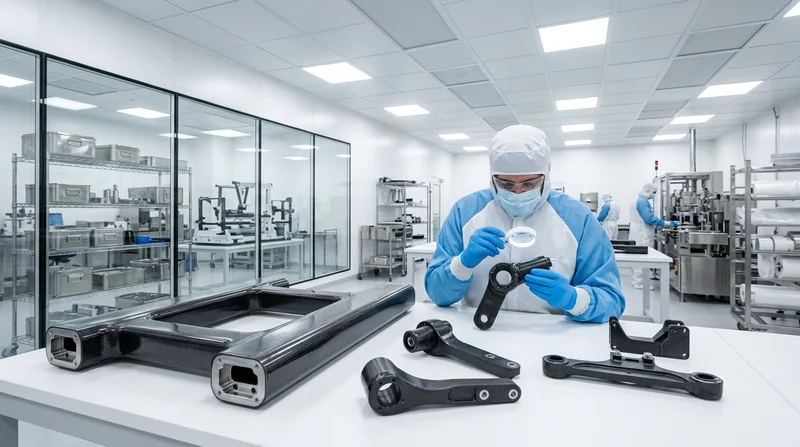
Custom Carbon Fiber Medical Device Components
Medical-grade carbon fiber components manufactured for imaging equipment, surgical instruments, and patient support systems. Carbon fiber's radiolucency (X-ray transparency) and high strength-to-weight ratio make it ideal for CT scanner beds, wheelchair frames, surgical robot arms, and MRI-compatible accessories. Biocompatible resin systems available.
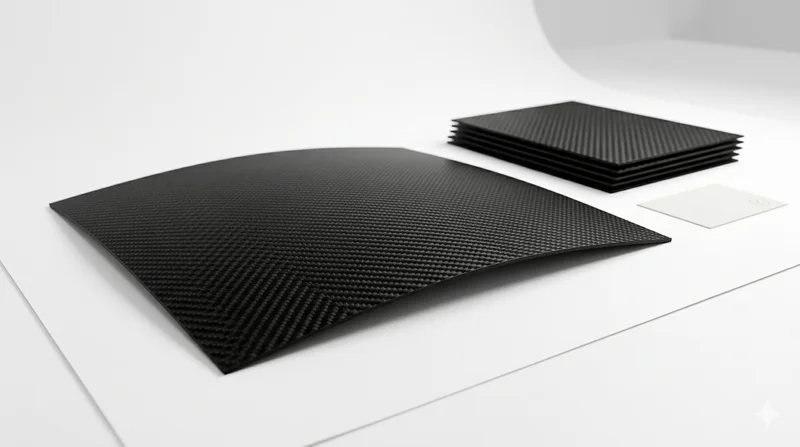
Carbon Fiber Plate — 3K Twill T700 1.5mm
Thin 1.5mm carbon fiber plate with 3K twill weave surface. Lightweight and stiff, commonly used for covers, panels, drone bodies, and applications requiring a premium aesthetic appearance.
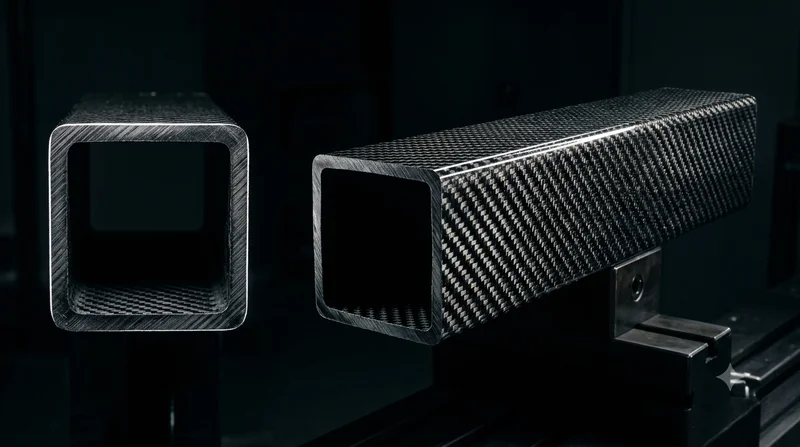
Square Carbon Fiber Tube — 3K Twill T700
Square cross-section carbon fiber tube manufactured with 3K twill weave for torsional strength. Preferred for structural frames, trusses, and support columns where rectangular geometry offers design flexibility.