
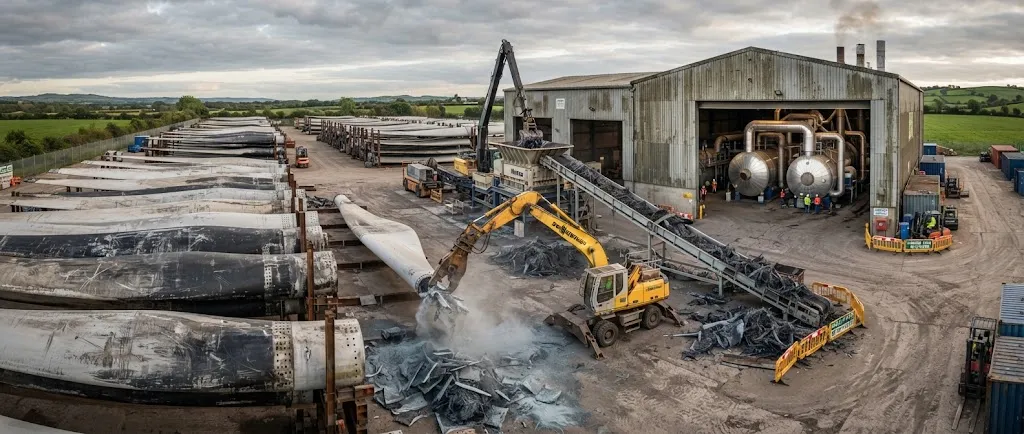
The carbon fiber reinforced polymer industry is entering a phase where end-of-life management can no longer be treated as an afterthought. By 2026, global carbon fiber production capacity has reached approximately 245,000 tonnes per year, with wind energy blades, aerospace components, a
Introduction
The carbon fiber reinforced polymer industry is entering a phase where end-of-life management can no longer be treated as an afterthought. By 2026, global carbon fiber production capacity has reached approximately 245,000 tonnes per year, with wind energy blades, aerospace components, and automotive structures representing the largest installed base of composite material that will eventually require recycling. The problem is stark: the world currently operates only about 6,120 tonnes per year of dedicated CFRP recycling capacity — less than 1% of the waste stream that will emerge as first-generation wind blades and退役 aerospace parts reach end of service life.
The European Union has quantified the challenge most precisely. European thermoset composite waste, predominantly from wind turbine blades, is estimated at 914,000 tonnes per year as of 2025, and this figure is projected to more than double by 2035 as the first large-scale offshore wind installations begin decommissioning. The gap between available recycling capacity and projected waste is not a future concern — it is a present emergency that is already constraining how composite manufacturers, wind farm operators, and aerospace recyclers plan their waste management strategies.
Mapping the Current Recycling Capacity Landscape
Global CFRP recycling capacity is distributed across a small number of pilot and demonstration plants, with commercial-scale operations concentrated in Europe. The table below summarizes the principal recycling facilities and their rated capacities:
| Facility / Operator | Location | Technology | Rated Capacity (t/yr) | Status (2026) |
|---|---|---|---|---|
| CFK Valley Stade | Germany | Mechanical shredding | 1,500 | Operational |
| Recicarb (Aditya Birla) | India | Pyrolysis | 1,200 | Operational |
| Fairmat | France | Pyrolysis + automated sorting | 800 | Operational |
| ELG Carbon Fibre | United Kingdom | Pyrolysis | 2,000 | Operational |
| Carbon Conversions | United States | Pyrolysis | 520 | Operational |
| TNO CIRCLE4WIN | Netherlands | Industrial pyrolysis | 10,000 (planned) | Demo phase |
| ZEBRA Consortium | France | Solvolysis | 2,500 (planned) | Pilot |
| Total Operational (2026) | — | — | ~6,120 | — |
The total operational capacity of approximately 6,120 tonnes per year is dominated by mechanical shredding and pyrolysis routes, with solvolysis still at pilot stage. Critically, the "planned" figures for CIRCLE4WIN and ZEBRA would bring total capacity to nearly 19,000 tonnes per year — still less than 3% of the 914 kt European waste stream.
Why the Gap Is Widening
Three structural forces are driving the recycling capacity gap wider even as new facilities come online:
- Blade retirement acceleration: First-generation wind turbine blades (installed 2000-2010) are entering the decommissioning window. The European Wind Energy Association estimates 52,000 tonnes of blade waste in 2025, rising to 430,000 tonnes per year by 2030. Each 50-meter blade weighs 12-18 tonnes, and most contain 30-40% glass fiber by weight plus carbon fiber spar caps in newer designs.
- Aerospace part obsolescence: As aircraft are retired or undergo mid-life upgrades, CFRP structural components from early-generation composite fuselages and wings become available for recycling. The rate is currently modest — estimated at 5,000-8,000 tonnes per year globally — but will accelerate as A350 and 787 fleets reach mid-life in the 2030s.
- Manufacturing scrap growth: Prepreg cutting waste and out-of-specification parts from composite manufacturing represent a steady, growing waste stream. Aerospace-grade prepreg scrap alone is estimated at 30,000-50,000 tonnes per year globally, with recycling rates below 15% due to mixed-material contamination.
Against this trajectory, the current 6,120 tonnes per year of recycling capacity is not just inadequate — it represents a system that will be overwhelmed within three to five years. The investment required to bring recycling capacity to even 100,000 tonnes per year by 2030 is estimated at €400-600 million, a fraction of the €3.2 billion annual market for virgin carbon fiber but a figure that neither wind farm operators nor composite manufacturers have committed to at scale.
Technology Pathways and Their Scaling Challenges
The three primary CFRP recycling technologies each face distinct scaling barriers that explain why capacity has not kept pace with waste generation:
- Mechanical shredding: The simplest route — grinding composite waste into fiber fragments — operates at the lowest cost (€200-400 per tonne) but produces degraded fiber with reduced length and mechanical properties. Recycled fiber retains only 50-70% of virgin tensile strength, limiting its application to non-structural uses such as injection-molded compounds and concrete reinforcement.
- Pyrolysis: Thermal decomposition in an oxygen-free atmosphere recovers longer fibers with better property retention (70-85% of virgin strength). However, the process is energy-intensive — consuming 3-5 kWh per kilogram of processed material — and requires sophisticated off-gas treatment. The capital cost of a pyrolysis plant capable of processing 10,000 tonnes per year is approximately €15-25 million.
- Solvolysis: Chemical dissolution of the resin matrix using subcritical water or organic solvents produces the highest-quality recycled fiber, approaching 85-95% of virgin properties. The technology remains at pilot scale because solvent recovery and waste stream management add complexity and cost (€500-800 per tonne processed), and no commercial-scale plant currently operates continuously.
Each technology must overcome not only engineering scale-up challenges but also the economic reality that virgin carbon fiber, while expensive, remains cheaper than recycled fiber in many applications when quality requirements are stringent. The recycled fiber market depends on demand drivers — automotive, consumer electronics, sports equipment — where mechanical properties can tolerate the 15-50% degradation inherent in current recycling routes.
Regulatory and Investment Outlook
European Union regulatory pressure is the strongest catalyst for closing the recycling gap. The EU End-of-Life Vehicle Directive revision (expected 2027) will mandate minimum recycled content in new composite parts, while the proposed Extended Producer Responsibility framework for wind energy could require blade manufacturers to fund recycling infrastructure. Germany's 2025 Composite Waste Ordinance already requires wind farm operators to demonstrate waste management plans for decommissioned blades.
Investment is beginning to respond. The European Investment Bank has committed €120 million to composite recycling infrastructure, and private equity firms are funding pyrolysis startups in France, Germany, and the Netherlands. However, the scale of investment needed — €400-600 million by 2030 to reach 100,000 tonnes per year of capacity — remains well above current commitments. The gap between regulatory ambition and infrastructure reality is the central tension in the CFRP recycling landscape.
Frequently Asked Questions
What happens to carbon fiber waste that is not currently recycled?
The majority of CFRP waste currently goes to landfill — approximately 85% in Europe and over 95% in the United States and Asia. A small fraction is downcycled into cement kiln fuel (co-processing), where the carbon content provides thermal energy but all fiber value is lost. In jurisdictions with landfill taxes or bans on composite waste, some operators ship waste to facilities that can process it — but the logistics and costs often exceed the value of the recovered material, creating a perverse incentive to delay recycling until regulatory compliance requires it.
How does recycled carbon fiber compare to virgin fiber in cost and performance?
Recycled carbon fiber costs between €8-15 per kilogram, compared to €15-25 per kilogram for standard-modulus virgin fiber. The 40-60% cost reduction is offset by property degradation: recycled fiber typically retains 50-95% of virgin tensile strength depending on the recycling method, with pyrolysis producing mid-range properties and solvolysis approaching virgin performance. For non-structural and semi-structural applications — automotive brackets, consumer electronics enclosures, sports equipment — recycled fiber offers a compelling cost-performance ratio. For primary aerospace structures, recycled fiber has not yet achieved certification, though several qualification programs are underway.
Can wind blade glass fiber also be recycled with CFRP facilities?
Yes, but with important limitations. Glass fiber reinforced polymer (GFRP) represents the largest volume of composite waste from wind blades — typically 60-70% of blade weight. Mechanical shredding facilities can process mixed CFRP and GFRP, but the recycled glass fiber has lower market value (€0.50-2 per kilogram) and limited demand. Pyrolysis and solvolysis routes are optimized for carbon fiber, and processing mixed GFRP/CFRP streams reduces the quality and value of the recovered carbon fiber. The CIRCLE4WIN project specifically addresses mixed-stream processing at industrial scale.
Conclusion
The 6,120 tonnes per year of global CFRP recycling capacity is a fraction of the waste stream already being generated, and the gap will widen dramatically as wind blade decommissioning accelerates through the late 2020s. Closing this gap requires coordinated investment in pyrolysis and solvolysis infrastructure, regulatory frameworks that internalize the cost of composite waste, and market development for recycled fiber applications that can absorb the projected volumes. The technology exists; what is missing is the capital commitment and policy certainty to scale it.
For manufacturers and waste managers navigating this transition, the practical path forward involves partnering with established recyclers, qualifying recycled fiber for applicable product lines, and monitoring regulatory developments in the EU End-of-Life Vehicle Directive revision and Extended Producer Responsibility frameworks. Explore our carbon fiber product range to understand how recycled fiber integrates with conventional materials, or contact our engineering team to discuss composite material sourcing strategies that account for end-of-life requirements.
Part of topic
Related Articles
- Recycled Carbon Fiber Market Forecast 2030: Technology Maturity and Commercialization Path
- South Korea Carbon Fiber Market 2026: Hydrogen Economy and Shipbuilding Innovation
- Wind Turbine Blade Leading Edge Protection 2026: Polyurethane, Tape, and Metallic Shield Solutions
- China Carbon Fiber Overcapacity 2026: Price War Impact and Industry Consolidation
- India Carbon Fiber Market 2026: Wind Energy, Aerospace, and Defense Expansion
- PAN Precursor Market 2026: Acrylonitrile Supply and Carbon Fiber Cost Structure