
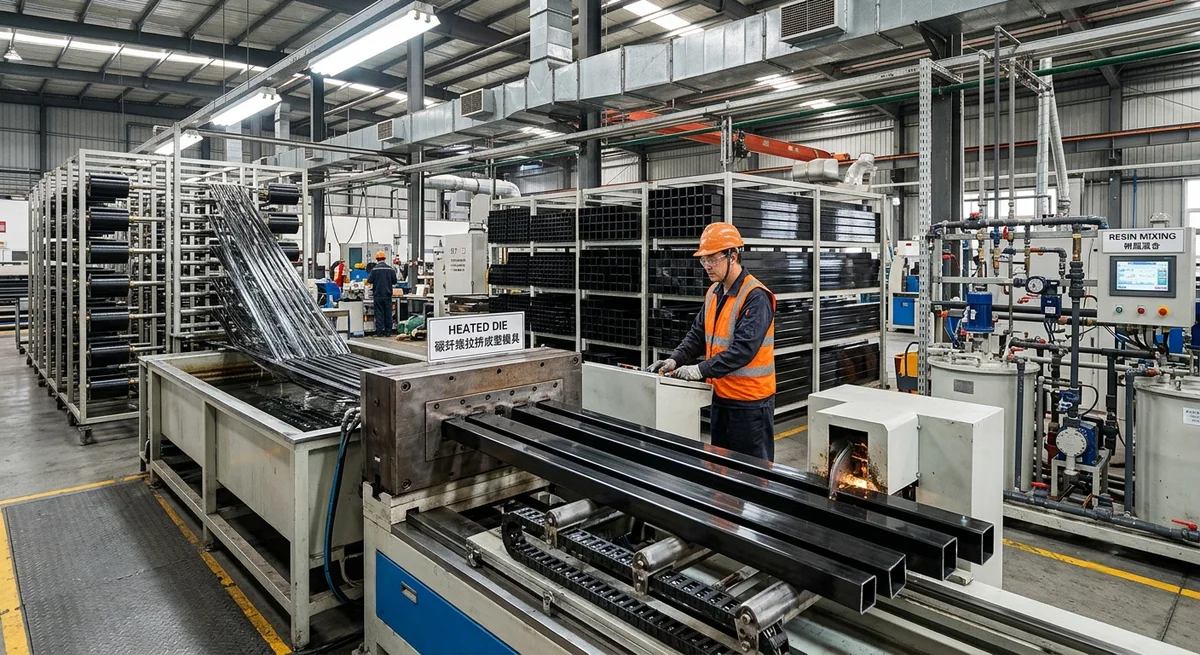
A technical guide to carbon fiber pultrusion covering process parameters, profile design rules, die design, and cost optimization strategies for B2B buyers and process engineers.
Carbon Fiber Pultrusion: Process Engineering Guide for 2026
Pultrusion is the most cost-effective continuous manufacturing process for constant-cross-section carbon fiber profiles. In 2026, global pultruded carbon fiber production reached approximately 14,500 tonnes annually, growing at 9.2% CAGR (2021-2026). This guide covers the process parameters, profile design constraints, and cost optimization strategies that B2B buyers need for procurement decisions.
Process Parameter Window
| Parameter | Typical Range | Optimal (Standard Modulus) | Optimal (IM Carbon) | Effect on Property |
|---|---|---|---|---|
| Fiber volume fraction (%) | 55-72 | 65-68 | 60-65 | ↑FVF = ↑ strength, ↑ cost |
| Line speed (m/min) | 0.3-2.0 | 0.8-1.2 | 0.4-0.7 | ↑speed = ↓wet-out quality |
| Die temperature (°C) | 140-200 | 165-185 | 170-190 | ↑temp = ↑ cure rate, ↑ thermal stress |
| Pull force (kN) | 20-150 | 40-80 | 60-120 | ↑force = ↑ fiber alignment |
| Resin bath temperature (°C) | 25-45 | 30-38 | 28-35 | ↑temp = ↓ viscosity, ↓ pot life |
| Die length (mm) | 600-1,200 | 800-1,000 | 900-1,100 | ↑length = ↑ cure time, ↑ friction |
| Cure time in die (s) | 30-180 | 45-90 | 60-120 | Must achieve >95% degree of cure |
Profile Design Rules
Pultruded carbon fiber profiles are manufactured in a wide range of shapes: solid rods, hollow tubes, flat sheets, channels, I-beams, angles, and custom profiles. Design constraints include:
- Minimum wall thickness: 1.5 mm for standard profiles, 2.5 mm for hollow sections with mandrel
- Maximum wall thickness: 25 mm (limited by exothermic heat buildup causing matrix degradation)
- Minimum corner radius: 1.0 mm internal, 2.0 mm external (for fiber wash resistance)
- Draft angle: 0.5-1.5° per side for ease of demolding (not required for straight-through dies)
- Maximum cross-section: 600×200 mm rectangular; 300 mm diameter round (limited by die cost and pull force capacity)
- Taper ratio: Maximum 2:1 cross-section change over length (for constant-profile pultrusion; variable requires post-machining)
- Hollow sections: Round/square tubes require floating mandrel; rectangular boxes need removable mandrel or two-piece die
Material System Selection Guide
| Resin System | Viscosity (cP @ 25°C) | Tg (°C) | Line Speed (m/min) | Cost Premium vs Polyester | Typical Applications |
|---|---|---|---|---|---|
| Polyester (ISO/NPG) | 300-500 | 80-110 | 1.0-2.0 | 1.0× (baseline) | Construction rebar, grating |
| Vinyl ester | 200-400 | 110-140 | 0.8-1.5 | 1.3-1.6× | Corrosion-resistant structural profiles |
| Epoxy (Bisphenol A/F) | 500-1,500 | 130-180 | 0.3-0.8 | 2.0-3.0× | Aerospace, high-performance structural |
| Polyurethane | 200-400 | 120-160 | 0.8-1.5 | 1.5-2.0× | Automotive, impact-resistant profiles |
| Phenolic | 400-800 | 150-200 | 0.5-1.0 | 1.2-1.5× | Fire-resistant (low smoke, FAR 25.853) |
Cost Breakdown: 50×50×5 mm Angle Profile
| Cost Component | Polyester/Glass | Vinyl Ester/Carbon | Epoxy/Carbon | Notes |
|---|---|---|---|---|
| Raw materials ($/m) | $0.85 | $4.20 | $5.80 | Carbon tow: $18-22/kg; glass: $1.50-2.50/kg |
| Labor ($/m) | $0.30 | $0.35 | $0.45 | Slower line speed = higher labor cost/m |
| Energy ($/m) | $0.08 | $0.12 | $0.18 | Heating longer dies at lower speed |
| Die amortization ($/m) | $0.05 | $0.05 | $0.05 | Die life: 50,000-200,000 m |
| Quality control ($/m) | $0.10 | $0.15 | $0.20 | NDT: ultrasonic + visual per ASTM D4385 |
| Total ($/m) | $1.38 | $4.87 | $6.68 | |
| Total ($/kg) | $4.60 | $24.35 | $33.40 |
Quality Standards and Testing
- ASTM D4385: Standard practice for classifying visual defects in pultruded profiles (Class 1-3)
- ASTM D3917: Dimensional tolerance standard for pultruded shapes (straightness: 1.0 mm/m; twist: 0.5°/m)
- ASTM D4475: Short-beam shear strength for pultruded rod (L/D ratio = 4)
- ISO 1268-5: Pultruded composite test specimen preparation
Q: What is the maximum practical fiber volume fraction in pultruded carbon fiber profiles?
A: Commercial pultrusion achieves 55-72% FVF. The upper limit is determined by fiber packing density (hexagonal close packing of filaments = 78.5% theoretical maximum) and resin wet-out capability. For 12K and 24K carbon tows, 65-68% FVF is the practical maximum for consistent quality at line speeds above 0.5 m/min. Higher FVF (70-72%) is achievable with 50K-60K industrial-grade tows and specialized high-injection-pressure dies, but at the cost of reduced line speed (below 0.5 m/min) and increased void content risk (>2%).
Q: How does pultruded carbon fiber compare to prepreg hand lay-up for structural profiles?
A: Pultruded profiles offer 35-50% lower cost than equivalent hand lay-up profiles, with comparable 0° tensile properties (within 5-10%) due to the high fiber alignment achieved by the pulling tension. However, pultrusion has three limitations: (1) only constant cross-sections (no taper, ply drops, or local reinforcements), (2) limited off-axis fiber orientation (typically 0° roving + ±45° continuous mat — no tailored ply angles), and (3) interlaminar shear strength 15-25% lower than autoclave-cured prepreg due to the absence of consolidation pressure (pultrusion uses only die wall pressure, maximum 0.5-2.0 MPa vs autoclave at 620 kPa + vacuum).
Q: What die materials are used for carbon fiber pultrusion, and what is their service life?
A: Pultrusion dies are typically made from: (1) Tool steel (D2/A2) — most common, $8,000-25,000 per die, life 50,000-100,000 linear meters for glass; for carbon (abrasive), life drops to 20,000-50,000 m. (2) Tungsten carbide-coated steel — 3-5× longer life for carbon, cost premium 2-3×. (3) Chrome-plated tool steel — reduces friction, life 30,000-60,000 m for carbon. Die wear manifests as surface scoring (from carbon fiber abrasion) and dimensional drift. Chrome plating is replateable at 30-40% of new die cost. For high-volume carbon production (e.g., construction rebar), tungsten carbide coated dies are cost-effective despite higher upfront cost.
Part of topic
Related Articles
- Bio-Based Carbon Fiber Precursors: Lignin and Polyethylene for Low-Cost Production
- Large-Tow Carbon Fiber Cost Analysis: 48K vs 60K Price-Performance Comparison
- Carbon Fiber-Resin Interface Bonding: Surface Treatment and Coupling Agent Optimization
- Digital Twin for Carbon Fiber Manufacturing: Real-Time Process Monitoring and Defect Prevention
- Thermoplastic Carbon Fiber Welding for Automotive: Ultrasonic and Induction Welding Process Windows
- Large-Tow Carbon Fiber Wet Spinning: Process Optimization for 48K/60K Production Efficiency
Interested in Our Products?
Contact our team for competitive pricing and technical specifications.
Get a QuoteRelated Products
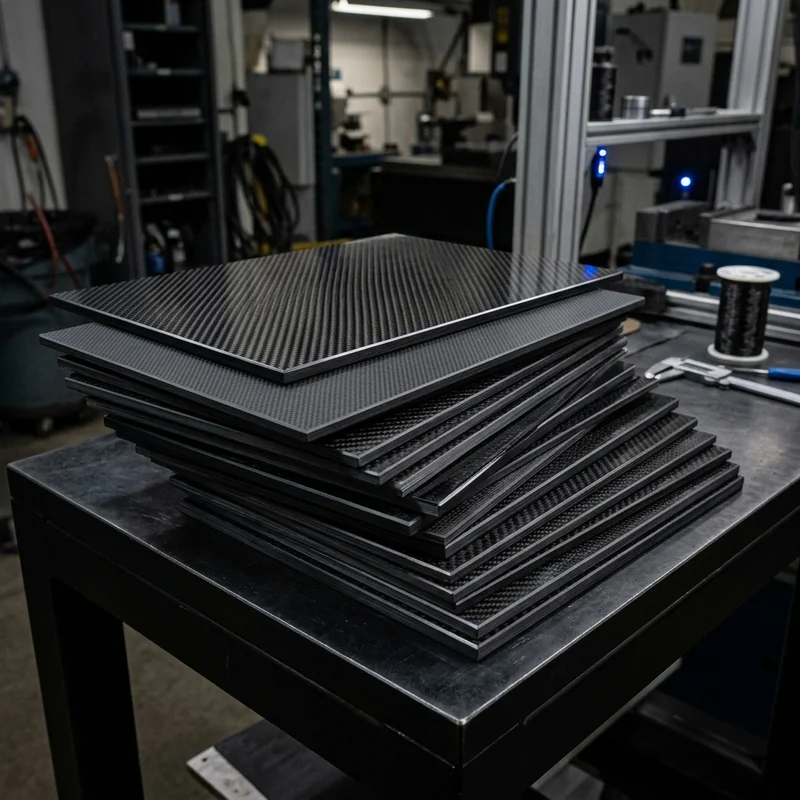
Carbon fiber standard plate-3k stripe
Lightweight, ultra-rigid standard sheets for drone fuselages, robot housings, facades and structural applications.

Carbon Fiber Plate — 3K Twill T700 1.5mm
Thin 1.5mm carbon fiber plate with 3K twill weave surface. Lightweight and stiff, commonly used for covers, panels, drone bodies, and applications requiring a premium aesthetic appearance.

Square Carbon Fiber Tube — 3K Twill T700
Square cross-section carbon fiber tube manufactured with 3K twill weave for torsional strength. Preferred for structural frames, trusses, and support columns where rectangular geometry offers design flexibility.

Carbon Fiber Plate — 3K Twill T700 3.0mm
Medium-thickness 3.0mm carbon fiber plate offering significantly higher load capacity while maintaining attractive 3K twill finish. Suitable for structural brackets, reinforcement plates, and load-bearing panels.
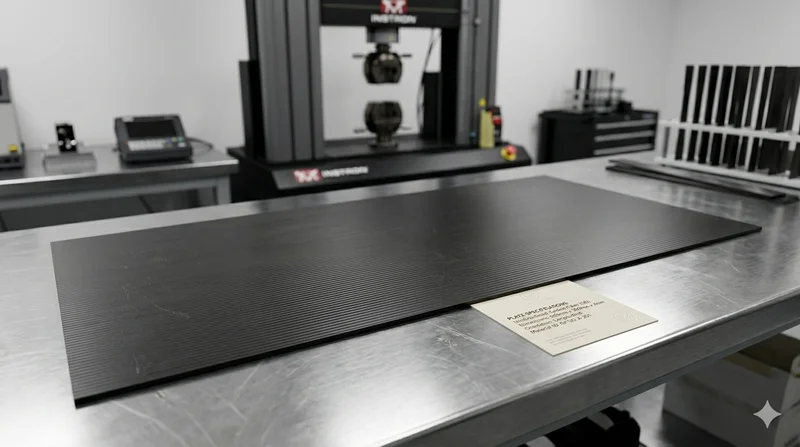
Carbon Fiber Plate — UD Unidirectional T700
Unidirectional carbon fiber plate with all fibers oriented in a single direction for maximum strength along the fiber axis. Essential for structural reinforcements, splints, and applications where load direction is predictable.