
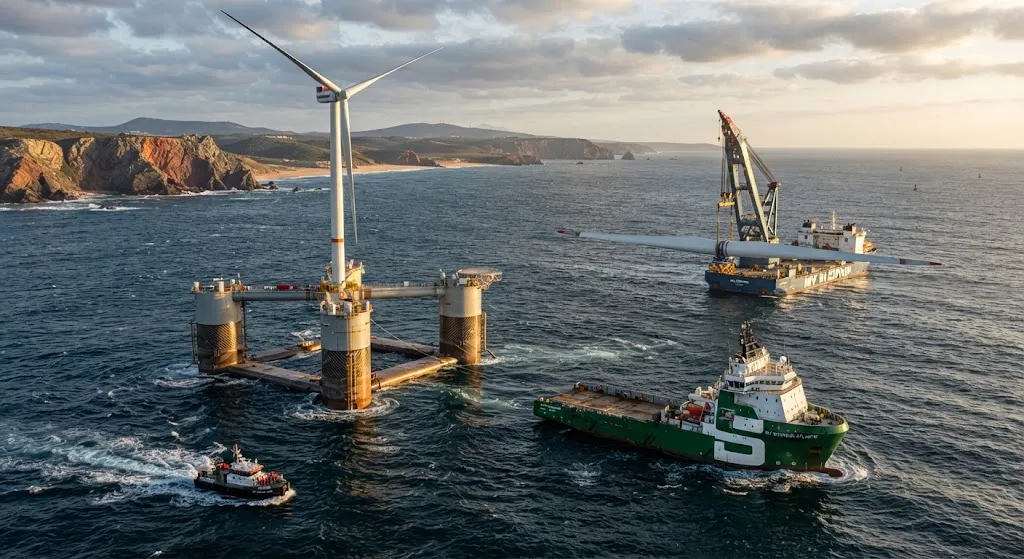
Portugal's Atlantic coastline offers some of the most favorable wind resources in Europe, with average wind speeds of 9-11 meters per second at hub height and water depths exceeding 200 meters within 50 kilometers of the shore. The Portuguese government has set a target of 10 gigawatts of offshore...
Introduction
Portugal's Atlantic coastline offers some of the most favorable wind resources in Europe, with average wind speeds of 9-11 meters per second at hub height and water depths exceeding 200 meters within 50 kilometers of the shore. The Portuguese government has set a target of 10 gigawatts of offshore wind capacity by 2030, with the majority expected to come from floating wind installations in the deep waters off the Algarve and northern coast. This represents a significant opportunity for composite material suppliers, as floating wind turbines require substantially more carbon fiber and glass fiber reinforcement than fixed-bottom installations.
This article analyzes Portugal's offshore wind policy environment, the composite structural demands of floating wind technology, and the market entry strategies available to carbon fiber suppliers targeting the Portuguese renewable energy sector.
Portugal's Offshore Wind Policy Framework
Portugal's offshore wind development is governed by a regulatory framework that has evolved significantly since the first licensing rounds in 2020. The key policy elements include:
- National Energy and Climate Plan (PNEC 2030): Sets the 10 GW offshore wind target as a cornerstone of Portugal's decarbonization strategy, with 5 GW allocated to floating wind in water depths exceeding 60 meters.
- Maritime spatial planning: The government has designated specific zones off the Alentejo and Algarve coasts for offshore wind development, avoiding shipping lanes, fishing grounds, and environmental protection areas. These zones cover approximately 3,000 square kilometers with water depths of 100-400 meters.
- Licensing process: The Portuguese environment agency (APA) manages environmental impact assessments, with typical licensing timelines of 24-36 months from application to construction permit. The process includes public consultation, marine habitat surveys, and bird migration assessments.
- Grid connection: The national grid operator REN is planning 15-20 gigawatts of grid reinforcement to accommodate offshore wind, with new high-voltage direct current links to connect remote wind zones to industrial load centers in Lisbon and Porto.
- Local content requirements: While not yet mandated, the government has signaled preferences for domestic manufacturing and assembly, creating opportunities for composite fabrication facilities in Portuguese ports.
The first commercial-scale floating wind projects, including the 25 MW WindFloat Atlantic expansion and the 1.5 GW Eolic Park off Viana do Castelo, are expected to reach final investment decisions in 2027-2028, driving near-term demand for composite materials.
Composite Demands in Floating Wind Technology
Floating offshore wind turbines impose distinct composite requirements compared to fixed-bottom installations. The structural demands are driven by the dynamic motion of the floating platform and the larger turbine sizes needed to justify the additional platform cost. The table below compares composite material requirements across wind installation types:
| Parameter | Fixed-Bottom Offshore | Floating Offshore | Difference |
|---|---|---|---|
| Turbine capacity (typical) | 8-12 MW | 12-20 MW | 50-100% larger |
| Blade length | 80-100 m | 100-120+ m | 20-40% longer |
| Carbon fiber spar cap content | Optional (glass fiber dominant) | Required for blade stiffness | CFRP mandatory |
| Platform structural composites | Minimal (gravity base) | Extensive (column, braces, deck) | 5-10x more composite |
| Fatigue design life | 20-25 years | 25-30+ years (higher motion) | Extended requirements |
| Salt spray and UV resistance | Standard marine grade | Enhanced (splash zone) | Higher protection |
The spar cap of floating wind blades is the primary driver of carbon fiber demand. As blade lengths exceed 100 meters, glass fiber spar caps become prohibitively heavy, increasing the gravitational bending load that the blade must support. Carbon fiber spar caps reduce blade weight by 20-30% compared to glass fiber, enabling longer blades without excessive root bending moments. This weight reduction also reduces the dynamic loading on the floating platform, creating a cascading weight savings across the entire system.
Supply Chain and Manufacturing Landscape
Portugal's existing industrial base provides a foundation for offshore wind composite manufacturing, though significant investment is needed to meet the scale requirements of the 2030 target. The current supply chain includes:
- Existing composite manufacturers: Portuguese companies such as EDP Renewables' maintenance facilities and several aerospace subcontractors have carbon fiber processing experience, though none currently operate at wind-turbine scale.
- Port infrastructure: The ports of Sines, Leixoes, and Viana do Castelo are being developed as offshore wind installation hubs, with quayside capacity for heavy-lift crane operations and component staging.
- Fiber and resin suppliers: No domestic carbon fiber production exists in Portugal. All reinforcement fibers must be imported, primarily from Toray (Japan), Hexcel (US/France), and SGL Carbon (Germany). Epoxy resin systems are available from local distributors but require qualification for marine structural applications.
- Skilled workforce: Portugal has a pool of composite technicians trained through the aerospace sector, but scaling to wind-turbine production volumes requires significant training investment. The government has announced a 200 million euro fund for offshore wind workforce development.
- Research institutions: The University of Porto's Institute of Science and Innovation in Mechanical and Industrial Engineering (INEGI) and the University of Aveiro's Ceramics and Composites Department provide R&D support for composite material development and testing.
For carbon fiber suppliers entering the Portuguese market, the most promising strategy is to establish partnerships with existing composite fabricators who can provide local manufacturing capability while the supplier provides material qualification, technical support, and supply chain reliability.
Floating Platform Composite Applications
Floating wind platforms use composites in several structural applications beyond the turbine blades:
- Column and brace structures: Semi-submersible and tension-leg platforms use composite-wrapped steel columns to reduce weight while maintaining corrosion resistance. The composite overwrap provides structural reinforcement and eliminates the need for external coating systems in the splash zone.
- Platform deck and equipment housing: Composite sandwich panels with foam or honeycomb cores replace steel decks for topside equipment, reducing the center of gravity and improving platform stability.
- Moorings and risers: Carbon fiber composite mooring lines are being evaluated as replacements for steel chain moorings, offering weight savings that reduce the vertical load on the floating platform and extend the allowable water depth for the installation.
- Cable protection: Composite cable protection systems and J-tubes protect subsea power cables at the platform interface, combining impact resistance with corrosion immunity in the marine environment.
The total composite content per floating wind turbine is estimated at 300-500 tons, compared to 100-200 tons for a fixed-bottom installation of equivalent capacity, representing a 2-3x multiplier for composite demand per megawatt of installed capacity.
Market Entry and Qualification Strategy
Carbon fiber suppliers seeking to enter the Portuguese offshore wind market should consider the following qualification and market development approach:
- Material certification: Obtain DNV GL or Bureau Veritas certification for offshore wind structural applications, including fatigue testing data for the specific fiber-resin system at relevant loading frequencies and environmental conditions.
- Partnership with blade OEMs: Establish technical collaboration with turbine manufacturers such as Vestas, Siemens Gamesa, and GE Renewable Energy, who are the primary decision-makers on blade material specifications.
- Local inventory and logistics: Establish warehousing in Portuguese ports to provide just-in-time delivery to blade factories and platform fabricators, reducing lead times and inventory costs for customers.
- Technical service capability: Provide on-site technical support for process optimization, quality troubleshooting, and material substitution analysis, as Portuguese manufacturers transition from glass fiber to hybrid carbon-glass designs.
- Long-term supply agreements: Secure multi-year framework agreements with volume commitments to justify the logistics investment and provide supply chain stability for project developers.
Frequently Asked Questions
Why is Portugal attractive for floating offshore wind development?
Portugal combines several factors that make it exceptionally attractive for floating wind. First, the deep Atlantic waters off the southern and northern coasts provide water depths of 100-400 meters within economic transmission distance of shore, conditions that exclude fixed-bottom foundations and require floating platforms. Second, the wind resource is excellent, with capacity factors of 45-55% that exceed most North Sea sites. Third, Portugal's existing port infrastructure and proximity to established European wind supply chains reduce logistics costs. Fourth, the government has created a supportive regulatory framework with clear zoning and permitting pathways. Finally, Portugal's Iberian neighbors Spain and potentially Morocco provide future market expansion opportunities for floating wind technology.
What composite materials are needed for floating wind turbine blades?
Floating wind blades exceeding 100 meters in length require carbon fiber spar caps in addition to glass fiber shell laminates. The spar cap is the primary structural element carrying flapwise bending loads, and carbon fiber provides the stiffness-to-weight ratio necessary to prevent excessive blade deflection under gravitational and aerodynamic loads. Typical material specifications include intermediate modulus carbon fiber (290-320 GPa) for the spar cap, combined with E-glass or S-glass for the shell and trailing edge. Epoxy resin systems with glass transition temperatures above 80 degrees Celsius are standard for marine environments. Total carbon fiber content per blade ranges from 15-25 tons for a 110-meter blade, depending on the design stiffness target.
When will Portugal's offshore wind projects reach material procurement stages?
The timeline for material procurement depends on the project development stage. The WindFloat Atlantic expansion and the Viana do Castelo project are in the environmental licensing phase, with final investment decisions expected in 2027-2028. Material procurement for these first projects will begin 12-18 months before construction start, placing the first major composite orders in late 2026 to early 2027. Subsequent projects in the 2030 pipeline will create sustained demand through the late 2020s and early 2030s. Suppliers should begin qualification and partnership development now to be competitive for the first procurement rounds.
Conclusion
Portugal's offshore wind market represents a significant growth opportunity for carbon fiber composite suppliers, driven by the government's 10 GW target, the deep-water conditions that mandate floating wind technology, and the cascading composite demand that floating platforms create across blades, structures, and mooring systems. The 2-3x composite content multiplier per megawatt for floating versus fixed-bottom installations makes this market disproportionately valuable for composite material suppliers. Early movers who establish certification, partnerships, and local logistics infrastructure will be best positioned to capture the procurement waves beginning in 2027.
For composite suppliers evaluating the Portuguese offshore wind opportunity, the critical success factors are marine-grade material certification, relationships with blade OEMs and platform designers, and the ability to provide reliable supply from Portuguese port facilities. Explore our carbon fiber and glass fiber reinforcement range, including marine-grade systems for offshore wind structural applications, or contact our technical team to discuss material qualification and supply chain solutions for the Portuguese market.
Related Articles
- Recycled Carbon Fiber Market Forecast 2030: Technology Maturity and Commercialization Path
- South Korea Carbon Fiber Market 2026: Hydrogen Economy and Shipbuilding Innovation
- Wind Turbine Blade Leading Edge Protection 2026: Polyurethane, Tape, and Metallic Shield Solutions
- China Carbon Fiber Overcapacity 2026: Price War Impact and Industry Consolidation
- India Carbon Fiber Market 2026: Wind Energy, Aerospace, and Defense Expansion
- PAN Precursor Market 2026: Acrylonitrile Supply and Carbon Fiber Cost Structure