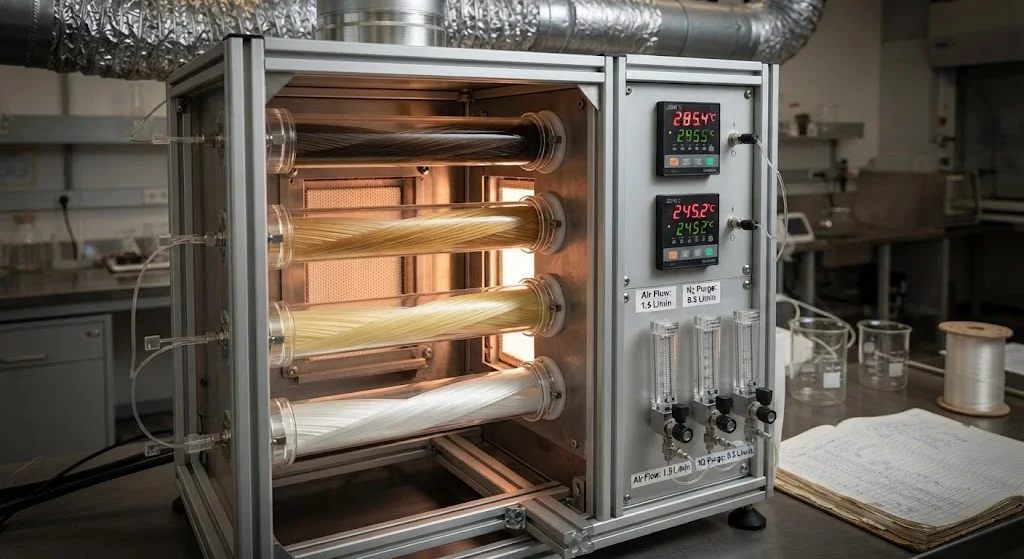
PAN oxidation (stabilization) is the most critical and time-consuming step in carbon fiber production, converting thermoplastic PAN precursor into thermoset oxidized PAN that can survive carbonization. This article examines oxidation kinetics, temperature profiling, and process optimization for high-quality carbon fiber.
Introduction
The oxidation — or stabilization — of polyacrylonitrile (PAN) precursor fiber is the most critical step in carbon fiber production. During this process, the thermoplastic PAN fiber is heated in air at 200–300°C for 30–120 minutes, transforming it into a thermoset oxidized PAN (OPF) structure that can withstand the subsequent carbonization temperatures of 1,000–1,500°C without melting or fusing. The quality of the oxidation process directly determines the mechanical properties, surface quality, and consistency of the final carbon fiber.
Despite its importance, PAN oxidation remains poorly understood at the molecular level. The process involves a complex sequence of chemical reactions — cyclization, dehydrogenation, and oxidation — that occur simultaneously and interact in ways that are still being investigated. This article provides a comprehensive overview of oxidation kinetics, temperature profiling strategies, and process optimization techniques used in industrial carbon fiber production.
Chemistry of PAN Oxidation
PAN oxidation involves three concurrent chemical reactions:
Cyclization: The nitrile groups (C≡N) on adjacent PAN chains react to form a ladder polymer structure with conjugated C=N bonds. This reaction is exothermic — releasing 20–40 kJ/mol — and is the primary source of heat generation during oxidation. The cyclization rate doubles approximately every 10°C increase in temperature, making temperature control critical.
Dehydrogenation: Hydrogen atoms are eliminated from the PAN backbone, creating C=C double bonds that contribute to the aromatic structure needed for carbonization. Dehydrogenation is slower than cyclization and is catalyzed by the presence of oxygen.
Oxidation: Oxygen from the air reacts with the PAN structure, introducing oxygen-containing functional groups (carbonyl, carboxyl, hydroxyl) that cross-link the polymer chains and improve thermal stability. Excessive oxidation causes chain scission and reduces fiber strength.
Temperature Profiling Strategies
The temperature profile through the oxidation oven is the primary process variable controlling fiber quality. Three strategies are used in industrial production:
Ramp-hold profile: The fiber enters at room temperature, ramps linearly to the peak oxidation temperature (220–260°C), holds for 20–60 minutes, then cools. This simple profile is easy to implement but may cause non-uniform oxidation in thick tows.
Stepped profile: The fiber passes through 3–5 temperature zones, each at a progressively higher temperature. This approach allows controlled reaction rates at each stage, reducing the risk of runaway exotherm. Most industrial carbon fiber producers use stepped profiles with 4–6 zones.
Exotherm-managed profile: Advanced systems monitor the fiber temperature in real time using infrared thermometers, adjusting oven temperature to maintain a target fiber temperature. This approach compensates for variations in tow tension, fiber linear density, and ambient conditions.
Process Parameters and Optimization
Residence time: Typical oxidation times are 60–120 minutes for standard carbon fiber and 30–60 minutes for high-strength grades. Shorter times require higher temperatures but may cause non-uniform oxidation.
Air flow: Adequate air flow is essential for oxygen supply and heat removal. Insufficient air flow causes oxygen depletion near the fiber surface, leading to non-uniform oxidation and reduced fiber properties.
Tow tension: Proper tension prevents fiber relaxation and maintains molecular orientation during oxidation. Excessive tension causes fiber breakage; insufficient tension allows the fiber to shrink, reducing modulus.
Chemical additives: Some PAN formulations include oxidation accelerators (itaconic acid, methyl acrylate) that lower the cyclization temperature and broaden the exotherm peak, making temperature control easier.
Quality Control
Oxidized PAN fiber quality is assessed through:
• Differential scanning calorimetry (DSC): Measures the residual exotherm — fully oxidized fiber shows no DSC peak above 300°C.
• FTIR spectroscopy: Monitors the development of conjugated C=N bonds and oxygen-containing functional groups.
• Color measurement: Properly oxidized fiber is dark brown to black; light color indicates insufficient oxidation.
• Thermogravimetric analysis (TGA): Verifies thermal stability by measuring weight loss during heating to carbonization temperatures.
Conclusion
PAN oxidation is a complex, multi-variable process that directly determines carbon fiber quality. Understanding the chemistry of cyclization, dehydrogenation, and oxidation — combined with precise temperature profiling and process control — enables production of high-quality oxidized PAN fiber that yields carbon fiber with consistent mechanical properties and surface quality.
Related Articles
- Bio-Based Carbon Fiber Precursors: Lignin and Polyethylene for Low-Cost Production
- Large-Tow Carbon Fiber Cost Analysis: 48K vs 60K Price-Performance Comparison
- Carbon Fiber-Resin Interface Bonding: Surface Treatment and Coupling Agent Optimization
- Digital Twin for Carbon Fiber Manufacturing: Real-Time Process Monitoring and Defect Prevention
- Thermoplastic Carbon Fiber Welding for Automotive: Ultrasonic and Induction Welding Process Windows
- Large-Tow Carbon Fiber Wet Spinning: Process Optimization for 48K/60K Production Efficiency
Interested in Our Products?
Contact our team for competitive pricing and technical specifications.
Get a QuoteRelated Products
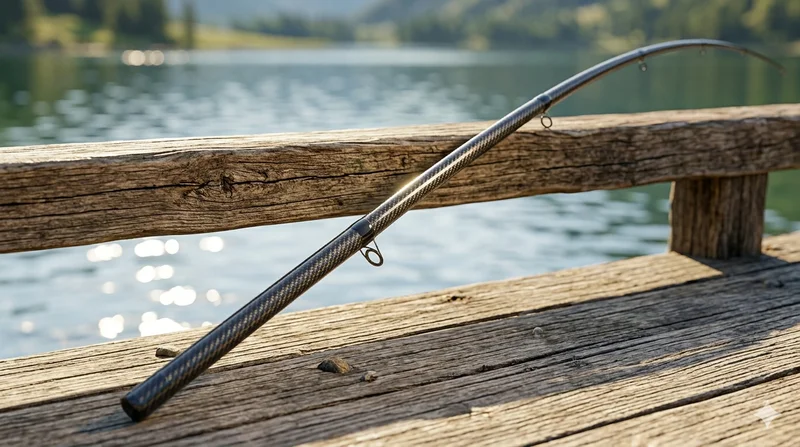
Carbon Fiber Fishing Rod Blank
High-quality carbon fiber fishing rod blank manufactured from multiple grades of Toray carbon fiber cloth. Available in a wide range of lengths, powers, and actions for freshwater and saltwater applications. Suitable for OEM rod building.
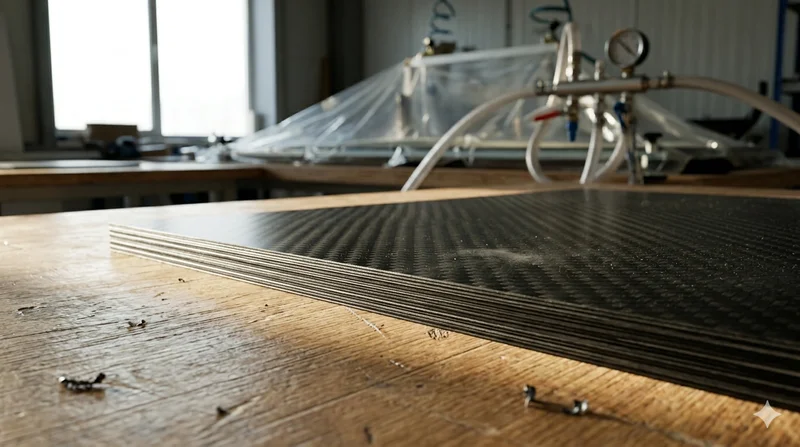
Carbon Fiber Plate — 3K Twill T700 3.0mm
Medium-thickness 3.0mm carbon fiber plate offering significantly higher load capacity while maintaining attractive 3K twill finish. Suitable for structural brackets, reinforcement plates, and load-bearing panels.
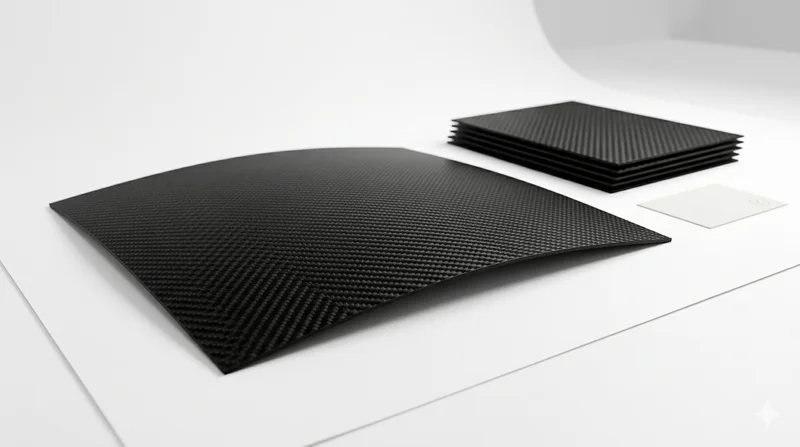
Carbon Fiber Plate — 3K Twill T700 1.5mm
Thin 1.5mm carbon fiber plate with 3K twill weave surface. Lightweight and stiff, commonly used for covers, panels, drone bodies, and applications requiring a premium aesthetic appearance.
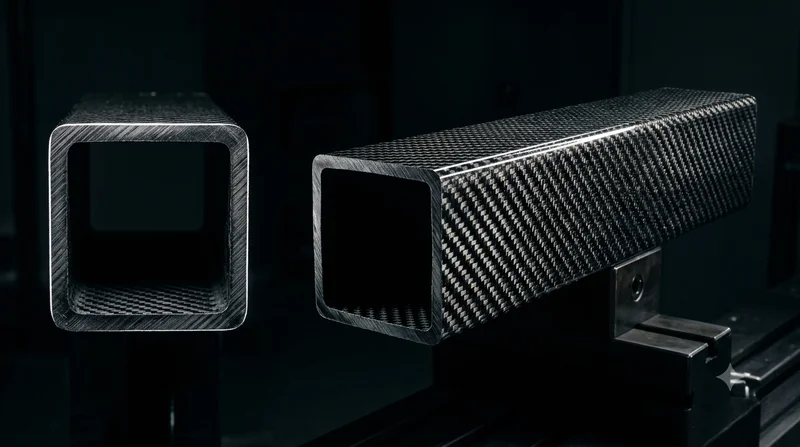
Square Carbon Fiber Tube — 3K Twill T700
Square cross-section carbon fiber tube manufactured with 3K twill weave for torsional strength. Preferred for structural frames, trusses, and support columns where rectangular geometry offers design flexibility.
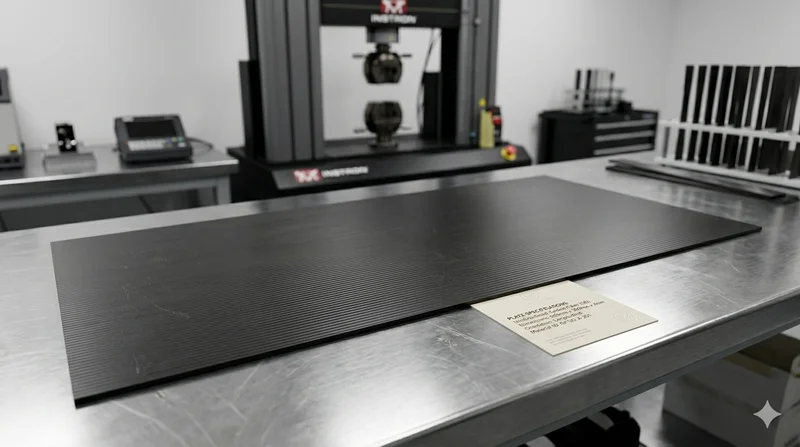
Carbon Fiber Plate — UD Unidirectional T700
Unidirectional carbon fiber plate with all fibers oriented in a single direction for maximum strength along the fiber axis. Essential for structural reinforcements, splints, and applications where load direction is predictable.