
A woven fabric is, by construction, a compromise: the warp and weft yarns cross over and under each other, and every crossing creates crimp that kinks the fibers out of their straight path. Under load, those kinked fibers try to straighten, which reduces stiffness, creates local stress
Introduction
A woven fabric is, by construction, a compromise: the warp and weft yarns cross over and under each other, and every crossing creates crimp that kinks the fibers out of their straight path. Under load, those kinked fibers try to straighten, which reduces stiffness, creates local stress concentrations, and limits how much fiber volume a laminate can reach before voids appear. Non-crimp fabrics (NCF) were developed to remove that compromise. Instead of weaving, an NCF lays flat, straight fiber layers at the required orientations — typically 0°, ±45° and 90° — and holds them in place with fine stitching yarns running through the stack. The fibers stay straight, and the fabric behaves much closer to the theoretical performance of the fiber itself.
This article explains how NCF is constructed, quantifies the differences between non-crimp and woven fabrics with a comparison table, and examines the three areas that decide material selection in practice: drape and handling, infusion performance, and the cost and property trade-offs in large-scale wind, automotive and marine programs.
How a Non-Crimp Fabric Is Constructed
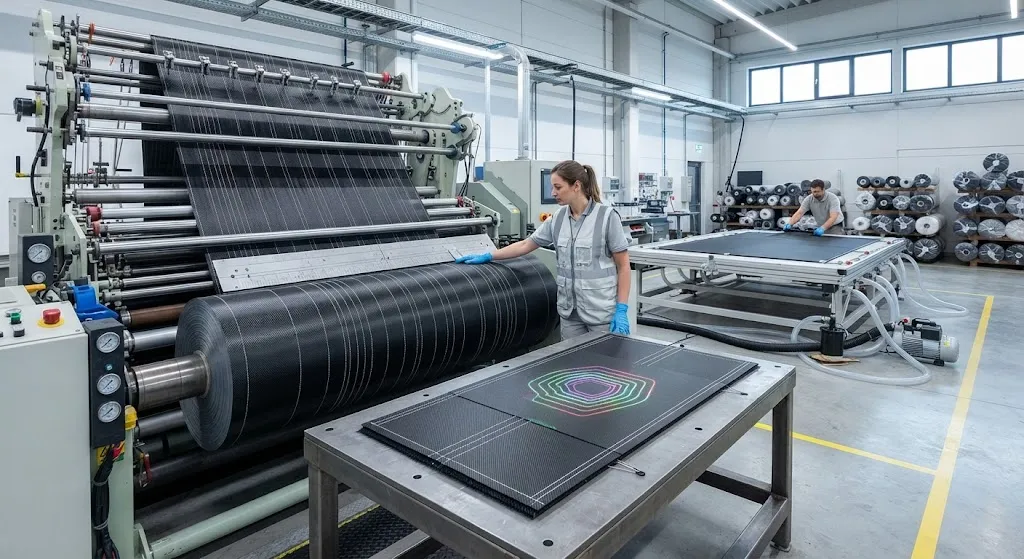
An NCF is built on a warp-knitting machine. One or more layers of straight fiber tows are laid down at fixed angles relative to the machine direction, and a tricot or chain stitching pattern locks them together. The layers can be uniaxial (single 0° or 90° layer), biaxial (±45° or 0/90°), triaxial (0°/±45°) or quadraxial (0°/90°/±45°), with areal weights from 300 to 1,200 g/m² and roll widths up to 2.5 m or more. The stitching yarn is typically polyester, polyamide or glass, and weighs less than one percent of the fabric — small enough that its effect on properties is minor, but large enough to define the fabric's handling character.
Two further elements shape performance. First, a dry fabric can carry a small percentage of thermoplastic binder powder that holds the layers together when heat is applied, which turns the fabric into a preformable stack for resin transfer molding. Second, the stitching itself disturbs local fibers: the needle punctures the layer stack, and the stitching tension creates tiny local undulations around each stitch line. Measured in-plane penalties are typically 2-5 percent compared with a hypothetical perfectly straight fiber layer, which is far smaller than the 8-15 percent loss caused by weave crimp.
NCF vs Woven Fabrics: A Performance Comparison
The table below compares a quadraxial carbon NCF with a 2x2 twill woven carbon fabric at the same fiber areal weight, reflecting typical production experience in infused laminates:
| Property | 2x2 Twill Woven Fabric | Quadraxial Carbon NCF |
|---|---|---|
| Fiber undulation per unit length | High (crimp at every crossing) | Near zero (straight tows) |
| 0° stiffness utilization of fiber value | 85-92% | 96-99% |
| Fiber volume fraction in infused laminate | 50-55% | 55-62% |
| Typical void content (well-processed infusion) | 1-2% | Below 0.5-1% |
| Drape on complex double-curvature molds | Excellent | Good to moderate |
| Manual layup rate, broad goods | 3-6 kg per hour | 8-15 kg per hour |
| Edge stitching and fraying resistance | Shear-sensitive, frays | Stable, minimal fraying |
| Typical raw material cost index | 1.0 | 1.1-1.3 |
The key takeaway is that an NCF delivers more structural performance from the same fiber weight: higher stiffness utilization and higher fiber volume fraction, which together mean the designer can specify a lighter laminate for the same stiffness, or a stiffer laminate at the same weight. The cost premium of roughly 10-30 percent is usually recovered in reduced resin use and lower laminate weight.
Infusion Performance: Why Straight Fibers Flow Better
Vacuum infusion and resin transfer molding reward fabrics with consistent, open permeability. Woven fabric presents a path of alternating tight and loose regions — resin races through the loose weave and struggles through the crimped intersections, which is a classic recipe for dry spots. An NCF offers a far more uniform flow network: the straight tows create steady in-plane channels, and the stitching perforates the stack, providing through-thickness flow paths that help resin wet out thick laminates. Process results support the intuition: infused NCF laminates routinely achieve void contents below one percent, while woven-fabric infusions of the same thickness typically land at one to two percent.
This behavior compounds in large parts. A 60-meter wind turbine blade spar cap or a 20-meter yacht hull infused from a central injection line depends on uniform resin advance over several meters of fabric; the predictability of NCF flow reduces the number and size of infusion inlets needed and cuts the risk of a rejected part. The same predictability makes cycle time estimates more reliable, which matters when a single infusion uses resin volumes measured in hundreds of kilograms.
Drape, Handling and Preforming
Drape is the area where woven fabric retains an advantage. The interlacement of a weave lets it shear and conform to double-curvature surfaces more readily, which is why woven fabric remains popular for complex boat hulls, tight-radius automotive panels and cosmetic surfaces. An NCF shears differently: the stitch lines restrict the fabric's ability to conform, so highly contoured parts can require darts, slits or binder-preformed stacks. In practice, this trade-off is managed at the design stage. Flat and single-curvature structures — spar caps, floors, pressure vessels, hull bottoms — use NCF freely, while parts with strong double curvature either use woven fabric or a hybrid where NCF is preformed with binder into a 3D shape before trimming.
Handling is a hidden benfactor of stitching. NCF broad goods do not fray at cut edges, tolerate rolling, lifting and vacuum-bagging without distortion, and can be laser-projected and cut with high accuracy, which supports automated kitting and robotic layup far better than shear-prone woven fabric.
Adoption in Wind, Automotive and Marine Programs
- Wind energy: Unidirectional and biaxial carbon NCF is the backbone of modern spar caps, root reinforcements and trailing-edge reinforcement in blades over 80 meters, where high modulus utilization directly reduces blade mass and tower loads. Glass NCF dominates the shear webs and anti-sandwich skins.
- Automotive: Structural floors, battery enclosure covers, seat structures and roof panels in electric and performance vehicles use infused or compression-molded NCF stacks, often in hybrid glass-carbon arrangements where the carbon layers carry bending loads and glass layers provide thermal and impact isolation.
- Marine: Quadraxial glass and carbon NCF is the default material for infused hulls and decks of yachts above roughly 15 meters, replacing woven roving for weight savings of 10-20 percent and much lower void content.
- Aerospace and defense: Secondary structures, fairings and access panels use NCF where infusion economics beat prepreg-autoclave processing and where through-thickness stitching adds damage tolerance.
Across these sectors the selection logic is consistent: NCF wins wherever the load path is largely straight, the part is large or flat, and the process is infusion-based; woven fabric keeps its role where drape and surface cosmetics dominate.
What to Specify When Selecting an NCF
- Layer architecture: Choose the number and orientation of layers — UD for uniaxial load paths, biaxial for shear, quadraxial for quasi-isotropic coverage — to minimize useless off-axis material.
- Areal weight and fiber type: Standard modulus carbon for stiffness, intermediate or high modulus where fatigue or buckling dominates, and hybrid glass-carbon stacks for controlled cost.
- Stitching pattern and yarn: Tricot stitching offers stability with low disturbance; chain stitching improves drape at the cost of edge integrity. Stitch yarn selection affects handling and resin compatibility.
- Binder content: Specify 0-6 percent thermoplastic binder when the fabric must preform into 3D shapes; zero binder for infusion-only flat applications.
- Width, roll length and QA: Confirm fiber angle tolerance, stitching pitch control, and roll width compatible with your cutting table to maximize material utilization.
Frequently Asked Questions
Is a non-crimp fabric stiffer and stronger than a woven fabric of the same fiber weight?
Yes for stiffness and usually for strength along the fiber direction, because the straight fibers are utilized at 96-99 percent of their rated modulus instead of the 85-92 percent typical of a woven fabric with crimp. At the same fiber volume fraction, an NCF laminate is typically 5-10 percent stiffer in the primary load direction. The trade-off is drape: a woven fabric conforms to complex double-curvature molds more easily than an NCF, so the stiffness advantage must be weighed against geometry when choosing materials.
Does the stitching weaken a non-crimp fabric?
Slightly — but the effect is small. The needle and stitching tension create tiny local undulations in the fiber layers around each stitch line, and measured in-plane penalties are typically 2-5 percent compared with a perfectly straight fiber layer. That is far smaller than the 8-15 percent penalty of weave crimp, and the stitching buys real benefits: the layers cannot shift during handling, cut edges do not fray, and the perforations improve through-thickness resin flow during infusion. In most applications the net balance is strongly favorable.
Can non-crimp fabrics form complex 3D shapes?
Yes, with a preforming step. Stitch lines restrict the shear that woven fabric achieves naturally, so highly contoured parts are typically made from NCF stacks tacked with thermoplastic binder into a 3D preform using a heated tool, then loaded into the mold as a rigid unit. The binder holds fiber angles in place and eliminates shifting during mold closing. For moderate curvature, NCF can be draped directly with slits or darts at problem areas. The rule of thumb: flat and single-curvature parts use NCF directly, double-curvature parts use binder-preformed NCF, and extreme curvatures may still favor woven fabric.
Conclusion
Non-crimp fabrics deliver the structural performance that woven crimp has always taken away: near-perfect fiber straightness, 55-62 percent fiber volume fractions, void contents below one percent in infusion, and layup rates two to three times higher than woven broad goods. They are the default structural fabric of the wind industry, a rising standard in electric vehicle structures, and the backbone of large-yacht infusion programs — in every case because straight fibers convert more of the expensive carbon content into actual load-carrying capability.
For designers and procurement teams comparing fabric systems, the practical checklist is architecture selection, areal weight, binder content and stitching pattern. Explore our non-crimp and multiaxial carbon fabric range with UD, biaxial and quadraxial options for infusion programs, or contact our engineering team for material selection and preform development support.
Part of topic
Related Articles
- Bio-Based Carbon Fiber Precursors: Lignin and Polyethylene for Low-Cost Production
- Large-Tow Carbon Fiber Cost Analysis: 48K vs 60K Price-Performance Comparison
- Carbon Fiber-Resin Interface Bonding: Surface Treatment and Coupling Agent Optimization
- Digital Twin for Carbon Fiber Manufacturing: Real-Time Process Monitoring and Defect Prevention
- Thermoplastic Carbon Fiber Welding for Automotive: Ultrasonic and Induction Welding Process Windows
- Large-Tow Carbon Fiber Wet Spinning: Process Optimization for 48K/60K Production Efficiency
Interested in Our Products?
Contact our team for competitive pricing and technical specifications.
Get a QuoteRelated Products
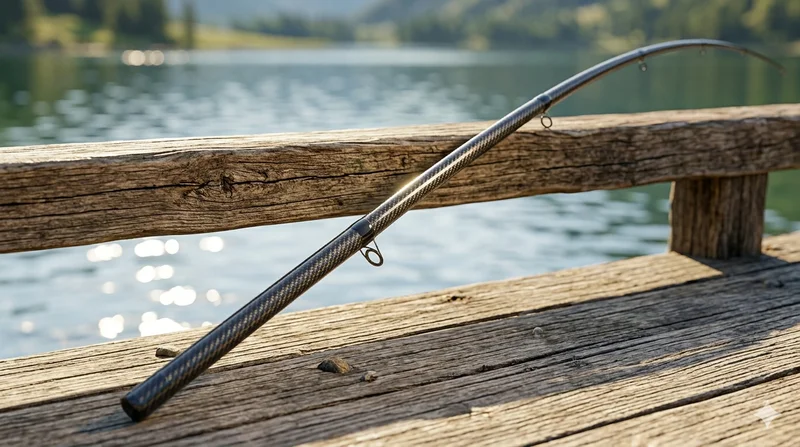
Carbon Fiber Fishing Rod Blank
High-quality carbon fiber fishing rod blank manufactured from multiple grades of Toray carbon fiber cloth. Available in a wide range of lengths, powers, and actions for freshwater and saltwater applications. Suitable for OEM rod building.

Carbon Fiber Plate — 3K Twill T700 3.0mm
Medium-thickness 3.0mm carbon fiber plate offering significantly higher load capacity while maintaining attractive 3K twill finish. Suitable for structural brackets, reinforcement plates, and load-bearing panels.

Carbon Fiber Plate — 3K Twill T700 1.5mm
Thin 1.5mm carbon fiber plate with 3K twill weave surface. Lightweight and stiff, commonly used for covers, panels, drone bodies, and applications requiring a premium aesthetic appearance.

Square Carbon Fiber Tube — 3K Twill T700
Square cross-section carbon fiber tube manufactured with 3K twill weave for torsional strength. Preferred for structural frames, trusses, and support columns where rectangular geometry offers design flexibility.
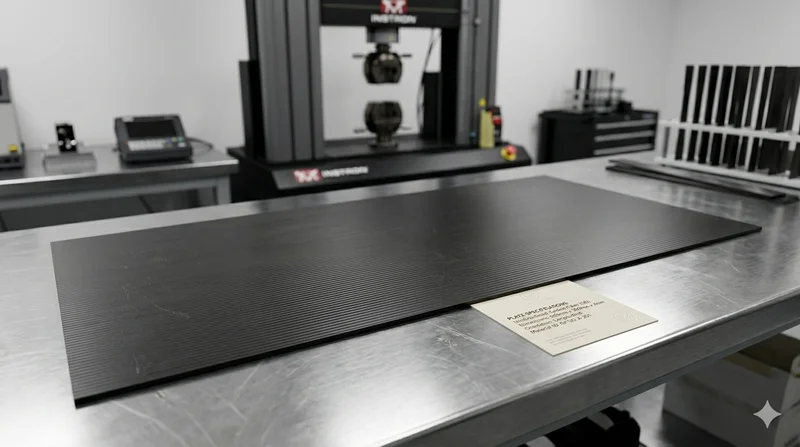
Carbon Fiber Plate — UD Unidirectional T700
Unidirectional carbon fiber plate with all fibers oriented in a single direction for maximum strength along the fiber axis. Essential for structural reinforcements, splints, and applications where load direction is predictable.