
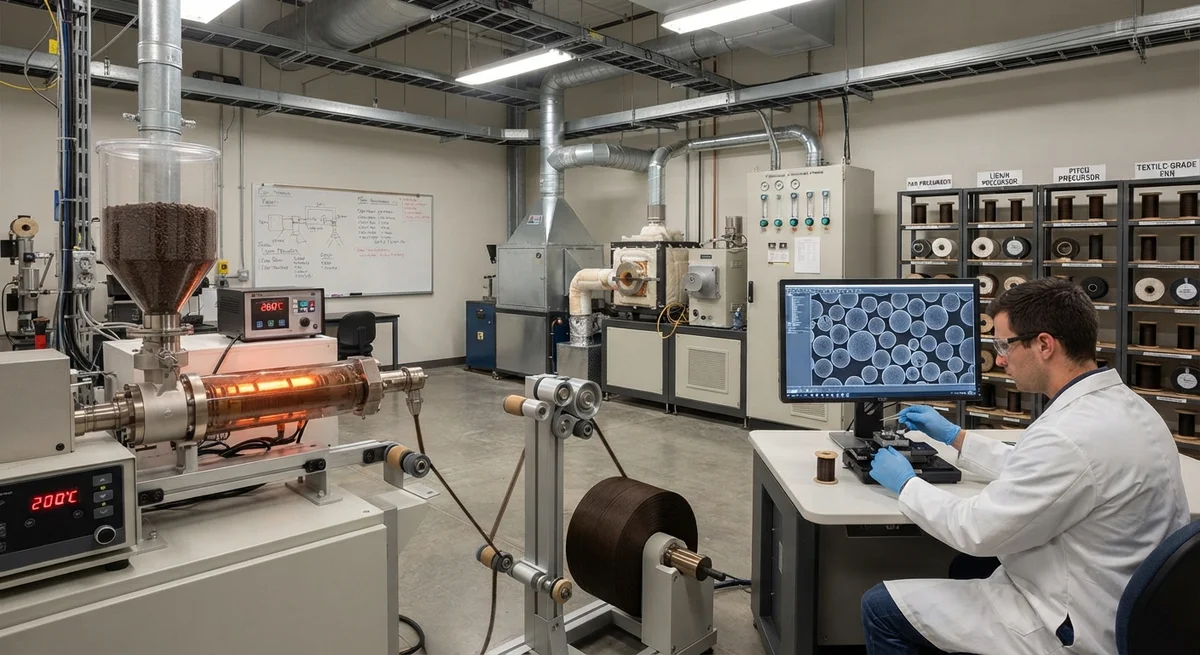
A technical examination of emerging low-cost precursor alternatives for carbon fiber manufacturing — lignin-based precursors, pitch-derived fibers, and textile-grade PAN — comparing material properties, process economics, carbon yield, and commercial readiness for cost-sensitive industrial applications.
Low-Cost PAN Precursor Alternatives for Carbon Fiber: Lignin, Pitch, and Textile-Grade PAN Developments
The high cost of carbon fiber — currently $20–60/kg for industrial-grade and $100–300/kg for aerospace-grade — remains the single greatest barrier to broader adoption across automotive, wind energy, construction, and consumer goods markets. At the heart of this cost challenge is the precursor material: polyacrylonitrile (PAN) accounts for 40–55% of the total manufacturing cost of carbon fiber. Standard PAN precursor is produced from specialty acrylic monomers purified to 99.95%+ purity, then solution-spun under tightly controlled conditions to achieve the fine filament diameters (5–12 μm) and molecular orientation necessary for high-performance carbon fiber. The economics are unforgiving — a 1% improvement in precursor yield or carbon conversion translates to millions of dollars in annual savings at commercial production scale.
This has driven intensive global research into alternative precursor systems that can match or approach PAN-based carbon fiber properties at substantially lower cost. Three precursor categories have emerged as the most promising candidates: lignin-based precursors derived from pulping industry byproducts, pitch-based precursors from petroleum or coal tar processing, and textile-grade PAN that leverages the existing global acrylic fiber supply chain. This article provides a technical and economic comparison of these alternatives, with a focus on the material properties, process compatibility, carbon yield, and commercial readiness metrics most relevant to B2B procurement and product development decisions.
Lignin-Based Carbon Fiber Precursors
Lignin — the world's second most abundant natural polymer after cellulose, accounting for 15–30% of woody biomass — has attracted intense interest as a carbon fiber precursor due to its low raw material cost ($0.50–$2.00/kg compared to $3–$8/kg for specialty PAN) and high carbon content (60–65% by weight). Lignin is recovered as a byproduct of the pulp and paper industry (kraft lignin) and, increasingly, from cellulosic ethanol biorefineries. Global lignin production capacity exceeds 100 million metric tons per year, of which only 2–3% is currently utilized for value-added products — creating a massive opportunity for carbon fiber precursor applications.
However, lignin-based carbon fiber faces fundamental technical hurdles. Native lignin has a complex, branched molecular structure with broad molecular weight distribution (polydispersity index of 3–8 versus 2–3 for specialty PAN) and limited spinnability due to the absence of the linear chain entanglement that enables continuous fiber drawing. Significant research advances in recent years have addressed these challenges through:
- Chemical modification: Acetylation, hydroxypropylation, and esterification of lignin hydroxyl groups reduce glass transition temperature and improve thermoplastic flow characteristics, enabling melt-spinning at 160–220°C without thermal degradation.
- Fractionation and purification: Solvent-based fractionation (using methanol, ethanol, or acetone) isolates low-polydispersity lignin fractions with molecular weight distributions comparable to PAN, producing filaments with tensile strength of 0.5–1.0 GPa after carbonization — approximately 30–60% of standard PAN-based carbon fiber.
- Blend spinning with plasticizers: Co-spinning lignin with 5–30% thermoplastic polymers (polyethylene oxide, polypropylene, or PLA) improves melt processability and circular fiber cross-section uniformity. The plasticizer is removed during the thermal stabilization stage, leaving a predominantly lignin-derived carbon structure.
Pitch-Based Carbon Fiber Precursors
Pitch-based carbon fiber — derived from petroleum asphalt, coal tar, or synthetic mesophase pitch — represents the most mature alternative precursor technology, with commercial production established since the 1970s. Pitch-based fibers occupy a unique market position: mesophase pitch-derived carbon fiber achieves the highest thermal conductivity (500–1,000 W/m·K) and tensile modulus (650–960 GPa) of any carbon fiber type, but with limited tensile strength (1.5–3.5 GPa) and high cost ($100–$500/kg). Isotropic pitch-based carbon fiber, conversely, offers moderate properties at lower cost but has struggled to compete with standard PAN-based fibers.
| Property | PAN-Based (Standard) | Mesophase Pitch | Isotropic Pitch | Lignin-Based | Textile PAN |
|---|---|---|---|---|---|
| Tensile Strength (GPa) | 3.5–7.0 | 1.5–3.5 | 0.5–1.0 | 0.3–1.2 | 1.8–3.5 |
| Tensile Modulus (GPa) | 200–450 | 400–960 | 30–60 | 30–80 | 150–300 |
| Thermal Conductivity (W/m·K) | 5–50 | 200–1,100 | 3–10 | 2–8 | 5–30 |
| Carbon Yield (wt%) | 45–55% | 80–90% | 70–85% | 35–45% | 40–50% |
| Estimated Precursor Cost ($/kg) | $3–$8 | $10–$30 | $2–$5 | $0.50–$2.00 | $1.50–$4.00 |
| Estimated Finished Fiber Cost ($/kg) | $20–$60 | $100–$500 | $15–$30 | $10–$25 | $12–$35 |
| Commercial Readiness | Mature (TRL 9) | Mature niche (TRL 9) | Limited (TRL 7) | Early (TRL 4–6) | Growing (TRL 7–8) |
Textile-Grade PAN Precursors
Textile-grade PAN — sometimes called "commodity PAN" or "acrylic fiber" — represents perhaps the most commercially attractive near-term alternative to standard PAN precursor. Whereas specialty PAN precursor is produced from high-purity acrylonitrile monomer (>99.95%) using proprietary spinning processes optimized for carbon fiber conversion, textile-grade PAN uses standard acrylonitrile (99.0–99.5% purity) with common comonomers (methyl acrylate, methyl methacrylate, or vinyl acetate at 5–15 wt%) that improve dyeability and hand feel for apparel applications.
The critical challenge is that the comonomers and production conditions optimized for textile performance are suboptimal for carbon fiber conversion. The ester comonomers used in textile PAN decompose exothermically during stabilization, making controlled oxidation more difficult and introducing porosity in the final carbon structure. Researchers and pilot facilities have addressed this through:
- Comonomer optimization: Replacing textile-grade comonomers with itaconic acid (1–3 wt%) or methacrylic acid, which catalyze cyclization during stabilization without generating exothermic decomposition. Itaconic acid-modified textile PAN demonstrates carbon fiber tensile strength of 2.5–3.5 GPa — 70–90% of standard PAN-based carbon fiber performance.
- Modified stabilization profiles: Lengthened stabilization times (60–120 minutes vs 30–60 minutes for standard PAN) with lower peak temperatures (220–260°C vs 250–300°C) accommodate the broader molecular weight distribution and higher defect density of textile-grade PAN.
- Gateway fiber approach: Using textile PAN as the precursor for industrial-grade carbon fiber (targeting 1.5–2.5 GPa tensile strength) where the 20–40% cost reduction justifies the moderate property trade-off. Applications such as wind turbine blade spar caps and automotive structural components are primary targets.
Process Economics Comparison
The economic viability of alternative precursors depends not only on raw material cost but on the downstream processing implications. A comprehensive cost model must account for carbon yield (lower yield means more precursor mass required per kilogram of finished fiber), stabilization and carbonization throughput (slower stabilization for some alternatives reduces furnace productivity), and process waste treatment costs (some pitch and lignin processes generate higher volatile organic compound emissions requiring abatement systems). Industry cost modeling suggests that lignin-based carbon fiber could reach a production cost of $10–$15/kg at commercial scale (10,000+ tonnes/year) — a 50–75% reduction from standard PAN-based fiber — but this assumes resolution of the current carbon yield limitations. Textile PAN-based carbon fiber, at $15–$25/kg estimated cost with less process modification required, is likely to achieve commercial viability sooner, with several pilot-scale facilities in Europe and Asia operating at the 100–500 tonne/year scale.
Which alternative precursor is closest to commercial production?
Textile-grade PAN is the closest to commercial production, with multiple pilot-scale facilities operating globally and at least two manufacturers (one in Germany, one in South Korea) offering commercial-grade carbon fiber produced from modified textile PAN at $18–$28/kg. Isotropic pitch-based carbon fiber from coal tar is commercially available at $15–$30/kg for lower-performance applications (construction reinforcement, electromagnetic shielding). Lignin-based carbon fiber remains at the pilot/demonstration stage (TRL 4–6), with no commercial-scale production established as of 2026.
Can alternative precursors match aerospace-grade PAN performance?
Not currently. Alternative precursors produce carbon fiber with tensile strengths in the 0.5–3.5 GPa range, compared to 4.5–7.0 GPa for aerospace-grade PAN-based fiber (T700, T800, T1000 grades). The molecular structure of PAN — specifically the linear chain architecture, high orientation achievable through wet/dry-jet spinning, and controlled cyclization during stabilization — has not been replicated in any alternative precursor. The market opportunity for alternative precursors is in industrial-grade (1.5–3.5 GPa) applications, which account for 65–70% of total carbon fiber demand by volume.
Conclusion
The search for low-cost carbon fiber precursor alternatives continues to advance across three parallel tracks. Lignin-based precursors offer the lowest theoretical raw material cost but face unresolved challenges in carbon yield, mechanical property consistency, and commercial-scale process validation. Pitch-based precursors — particularly mesophase pitch — occupy a unique high-performance niche not addressable by PAN-based fibers. Textile-grade PAN, with its established global production infrastructure of 5+ million tonnes per year and proven modification pathways, presents the most commercially realistic near-term alternative for industrial-grade carbon fiber production at $12–$28/kg. For B2B buyers and procurement specialists, the key strategic insight is that alternative precursors are unlikely to replace PAN in high-performance applications but offer compelling cost-performance propositions for the expanding volume segment of industrial carbon fiber — where a 40–60% cost reduction at 60–80% of standard mechanical properties creates viable new applications in automotive, wind energy, construction, and consumer goods that were previously cost-prohibitive.
Part of topic
Related Articles
- Bio-Based Carbon Fiber Precursors: Lignin and Polyethylene for Low-Cost Production
- Large-Tow Carbon Fiber Cost Analysis: 48K vs 60K Price-Performance Comparison
- Carbon Fiber-Resin Interface Bonding: Surface Treatment and Coupling Agent Optimization
- Digital Twin for Carbon Fiber Manufacturing: Real-Time Process Monitoring and Defect Prevention
- Thermoplastic Carbon Fiber Welding for Automotive: Ultrasonic and Induction Welding Process Windows
- Large-Tow Carbon Fiber Wet Spinning: Process Optimization for 48K/60K Production Efficiency
Interested in Our Products?
Contact our team for competitive pricing and technical specifications.
Get a QuoteRelated Products
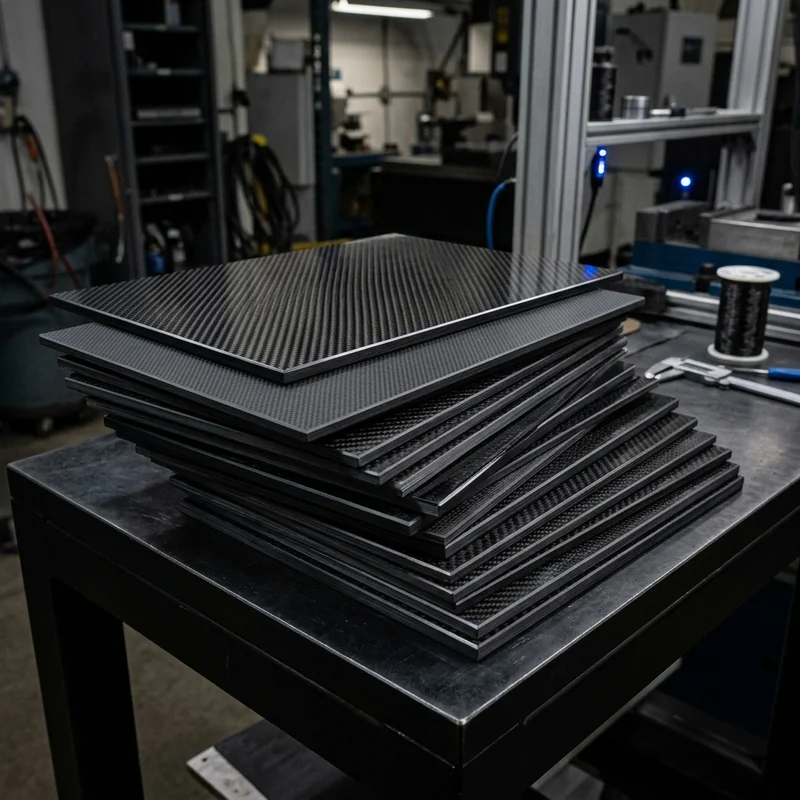
Carbon fiber standard plate-3k stripe
Lightweight, ultra-rigid standard sheets for drone fuselages, robot housings, facades and structural applications.

Carbon Fiber Plate — 3K Twill T700 1.5mm
Thin 1.5mm carbon fiber plate with 3K twill weave surface. Lightweight and stiff, commonly used for covers, panels, drone bodies, and applications requiring a premium aesthetic appearance.

Square Carbon Fiber Tube — 3K Twill T700
Square cross-section carbon fiber tube manufactured with 3K twill weave for torsional strength. Preferred for structural frames, trusses, and support columns where rectangular geometry offers design flexibility.

Carbon Fiber Plate — 3K Twill T700 3.0mm
Medium-thickness 3.0mm carbon fiber plate offering significantly higher load capacity while maintaining attractive 3K twill finish. Suitable for structural brackets, reinforcement plates, and load-bearing panels.
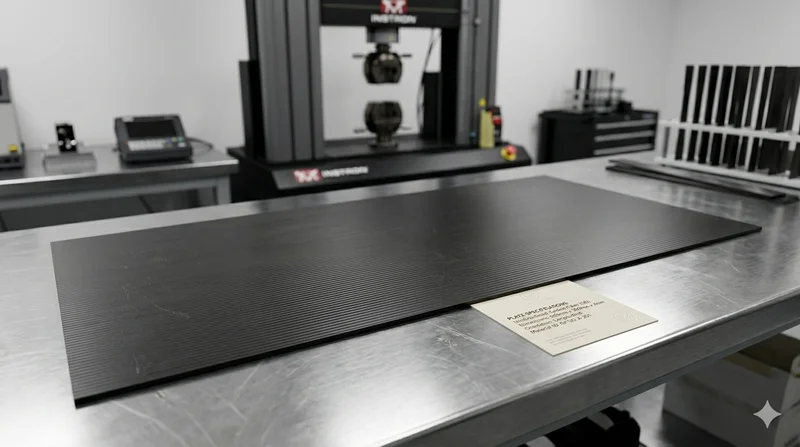
Carbon Fiber Plate — UD Unidirectional T700
Unidirectional carbon fiber plate with all fibers oriented in a single direction for maximum strength along the fiber axis. Essential for structural reinforcements, splints, and applications where load direction is predictable.