
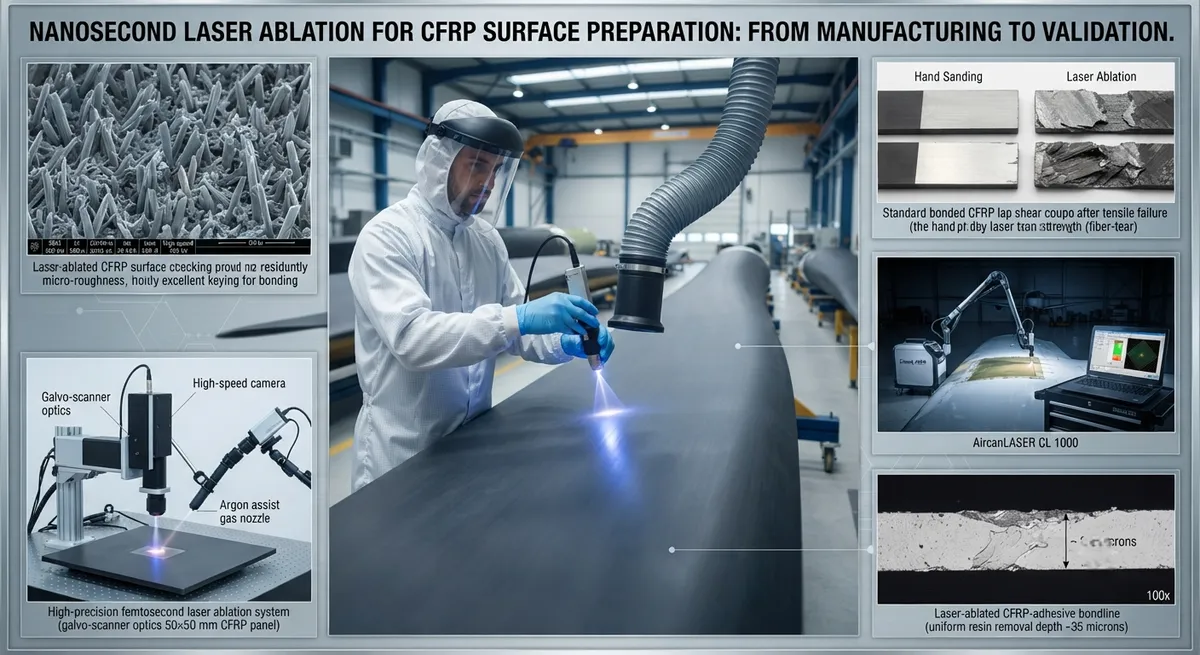
A comprehensive technical guide to laser ablation surface preparation for carbon fiber composites — how nanosecond and femtosecond laser systems improve bondline strength, reduce contamination, and enable field-repairable composite structures.
Adhesive bonding of carbon fiber reinforced polymer (CFRP) structures is a critical process in composite repair, assembly, and field maintenance. The quality of the surface preparation directly determines bondline integrity — poor preparation leads to kissing bonds, porosity at the interface, and premature failure. Traditional methods such as hand sanding, grit blasting, and peel-ply removal have inherent variability and contamination risks. Laser ablation has emerged as a precise, repeatable, and contamination-free alternative for preparing CFRP surfaces prior to adhesive bonding.
How Laser Ablation Works on CFRP Surfaces
Laser ablation removes the surface layer of the epoxy resin matrix through photothermal and photochemical processes. When the laser pulse energy exceeds the ablation threshold of the epoxy (~0.3–1.5 J/cm² depending on wavelength and pulse duration), the resin vaporizes or is ejected as fine particulate, exposing the underlying carbon fibers. The key objective is to remove the contaminated resin layer (typically 10–50 μm deep) without causing fiber damage or excessive heat-affected zone (HAZ) in the remaining material.
Comparison of Surface Preparation Methods
| Method | Lap Shear Strength (MPa) | Process Time (min/m²) | Fiber Damage Risk | Contamination Control | Automation Readiness |
|---|---|---|---|---|---|
| Hand sanding (P80-P120) | 18–22 | 45–60 | Medium (fiber fraying) | Poor (dust + release agent) | Low |
| Grit blasting (alumina 60 μm) | 20–25 | 10–15 | High (fiber fracture) | Fair (embedded grit) | Moderate |
| Peel ply + solvent wipe | 16–20 | 5–10 | Low | Variable (residual nylon) | High |
| Atmospheric plasma | 22–28 | 2–5 | Very low | Good (surface activation) | High |
| Nanosecond laser (1064 nm) | 28–35 | 3–8 | Low–Medium | Excellent (self-cleaning) | Very high |
| Femtosecond laser (1030 nm) | 32–40 | 5–12 | Very low | Excellent (minimal HAZ) | Very high |
Process Parameters That Affect Bonding Quality
Six critical laser parameters govern the quality of CFRP surface preparation:
- Wavelength: Near-infrared (1064 nm) is most common for nanosecond systems. Ultraviolet (355 nm) offers higher resin absorption but lower throughput. Mid-IR (9.3–10.6 μm CO₂ lasers) couples well with epoxy but produces more HAZ.
- Pulse energy and fluence: Typical fluence for resin removal without fiber damage is 0.5–2.0 J/cm² for 1064 nm nanosecond pulses. Below 0.3 J/cm² no ablation occurs; above 3.0 J/cm² fiber breakage becomes significant.
- Scan speed and overlap: Line speeds of 500–2,000 mm/s with 50–80% hatch overlap produce uniform removal. Faster scanning reduces HAZ but may leave islands of untreated resin.
- Number of passes: 2–4 passes are typically sufficient for complete resin removal. Excessive passes (>6) risk exposing and damaging bare fibers.
- Focal position: A defocus of +1 to +3 mm (above the surface) widens the kerf and reduces energy density, useful for final cleaning passes without fiber damage.
- Assist gas: Compressed air or nitrogen at 2–6 bar helps eject ablation debris and reduces redeposition of vaporized resin on the treated surface.
Bond Strength Validation Data
Independent studies by the German Aerospace Center (DLR) and the University of Bristol have consistently demonstrated that laser-ablated CFRP surfaces achieve lap shear strengths of 32–40 MPa when bonded with film adhesives such as AF 163-2K or FM 300-2. This represents a 55–80% improvement over hand-sanded surfaces and a 25–35% improvement over grit-blasted surfaces. Mode I fracture toughness (G_IC) values exceed 600 J/m², indicating a ductile cohesive failure mode in the adhesive rather than brittle interfacial failure. Peel strength tests (ASTM D3167) show 45–55 N/mm for laser-treated surfaces versus 25–35 N/mm for grit-blasted controls.
Frequently Asked Questions
Can laser ablation be used on wet-cured or out-of-autoclave CFRP?
Yes. Laser ablation is effective on all common CFRP processing routes — autoclave-cured, out-of-autoclave (OOA), vacuum-bag-only (VBO), and RTM panels. The key consideration is moisture content. Wet-layup or OOA panels may have higher moisture absorption (1.0–1.5% by weight), which can cause micro-cracking during laser ablation due to rapid steam expansion. Pre-drying at 70°C for 2 hours is recommended for moisture-sensitive panels before laser treatment.
How does laser ablation affect the fatigue performance of bonded CFRP joints?
Laser-prepared joints demonstrate superior fatigue resistance compared to mechanically abraded joints. In tension-tension fatigue tests (R=0.1, 10 Hz), laser-ablated samples sustain 2–3× more cycles to failure at 60% of ultimate tensile strength. The improvement is attributed to the absence of micro-crack initiation sites (which are prevalent on sanded surfaces) and the uniform micro-roughness profile that promotes mechanical interlocking at the adhesive interface. After 10⁶ cycles at 40% load level, laser-prepared joints retain 92% of their initial quasi-static strength.
What equipment is needed for field deployment of laser ablation systems?
Portable nanosecond laser ablation systems are now commercially available for field repair applications. A typical field kit includes a Q-switched Nd:YAG laser head (1064 nm, 20–50 W, handheld scanning head with integrated fume extraction), a portable chiller (15–25 kg), a 3–5 meter umbilical cable, and a laptop control station running the process recipe. The complete system weighs approximately 80–120 kg and fits in a single transport case. Current commercial systems include CleanLASER CL 1000 and Adapt Laser AL-200. Battery-powered units for remote site repair are under development with target weight under 50 kg.
Part of topic
Related Articles
- Bio-Based Carbon Fiber Precursors: Lignin and Polyethylene for Low-Cost Production
- Large-Tow Carbon Fiber Cost Analysis: 48K vs 60K Price-Performance Comparison
- Carbon Fiber-Resin Interface Bonding: Surface Treatment and Coupling Agent Optimization
- Digital Twin for Carbon Fiber Manufacturing: Real-Time Process Monitoring and Defect Prevention
- Thermoplastic Carbon Fiber Welding for Automotive: Ultrasonic and Induction Welding Process Windows
- Large-Tow Carbon Fiber Wet Spinning: Process Optimization for 48K/60K Production Efficiency
Interested in Our Products?
Contact our team for competitive pricing and technical specifications.
Get a QuoteRelated Products
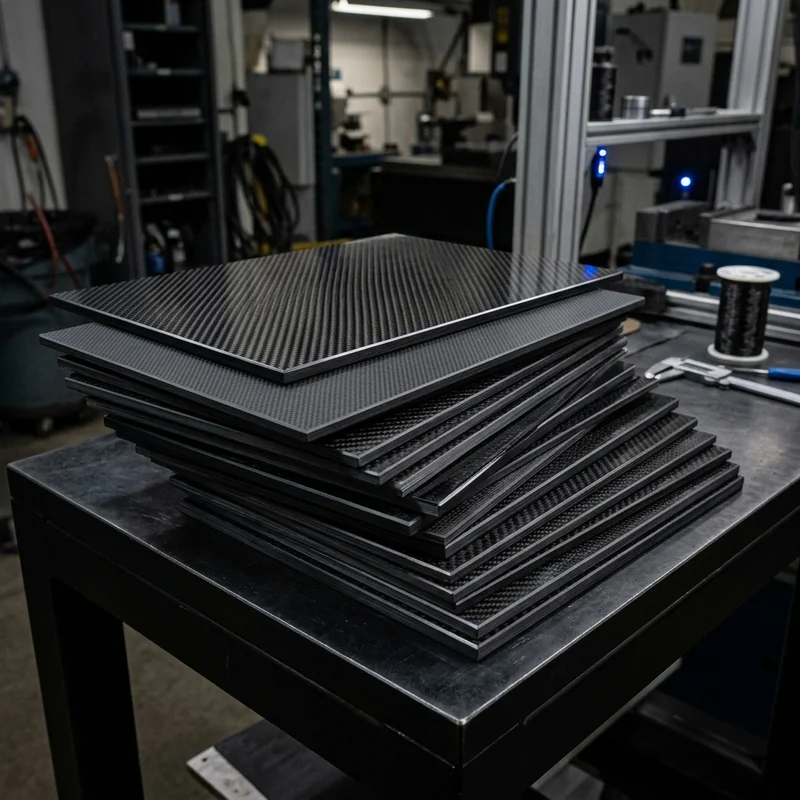
Carbon fiber standard plate-3k stripe
Lightweight, ultra-rigid standard sheets for drone fuselages, robot housings, facades and structural applications.

Carbon Fiber Plate — 3K Twill T700 3.0mm
Medium-thickness 3.0mm carbon fiber plate offering significantly higher load capacity while maintaining attractive 3K twill finish. Suitable for structural brackets, reinforcement plates, and load-bearing panels.

Carbon Fiber Plate — 3K Twill T700 1.5mm
Thin 1.5mm carbon fiber plate with 3K twill weave surface. Lightweight and stiff, commonly used for covers, panels, drone bodies, and applications requiring a premium aesthetic appearance.
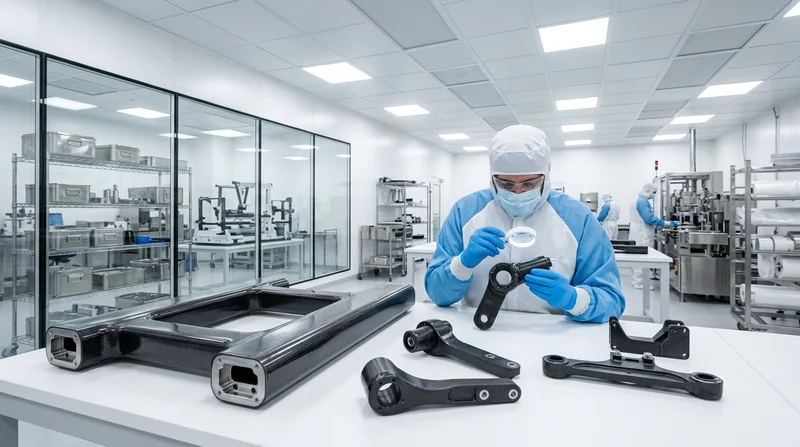
Custom Carbon Fiber Medical Device Components
Medical-grade carbon fiber components manufactured for imaging equipment, surgical instruments, and patient support systems. Carbon fiber's radiolucency (X-ray transparency) and high strength-to-weight ratio make it ideal for CT scanner beds, wheelchair frames, surgical robot arms, and MRI-compatible accessories. Biocompatible resin systems available.

Square Carbon Fiber Tube — 3K Twill T700
Square cross-section carbon fiber tube manufactured with 3K twill weave for torsional strength. Preferred for structural frames, trusses, and support columns where rectangular geometry offers design flexibility.