
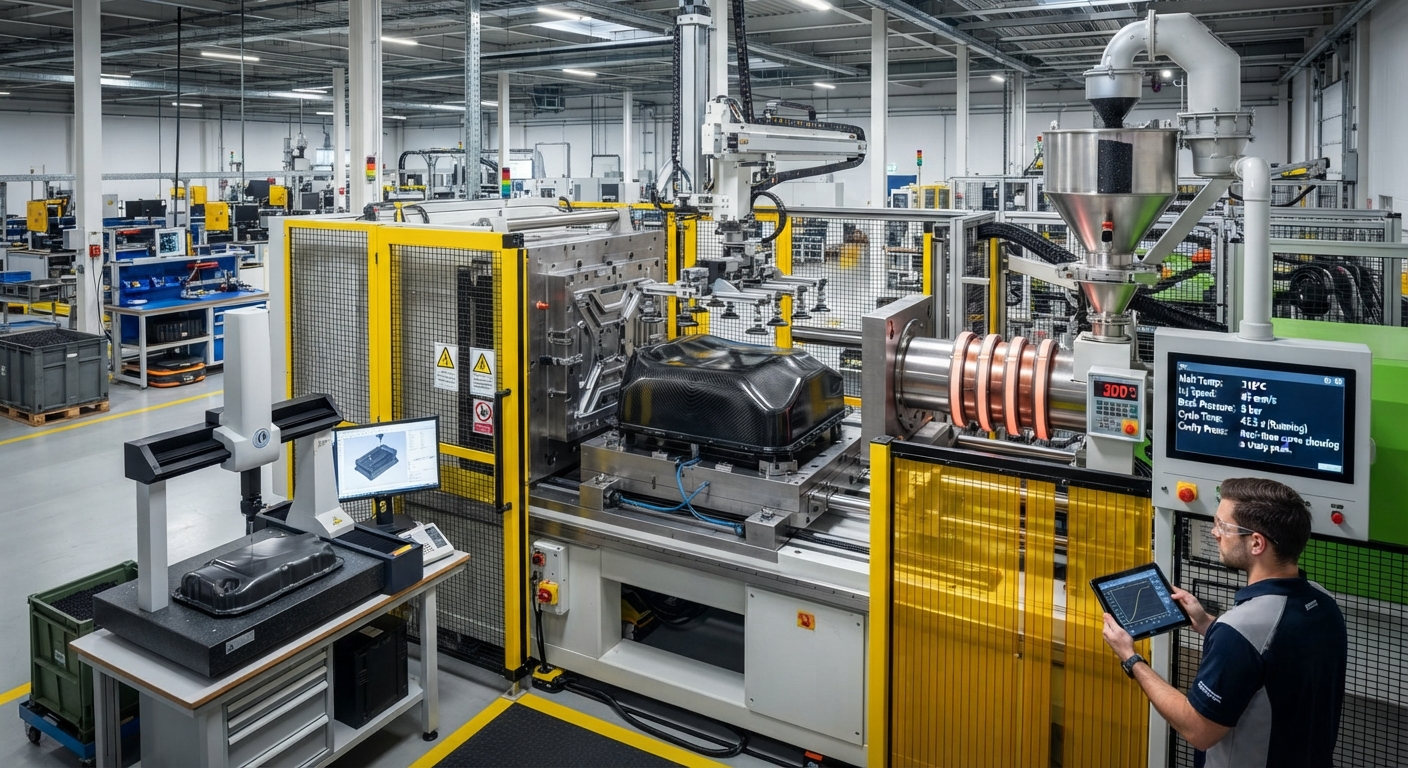
Technical guide to injection molded short carbon fiber reinforced polymers (SCFRP): mechanical property comparison, process parameters, warpage control strategies, and applications in automotive and consumer electronics.
Injection Molded Short Carbon Fiber Reinforced Polymers: An Overview
Injection molded short carbon fiber reinforced polymers (SCFRP) represent the most cost-effective route for mass-producing carbon fiber composite components at scale. Unlike continuous fiber composites that require labor-intensive layup or expensive automated fiber placement, SCFRP compounds can be processed on standard injection molding machines with cycle times of 30–90 seconds, making them ideal for high-volume automotive, consumer electronics, and industrial applications.
The global SCFRP market was valued at approximately $1.8 billion in 2025 and is projected to reach $3.2 billion by 2030, driven primarily by electric vehicle lightweighting requirements and the miniaturization of electronic device housings. Key growth sectors include electromagnetic interference (EMI) shielding enclosures, structural battery housings, and precision gear components.
Short Fiber vs. Long Fiber: Mechanical Property Comparison
The fiber length distribution in injection molded compounds critically determines mechanical performance. Short fiber compounds (0.2–0.4 mm fiber length after molding) offer superior flowability and surface finish, while long fiber thermoplastics (LFT, 2–10 mm residual length) provide higher impact resistance and structural properties.
| Property | Short Fiber (0.2–0.4 mm) | Long Fiber (2–10 mm) | Unit |
|---|---|---|---|
| Tensile Modulus | 14–18 | 16–22 | GPa |
| Tensile Strength | 95–140 | 130–180 | MPa |
| Flexural Modulus | 12–16 | 14–20 | GPa |
| Notched Izod Impact | 4–8 | 12–25 | kJ/m² |
| HDT @ 1.82 MPa | 245–260 | 255–270 | °C |
| Mold Shrinkage (flow direction) | 0.2–0.4 | 0.1–0.3 | % |
| Surface Roughness (Ra) | 0.4–0.8 | 1.2–2.5 | µm |
| Cycle Time | 30–60 | 50–90 | seconds |
Injection Molding Process Parameters for SCFRP
Optimizing process parameters is critical for achieving consistent mechanical properties and dimensional accuracy in SCFRP parts. The key parameters affecting fiber orientation, residual length, and part quality include:
- Melt Temperature: Typically 280–320°C for PA66-based compounds; higher temperatures reduce viscosity but accelerate thermal degradation of the sizing agent on fiber surfaces
- Mold Temperature: 80–120°C for semi-crystalline matrices; higher mold temperatures promote crystallinity and improve surface finish but increase cycle time
- Injection Speed: Medium to high (50–150 mm/s) to minimize fiber breakage in the gate region while ensuring complete cavity fill
- Back Pressure: 5–15 bar — excessive back pressure (≥20 bar) causes severe fiber attrition and reduces mechanical properties by 15–25%
- Screw Design: Low-compression ratio screws (2:1 to 2.5:1) with special wear-resistant coatings (DLC or CrN) to minimize fiber degradation
- Gate Design: Fan gates or tab gates recommended to reduce shear-induced fiber orientation and weld-line formation
- Holding Pressure: 40–70% of injection pressure for 3–8 seconds to compensate for volumetric shrinkage
Warpage Control Strategies
Warpage in SCFRP injection molded parts is primarily caused by anisotropic shrinkage resulting from fiber orientation distribution through the part thickness. The skin-core morphology typically exhibits highly oriented fibers in the skin layer (0.7–0.9 orientation tensor) and randomly oriented fibers in the core (0.3–0.5 orientation tensor). This differential orientation creates asymmetric shrinkage that leads to bending, twisting, and dimensional non-conformance.
Effective warpage mitigation strategies include: (1) conformal cooling channel design using additive manufacturing techniques to achieve uniform mold surface temperature distribution within ±3°C; (2) variable packing pressure profiles that compensate for fiber orientation-driven differential shrinkage across thick and thin sections; (3) sequential valve gating in multi-cavity tools to control flow front progression and reduce weld line formation; (4) mold surface texturing to modify surface layer fiber orientation through controlled melt flow perturbation; and (5) annealing cycles at 160–180°C for 2–4 hours post-molding to relax residual stresses and reduce warpage by up to 40%. Finite element simulation tools such as Moldflow and Moldex3D are routinely used to predict warpage patterns before tool steel cutting, reducing mold trial iterations by 50–60%.
Automotive and Consumer Electronics Applications
SCFRP compounds have found widespread adoption in structural and semi-structural applications across multiple industries. In automotive, 30–40% carbon fiber-reinforced PA66 and PA6 compounds are used for transmission components, engine covers, pedal brackets, and structural battery module frames. The automotive sector accounts for 55% of global SCFRP consumption, driven largely by electric vehicle battery enclosure requirements. A typical EV battery pack cover molded from 30% CF-PA66 weighs 2.8 kg versus 5.2 kg for the glass fiber-reinforced equivalent — a 46% weight reduction that directly increases vehicle range by approximately 8–12 km per charge.
In consumer electronics, thin-wall (<1 mm) housings for laptops, tablets, and smartphones utilize SCFRP primarily for EMI shielding (40–60 dB attenuation at 1 GHz) and structural rigidity. The thermal conductivity of carbon fiber — 8–10 W/m·K in-plane versus 0.3 W/m·K for unfilled polymers — makes SCFRP an effective heat dissipation material for high-performance electronic enclosures. Leading OEMs including Apple, Dell, and Samsung have qualified SCFRP compounds for next-generation device frames, with average wall thickness reducing from 1.2 mm to 0.6 mm over the past five years through iterative material and process optimization.
Additional high-growth application sectors include industrial robotics (end-effector arms and gripper jaws), power tools (motor housings and gear cases), and sporting goods (bicycle pedal bodies and ski binding components). The medical device sector is emerging as a growth area, with SCFRP compounds being qualified for MRI-compatible surgical instrument housings and prosthetics components requiring high stiffness-to-weight ratios.
What is the maximum carbon fiber content achievable in injection molding compounds?
Commercially available SCFRP compounds range from 10% to 50% carbon fiber by weight. The practical maximum for injection molding is 40–45 wt% — above this level, melt flow becomes insufficient for complex geometries, fiber-fiber interaction causes severe agglomeration, and mechanical property improvements plateau. For structural applications, 30 wt% offers the best balance of processability, mechanical properties, and cost efficiency.
How does fiber length degrade during injection molding processing?
Fiber length degradation follows an exponential decay model. Initial pellet length of 6–12 mm is reduced to an average of 0.2–0.4 mm after molding. The majority of breakage (60–70%) occurs in the plasticization unit — specifically during melting and conveying through the screw. An additional 20–25% breakage occurs at the gate. Strategies to minimize attrition include using specialized low-shear screws, oversize gate dimensions, and pre-drying compounds to consistent moisture levels below 0.02%.
What are the key cost factors for SCFRP vs. metal replacement?
The total cost comparison depends on part geometry, production volume, and secondary operations. SCFRP compounds are priced at $8–15/kg (30 wt% CF), compared to $2–4/kg for 30% glass-filled compounds. However, parts consolidation (eliminating 5–8 metal components into one molded part), elimination of secondary machining, 40–60% weight reduction, and corrosion resistance often yield 15–30% overall cost reduction at volumes above 100,000 units/year. Tooling costs are comparable to conventional injection molding.
Related Articles
- Bio-Based Carbon Fiber Precursors: Lignin and Polyethylene for Low-Cost Production
- Large-Tow Carbon Fiber Cost Analysis: 48K vs 60K Price-Performance Comparison
- Carbon Fiber-Resin Interface Bonding: Surface Treatment and Coupling Agent Optimization
- Digital Twin for Carbon Fiber Manufacturing: Real-Time Process Monitoring and Defect Prevention
- Thermoplastic Carbon Fiber Welding for Automotive: Ultrasonic and Induction Welding Process Windows
- Large-Tow Carbon Fiber Wet Spinning: Process Optimization for 48K/60K Production Efficiency
Interested in Our Products?
Contact our team for competitive pricing and technical specifications.
Get a QuoteRelated Products
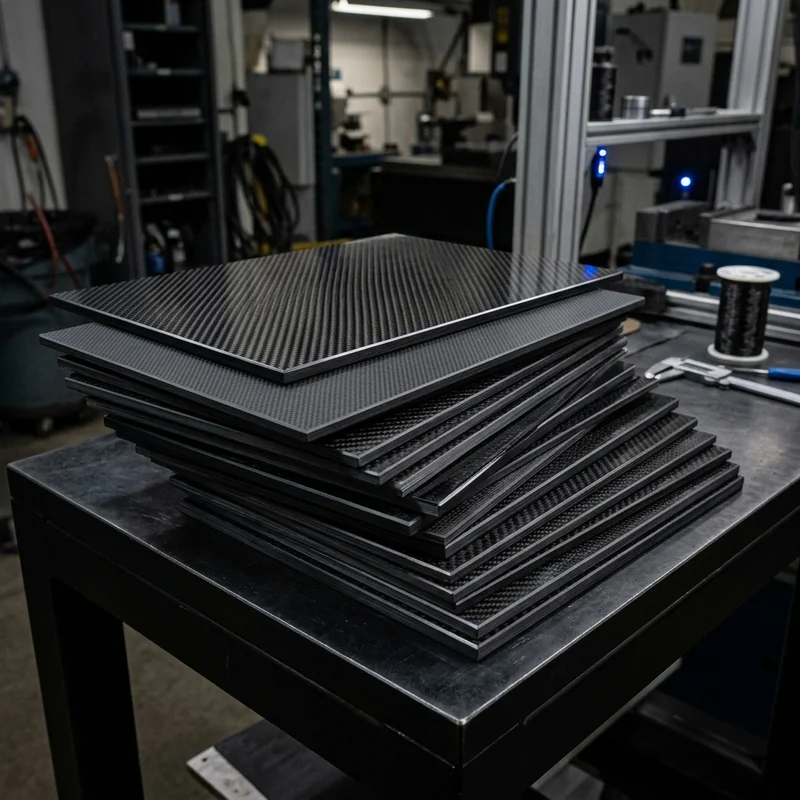
Carbon fiber standard plate-3k stripe
Lightweight, ultra-rigid standard sheets for drone fuselages, robot housings, facades and structural applications.

Carbon Fiber Plate — 3K Twill T700 3.0mm
Medium-thickness 3.0mm carbon fiber plate offering significantly higher load capacity while maintaining attractive 3K twill finish. Suitable for structural brackets, reinforcement plates, and load-bearing panels.

Carbon Fiber Plate — 3K Twill T700 1.5mm
Thin 1.5mm carbon fiber plate with 3K twill weave surface. Lightweight and stiff, commonly used for covers, panels, drone bodies, and applications requiring a premium aesthetic appearance.
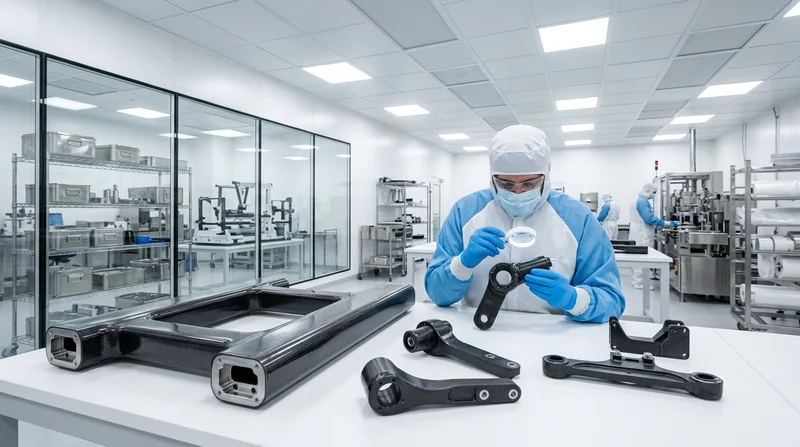
Custom Carbon Fiber Medical Device Components
Medical-grade carbon fiber components manufactured for imaging equipment, surgical instruments, and patient support systems. Carbon fiber's radiolucency (X-ray transparency) and high strength-to-weight ratio make it ideal for CT scanner beds, wheelchair frames, surgical robot arms, and MRI-compatible accessories. Biocompatible resin systems available.

Square Carbon Fiber Tube — 3K Twill T700
Square cross-section carbon fiber tube manufactured with 3K twill weave for torsional strength. Preferred for structural frames, trusses, and support columns where rectangular geometry offers design flexibility.