The 700-bar hydrogen truck tank has become the defining hardware of the heavy-duty fuel cell transition in Europe. Unlike passenger vehicles, where automakers still debate 350-bar versus 700-bar storage, the truck segment has effectively standardized on 700 bar because it is the only pr
Introduction
The 700-bar hydrogen truck tank has become the defining hardware of the heavy-duty fuel cell transition in Europe. Unlike passenger vehicles, where automakers still debate 350-bar versus 700-bar storage, the truck segment has effectively standardized on 700 bar because it is the only pressure level that packs acceptable range into the space available on a Class 8 chassis. Daimler Truck, Hyundai, Toyota, and Volvo are all fielding fuel cell tractor units whose storage systems follow the same fundamental architecture: a thin polymer liner, overwrapped with carbon fiber composite and carried at a nominal working pressure of 700 bar.
This article examines the engineering that makes 700-bar Type IV storage possible at fleet scale. We look at why 700 bar won over 350 bar for heavy trucks, how the Type IV architecture is constructed with T700 carbon fiber, what the ECE R134 regulation requires for commercialization, and which fleet programmes along corridors such as the Rhine-Ruhr are currently absorbing tank volume. For carbon fiber suppliers and tank manufacturers, these programmes determine which tow grades, winding patterns, and certification pathways matter most over the next five years.
Why 700 Bar Won for Heavy Trucks
The choice between 350 bar and 700 bar is ultimately a volumetric argument. Hydrogen at 700 bar and 15 degrees Celsius holds a density of roughly 40 kilograms per cubic meter, compared with about 24 kilograms per cubic meter at 350 bar. A fuel cell truck traveling 500 kilometers consumes somewhere between 25 and 35 kilograms of hydrogen depending on payload and aerodynamics, which means the storage system must package tens of kilograms of gas into the narrow space between and behind the cab where tank bundles are mounted.
The table below compares the two pressure levels for a nominal 30-kilogram hydrogen load on a heavy-duty truck:
| Parameter | 350 bar system | 700 bar system |
|---|---|---|
| Hydrogen density | Approx. 24 kg/m³ | Approx. 40 kg/m³ |
| Total tank volume needed for 30 kg | Approx. 1,250 liters | Approx. 750 liters |
| Typical tank count per tractor | 7-8 large tanks | 4-6 tanks |
| System gravimetric efficiency | 4.0-4.5% | 4.5-5.2% |
| Carbon fiber mass per tank | Lower | Higher (thicker wall) |
| Refueling time to 100% | Approx. 8-10 minutes | Approx. 12-15 minutes |
The practical consequence of the density gap is that 350-bar storage simply does not fit the packaging budget of a long-haul tractor. At 350 bar, a 30-kilogram load demands more than 1,200 liters of tank volume, forcing designers to stack an unrealistic number of vessels or sacrifice slotting, fifth-wheel position, and payload. At 700 bar the same energy fits in about 750 liters, which is why every major European OEM pursuing fuel cell long-haul has adopted it despite the higher carbon fiber content per tank.
Type IV Tank Architecture and the Role of T700
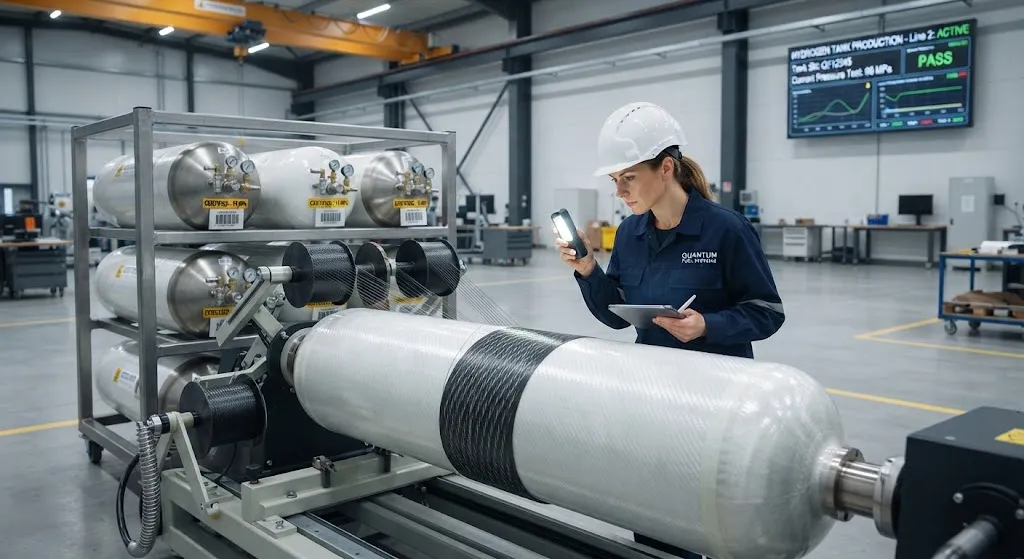
The Type IV vessel is defined by its materials layup. A seamless high-density polyethylene liner provides the gas barrier, a metallic boss at each end carries the valve interface, and a full carbon fiber overwrap bears the structural hoop and axial loads. Because the liner carries none of the pressure load, it can be thin, and because the composite carries everything, tank performance is ultimately a function of fiber selection and winding design.
The dominant fiber grade for 700-bar truck tanks is T700-class intermediate-modulus tow, typically 12K or 24K. T700 offers a tensile strength in the region of 4,900 MPa with a modulus near 230 GPa, which translates directly into burst pressure margin before the overwrap yields. Tank manufacturers wind the vessel in a hybrid pattern: helical layers at steep angles near the domes carry axial stress and protect the boss transition, while hoop layers wound near 90 degrees to the axis carry the large circumferential stress in the cylindrical section. The result is a laminate that thins toward the domes and thickens where hoop stress dominates.
Three design details distinguish a 700-bar truck tank from a lower-pressure vessel:
- Dome reinforcement: The transition from cylinder to dome concentrates stress at the boss, so manufacturers add locally thickened helical wraps and sometimes fiber patches to keep the safety factor uniform across the vessel.
- Liner-boss sealing: At 700 bar the interface between the polyethylene liner and the aluminum boss must sustain repeated thermal and pressure cycling without creep leakage, typically secured by an interference-fit joint and elastomeric seal.
- Balance of plant integration: Pressure relief devices, shutoff valves, and thermal management are integrated at the valve end so that the tank bundle can be serviced as a single storage module.
Gravimetric efficiency, the ratio of stored hydrogen mass to total system mass, lands at about 4.5-5.2% for production 700-bar Type IV tank systems. That figure is the product of careful fiber layup efficiency, since every gram of excess composite is dead weight that reduces payload and erodes the fuel economy advantage of the fuel cell powertrain.
ECE R134 Certification: The Gate to Fleet Deployment
Commercial deployment of 700-bar hydrogen truck tanks is governed by UN Regulation ECE R134, which harmonizes safety requirements for hydrogen and fuel cell vehicles. The regulation is the reference framework for OEM tank qualification in Europe and is widely mirrored by national regulations in Asia and North America. It defines the structural safety envelope that any 700-bar Type IV tank must survive before it is allowed on public roads.
The core acceptance criteria include a burst pressure of at least 2.25 times the nominal working pressure, so a 700-bar tank must burst above approximately 1,575 bar. Beyond static burst, the regulation requires:
- Pressure cycling: Tens of thousands of fill-drain cycles at elevated pressure with zero leakage or visible degradation, simulating a decade of daily refueling.
- Performance at extreme temperature: The tank must hold pressure and containment through the automotive temperature range with no loss of integrity or measurable hydrogen permeation beyond the allowed limit.
- Impact and abuse resistance: Drop tests, impact tests, and a bonfire test expose the tank without catastrophic failure, protecting the vehicle and its surroundings.
- Fleet periodic inspection: The regulation defines inspection intervals for in-service tanks, typically linked to mileage or chronological age, with visual and leak checks before continued operation.
For carbon fiber suppliers, the certification regime translates into strict material traceability. Manuscripts must hold stable T700 tow properties across lots, and winding trials must demonstrate repeatable burst margin on statistically meaningful sample sizes. OEMs typically demand that the fiber and prepreg chemistry remain frozen once certified, which is why tank programmes lock in tow suppliers early and why qualification cycles run 18 months or more before volume ramp.
Fleet Programmes Driving Tank Volume
The demand pull for 700-bar Type IV tank capacity in 2026 comes from a small number of visible heavy-duty fleet programmes concentrated in Europe's hydrogen corridors. The Rhine-Ruhr region functions as the anchor network, with refueling infrastructure density that makes daily 500-700 kilometer fuel cell duty cycles practical for logistics operators. Daimler Truck's GenH2 demonstration fleet, Hyundai's XCIENT Fuel Cell units operating in Germany and Switzerland, Toyota fuel cell truck projects in Europe, and Volvo's fuel cell partnerships all draw on the same 700-bar tank supply base.
Hydrogen refueling stations along these corridors now largely feature 700-bar dispensers at 35 to 70 MPa with pre-cooling, enabling the approximate 12-15 minute fills required for truck turnaround. As station coverage densifies, logistics operators are converting from pilot vehicles to fleet-scale orders, and tank manufacturers are responding with dedicated Type IV production lines. The longer-term regulatory signal is equally supportive: the EU's Alternative Fuels Infrastructure Regulation and the refueling density targets for the Trans-European Transport Network continue to pull storage demand forward through the end of the decade.
Frequently Asked Questions
Why do heavy-duty hydrogen trucks use 700-bar tanks instead of 350-bar tanks?
Because hydrogen density at 700 bar is nearly double that at 350 bar, a truck can carry the same mass of fuel in roughly 40% less tank volume. Long-haul tractors need 25-35 kilograms of hydrogen for a 500-kilometer shift, and 350-bar storage would require an impractical volume that compromises chassis packaging and payload.
What carbon fiber is used in 700-bar Type IV truck tanks?
The standard choice is T700-class intermediate-tensile-strength tow, typically 12K or 24K, wound in hybrid helical and hoop patterns. T700's combination of roughly 4,900 MPa tensile strength and 230 GPa modulus delivers the burst margin required at 700 bar operating pressure while keeping weight low enough to reach 4.5-5.2% gravimetric efficiency.
What does ECE R134 certification require for a hydrogen tank?
The regulation requires a burst pressure of at least 2.25 times working pressure, tens of thousands of pressure cycles without leakage, performance across extreme temperatures, impact and bonfire abuse tests, and defined periodic in-service inspections. Compliance is a prerequisite for public-road operation of hydrogen vehicles in Europe.
How much hydrogen does a 700-bar truck tank system store?
A typical heavy-duty tractor carries 4-6 Type IV tanks totaling 650-800 liters, storing roughly 25-35 kilograms of hydrogen at 700 bar. That supports a 400-600 kilometer driving range depending on payload, aerodynamics, and route topography.
Conclusion
The 700-bar Type IV hydrogen truck tank is the storage backbone of the heavy-duty fuel cell transition. Its architecture, built around a polyethylene liner and a T700 carbon fiber overwrap, delivers the volumetric density, weight efficiency, and certified safety that 350-bar systems cannot match, and ECE R134 gives OEMs and operators a common framework for qualification and in-service confidence. As Rhine-Ruhr corridors densify and fuel cell truck orders scale from pilots to fleets, demand for certified 12K and 24K tow continues to pull the tank supply chain forward.
YongXian supplies carbon fiber products for hydrogen storage and industrial applications worldwide. Explore our carbon fiber product range or contact our team to discuss tow grades, winding materials, and supply arrangements for Type IV tank programmes.
Part of topic
Related Articles
- Carbon Fiber Plate Amazon: Complete Guide
- Carbon Fiber And PU Case: Complete Guide
- Carbon Fiber Parts For Cars: Complete Guide
- Carbon Fiber Manufacturing Companies: Complete Guide
- Carbon Fiber Parts Manufacturing: Complete Guide
- Carbon Fiber Sheets for Sale: A Buyer Checklist for Thickness, Weave and Finish
Interested in Carbon Fiber Tubes?
Contact our team for competitive pricing and technical specifications.
Get a Quote