Hydrogen storage is one of the defining engineering problems of the energy transition, and composite pressure vessels have emerged as the leading solution for onboard and mobile storage because they achieve the highest gravimetric and volumetric efficiency of any practical containment t
Introduction
Hydrogen storage is one of the defining engineering problems of the energy transition, and composite pressure vessels have emerged as the leading solution for onboard and mobile storage because they achieve the highest gravimetric and volumetric efficiency of any practical containment technology. Hydrogen tanks are classified into types I through V, with each type representing an evolution in lightweighting. Type V is the newest and most aggressive: a fully linerless composite vessel in which the polymer liner that prevents permeation is eliminated and the carbon fiber composite shell must provide both the pressure containment and the gas barrier. Eliminating the liner reduces mass and simplifies manufacturing, but it raises a fundamental certification question — how does a tank that stores gas in direct contact with a composite shell prove that it meets safety and performance standards?
This article explains the Type V design, why it is attractive for hydrogen storage, and the certification standards path it must follow. We cover the vessel types for context, the properties that make linerless storage challenging, the relevant standards (including UN/ECE R134, ISO 19881, and emerging Type V guidance), and the qualification testing that manufacturers must complete.
Vessel Types from I to V
The vessel classification is an essential context because each type carries different certification requirements and different hydrogen-diffusion characteristics. The progression is toward less material and lower mass:
| Type | Construction | Liner | Typical Service Pressure | Key Characteristic |
|---|---|---|---|---|
| Type I | All-metal (steel or aluminum) | — (the wall is the gas barrier) | 200-450 bar | Heaviest, fully metallic barrier |
| Type II | Metal cylinder with a fiber-reinforced hoop wrap | Metal | 200-450 bar | Hoop wrap reduces weight |
| Type III | Full fiber-wound composite with a metal liner | Metal (aluminum) | 350-700 bar | Metal liner provides the barrier |
| Type IV | Full composite with a polymer liner | Polymer (HDPE, PA) | 350-700 bar | Lighter, polymer liner prevents permeation |
| Type V | Fully linerless composite | None | 350-700 bar (emerging) | Lightest; composite is both structure and barrier |
Type IV vessels are currently the mainstream for automotive and transport hydrogen because the polymer liner reliably manages hydrogen permeation. Type V removes even that liner, promising the best weight and a simpler, lower-cost manufacturing route — at the price of a much more demanding certification environment.
Why Linerless Storage Is Challenging
Removing the liner solves a weight problem but creates three interacting challenges that drive the certification story: hydrogen permeation, linerless sealing at the boss, and damage tolerance of a shell that is now the sole gas barrier.
- Hydrogen permeation: Hydrogen molecules are small enough to diffuse through the polymer matrix of a composite. A liner exists mainly to keep permeation at negligible levels. In a linerless design, the composite shell must itself limit permeation, which requires high fiber volume, a low-porosity matrix, and crack control under cyclic pressure.
- Boss sealing: The liner is the natural medium for sealing the metallic boss that connects the tank to the valve and plumbing. Without it, the seal between the composite shell and the boss must be engineered directly into the glass-to-metal-like interface, a difficult joint that must remain leak-tight through thousands of cycles and temperature excursions.
- Damage tolerance: In lined vessels, a liner crack or a small composite surface defect is containable. In a linerless vessel, any through-thickness crack becomes a direct leak path and a potential structural failure, so damage tolerance criteria and inspection requirements become central to safety.
These challenges are not disqualifying — several manufacturers have demonstrated linerless prototypes — but they shift the burden of proof, and certification agencies are still building a mature consensus standard for how that proof is made.
The Standards Landscape
Hydrogen vessel certification is governed by a patchwork of standards, and a Type V vessel must be qualified against the most relevant of them. There is not yet a single, universally adopted Type V standard, so manufacturers typically pursue certification against an existing hydrogen vessel standard, demonstrating equivalence through supplementary testing:
- UN/ECE R134 (Type Approval of Hydrogen-Fueled Vehicles): The primary regulation for onboard hydrogen fuel storage in vehicles, specifying materials, design, and a qualification test battery including burst, cyclicity, leak, and crash.
- ISO 19881 (Gaseous Hydrogen — Land Vehicle Fuel Containers): The international standard for hydrogen vehicle fuel containers, harmonized with ECE R134 in many respects and referenced around the world.
- ISO 11119-3 (Gas cylinders — Composite reinforced tubes of hoop-wrapped and fully reinforced construction): Relevant for stationary and some transport applications, covering composite cylinders and their qualification.
- SAE J2579 (Standard for Fuel Systems in Fuel Cell and Other Hydrogen Vehicles): A North American standard that includes permeation and durability testing emphasized for polymer-lined and emerging linerless designs.
- ASME Boiler and Pressure Vessel Code (BPVC) and related: For stationary storage, Annexed requirements address high-pressure composite vessels, with separate treatment for linerless designs under review.
Because Type V is novel, certification is often achieved by qualifying against the most stringent existing provisions (typically ECE R134 or ISO 19881), then adding linerless-specific evidence such as long-duration permeation measurement and enhanced damage-tolerance testing. The emerging direction is toward a dedicated Type V clause, but until one is universally accepted, the burden rests on demonstrating equivalence.
The Qualification Test Battery
Regardless of the governing standard, a Type V hydrogen vessel must pass a demanding test battery. The specific list depends on the application and the authority, but the core elements are consistent with hydrogen high-pressure vessel qualification:
| Test | Purpose | Relevance to Linerless Design |
|---|---|---|
| Hydraulic burst test | Verify the minimum burst pressure at a defined margin over service pressure | Baseline structural integrity of the composite shell |
| Pressure cycling (hydraulic and gas) | Prove resistance to fatigue over the design life (typically 5,000-15,000 cycles) | Crack initiation and growth in the matrix determine permeation and life |
| Permeation / leakage test | Measure hydrogen diffusion rate through the wall under service conditions | Critical: the composite itself must meet the permeation limit |
| Theoretical fill / thermo-cycling | Simulate rapid filling and temperature extremes | Temperatures and thermal stresses affect the matrix and seals |
| Impact and drop test | Verify damage tolerance of the container | Any surface damage near through-thickness becomes a leak and failure risk |
| Fire resistance test | Verify safe behavior (pressure relief) in a fire | Pressure-relief device sizing accounts for composite degradation |
For a linerless vessel, the permeation and damage-tolerance tests carry outsized weight, because the composite is both the structural element and the sole gas barrier. Each test produces data used to set service-life limits, inspection intervals, and the pressure-relief protocol.
Manufacturing Consistency and Quality Control
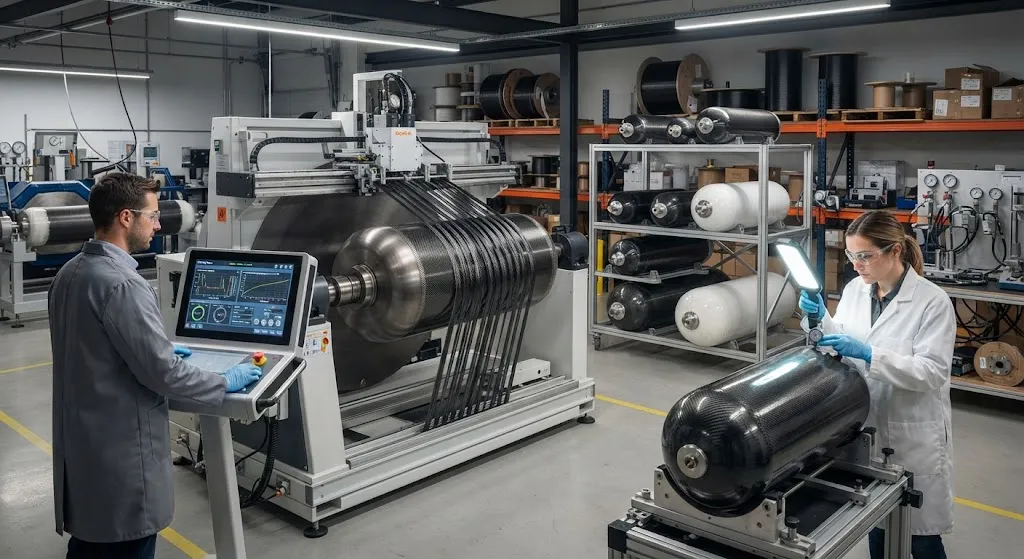
Certification hinges on demonstrating that what was tested is what will be produced — which makes manufacturing consistency as important as the design. For linerless tanks this is especially demanding, because a single manufacturing defect in the barrier layer can be the difference between a safe vessel and a leaking, potentially failing one. Key quality concerns include:
- Fiber winding tension and placement: Consistent wrap pattern and tension control matrix porosity, which directly governs permeation.
- Matrix quality and void content: Voids are nucleation sites for microcracks that become permeation paths; low void content is a certification prerequisite.
- Boss-to-shell interface: The linerless seal at the boss must be produced with repeatable, documented processes because it cannot rely on a polymer liner to absorb tolerance.
- Inspection and non-destructive testing: Ultrasonic and computed-tomography inspection are used to verify internal consistency, since visual inspection cannot see matrix-level defects.
Regulators increasingly look for robust process qualification alongside product qualification — evidence that the manufacturing line, not just the test articles, can hold the required tolerances. This is the practical bridge between the headlines about Type V potential and the reality of certified, fielded vessels.
Frequently Asked Questions
Is there an official, universally accepted Type V hydrogen tank standard yet?
Not yet. There is no single dedicated Type V standard that every authority recognizes. Manufacturers currently qualify Type V vessels against the most stringent existing hydrogen storage standards — most commonly UN/ECE R134 or ISO 19881 for vehicles, and ISO 11119-3 or ASME-related codes for some stationary applications — and add linerless-specific evidence such as extended permeation measurement and enhanced damage-tolerance testing to demonstrate equivalence. Standards bodies are working toward a dedicated Type V clause, and until one is universally adopted, qualification is necessarily a case-by-case process with significant supplementary testing and authority negotiation.
How does a linerless tank keep hydrogen from leaking through the composite?
A linerless tank controls permeation by design rather than with a separate barrier layer. The composite shell is made with a high fiber volume fraction and a low-porosity matrix, and the winding is managed to keep matrix voids and microcracks below the threshold that would create a continuous leak path. Hydrogen that diffuses through the polymer matrix is low, but the volume must still meet the regulatory permeation limit, so the shell design and process must be tightly controlled. The boss-to-shell joint is also engineered to seal directly, replacing the easy seal that a polymer liner would provide. In practice, meeting the permeation limit is one of the hardest parts of Type V qualification because the margin is thin and depends on manufacturing consistency.
Why not just keep the liner and use a Type IV tank?
For most current hydrogen applications, Type IV is a proven, lower-risk choice, and linerless Type V is pursued where the weight or cost saving justifies the added certification burden. The liner adds mass (about 5-10% of vessel weight for a polymer liner) and a manufacturing step, and it can constrain the temperature range and cycle life. Removing it gives the lightest possible vessel, simplifies the winding process, and can lower cost at scale. The trade-off is that you must prove the composite shell alone handles permeation, sealing, and damage tolerance — which is why Type V is entering service first in weight-sensitive roles such as aerospace and high-performance transport before it displaces Type IV in cost-sensitive markets.
Conclusion
Type V linerless hydrogen tanks represent the frontier of lightweight pressure containment, promising the lowest mass and a simpler manufacturing route, but they carry a certification burden that hinges on two hard problems: keeping hydrogen from permeating through the composite shell, and sealing the boss without a liner. Until a universal Type V standard arrives, qualification proceeds against existing high-pressure hydrogen standards such as UN/ECE R134 and ISO 19881, supplemented by linerless-specific evidence. The decisive factors are permeation control, damage tolerance, and manufacturing consistency — the same factors that determine whether any hydrogen vessel is safe in service.
For engineers and buyers evaluating linerless hydrogen storage, the practical takeaway is that material quality and process consistency are the foundation of certification. Explore our carbon fiber materials for pressure vessel applications, or contact our technical team to discuss fiber and prepreg specifications for high-pressure hydrogen tank manufacturing.
Part of topic
Related Articles
- Bio-Based Carbon Fiber Precursors: Lignin and Polyethylene for Low-Cost Production
- Large-Tow Carbon Fiber Cost Analysis: 48K vs 60K Price-Performance Comparison
- Carbon Fiber-Resin Interface Bonding: Surface Treatment and Coupling Agent Optimization
- Digital Twin for Carbon Fiber Manufacturing: Real-Time Process Monitoring and Defect Prevention
- Thermoplastic Carbon Fiber Welding for Automotive: Ultrasonic and Induction Welding Process Windows
- Large-Tow Carbon Fiber Wet Spinning: Process Optimization for 48K/60K Production Efficiency
Interested in Custom Carbon Fiber Products?
Contact our team for competitive pricing and technical specifications.
Get a Quote