
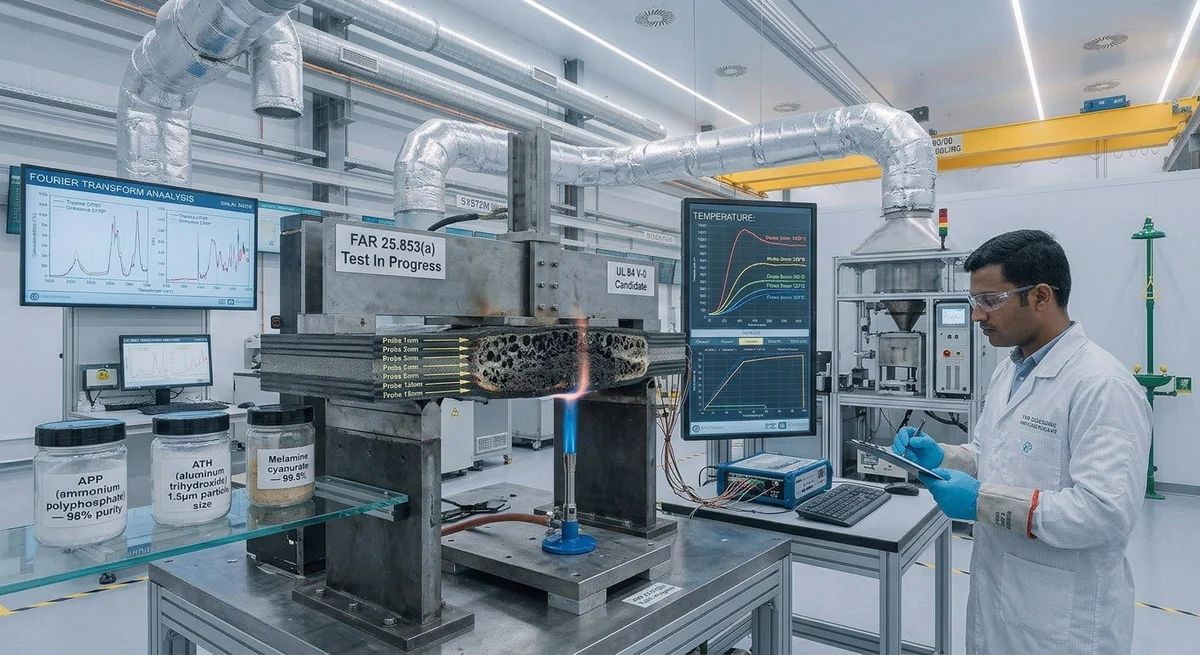
Fire retardant properties are increasingly critical for carbon fiber composites in aerospace interiors, public transportation, and building applications. This article examines additive technologies (APP, ATH, MCA, nanoclays), international flammability standards, and performance data for B2B buyers seeking certified fire-safe composite solutions.
Fire safety regulations for carbon fiber composites have tightened significantly across aerospace, rail, marine, and building construction sectors. Carbon fiber reinforced polymer (CFRP) composites based on standard epoxy, polyester, and vinyl ester resin systems typically exhibit Limiting Oxygen Index (LOI) values of 18-22% — below the self-extinguishing threshold — and are classified as flammable materials. Without fire retardant (FR) modification, CFRP can sustain combustion, release toxic smoke, and contribute to flame spread in fire scenarios.
The global market for fire retardant composites is projected to reach $5.8 billion by 2031, growing at 7.5% CAGR, with carbon fiber FR composites representing the highest-value segment. B2B buyers in aerospace, rail, marine, and public infrastructure must navigate a complex landscape of international fire standards, additive chemistries, and processing trade-offs. This article provides the technical data needed for informed material selection and certification planning.
Fire Retardant Additive Technologies for CFRP
Fire retardant additives for carbon fiber composites fall into four main categories: halogenated (increasingly restricted), mineral fillers, phosphorus-based systems, and intumescent systems. Each additive type operates through different fire retardancy mechanisms — gas-phase radical quenching, char-forming, endothermic decomposition, or barrier layer formation.
| Additive Type | Chemical Examples | Loading Level (phr) | Mechanism | LOI Achieved (%) | Cost Premium | Processing Impact | Key Application |
|---|---|---|---|---|---|---|---|
| Aluminum trihydroxide (ATH) | Al(OH)₃ | 40-100 | Endothermic (1,050 J/g), releases H₂O, dilutes fuel | 28-36 | 1.2-1.5× | ↑ viscosity, ↓ mechanical properties 15-25% | Rail, construction, marine |
| Magnesium hydroxide (MDH) | Mg(OH)₂ | 40-80 | Endothermic (1,300 J/g), releases H₂O above 300°C | 30-38 | 1.3-1.6× | ↑ viscosity, ↓ mechanical 10-20% | High-temperature processing (>200°C) |
| Ammonium polyphosphate (APP) | (NH₄PO₃)ₙ, n=100-1,000 | 10-30 | Intumescent — forms cellular char layer, thermal insulation | 32-45 | 1.5-2.5× | Moderate viscosity increase, ↓ mechanical 5-15% | Aerospace, rail interior panels |
| Melamine cyanurate (MCA) | C₃H₆N₆·C₃H₃N₃O₃ | 5-15 | Gas-phase — sublimes, releases inert N₂ diluent | 25-35 | 2.0-3.5× | Low viscosity impact, ↓ mechanical 5-10% | Thin-wall aerospace, electronics |
| Red phosphorus (RP) | P₄ (encapsulated) | 5-15 | Char-promoting — forms polyphosphoric acid, crosslinks polymer | 30-42 | 2.5-4.0× | Color concern (dark red), handling safety | Epoxy systems, electronic potting |
| Nanoclay (MMT) | Montmorillonite, organo-modified | 2-8 | Barrier — exfoliated platelets reduce heat/mass transfer | 24-32 | 1.5-2.0× | Minimal viscosity increase if properly dispersed | Aerospace, synergistic with APP |
| Carbon nanotubes (CNT) | MWCNT, diameter 10-30 nm | 0.5-3 | Network barrier — forms conductive char network, reduces peak HRR | 22-30 | 4.0-10.0× | Dispersion critical, increases viscosity | High-performance, multifunctional |
| Intumescent (IFR) system | APP + PER + MEL (triple system) | 15-30 (total) | Acid source + char former + blowing agent → thick char | 35-48 | 2.0-3.0× | Moderate impact, moisture sensitivity | Rail, building, marine panels |
International Flammability Standards
Carbon fiber composite components must comply with different flammability standards depending on their end-use application and geographic market. The most important standards for B2B buyers are:
Aerospace Interior Standards
- FAR 25.853 (12-second vertical test): The primary US FAA standard for aircraft interior materials. Requirements: burn length ≤ 152 mm (6 inches), after-flame time ≤ 15 seconds (≤ 12 seconds for seat cushions), drip extinguishing time ≤ 3 seconds (≤ 5 seconds for 60° test). Heat release: peak HRR ≤ 65 kW/m² per FAR 25.853(d) for large-surface-area components (OSU calorimeter, ASTM E906). Smoke density: Dₛ(4) ≤ 200 per FAR 25.853(d) (NBS smoke chamber, ASTM E662).
- FAR 25.856(a) (thermal/acoustic insulation): Burnthrough resistance test. Flame penetration must not occur within 5 minutes at 1,038°C (1,900°F) flame temperature. CFRP insulation blankets require APP-based intumescent coatings to pass.
- ABD0031 (Airbus): Supplementary requirements including smoke toxicity (HCN < 100 ppm, CO < 1,000 ppm, NOₓ < 100 ppm, SO₂ < 100 ppm, HCl < 150 ppm, HF < 100 ppm) and heat release rate (OSU peak < 65 kW/m², total < 65 kW·min/m²).
- BMS 8-363 (Boeing): Interior panel specification requiring vertical burn per FAR 25.853, OSU heat release (peak < 55 kW/m²), NBS smoke (Dₛ < 150 at 4 min), and flexural modulus retention after thermal cycling.
Railway Standards
- EN 45545-2 (European standard): The most comprehensive rail fire standard. Requirements vary by Hazard Level (HL1, HL2, HL3 — with HL3 being the most stringent for trains running in tunnels). R1 (interior seat shells) requires: smoke density Dₛ(4) < 150 (HL3), maximum average rate of heat emission (MAHRE) < 60 kW/m². R7 (interior panels) requires: CFE (critical flux at extinguishment) > 20 kW/m² (HL3), smoke production rate (SPR) < 0.25 m²/s.
- NFPA 130 (North America): Standard for fixed guideway transit and passenger rail systems. Requires flame spread index (FSI) ≤ 35 per ASTM E162, smoke developed index (SDI) ≤ 100 per ASTM E662. CFRP components typically achieve FSI 10-25 and SDI 40-80 with intumescent APP-based formulations.
- TB/T 3237 (Chinese standard): Railway vehicle interior materials flammability standard. Classification: A (non-flammable), B1 (flame retardant), B2 (difficult to ignite). CFRP interior panels for high-speed trains (e.g., CR400/CRH series) require B1 classification: oxygen index ≥ 32%, smoke density grade < 75%, after-flame time < 10 seconds, burn length < 150 mm.
- GOST 12.1.044-89 (Russian standard): Flammability classification for railway materials. CFRP must achieve Group V0 (difficult to ignite) for Russian high-speed train applications: oxygen index > 28%, temperature index > 250°C, smoke coefficient Dₘ < 500 m²/kg.
Building and Construction Standards
- UL 94 (US/International): Vertical (V-0, V-1, V-2) and horizontal (HB) burning classifications for plastic materials. CFRP with intumescent FR additives (APP 20 phr + MCA 5 phr) routinely achieves V-0 rating (no flaming drips, after-flame < 10 seconds per application, total < 50 seconds for 5 specimens). UL 94 V-0 requires flame extinguishment within 10 seconds after burner removal with no flaming drips. Unmodified CFRP typically achieves only HB (horizontal burn) or V-2 classification.
- EN 13501-1 (European): Reaction to fire classification for construction products. Classes: A1/A2 (non-combustible), B/C (very limited/singleton flame spread), D/E (acceptable for some applications). CFRP with intumescent coatings typically achieves B-s1,d0 classification — fire growth rate index (FIGRA) < 120 W/s, total heat release (THR) ≤ 7.5 MJ/m², smoke production (s1 = limited), and no flaming droplets (d0).
- GB 8624-2012 (Chinese): Classification for building materials. CFRP interior panels require Class A2 (B1 for decorative panels): heat release rate ≤ 9.0 MJ/kg, total smoke production ≤ 50 m², the critical flux ≥ 25 kW/m².
- ASTM E84 (UL 723) — Steiner Tunnel Test: Flame spread index (FSI) and smoke developed index (SDI). CFRP with 30 phr ATH achieves FSI 15-25 (Class A, FSI ≤ 25) and SDI 50-100 (Class A, SDI ≤ 450). Unmodified CFRP: FSI 50-150, potentially Class B or C.
| Standard | Sector | Key Metric | Requirement | Unmodified CFRP | FR CFRP (APP/IFR) |
|---|---|---|---|---|---|
| FAR 25.853 | Aerospace | After-flame time (s) | ≤ 15 s | 30-90 s (fail) | 2-8 s (pass) |
| FAR 25.853(d) | Aerospace | Peak HRR (OSU, kW/m²) | ≤ 65 kW/m² | 150-250 (fail) | 35-55 (pass) |
| UL 94 | General | Classification | V-0 (highest) | HB or V-2 | V-0 (pass) |
| EN 45545-2 R1 HL3 | Rail | Dₛ(4) smoke density | < 150 | 300-500 (fail) | 60-120 (pass) |
| EN 45545-2 R7 HL3 | Rail | CFE (kW/m²) | > 20 | 8-12 (fail) | 22-30 (pass) |
| NFPA 130 | Rail | FSI / SDI | ≤ 35 / ≤ 100 | 50-150 / 200-500 | 10-25 / 40-80 |
| TB/T 3237 B1 | Rail (China) | Oxygen index (%) | ≥ 32% | 18-22% (fail) | 32-42% (pass) |
| ASTM E84 Class A | Building | FSI | ≤ 25 | 50-150 (B/C) | 15-25 (A) |
| EN 13501-1 | Building | FIGRA (W/s) | < 120 (B) | 200-400 | 60-110 (< 120) |
Processing Considerations for FR CFRP
Incorporating fire retardant additives into CFRP introduces processing challenges that B2B buyers must understand:
- Resin viscosity increase: ATH at 60 phr loading increases epoxy viscosity from 500 cP to 8,000-15,000 cP at 25°C, complicating infusion and wet-out. APP at 20 phr increases viscosity to 2,000-4,000 cP. Preheating (40-60°C) or using low-viscosity resin blends is recommended for resin transfer molding (RTM) and vacuum-assisted resin infusion (VARI) processes.
- Mechanical property reduction: Mineral fillers (ATH, MDH) at high loadings (40-100 phr) reduce tensile strength by 15-25%, flexural modulus by 10-20%, and interlaminar shear strength (ILSS) by 10-30%. The reduction is caused by stress concentration around filler particles and reduced crosslink density in the matrix. Intumescent systems (APP at 15-25 phr) cause only 5-15% mechanical reduction — significantly less than mineral fillers.
- Moisture sensitivity: APP and IFR systems are hygroscopic. At 50°C/85% RH for 500 hours, APP-containing CFRP absorbs 2-5% moisture by weight (vs. 0.5-1.5% for unmodified epoxy). This can reduce Tg by 10-20°C and affect flammability performance. Encapsulated APP grades and hydrophobic sizing agents mitigate this effect.
- Thermal stability during processing: ATH decomposes above 200°C, MDH above 300°C, APP above 240°C. For high-temperature cure cycles (epoxy: 120-180°C, BMI: 220-250°C), MDH or coated APP grades are recommended over standard ATH.
- Color and aesthetics: APP and ATH produce off-white/beige FR composites. Red phosphorus gives dark red/brown coloration. For applications requiring specific aesthetics (aircraft interior panels, train seat shells), FR additives are selected for minimal color impact or matched with pigmented gel-coat systems.
Case Study: FAR 25.853 Certification of CFRP Aircraft Interior Panel
| Parameter | Unmodified Epoxy/CFRP | APP-IFR Modified (20 phr APP + 5 phr MCA) | Requirement (FAR 25.853) |
|---|---|---|---|
| Fiber volume fraction (%) | 60 | 58 | — |
| Areal weight (kg/m²) | 1.8 | 2.0 | — |
| After-flame time, vertical (s) | 45 | 4 | ≤ 15 |
| Burn length, vertical (mm) | 180 | 55 | ≤ 152 |
| Drip extinguishing time (s) | 12 (drips burn) | 0 (no drips) | ≤ 3 |
| Peak HRR (OSU calorimeter, kW/m²) | 180 | 42 | ≤ 65 |
| Total HRR (OSU, kW·min/m²) | 120 | 38 | ≤ 65 |
| Dₛ(4) smoke density (NBS chamber) | 380 | 110 | ≤ 200 |
| HCN concentration (ppm, smoke toxicity) | 85 | 45 | < 100 (Airbus ABD0031) |
| CO concentration (ppm) | 650 | 280 | < 1,000 |
| Tensile strength (MPa) | 620 | 560 | −10% (acceptable) |
| Flexural modulus (GPa) | 55 | 49 | −11% (acceptable) |
| ILSS (MPa) | 52 | 44 | −15% (acceptable) |
| Tg by DMA (°C) | 175 | 162 | −13°C (acceptable if > 135°C) |
FAQ
What is the most cost-effective fire retardant additive system for CFRP achieving UL 94 V-0?
The most cost-effective approach for UL 94 V-0 certification in carbon fiber composites is an intumescent system based on ammonium polyphosphate (APP) at 16-20 phr loading combined with melamine cyanurate (MCA) at 3-5 phr as a synergist. This system achieves V-0 at a cost premium of approximately 1.8-2.5× over standard epoxy. For comparison: ATH alone requires 60-80 phr loading to achieve V-0 (2.0-2.5× cost premium, worse mechanical property retention). Aluminum trihydroxide (ATH) at high loadings (60-100 phr) can achieve V-0 in polyester/vinyl ester systems at a lower additive cost (1.2-1.5×), but significantly degrades mechanical properties (20-30% reduction). For epoxy-based CFRP, the APP/MCA system is preferred due to its lower mechanical property penalty (5-15% reduction vs. 20-30% for ATH). The UK's Building Regulations Approved Document B and many European railway standards permit the APP/MCA approach as a certified FR solution.How does the addition of fire retardant fillers affect the mechanical properties of carbon fiber composites?
The effect depends on the additive type and loading level. Mineral fillers (ATH, MDH) at 40-100 phr loading cause the most significant mechanical reduction: tensile strength decreases 15-25%, flexural modulus 10-20%, and interlaminar shear strength (ILSS) 10-30%. This occurs because: (1) the filler particles act as stress concentration sites, (2) the high filler loading reduces the available resin volume for fiber-matrix bonding, and (3) particle agglomeration creates defect sites. Phosphorus-based systems (APP, red phosphorus) at 10-25 phr cause only 5-15% mechanical reduction due to lower loading levels and better compatibility with epoxy matrices. Nanofillers (nanoclays 2-8 phr, CNT 0.5-3 phr) cause minimal mechanical property reduction (0-5%) when properly dispersed. For applications requiring both V-0 flammability rating and high structural performance, a hybrid approach combining low-level APP (12-15 phr) with nanoclays (3-5 phr) as synergistic FR additives provides the best balance: UL 94 V-0 achieved with < 10% mechanical property reduction.What are the smoke and toxicity requirements for CFRP in railway interiors under EN 45545-2?
EN 45545-2 specifies requirements for smoke density and smoke toxicity for railway interior materials, with stringency varying by Hazard Level (HL1, HL2, HL3). For HL3 (most stringent, typically for trains operating in tunnels): Smoke density Dₛ(4) (4-minute value per ISO 5659-2) must be < 150 for R1 (seat shells) and R7 (interior panels). Smoke toxicity is measured per EN 45545-2 Annex C using the NF X 70-100-1/2 method: CO < 800 ppm, HCN < 100 ppm, NOₓ < 100 ppm, SO₂ < 100 ppm, HCl < 100 ppm, HBr < 100 ppm, HF < 100 ppm. For comparison, FR CFRP with intumescent APP/MCA system achieves Dₛ(4) = 60-120 and meets all toxicity limits. Standard CFRP (unmodified epoxy) produces Dₛ(4) = 300-500 and CO levels of 500-1,200 ppm. Halogenated FR additives (now restricted in European rail applications under EN 45545-2 Annex A) produce HCl, HBr, and HF levels that can exceed limits. Halogen-free FR systems (APP, ATH, MCA) are strongly preferred for railway interior certification in Europe and China.Can carbon fiber composites pass FAR 25.853 without significant weight or thickness increase?
Yes, with modern intumescent additive technology. APP-based intumescent systems at 18-22 phr loading in epoxy CFRP achieve FAR 25.853 compliance (12-second vertical burn, OSU heat release, NBS smoke) with only 5-10% weight increase (from additive loading) and no thickness increase. The CFRP panel thickness is determined by structural requirements, not fire requirements, when FR additives are formulated into the resin. Alternative approaches — such as intumescent coatings applied to the surface (0.2-0.8 mm coating thickness, 0.4-0.8 kg/m² add-on weight) — can achieve FAR 25.853 compliance with zero weight penalty in the composite itself. Surface coatings are commonly used for aircraft interior components where weight is the most critical factor, while bulk resin modification (additives in the matrix) is standard for panels and structural components. The key is that FAR 25.853 compliance does NOT require ceramic fiber replacement, metal foil layers, or significant thickness increases — properly formulated CFRP with intumescent technology passes all current requirements.Related Articles
- Bio-Based Carbon Fiber Precursors: Lignin and Polyethylene for Low-Cost Production
- Large-Tow Carbon Fiber Cost Analysis: 48K vs 60K Price-Performance Comparison
- Carbon Fiber-Resin Interface Bonding: Surface Treatment and Coupling Agent Optimization
- Digital Twin for Carbon Fiber Manufacturing: Real-Time Process Monitoring and Defect Prevention
- Thermoplastic Carbon Fiber Welding for Automotive: Ultrasonic and Induction Welding Process Windows
- Large-Tow Carbon Fiber Wet Spinning: Process Optimization for 48K/60K Production Efficiency
Interested in Our Products?
Contact our team for competitive pricing and technical specifications.
Get a QuoteRelated Products
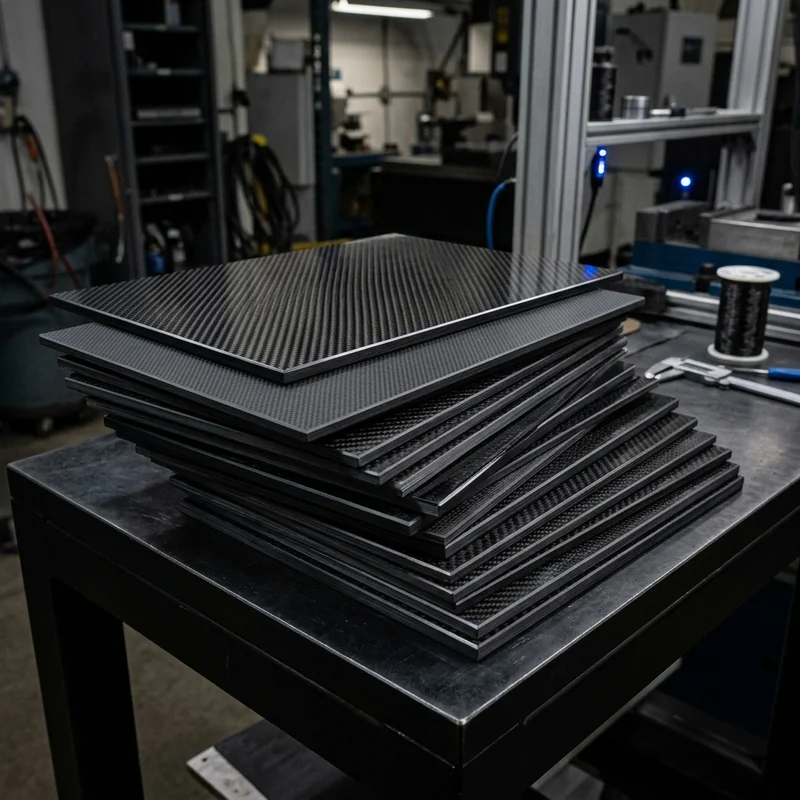
Carbon fiber standard plate-3k stripe
Lightweight, ultra-rigid standard sheets for drone fuselages, robot housings, facades and structural applications.

Carbon Fiber Plate — 3K Twill T700 1.5mm
Thin 1.5mm carbon fiber plate with 3K twill weave surface. Lightweight and stiff, commonly used for covers, panels, drone bodies, and applications requiring a premium aesthetic appearance.

Square Carbon Fiber Tube — 3K Twill T700
Square cross-section carbon fiber tube manufactured with 3K twill weave for torsional strength. Preferred for structural frames, trusses, and support columns where rectangular geometry offers design flexibility.

Carbon Fiber Plate — 3K Twill T700 3.0mm
Medium-thickness 3.0mm carbon fiber plate offering significantly higher load capacity while maintaining attractive 3K twill finish. Suitable for structural brackets, reinforcement plates, and load-bearing panels.
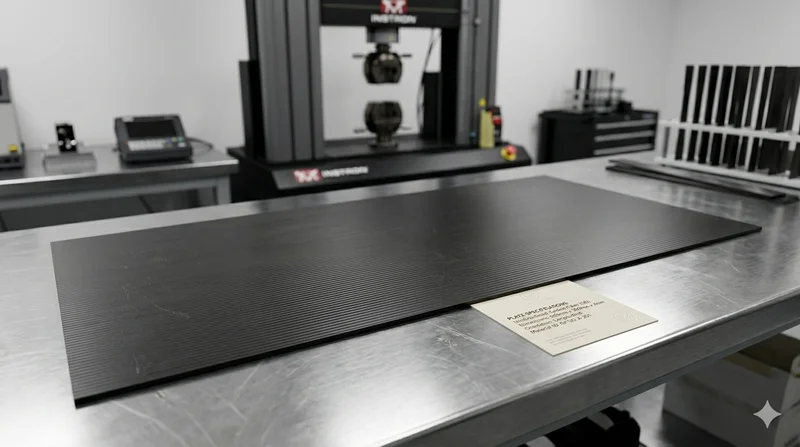
Carbon Fiber Plate — UD Unidirectional T700
Unidirectional carbon fiber plate with all fibers oriented in a single direction for maximum strength along the fiber axis. Essential for structural reinforcements, splints, and applications where load direction is predictable.