
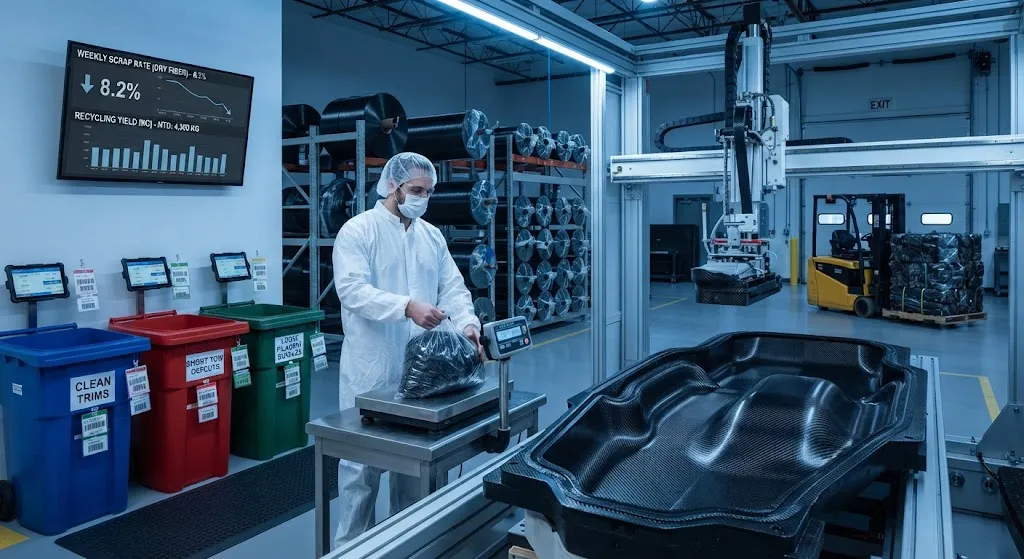
Automated fiber placement has become the workhorse process for large aerospace and industrial carbon fiber structures, from fuselage barrels to rocket motor cases. Yet AFP is not a zero-waste process. A machine placing 12.7-millimeter-wide tow at high speed produces trims, gaps, and rol
Introduction
Automated fiber placement has become the workhorse process for large aerospace and industrial carbon fiber structures, from fuselage barrels to rocket motor cases. Yet AFP is not a zero-waste process. A machine placing 12.7-millimeter-wide tow at high speed produces trims, gaps, and roll remnants that together can reach 10-30% of purchased material on complex contoured parts. For aerospace-grade carbon fiber priced at 80-200 USD per kilogram, that scrap represents both a cost leak and an environmental burden, since virgin carbon fiber carries an embodied energy of roughly 200 MJ per kilogram. This article explains where dry fiber scrap originates in AFP production, compares the recycling routes that can reclaim it, and outlines the yield-management practices that reduce waste at the source.
Where AFP Waste Comes From
Dry fiber scrap in AFP production falls into five recurring categories, each with a distinct cause and a different recycling response:
- Course and boundary trims: Each tow course is cut at the ply boundary, leaving a short offcut. On parts with complex contours and frequent cut-restart events, this is the single largest waste stream.
- Gap and overlap waste: To meet fiber volume fraction requirements, operators deliberately place courses with controlled gaps; scrap generated during steering and rework adds to the total.
- End-of-roll remnants: Spools that cannot finish a course become idle inventory, and the last meters of each spool are frequently unusable.
- Startup, qualification, and trial waste: Machine setup, coupon panels, and process qualification burns material that never enters a production part.
- Contaminated or expired material: Tow exposed to moisture, dust, or damaged spools is rejected for structural use but remains perfectly recyclable.
Reported scrap rates vary widely: flat, gently curved panels may lose only 5-10%, while highly contoured parts such as wing skins, engine nacelles, and pressure vessel domes can lose 20-30%. Understanding the local distribution of waste, rather than the average, is the first step toward reducing it.
Recycling Routes for Dry Carbon Tow
Because dry fiber scrap contains no cured resin, it is the easiest and cheapest carbon waste stream to recycle. Four routes are in commercial use today, with different fiber lengths, strength retention, and unit costs:
| Route | Output form | Fiber length | Strength retention | Typical cost (USD/kg) | Best-fit applications |
|---|---|---|---|---|---|
| Chopping into discontinuous fiber | 3-50 mm chopped tow | 3-50 mm | 80-95% | 5-12 | Molded compounds, nonwoven veils, cement reinforcement |
| Re-carding and air-laid nonwovens | Recycled carbon fiber mat | 30-80 mm | 70-90% | 8-18 | Compression molding, semi-structural panels |
| Direct tow reuse | Re-spooled continuous tow | Continuous | 95-100% | 25-45% below virgin | Pultrusion, filament winding, non-structural AFP |
| Short-fiber thermoplastic compounds | Injection-grade pellets | 0.2-2 mm | 60-80% | 6-14 | Automotive brackets, housings, EMI shielding |
The choice depends on the contamination level of the scrap stream. Clean, well-segregated trim can support direct tow reuse or high-strength chopped products, while mixed or dusty scrap is better downgraded to molding compounds. Segregation at the layup cell, with dedicated bins for each grade, is the single most important enabler of high-value recycling.
Economics and ESG Drivers
The business case for dry fiber recycling rests on three numbers. First, a typical AFP cell producing 200 tonnes of parts per year with a 15% scrap rate generates 30 tonnes of dry fiber waste annually; at 100 USD/kg that is 3 million USD of discarded material. Second, recycled carbon fiber production typically consumes 5-10% of the energy of virgin fiber, cutting the embodied carbon of each reclaimed kilogram by roughly 90%. Third, the price gap between recycled and virgin fiber, which stood at 30-50% for chopped products in 2025-2026, continues to widen as recycling capacity scales. Aerospace programs under net-zero roadmaps increasingly require suppliers to report and reduce production waste, making in-cell recycling systems a contractual differentiator as well as a cost lever.
Improving Process Yield at the Source
Recycling addresses waste after it is created; yield management prevents it. Four practices deliver the largest gains in AFP plants today:
- Nesting and course optimization software: Smarter path planning reduces the number of cut-restart events and trims, cutting scrap by 20-40% on contoured parts without any equipment change.
- Gap control and compaction monitoring: In-process sensors flag gap excursions early, reducing rework and the offcuts rework generates.
- Spool management and remnant reuse: Tracking remaining spool length lets planners use remnants for short courses or non-structural plies, reclaiming much of the end-of-roll stream.
- In-cell segregation for recycling: Color-coded bins and barcode tracking keep clean trim separate from contaminated scrap, raising the value of the recyclate that leaves the plant.
Implementation follows a natural sequence. Yield-optimization software and spool management deliver returns within weeks and require no capital equipment, making them the logical first step. In-cell segregation is a layout and procedure change that begins to pay for itself as soon as the first recycling agreement is signed. The capital-intensive step is the recycling line itself, whether that means shredding, carding, and compounding equipment on site, or a partnership with a commercial recycler. Most AFP shops choose the partnership route initially, selling segregated dry fiber scrap to specialized recyclers and reserving in-house processing for the highest-value streams. This phased approach limits risk while capturing most of the economic value, and it aligns with the rapid growth of commercial carbon fiber recycling capacity.
Plants that combine these practices report process yields of 95% or better on moderately contoured parts, shrinking the recycling task to the unavoidable residue. The two approaches are complementary: yield engineering reduces the volume of scrap, and recycling converts the unavoidable remainder into revenue instead of landfill cost.
Frequently Asked Questions
Is dry fiber scrap from AFP easier to recycle than cured composite waste?
Yes, and the difference is significant. Cured composite waste must first be separated from the resin matrix, either by pyrolysis at 400-700 degrees Celsius, by solvolysis with chemical solvents, or by mechanical grinding; each route consumes energy and shortens fiber. Dry fiber scrap skips the matrix-removal step entirely because no resin has been applied. The fiber can be chopped, carded, or re-spooled directly, which is why strength retention of 80-95% is achievable for chopped products and why dry fiber commands a higher recycling value than post-cure scrap. Keeping the two waste streams segregated at the cell is essential to preserve this advantage.
What is the typical scrap rate in AFP production, and what drives it?
Published plant data and equipment-maker benchmarks put AFP scrap between 5-10% for flat or gently curved panels and 20-30% for highly contoured parts such as wing skins, fuselage sections, and pressure vessel domes. The main drivers are the number of cut-restart events, steering constraints that force gaps, boundary trims at ply edges, and end-of-roll remnants. Parts designed for AFP, with relaxed ply-boundary constraints and wider steering radii, consistently show lower scrap than legacy designs adapted to the process. Course-optimization software typically recovers 20-40% of the contoured-part scrap without new capital equipment.
Does recycled carbon fiber meet aerospace quality requirements?
Recycled carbon fiber is not yet qualified for primary aerospace structure in most programs, and the aerospace-grade fiber at 80-200 USD/kg is typically not the scrap stream that makes economic sense to recycle. The commercial case is strongest for industrial applications: chopped recycled fiber in molded compounds, nonwoven mats, and short-fiber thermoplastics is qualified for automotive, consumer, and semi-structural parts, where the 30-50% price advantage over virgin fiber matters most. As recycling processes mature and fiber-length distributions become more controllable, secondary-structure and eventually primary-structure qualifications are the direction of travel, but today the realistic scope is industrial and semi-structural use.
Conclusion
Dry fiber scrap is the most tractable waste stream in the carbon fiber industry: it contains no cured resin, it can be reclaimed with 80-95% strength retention, and its volume is directly controllable through course optimization and segregation. For an AFP shop, the economic math is compelling, a 15% scrap rate on aerospace-grade tow represents millions of dollars of recoverable material, and the ESG reporting value of near-zero production waste is becoming a contract requirement. The winning strategy pairs source-level yield engineering with in-cell segregation feeding high-value recycling routes.
YongXian supplies carbon fiber tow, fabrics, and laminates for AFP and industrial processes worldwide. Explore our carbon fiber product range for automated layup and molding applications, or contact our engineering team to discuss material specifications, waste-reduction strategies, and qualification support for your program.
Part of topic
Related Articles
- Pultruded Carbon Fibre Rods: Cross-Sectional Properties and Standard Sizes
- Carbon Fiber Tube Fittings and Connectors: Joining Solutions for Structural Assemblies
- Carbon Fiber Plate Insert: Threaded Insert Design for Composite Structures
- Filament Wound Epoxy Tubing: Selection Guide for Industrial and Aerospace Applications
- Filament Wound Epoxy Tubes Advantages: Over Metal and Pultruded Alternatives
- Carbon Fiber Tube Strength: Analysis Methods and Design Allowables
Interested in Our Products?
Contact our team for competitive pricing and technical specifications.
Get a QuoteRelated Products
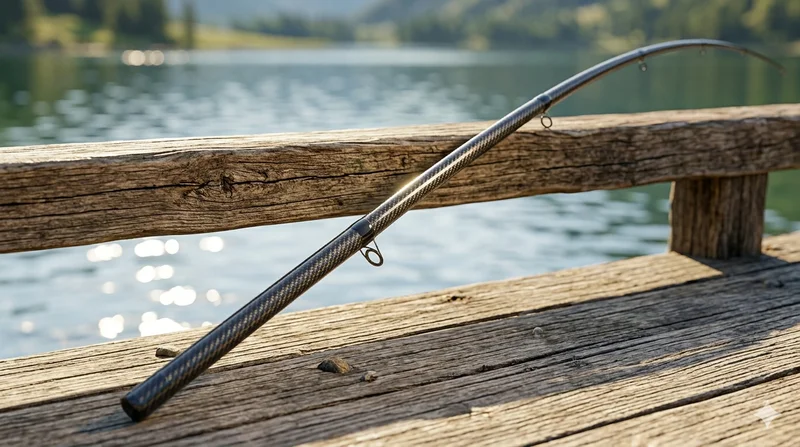
Carbon Fiber Fishing Rod Blank
High-quality carbon fiber fishing rod blank manufactured from multiple grades of Toray carbon fiber cloth. Available in a wide range of lengths, powers, and actions for freshwater and saltwater applications. Suitable for OEM rod building.

Carbon Fiber Plate — 3K Twill T700 1.5mm
Thin 1.5mm carbon fiber plate with 3K twill weave surface. Lightweight and stiff, commonly used for covers, panels, drone bodies, and applications requiring a premium aesthetic appearance.

Carbon Fiber Plate — 3K Twill T700 3.0mm
Medium-thickness 3.0mm carbon fiber plate offering significantly higher load capacity while maintaining attractive 3K twill finish. Suitable for structural brackets, reinforcement plates, and load-bearing panels.
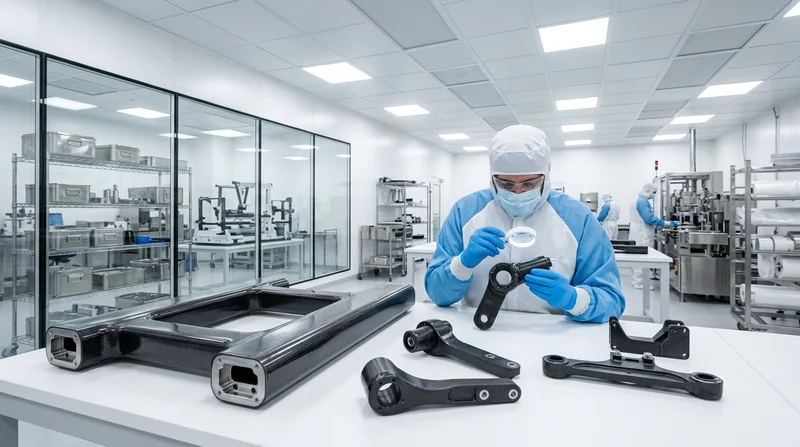
Custom Carbon Fiber Medical Device Components
Medical-grade carbon fiber components manufactured for imaging equipment, surgical instruments, and patient support systems. Carbon fiber's radiolucency (X-ray transparency) and high strength-to-weight ratio make it ideal for CT scanner beds, wheelchair frames, surgical robot arms, and MRI-compatible accessories. Biocompatible resin systems available.

Square Carbon Fiber Tube — 3K Twill T700
Square cross-section carbon fiber tube manufactured with 3K twill weave for torsional strength. Preferred for structural frames, trusses, and support columns where rectangular geometry offers design flexibility.