
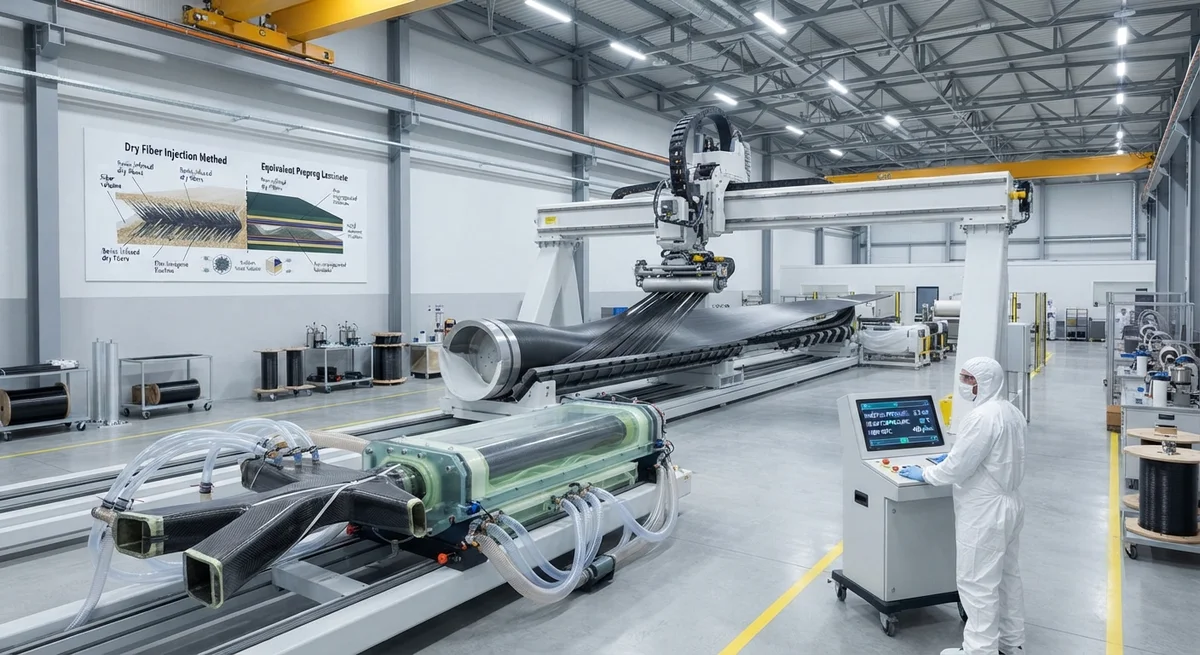
Dry fiber placement combined with resin transfer molding (DFP-RTM) offers significant cost and cycle time advantages over traditional prepreg-autoclave processing for large composite structures in wind energy, marine, and infrastructure applications.
Introduction: The Limits of Prepreg-Autoclave for Large Structures
Prepreg-autoclave processing has been the gold standard for high-performance carbon fiber composite manufacturing for over four decades, delivering void contents below 1%, precise fiber volume fractions of 55–65%, and consistent mechanical properties. However, as carbon fiber composite structures grow larger — wind turbine blades exceeding 100 meters, marine vessel hulls over 50 meters, and bridge decks spanning 30 meters — the fundamental constraints of prepreg-autoclave processing become increasingly costly. Autoclave size limitations, high capital equipment costs, batch processing constraints, and the short shelf life of prepreg materials at room temperature create a compelling case for alternative manufacturing routes.
Dry fiber placement combined with resin transfer molding (DFP-RTM) and its variant, vacuum-assisted resin transfer molding (VARTM), have emerged as the leading alternative for large-structure carbon fiber composite manufacturing. In DFP-RTM, dry carbon fiber tows are robotically placed onto a tool surface and held together by a thermoplastic binder or tackifier, forming a dry preform. The preform is then sealed in a closed mold or vacuum bag, and liquid resin is injected under pressure or vacuum to impregnate the fiber bed. After curing at elevated temperature (typically 60–120°C), the consolidated part is demolded. This article provides a technical comparison of DFP-RTM versus prepreg-autoclave processing across key performance, cost, and quality metrics.
Process Comparison: DFP-RTM vs. Prepreg-Autoclave
| Parameter | Prepreg-Autoclave | DFP-RTM / VARTM | Advantage |
|---|---|---|---|
| Capital equipment cost (10m part) | USD 8–15M (autoclave) | USD 1.5–4M (injection press/oven) | DFP-RTM |
| Tooling cost (per part set) | USD 80,000–250,000 | USD 30,000–120,000 | DFP-RTM |
| Material cost (per kg CF) | USD 45–85 (prepreg) | USD 25–45 (dry fiber + resin) | DFP-RTM |
| Cycle time (10m spar cap) | 8–16 hours (layup + cure + cool) | 4–8 hours (placement + injection + cure) | DFP-RTM |
| Fiber volume fraction (%) | 55–65 | 50–62 (VARTM); 55–65 (HP-RTM) | Similar |
| Void content (%) | <1 | <1 (HP-RTM); 1–3 (VARTM) | Prepreg (slight) |
| Tensile strength utilization (%) | 85–95 | 75–90 | Prepreg |
| Part thickness range (mm) | 0.5–25 (per cure cycle) | 1–100+ (single injection) | DFP-RTM |
| Maximum part dimension | Limited by autoclave (~5m typical) | Theoretically unlimited | DFP-RTM |
| Prepreg shelf life (25°C) | 2–4 weeks (frozen: 6–12 months) | Indefinite (dry fiber + separate resin) | DFP-RTM |
| Automation level | Moderate (cutting + hand layup) | High (robotic DFP + automated injection) | DFP-RTM |
| Scrap/waste rate (%) | 15–30 | 3–8 | DFP-RTM |
Dry Fiber Placement Technology
Dry fiber placement (DFP) is an automated process in which dry carbon fiber tows are placed onto a tool surface by a computer-controlled robotic head. The DFP head performs the following functions: tow tension control (typically 1–5 N per tow), tow guiding through individual ceramic eyelets to prevent filament damage, binder activation (thermal or ultrasonic) to tackify the tows to the underlying layer, tow cutting to specified length at ply boundaries, and compaction via a heated roller or shoe (50–120°C, 100–500 N compaction force).
Typical DFP deposition rates range from 5–15 kg/hour for a single head, compared to hand layup rates of 0.5–2 kg/hour and automated tape laying (ATL) of 10–30 kg/hour for prepreg. While DFP is slower than ATL for prepreg, it eliminates the subsequent debulking cycles required for thick prepreg laminates and enables placement of complex 3D geometries that are difficult to achieve with flat prepreg tape.
Resin Injection Systems
Three primary resin injection methods are used with DFP preforms, each suited to different part sizes and quality requirements:
- VARTM (Vacuum-Assisted RTM): Resin is drawn through the preform under vacuum (0.5–1.0 bar differential pressure). Suitable for very large parts (boat hulls, bridge decks, wind turbine blades) at the lowest tooling cost. Typical injection rates: 200–1,000 g/min. Peak exotherm must be managed in thick sections.
- HP-RTM (High-Pressure RTM): Resin is injected at 30–150 bar into a closed matched-metal mold. Suitable for higher-volume production with Class A surface finish. Cycle times of 3–10 minutes for automotive parts.
- RTM Light: A hybrid approach using a rigid half-mold and a flexible counter-mold with vacuum assistance. Balanced cost and quality for medium-sized parts (2–8m).
Case Study: Wind Turbine Blade Spar Caps
Wind turbine blade spar caps — the primary load-bearing structure spanning the blade root to tip — represent the largest volume application for DFP-RTM in carbon fiber composites. A typical 80-meter blade requires a spar cap containing 300–600 kg of carbon fiber, with thickness ranging from 10 mm at the tip to 80 mm at the root. Using prepreg-autoclave processing, each spar cap requires: cutting and kitting of prepreg plies (4 hours), manual layup of 80–150 plies (16–24 hours), vacuum bagging and debulking (4 hours), autoclave cure cycle (8–12 hours at 120–180°C and 6–7 bar), and cool-down/demolding (4 hours). Total cycle: 36–48 hours per spar cap. With DFP-RTM: robotic dry fiber placement of 40–80 layers (6–10 hours), preform bagging (1 hour), resin injection and cure at 80°C (4–6 hours), demolding (1 hour). Total cycle: 12–18 hours per spar cap — a 60–70% reduction in cycle time.
Mechanical Property Comparison
For standard modulus carbon fiber (T700S-class) with epoxy resin, DFP-RTM laminates achieve approximately 90–95% of the tensile strength and 95–100% of the tensile modulus of equivalent prepreg laminates. The slightly lower tensile strength is attributed to the thermoplastic binder particles (typically 3–8% by weight in the preform) which create small resin-rich zones that reduce fiber packing density and act as crack initiation sites. However, for most large-structure applications — wind turbine blades, marine hulls, bridge decks — the design is stiffness-driven, and the 5–10% strength reduction is acceptable when weighed against the 40–60% cost savings. Compression strength after impact (CAI) is comparable between the two processes when using toughened epoxy resin systems.
Frequently Asked Questions
Q: Can any carbon fiber type be used for dry fiber placement?
A: Most standard modulus and intermediate modulus fibers (T700S, T800, IM7-class) are suitable. High-modulus fibers (M40J, M55J) are more brittle and may experience filament breakage during the DFP process. Tow sizes of 12K–50K are typical; larger tows (50K–80K) require wider creel tension control.
Q: What is the maximum thickness achievable with a single resin injection?
A: VARTM typically achieves 20–50 mm thickness in a single injection for carbon fiber. HP-RTM can achieve 50–100 mm with careful thermal management. Beyond 100 mm, staged injection or resin film infusion is recommended.
Q: How does DFP-RTM compare to prepreg for fatigue performance?
A: Fatigue performance of DFP-RTM laminates is approximately 85–95% of equivalent prepreg laminates in tension-tension (R=0.1) loading. The reduction is primarily in the high-cycle (10^6–10^7 cycles) regime and is attributed to the binder particle-induced stress concentrations. For wind turbine blade applications (typical design life: 10^8 cycles spectrum loading), this is accounted for in the safety factor.
Conclusion
Dry fiber placement combined with resin transfer molding represents a compelling manufacturing alternative to prepreg-autoclave processing for large carbon fiber composite structures. The DFP-RTM process delivers 40–60% cost reduction, 50–70% cycle time reduction, theoretically unlimited part dimensions, and indefinite raw material shelf life, with mechanical properties within 90–95% of prepreg equivalents. For wind energy, marine, and infrastructure applications where part dimensions exceed autoclave capacity and cost sensitivity is high, DFP-RTM is not just an alternative but increasingly the preferred manufacturing route. YongXian CarbonFiber supplies binder-compatible dry carbon fiber tows specifically engineered for DFP processing, with optimized sizing chemistry for epoxy, polyester, and vinyl ester resin systems.
Part of topic
Related Articles
- Bio-Based Carbon Fiber Precursors: Lignin and Polyethylene for Low-Cost Production
- Large-Tow Carbon Fiber Cost Analysis: 48K vs 60K Price-Performance Comparison
- Carbon Fiber-Resin Interface Bonding: Surface Treatment and Coupling Agent Optimization
- Digital Twin for Carbon Fiber Manufacturing: Real-Time Process Monitoring and Defect Prevention
- Thermoplastic Carbon Fiber Welding for Automotive: Ultrasonic and Induction Welding Process Windows
- Large-Tow Carbon Fiber Wet Spinning: Process Optimization for 48K/60K Production Efficiency
Interested in Our Products?
Contact our team for competitive pricing and technical specifications.
Get a QuoteRelated Products
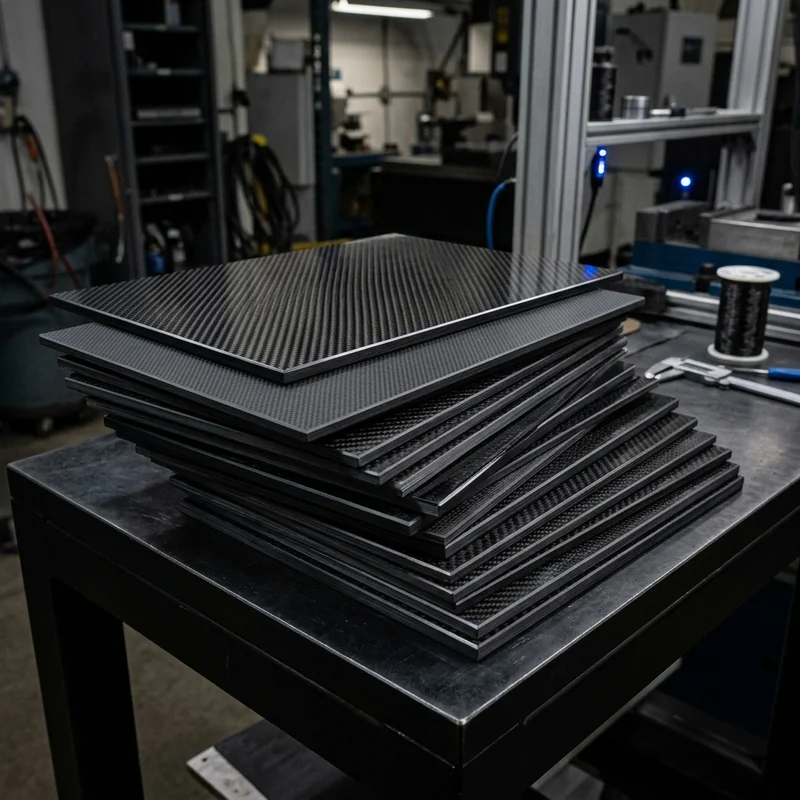
Carbon fiber standard plate-3k stripe
Lightweight, ultra-rigid standard sheets for drone fuselages, robot housings, facades and structural applications.
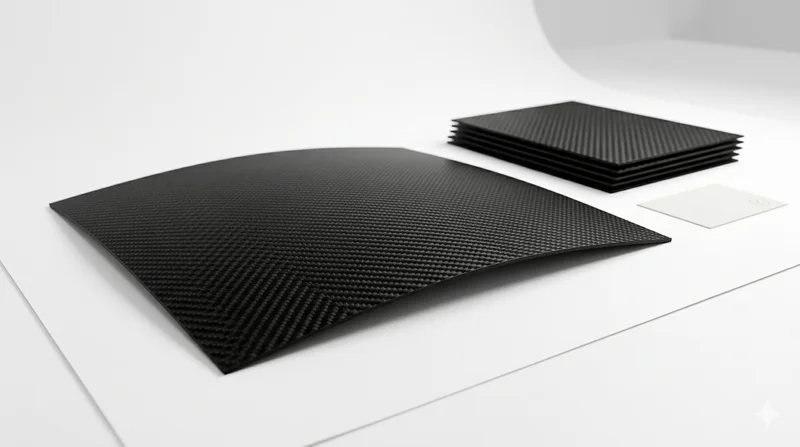
Carbon Fiber Plate — 3K Twill T700 1.5mm
Thin 1.5mm carbon fiber plate with 3K twill weave surface. Lightweight and stiff, commonly used for covers, panels, drone bodies, and applications requiring a premium aesthetic appearance.
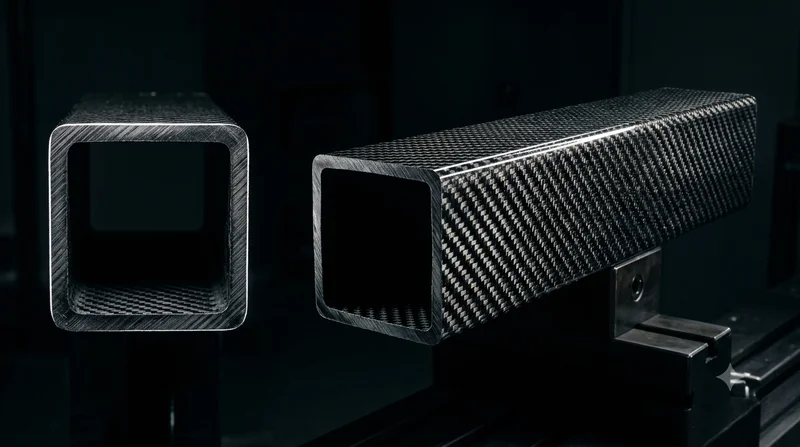
Square Carbon Fiber Tube — 3K Twill T700
Square cross-section carbon fiber tube manufactured with 3K twill weave for torsional strength. Preferred for structural frames, trusses, and support columns where rectangular geometry offers design flexibility.
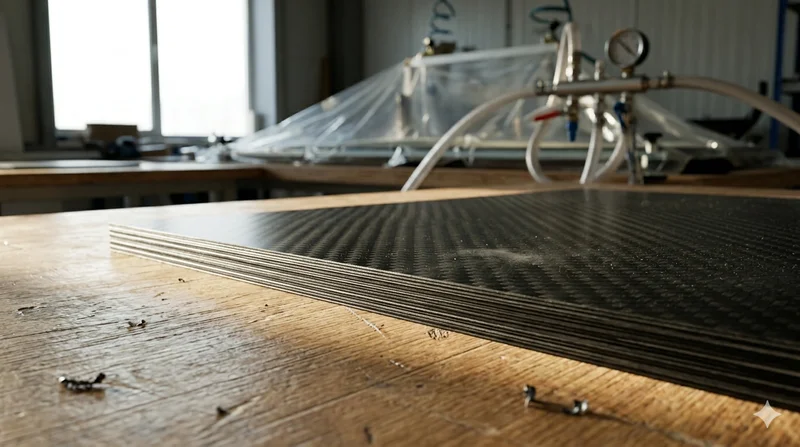
Carbon Fiber Plate — 3K Twill T700 3.0mm
Medium-thickness 3.0mm carbon fiber plate offering significantly higher load capacity while maintaining attractive 3K twill finish. Suitable for structural brackets, reinforcement plates, and load-bearing panels.
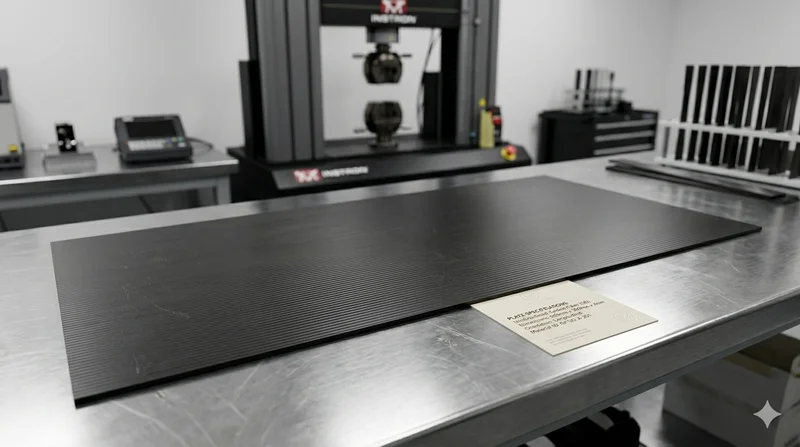
Carbon Fiber Plate — UD Unidirectional T700
Unidirectional carbon fiber plate with all fibers oriented in a single direction for maximum strength along the fiber axis. Essential for structural reinforcements, splints, and applications where load direction is predictable.