
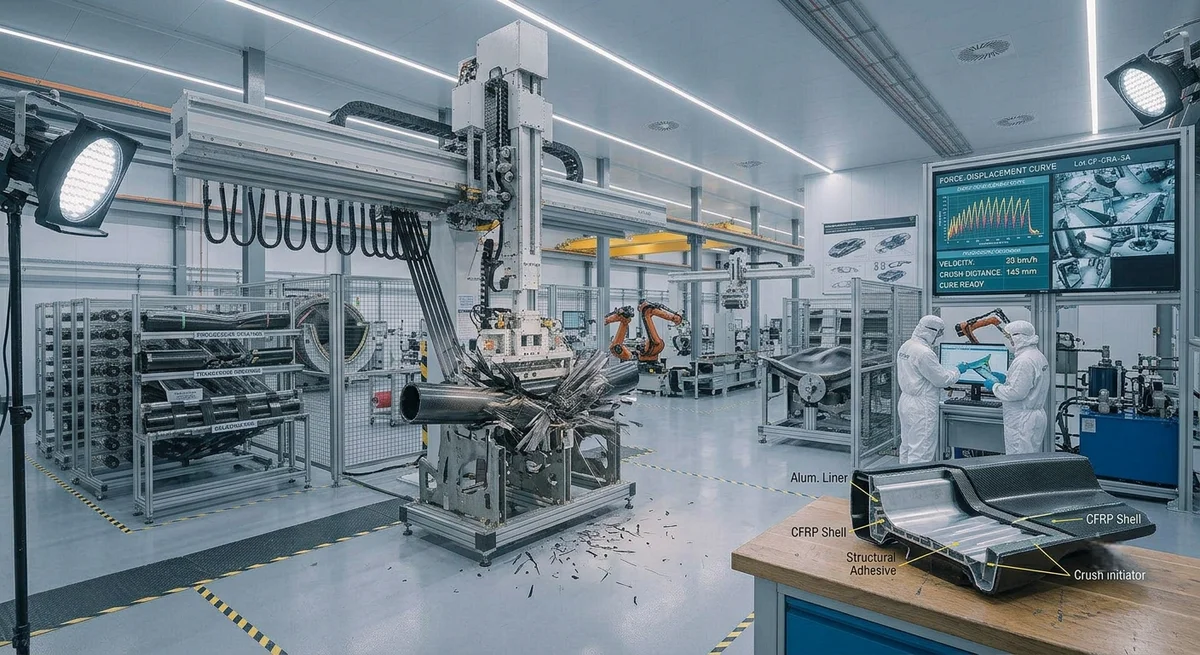
An engineering analysis of carbon fiber composite crash energy absorption design — covering progressive crush mechanisms, trigger design, fiber architecture optimization, and validation testing for automotive front-end structures.
# Carbon Fiber Crash Energy Absorption: Designing for Automotive Impact Performance
Introduction
As the automotive industry accelerates toward lightweight body structures to extend electric vehicle range and improve fuel efficiency, carbon fiber reinforced polymer (CFRP) composites are becoming increasingly prevalent in primary load-bearing structures. A critical challenge that has historically limited CFRP adoption in automotive crash structures is its fundamentally different energy absorption behavior compared to ductile metals like steel and aluminum. Where metals absorb crash energy through plastic deformation — crumpling, folding, and tearing — carbon fiber composites absorb energy through controlled brittle fracture: fiber breakage, matrix cracking, delamination, and friction between fractured fragments.
Understanding and engineering this progressive crushing behavior is essential for automotive OEMs and Tier-1 suppliers seeking to integrate carbon fiber into crash-critical structures.
Material Performance Comparison
| Parameter | CFRP Quasi-Isotropic | CFRP Braided Tube | Aluminum 6061-T6 | Mild Steel (DP590) | Unit |
|---|---|---|---|---|---|
| Specific Energy Absorption (SEA) | 55–75 | 70–95 | 18–25 | 12–18 | kJ/kg |
| Crush Force Efficiency (CFE) | 0.65–0.80 | 0.75–0.90 | 0.85–0.95 | 0.80–0.90 | — |
| Peak Crush Load (normalized) | 1.2–1.6× FC | 1.1–1.3× FC | 1.05–1.15× FC | 1.1–1.25× FC | — |
| Density | 1.55 | 1.55 | 2.70 | 7.85 | g/cm³ |
| Weight for equivalent energy (20 kJ) | 0.27–0.36 | 0.21–0.29 | 0.80–1.11 | 1.11–1.67 | kg |
| Crush zone length (20 kJ) | 120–160 | 90–130 | 350–480 | 500–750 | mm |
Progressive Crush Mechanisms in CFRP
- **Fiber fracture (40–55% of total energy):** As the crush front advances, fibers are bent to a critical radius of curvature then fracture in tension. Micro-buckling of fibers on the compression side also contributes.
- **Interlaminar delamination (20–30%):** Mode I and Mode II delamination cracks propagate ahead of the primary crush zone, absorbing significant energy.
- **Matrix cracking (10–20%):** Microcracking in the resin matrix between fibers absorbs energy through multiple crack initiation events.
- **Fragment-to-fragment friction (5–15%):** Fractured fragments pressed against the crush front dissipate energy through frictional sliding.
Crush Trigger Design
| Trigger Type | Peak Load Reduction | CFE Improvement | Application |
|---|---|---|---|
| 45° chamfer (external) | 30–40% | +0.10–0.15 | Front rails, crash boxes |
| Notch/dimple pattern | 25–35% | +0.08–0.12 | Battery enclosure beams |
| Plug initiator (metallic) | 40–55% | +0.15–0.20 | Racecar impact structures |
The 45° external chamfer is the most widely adopted trigger in production CFRP automotive parts.
Fiber Architecture Optimization for Crash
- **Dominant ±45° layers (50–70% of total thickness):** Orient fibers at ±45° to the crush axis to promote controlled splaying during crushing. This produces the highest SEA (70–95 kJ/kg for braided tubes).
- **Braided vs. unidirectional prepreg:** Braided CFRP tubes achieve SEA of 70–95 kJ/kg with CFE of 0.75–0.90, versus 55–75 kJ/kg for quasi-isotropic unidirectional laminates.
- **Thin-ply technology (20–40 gsm):** Produces finer fragmentation, increasing fracture surface area by 40–60% and SEA by 15–25%.
- **Hybrid interlayering (CF/GF or CF/Aramid):** A 10–20% glass fiber content by volume can improve CFE from 0.70 to 0.85 while preserving 85–90% of SEA.
Multi-Material Hybrid Crash Structures
- **CFRP outer shell + aluminum inner liner (tube-in-tube):** CFRP braided tube surrounding an aluminum extrusion. Used in BMW i3/i8 front crash rail.
- **CFRP trigger + steel main structure:** CFRP crash initiator module absorbs initial 15–25 kJ with a crush zone of only 80–120 mm.
- **Spot-welded CFRP patches:** Bonded and spot-welded to steel body-in-white structures for side-impact stiffening.
Frequently Asked Questions
**Q: How does carbon fiber's crash performance compare to steel and aluminum in real-world vehicle crashes?**
A: Carbon fiber composites can absorb 3–5× more energy per unit mass than steel and 2–4× more than aluminum. A CFRP front rail weighing only 0.3 kg can absorb the same energy as a 1.1–1.7 kg steel rail. However, the peak deceleration pulse can be 20–30% higher in a CFRP structure, requiring careful tuning of the restraint system. Modern hybrid CFRP-metal designs combine the best of both approaches. Production vehicles such as the BMW 7 Series (Carbon Core) and McLaren Artura have validated CFRP crash performance to global NCAP standards.
**Q: What are the manufacturing cost implications of CFRP crash structures versus stamped steel or cast aluminum?**
A: Per-part cost is 3–8× that of stamped steel at low-to-medium volumes. At high volumes (>100,000 parts/year), automated fiber placement can bring costs to 1.5–2.5× steel. System-level savings from weight reduction offset 20–40% of the CFRP cost premium through downstream savings in suspension, brakes, and battery systems. For OEMs targeting 15–20% weight reduction, CFRP crash structures add $200–$600 per vehicle but save $300–$800 in powertrain downsizing.
**Q: Can carbon fiber crash structures be repaired after a collision?**
A: No — the progressive crushing mechanism consumes the material's energy absorption capacity irreversibly. Most OEMs specify complete replacement of CFRP crash structures that show any damage. Modular CFRP crash box designs (bolt-on, single-use energy absorbers at $80–$200 each) are becoming standard practice, enabling cost-effective post-crash repair.
Conclusion
Carbon fiber composites offer extraordinary energy absorption — 3–5× greater than steel on a mass-specific basis. Success depends on mastering progressive crush mechanics through optimized fiber architecture, trigger design, and hybrid multi-material integration.
Part of topic
Related Articles
- Bio-Based Carbon Fiber Precursors: Lignin and Polyethylene for Low-Cost Production
- Large-Tow Carbon Fiber Cost Analysis: 48K vs 60K Price-Performance Comparison
- Carbon Fiber-Resin Interface Bonding: Surface Treatment and Coupling Agent Optimization
- Digital Twin for Carbon Fiber Manufacturing: Real-Time Process Monitoring and Defect Prevention
- Thermoplastic Carbon Fiber Welding for Automotive: Ultrasonic and Induction Welding Process Windows
- Large-Tow Carbon Fiber Wet Spinning: Process Optimization for 48K/60K Production Efficiency
Interested in Our Products?
Contact our team for competitive pricing and technical specifications.
Get a QuoteRelated Products

Carbon Fiber Plate — 3K Twill T700 1.5mm
Thin 1.5mm carbon fiber plate with 3K twill weave surface. Lightweight and stiff, commonly used for covers, panels, drone bodies, and applications requiring a premium aesthetic appearance.
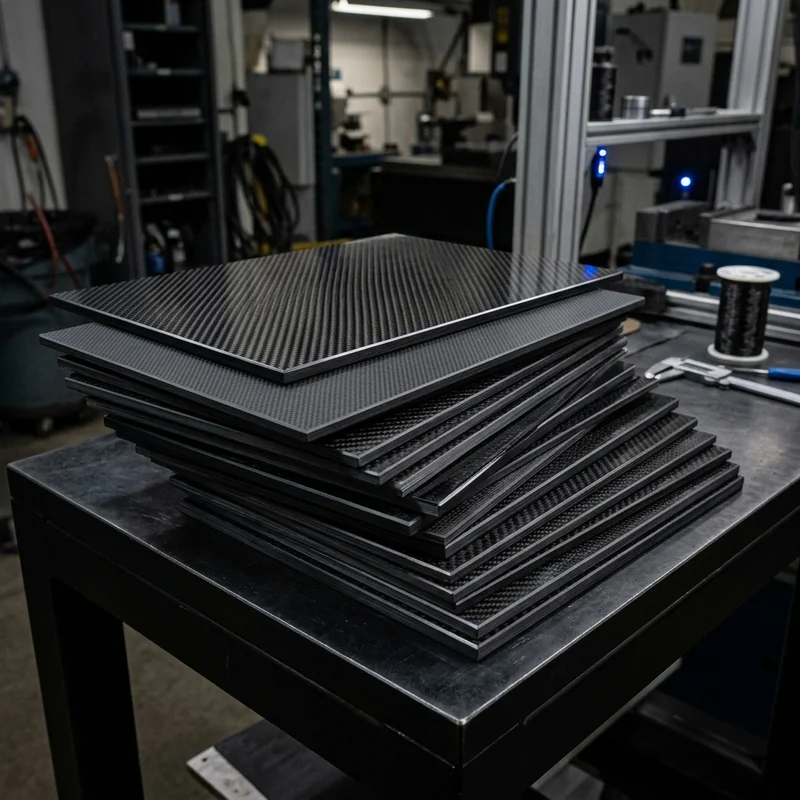
Carbon fiber standard plate-3k stripe
Lightweight, ultra-rigid standard sheets for drone fuselages, robot housings, facades and structural applications.

Square Carbon Fiber Tube — 3K Twill T700
Square cross-section carbon fiber tube manufactured with 3K twill weave for torsional strength. Preferred for structural frames, trusses, and support columns where rectangular geometry offers design flexibility.

Carbon Fiber Plate — 3K Twill T700 3.0mm
Medium-thickness 3.0mm carbon fiber plate offering significantly higher load capacity while maintaining attractive 3K twill finish. Suitable for structural brackets, reinforcement plates, and load-bearing panels.
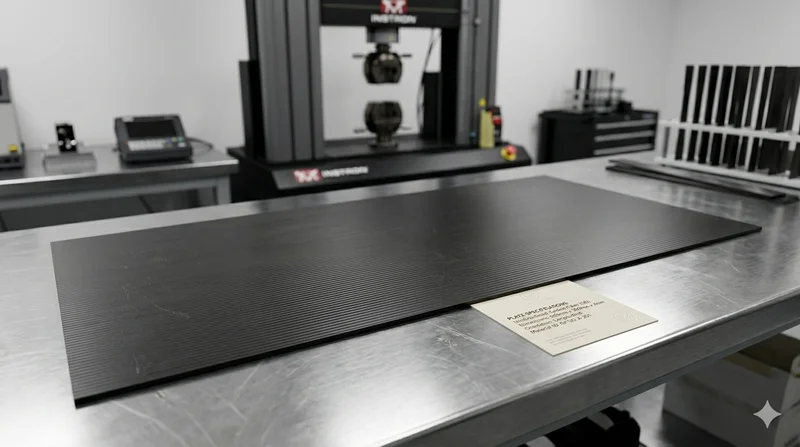
Carbon Fiber Plate — UD Unidirectional T700
Unidirectional carbon fiber plate with all fibers oriented in a single direction for maximum strength along the fiber axis. Essential for structural reinforcements, splints, and applications where load direction is predictable.