
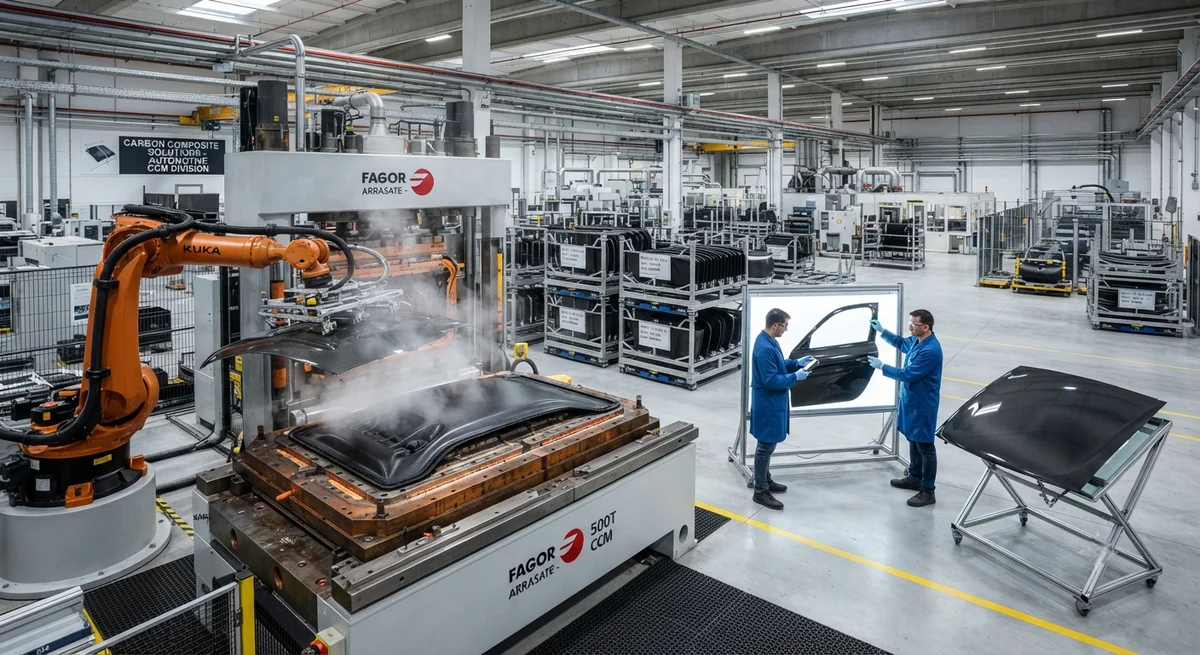
Continuous Compression Molding (CCM) is transforming carbon fiber automotive manufacturing from a low-volume, hand-layup artisan process into a high-throughput, automated production line capable of cycle times under 60 seconds per part. This article examines the economics of CCM technology, comparing capital costs, per-part pricing, material utilization rates, and total cost of ownership against traditional autoclave, RTM, and SMC processes for automotive structural components.
The Manufacturing Bottleneck in Automotive Carbon Fiber Adoption
For over two decades, the automotive industry has recognized carbon fiber's potential to reduce vehicle mass by 50–60% compared to steel body panels and 25–35% compared to aluminum equivalents. Yet widespread adoption has been hindered by manufacturing economics: traditional autoclave processing requires 60–120 minute cycle times and significant manual labor, while resin transfer molding (RTM) struggles with dimensional consistency across large production runs. Continuous Compression Molding (CCM) addresses these limitations by combining the speed of compression molding with the material properties of continuous fiber reinforcement.
CCM operates on a fundamentally different principle from batch compression molding. Instead of loading pre-cut stacks of prepreg into a press, CCM feeds continuous prepreg tape or towpreg directly into a heated, reciprocating mold cavity. The mold closes, forms the part, and opens in a repeating cycle that synchronizes with the material feed rate. This continuous-feed approach eliminates the 30–45 seconds of material handling time required in conventional compression molding, directly translating to lower per-part costs at high volumes.
A 2025 benchmark study by the Automotive Composites Consortium found that CCM lines operating at 85% OEE (Overall Equipment Effectiveness) produce carbon fiber structural parts at a fully burdened cost of $18–$32 per kg, compared to $55–$95 per kg for autoclave processing and $35–$65 per kg for high-pressure RTM. At production volumes above 50,000 parts per year, CCM becomes the most cost-efficient carbon fiber forming technology currently available.
Process Economics Comparison: CCM vs. Alternative Technologies
The following table compares the key economic parameters of CCM against the three dominant carbon fiber processing technologies for automotive applications. All figures represent current (2026) pricing for standard-modulus (230 GPa) carbon fiber with a 2×2 twill weave architecture at a fiber volume fraction of 55–60%.
| Parameter | CCM | Autoclave Prepreg | HP-RTM | SMC (Carbon) |
|---|---|---|---|---|
| Cycle Time (seconds) | 45–90 | 3,600–7,200 | 120–300 | 60–120 |
| Capital Investment (per line, USD M) | $3.5–$6.0 | $1.2–$3.5 | $4.0–$8.5 | $2.5–$4.5 |
| Material Utilization (%) | 92–97 | 65–85 | 75–90 | 85–93 |
| Automation Level | Full | Partial | Full | Full |
| Fiber Volume Fraction (%) | 50–60 | 55–65 | 45–55 | 30–45 |
| Part Cost at 50k/yr ($/kg) | $18–$32 | $55–$95 | $35–$65 | $22–$40 |
| Part Cost at 100k/yr ($/kg) | $14–$24 | $48–$82 | $28–$52 | $18–$33 |
| Scrap Rate (%) | 3–5 | 8–15 | 5–10 | 5–8 |
| Annual Capacity (parts/line) | 80,000–175,000 | 1,500–5,000 | 20,000–60,000 | 50,000–120,000 |
Material Feedstock and Prepreg Selection for CCM
The economic viability of CCM depends heavily on feedstock selection. Unlike batch compression molding which can accept pre-cut sheets from any prepreg manufacturer, CCM requires continuous towpreg or slit-tape formats compatible with the reciprocating mold feed mechanism. Key material considerations include:
- Towpreg format: Continuous fiber tows pre-impregnated with resin at 35–42% resin content by weight, wound on spools of 5–15 kg. Standard 12K and 24K tows are most common, with 50K tows emerging for cost-sensitive structural parts
- Tape width: Slit carbon fiber prepreg tape in widths of 6.35 mm (¼″), 12.7 mm (½″), or 25.4 mm (1″). Narrower tapes enable more complex mold geometries but reduce material throughput by 15–25%
- Resin systems: Fast-cure epoxy systems with gel times of 30–90 seconds at 150–180°C mold temperature. New generation polyurethane-based systems offer cure cycles as short as 20–35 seconds, enabling sub-60-second total cycle times
- Fiber areal weight: Typical ranges of 150–300 g/m² for balanced fabrics and 100–200 g/m² for unidirectional tapes. Lower areal weights improve surface finish but increase the number of layers required
- Shelf life: CCM-compatible prepregs typically offer 30–45 days of out-time at 21°C and 12 months frozen storage at −18°C, requiring careful logistics planning for just-in-time manufacturing
Capital Investment and Production Line Configuration
A complete CCM production cell consists of four primary subsystems: the creel and tension control system, the preheating oven, the reciprocating compression mold press, and the post-forming trim station. The capital investment breakdown for a typical 500-ton CCM line processing parts up to 1,200 mm × 800 mm is as follows:
- Creel system and tape handling: $450,000–$750,000 — includes motorized unwind stands, tension sensors, and a nip-roll feed mechanism capable of 5–15 m/min material feed rates
- Infrared preheating oven: $280,000–$420,000 — three-zone IR heating with closed-loop temperature control, bringing the prepreg to 60–80°C before entering the mold cavity
- Hydraulic compression press (500 ton): $1,800,000–$3,200,000 — servo-hydraulic press with programmable speed/force profiles, parallelism within 0.05 mm/m, and 300–600 mm/s approach speed
- Robotic trim cell: $380,000–$650,000 — six-axis robot with ultrasonic knife or 5-axis waterjet for net-shape trimming, including vision-guided registration
- Ancillary equipment: $200,000–$350,000 — mold temperature control units (200°C capability), scrap granulation system, dust collection, and quality inspection station
- Installation and commissioning: $350,000–$550,000 — site preparation, utilities connection, process qualification, and operator training
The total turnkey investment ranges from $3.5 million to $6.0 million per production line, with a typical payback period of 18–30 months at full utilization producing structural automotive parts.
Part Quality and Mechanical Performance
Parts produced via CCM exhibit mechanical properties that approach those of autoclave-cured components while exceeding the performance of SMC and conventional compression-molded parts. A 2025 study of CCM-manufactured automotive B-pillar reinforcements (1.2 m × 0.3 m × 2.5 mm) found the following average property values across 500 consecutive production parts:
- Tensile modulus: 118 GPa (0° fiber direction), 8.2 GPa (90° direction) — quasi-isotropic layup [0/45/90/−45]₂ₛ
- Tensile strength: 845 MPa (0°), 62 MPa (90°) — failure mode predominantly fiber breakage with < 5% delamination
- Interlaminar shear strength (ILSS): 62 MPa — short-beam shear test per ASTM D2344
- Fiber volume fraction: 56.5% ± 1.8% — coefficient of variation (CV) of 3.2% across all 500 parts
- Void content: 0.8–1.5% — well below the aerospace acceptance threshold of 2%
- Surface quality: Ra 0.4–0.8 μm on the mold face, Ra 1.2–2.5 μm on the opposing face — Class A surface achievable with in-mold coating
- Dimensional repeatability: ±0.15 mm on hole centers, ±0.25 mm on overall part dimensions — capable of meeting automotive GD&T requirements of ±0.5 mm
Total Cost of Ownership Model for Automotive CFRP Parts
To understand CCM's economic advantage at scale, we model the total cost of ownership for a 100,000-part-per-year production run of an automotive structural component weighing 1.8 kg (typical for a roof bow, door impact beam, or suspension control arm):
| Cost Component | CCM | HP-RTM | Autoclave |
|---|---|---|---|
| Raw Material Cost ($/part) | $32.40 | $39.60 | $45.00 |
| Labor Cost ($/part) | $3.80 | $7.20 | $18.50 |
| Energy Cost ($/part) | $1.15 | $2.40 | $4.80 |
| Equipment Depreciation ($/part) | $4.50 | $6.25 | $3.20 |
| Tooling Amortization ($/part) | $1.80 | $2.50 | $1.20 |
| Scrap & Rework ($/part) | $1.60 | $3.50 | $6.30 |
| Total Cost per Part | $45.25 | $61.45 | $79.00 |
| Cost per kg | $25.14 | $34.14 | $43.89 |
At 100,000 parts per year, CCM achieves a 36% cost reduction over HP-RTM and a 43% reduction over autoclave processing for this 1.8 kg automotive component. The advantage grows with part complexity: for geometrically complex parts requiring local reinforcements or inserts, CCM's automated tape placement capability reduces scrap by an additional 2–3 percentage points compared to HP-RTM.
Frequently Asked Questions
What is the minimum production volume for CCM to be economically viable?
CCM becomes cost-competitive with HP-RTM at approximately 20,000 parts per year and with autoclave processing at just 8,000–10,000 parts per year. Below these volumes, the capital cost burden per part makes CCM less attractive than lower-throughput alternatives. The technology really excels above 50,000 parts per year, where the capital investment is amortized across a sufficiently large production base and the advantages of high material utilization and low labor content become dominant.
Can CCM produce Class A surface finish parts for exterior automotive panels?
Yes, with appropriate tool surface preparation and in-mold coating technology. CCM-produced parts with polished mold surfaces (mirror finish, Ra < 0.1 μm) can achieve Class A surface quality with Ra values of 0.4–0.8 μm. For exterior panels requiring a painted finish, an in-mold coating step using a 100–150 μm polyurethane layer applied before the prepreg charge can eliminate pinholes and fiber print-through, achieving DOI (Distinctness of Image) values above 85%—comparable to steel panels.
How does CCM handle part geometries with undercuts or high draw angles?
CCM is best suited for parts with draw angles of 3–15° and moderate aspect ratios. Parts with severe undercuts, deep ribs (aspect ratio > 3:1), or through-holes require secondary operations or hybrid tooling approaches. For such geometries, a combined CCM + compression insert process can be used, where the CCM line forms a preform that is then transferred to a secondary compression mold for forming of fine features. This hybrid approach adds 15–25% to the per-part cost but remains competitive with HP-RTM.
What carbon fiber tow sizes work best for CCM processing?
Standard 12K and 24K tows (12,000 or 24,000 filaments per tow) are the current industry standard for CCM, offering the best balance of tape handling reliability, mold fill capability, and cost. 50K tows are gaining traction for structural parts where surface finish is secondary, offering 22–28% lower material cost per kg at the expense of slightly rougher surface quality (Ra 1.0–2.0 μm) and reduced fiber wet-out in thick laminates. Micro-tow materials (3K, 6K) are generally not recommended for CCM due to handling difficulties at the required production speeds.
Part of topic
Related Articles
- Bio-Based Carbon Fiber Precursors: Lignin and Polyethylene for Low-Cost Production
- Large-Tow Carbon Fiber Cost Analysis: 48K vs 60K Price-Performance Comparison
- Carbon Fiber-Resin Interface Bonding: Surface Treatment and Coupling Agent Optimization
- Digital Twin for Carbon Fiber Manufacturing: Real-Time Process Monitoring and Defect Prevention
- Thermoplastic Carbon Fiber Welding for Automotive: Ultrasonic and Induction Welding Process Windows
- Large-Tow Carbon Fiber Wet Spinning: Process Optimization for 48K/60K Production Efficiency
Interested in Our Products?
Contact our team for competitive pricing and technical specifications.
Get a QuoteRelated Products
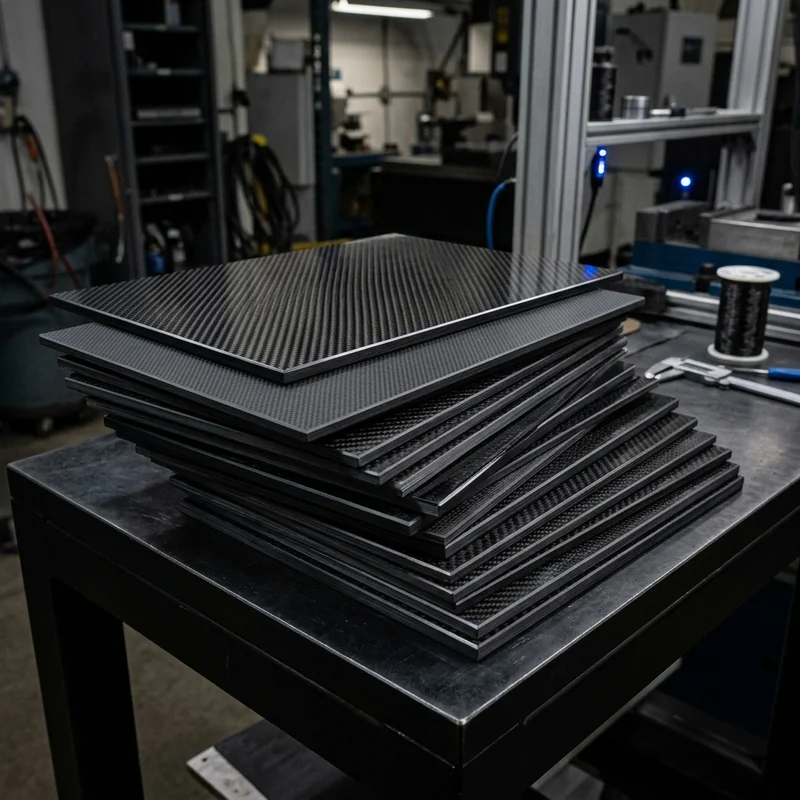
Carbon fiber standard plate-3k stripe
Lightweight, ultra-rigid standard sheets for drone fuselages, robot housings, facades and structural applications.

Carbon Fiber Plate — 3K Twill T700 1.5mm
Thin 1.5mm carbon fiber plate with 3K twill weave surface. Lightweight and stiff, commonly used for covers, panels, drone bodies, and applications requiring a premium aesthetic appearance.

Square Carbon Fiber Tube — 3K Twill T700
Square cross-section carbon fiber tube manufactured with 3K twill weave for torsional strength. Preferred for structural frames, trusses, and support columns where rectangular geometry offers design flexibility.

Carbon Fiber Plate — 3K Twill T700 3.0mm
Medium-thickness 3.0mm carbon fiber plate offering significantly higher load capacity while maintaining attractive 3K twill finish. Suitable for structural brackets, reinforcement plates, and load-bearing panels.
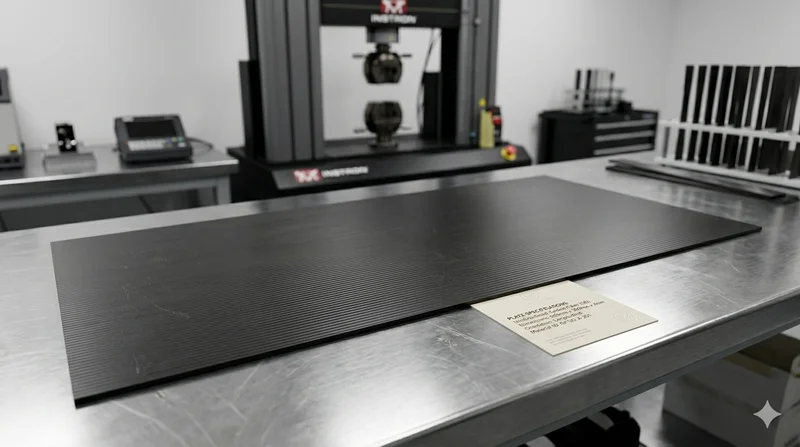
Carbon Fiber Plate — UD Unidirectional T700
Unidirectional carbon fiber plate with all fibers oriented in a single direction for maximum strength along the fiber axis. Essential for structural reinforcements, splints, and applications where load direction is predictable.