
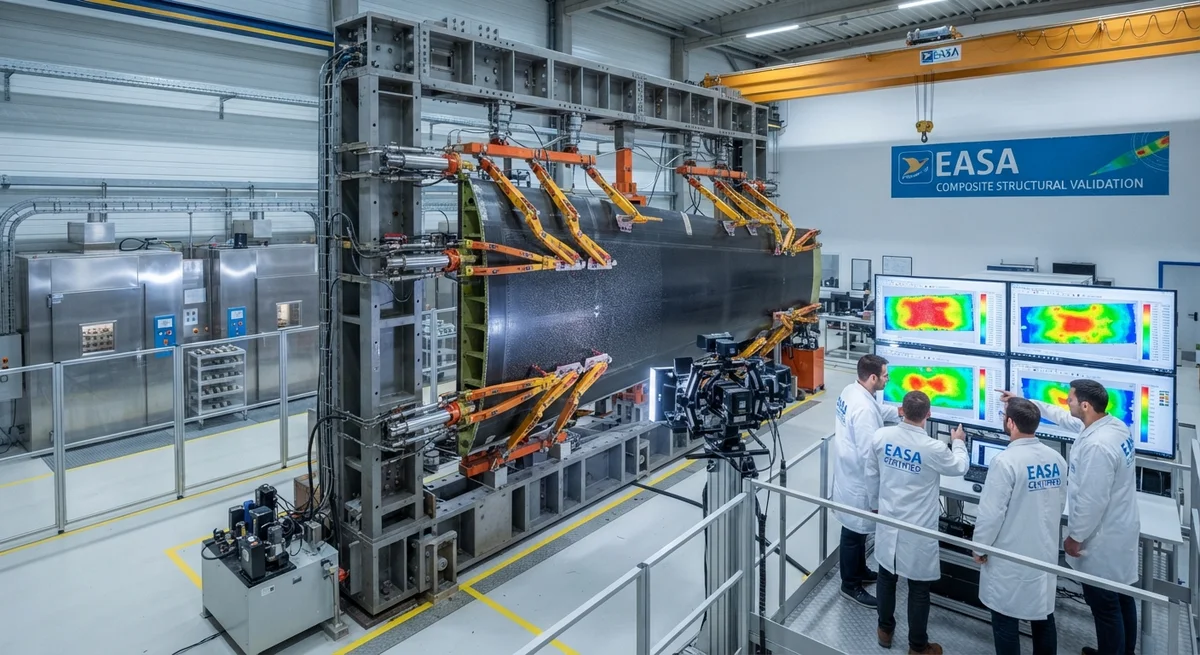
A comprehensive technical analysis of evolving EASA and FAA composite airworthiness certification requirements in 2026 (CS-25, Part 25, AC 20-107B), covering testing protocols, compliance pathways, and certification differences for B2B aerospace suppliers.
EASA and FAA Composite Certification in 2026: Bjorn's Corner on Evolving Aerospace Standards
The certification of composite primary structures has evolved significantly since the first CFRP primary structure (Airbus A310 fin box, 1985). In 2026, both EASA and FAA operate under updated frameworks reflecting three decades of composite service experience — including lessons from the A350 XWB wing, Boeing 787 fuselage, and composite fan blades with 300 million flight hours. This article compares current EASA CS-25 and FAA Part 25 certification requirements for composite structures, focusing on practical compliance pathways for B2B aerospace suppliers.
Regulatory Framework Overview
| Certification Aspect | EASA (CS-25) | FAA (Part 25 / AC 20-107B) |
|---|---|---|
| Primary guidance | CS-25 + AMC 20-29 (2024 rev.) | 14 CFR Part 25 + AC 20-107B (2021 + 2025 clarifications) |
| Composite advisory | AMC 20-29 (detailed, prescriptive) | AC 20-107B (performance-based) |
| Material qualification | EASA Part 21.A.14 (DOA holder) | FAA PS-ANM-25.603 (§25.603) |
| Properties database | CMH-17 | CMH-17 |
| Structural substantiation | Building block per AMC 20-29 §5.2 | Building block per AC 20-107B §6.0 |
| Environmental conditions | Hot-wet and cold-dry per CS-25 §25.613 | Same conditions; FAA accepts CS-25 conditions by agreement |
| Damage tolerance | CS-25 §25.571 + AMC 20-29 §6.3 | AC 20-107B §7.0 |
| Flammability | CS-25 Appendix F + CM.ES.0019 | Part 25 Appendix F |
| Lightning protection | CS-25 §25.581 + ED-105 | AC 20-107B §10.0 + SAE ARP |
| Bilateral acceptance | EASA–FAA BASA (since 2008) | Same — mutual acceptance of certification data |
The core difference is regulatory philosophy: EASA's AMC 20-29 provides prescriptive guidance, while FAA's AC 20-107B allows alternative compliance means with engineering justification. Major programs pursue dual certification, converging toward the most conservative interpretation.
2026 Certification Updates
- EASA AMC 20-29 Rev. 3 (December 2025): Requires bonded repair designs for primary structures to demonstrate §25.571 damage tolerance through test evidence, not analysis alone — closing a loophole where bonded repairs were certified by static strength without damage tolerance verification.
- FAA AC 20-107B Clarification (March 2026): "No growth" damage tolerance designation requires data representing at least two lifetime cycles, while "slow growth" requires four lifetimes. "No growth" qualification typically needs 40–60% fewer test coupons, reducing fatigue testing cost from $400,000–$600,000 to $200,000–$350,000 — but may add 3–8% structural weight through thicker laminates.
- EASA CRI on recycled carbon fiber (February 2026): Establishes a provisional pathway for secondary structures using recycled carbon fiber, requiring batch-to-batch variability not exceeding ±15% for tensile strength and ±10% for modulus. This is the first major regulatory signal enabling recycled carbon fiber in aerospace.
Material Qualification Process
| Test Level | Required Tests | Typical Quantity | Cost Range (USD) |
|---|---|---|---|
| Lamina | 0°/90° tension & compression, ±45° shear (ASTM D3518) | 300–500 | $150,000–300,000 |
| Laminate | Open-hole, filled-hole, bearing/bypass, CAI | 500–800 | $300,000–600,000 |
| Sub-element | Stringer pull-off, skin-splice, bonded/fastened joints | 200–400 | $500,000–1,200,000 |
| Full-scale | Wing box ultimate load, fuselage pressure cycle, bird strike | 1–3 | $2,000,000–8,000,000 |
| Environmental | Hot-wet (82°C/85% RH), cold-dry (−55°C), thermal cycling | 30–40% of coupons | $200,000–500,000 |
| Fatigue & damage tolerance | Constant amplitude, spectrum, compression-after-fatigue | 400–600 | $400,000–800,000 |
| Lightning strike | Zones 1A/1B/2A per SAE ARP 5416 | 30–80 | $300,000–700,000 |
Full Type-III material system qualification (per CMH-17) costs $5–15 million over 18–36 months — explaining why fewer than 15 new carbon fiber systems have achieved aerospace primary structure qualification in the past decade.
EASA vs FAA: Key Compliance Differences
- Material specification control: EASA requires explicit MSP approval within the DOA; FAA allows process specification control through the manufacturer's quality system per §25.603. EASA is more prescriptive about raw material source qualification.
- Bonded joint acceptance: EASA AMC 20-29 §5.4.2 requires bonded primary joints to fail by fiber-tear under hot-wet conditions; FAA AC 20-107B §8.2 allows analytical demonstration with a smaller test database.
- Lightning burn thresholds: EASA allows 1.5 mm burn-through (Zone 1A); FAA allows 2.0 mm. The 0.5 mm difference requires additional copper mesh for EASA-certified aircraft.
- Flammability: EASA requires 12-second self-extinguish time vs FAA's 15-second criterion for 60-second vertical burn tests. Dual-certified aircraft meet the more stringent standard.
Compliance Pathway for B2B Suppliers
- Phase 1 — Material screening (months 1–6): Generate lamina-level A- and B-basis allowables per CMH-17. Target B-basis ≥85% of incumbent system. Cost: $150,000–300,000.
- Phase 2 — Design values (months 6–18): Laminate-level allowables across hot-wet, cold-dry, and RTA conditions. Cost: $500,000–1,000,000.
- Phase 3 — Sub-element testing (months 12–30): Representative structural details. Using the "statistical similarity" argument per AMC 20-29 §6.1 can reduce scope by 30–40%. Cost: $1,000,000–3,000,000.
- Phase 4 — Certification submission (months 24–36): Compilation of material specification, process specification, allowable database, analysis validation, and test evidence. Cost: $300,000–600,000.
Can EASA-qualified materials be automatically accepted by FAA?
Under the EASA–FAA BASA, yes — with caveats. For primary structures, compliance data must use test standards acceptable to both authorities. FAA accepts EASA-qualified materials with a bridging letter documenting test method equivalency. For secondary and non-structural applications, cross-acceptance is automatic. Primary structures may require 10–15% additional testing (typically hot-wet compression and CAI at specific conditions) for the second authority.
What is the cost and timeline for new carbon fiber primary structure qualification?
Full aerospace primary structure qualification costs $5–15 million over 18–36 months. Major cost elements: material allowables ($1–3 million), sub-component testing ($2–5 million), full-scale testing ($1–8 million), and environmental qualification ($200,000–$1 million). The timeline is driven by the building-block sequence and moisture conditioning (45–90 days to reach equilibrium at 85% RH). Recent EASA-FAA harmonization has reduced dual certification cost differential from ~40% to under 15%.
How does the 2026 "no growth" vs "slow growth" clarification affect costs?
The March 2026 FAA clarification significantly impacts certification cost. "No growth" requires 40–60% fewer fatigue coupons than "slow growth" (two lifetimes vs four), reducing fatigue testing from $400,000–$600,000 to $200,000–$350,000. However, "no growth" demands more conservative design — thicker laminates adding 3–8% weight. The trade-off must be evaluated program by program.
Conclusion
EASA and FAA composite certification in 2026 presents a mature regulatory landscape with important recent developments. The building-block approach remains foundational, but 2026 clarifications on damage tolerance designation, bonded repair certification, and recycled carbon fiber acceptance are reshaping compliance strategies. For B2B aerospace suppliers, key takeaways are: (1) the $5–15 million material qualification barrier remains the largest competitive moat in aerospace composites, (2) dual EASA-FAA certification now adds under 15% to qualification cost due to BASA harmonization, and (3) the 2026 regulatory opening for recycled carbon fiber in secondary structures creates a new market opportunity for suppliers with robust batch control processes.
Part of topic
Related Articles
- Bio-Based Carbon Fiber Precursors: Lignin and Polyethylene for Low-Cost Production
- Large-Tow Carbon Fiber Cost Analysis: 48K vs 60K Price-Performance Comparison
- Carbon Fiber-Resin Interface Bonding: Surface Treatment and Coupling Agent Optimization
- Digital Twin for Carbon Fiber Manufacturing: Real-Time Process Monitoring and Defect Prevention
- Thermoplastic Carbon Fiber Welding for Automotive: Ultrasonic and Induction Welding Process Windows
- Large-Tow Carbon Fiber Wet Spinning: Process Optimization for 48K/60K Production Efficiency
Interested in Our Products?
Contact our team for competitive pricing and technical specifications.
Get a QuoteRelated Products
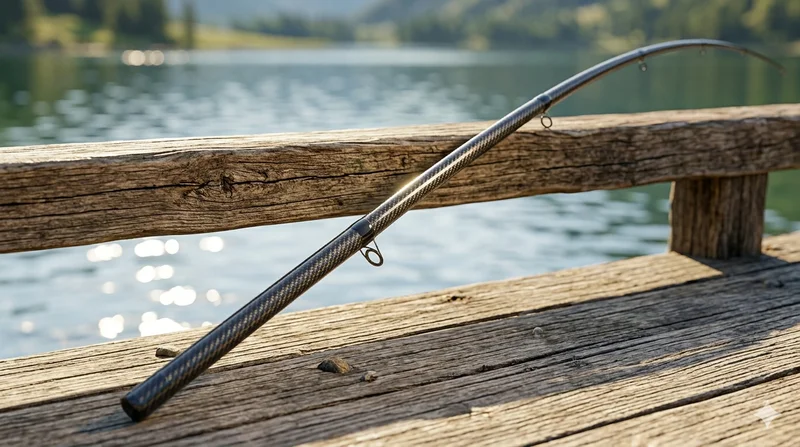
Carbon Fiber Fishing Rod Blank
High-quality carbon fiber fishing rod blank manufactured from multiple grades of Toray carbon fiber cloth. Available in a wide range of lengths, powers, and actions for freshwater and saltwater applications. Suitable for OEM rod building.
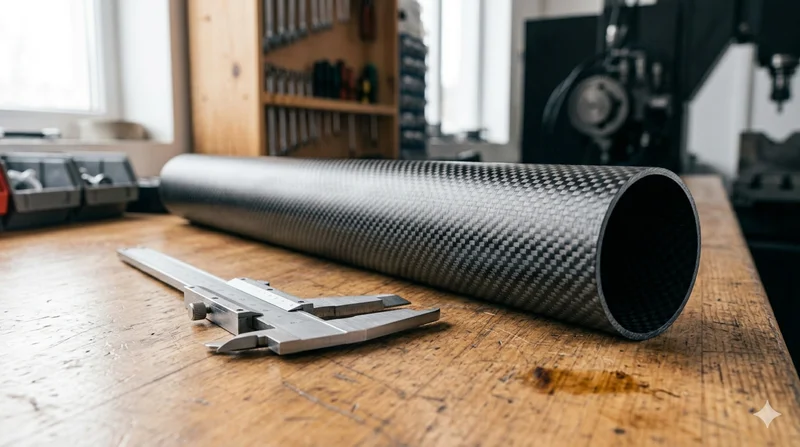
Round Carbon Fiber Tube — 3K Plain Weave T700
Standard round carbon fiber tube manufactured from Toray T700 grade fiber with 3K plain weave. Offers balanced strength and stiffness for general industrial applications including robotics, automation, sports equipment, and aerospace structures.

Custom Carbon Fiber Musical Instrument Parts
Carbon fiber components for musical instrument manufacturing offering superior dimensional stability, low weight, and consistent acoustic properties. We produce carbon fiber bows, guitar necks, violin chin rests, drum shells, and wind instrument bodies. Carbon fiber instruments are immune to humidity changes and temperature fluctuations that affect wooden instruments.
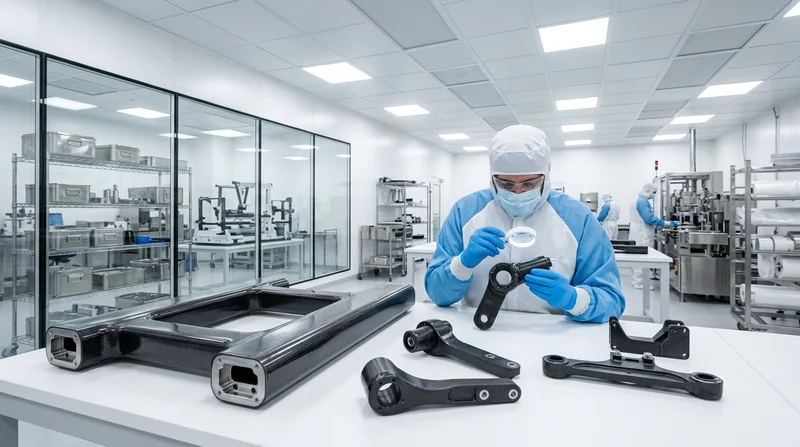
Custom Carbon Fiber Medical Device Components
Medical-grade carbon fiber components manufactured for imaging equipment, surgical instruments, and patient support systems. Carbon fiber's radiolucency (X-ray transparency) and high strength-to-weight ratio make it ideal for CT scanner beds, wheelchair frames, surgical robot arms, and MRI-compatible accessories. Biocompatible resin systems available.
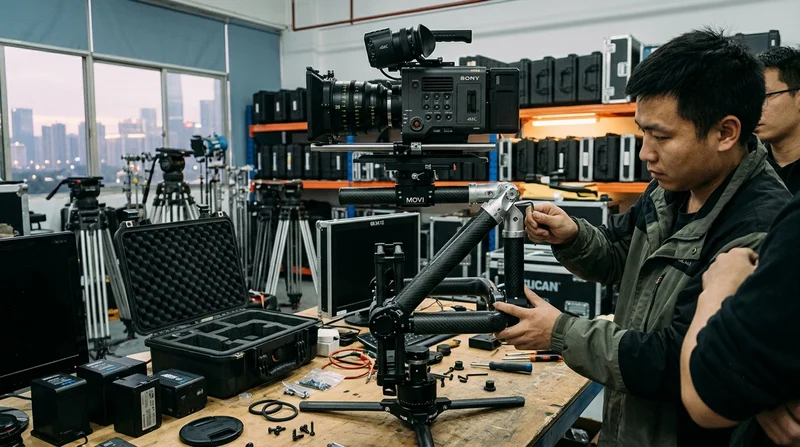
Custom Carbon Fiber Gimbal & Camera Mount
Lightweight carbon fiber gimbal arms and camera mounting components for aerial photography, film production, and broadcast applications. Our precision CNC machining ensures tight tolerances for vibration-sensitive equipment. Available in custom shapes to fit specific gimbal systems.