
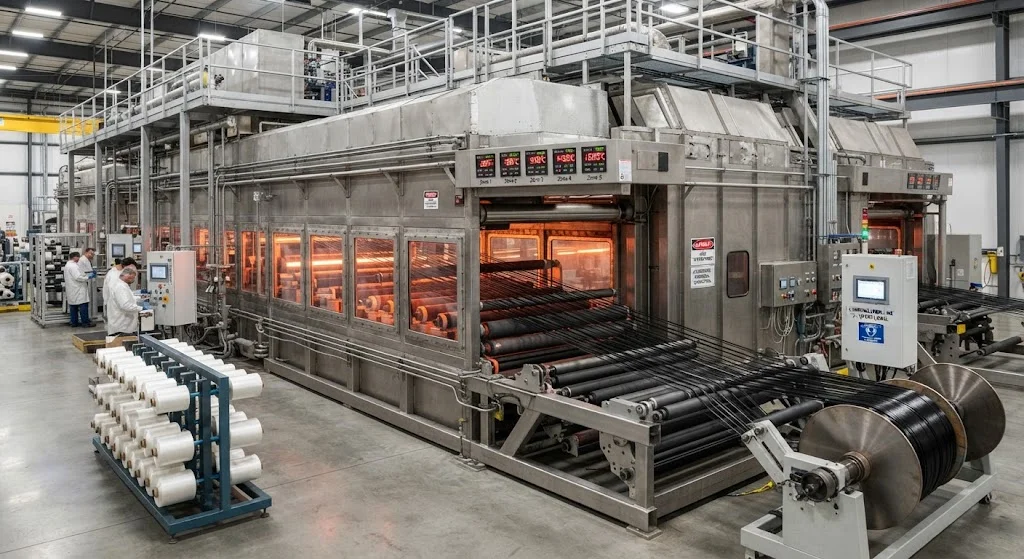
Precise temperature control during carbon fiber carbonization determines the final mechanical properties of the fiber. This article covers furnace design, temperature profiling from stabilization through high-temperature carbonization, and process optimization strategies for consistent fiber quality.
Introduction
The carbonization furnace is the heart of carbon fiber production, where stabilized polyacrylonitrile (PAN) precursor undergoes thermal decomposition in an inert atmosphere to form the final carbon fiber structure. Temperature control within the furnace directly determines the fiber's tensile strength, modulus, and strain-to-failure — the mechanical properties that define commercial value.
Modern carbonization furnaces operate at temperatures up to 1,600°C for standard-modulus fibers and above 2,000°C for high-modulus variants. At each stage, the temperature-time profile must be precisely controlled to manage the complex chemistry of cyclization, dehydrogenation, and carbon structural reorganization that transforms a polymer precursor into a high-performance carbon fiber.
Furnace Design and Zones
Industrial carbonization furnaces are continuous roller hearth or marching hearth designs, with multiple temperature zones that create the precise thermal profile required for optimal fiber conversion:
Pre-heat zone (200–400°C): Gradual heating of stabilized PAN tow to initiate controlled thermal decomposition. Rapid heating causes excessive exothermic reactions and fiber defects. The pre-heat zone typically uses convective heating with preheated nitrogen, ramping at 3–8°C/minute.
Low-temperature carbonization (400–800°C): The primary decomposition zone where non-carbon elements — nitrogen, hydrogen, oxygen — are progressively removed as gaseous byproducts. This zone requires careful atmosphere control to manage volatile emissions and prevent fiber fusion. Temperature ramp rates of 5–15°C/minute are typical.
High-temperature carbonization (800–1,600°C): The graphitization zone where the carbon structure reorganizes into turbostratic graphite crystallites aligned along the fiber axis. Higher temperatures produce larger crystallites and higher modulus. This zone uses graphite or molybdenum heating elements in a nitrogen or argon atmosphere.
Slow cool zone: Controlled cooling to prevent thermal shock that can cause surface cracks and reduce fiber strength. Cooling rates of 10–30°C/minute are maintained until the fiber exits the furnace below 300°C.
Temperature Profiling
The temperature profile through the furnace must be tailored to the specific precursor and target fiber properties:
Ramp rate control: Too-rapid heating causes uncontrolled exothermic decomposition, producing voids, surface defects, and inconsistent fiber diameter. Too-slow heating reduces throughput without significant quality improvement. Optimal ramp rates depend on tow width, filament count, and stabilization level.
Dwell time: Holding at specific temperatures allows complete reaction before proceeding to the next stage. Insufficient dwell time results in incomplete decomposition and poor mechanical properties. Excessive dwell time reduces throughput and can cause fiber degradation.
Peak temperature: The maximum carbonization temperature is the primary determinant of fiber modulus. Standard modulus fibers (230–240 GPa) are carbonized at 1,000–1,200°C. Intermediate modulus (270–300 GPa) requires 1,400–1,600°C. High modulus (350–600 GPa) demands graphitization above 2,000°C.
Atmosphere Control
Carbonization occurs in an inert atmosphere — typically nitrogen, with argon used for the highest temperatures. Atmosphere purity and flow management are critical:
Oxygen exclusion: Even trace oxygen (above 10 ppm) causes fiber oxidation, producing surface pits and reducing strength. Furnace design includes multiple nitrogen purge stages, labyrinth seals at entry and exit points, and continuous oxygen monitoring.
Flow management: Nitrogen flow must remove gaseous decomposition products — HCN, NH₃, CO, CO₂ — while maintaining uniform temperature distribution. Excessive flow creates temperature gradients; insufficient flow allows volatile accumulation that can cause fiber defects.
Pressure control: Slightly positive pressure (50–200 Pa above ambient) prevents air infiltration while avoiding excessive gas consumption. Pressure monitoring at multiple furnace locations ensures uniform atmosphere conditions.
Process Monitoring
Modern carbonization furnaces integrate multiple monitoring systems for real-time process control:
Temperature monitoring: Thermocouple arrays at multiple positions and heights within each zone provide 3D temperature mapping. Infrared pyrometers at the fiber surface offer non-contact verification of actual fiber temperature, which can differ from the gas temperature by 20–50°C.
Atmosphere monitoring: Continuous oxygen analyzers (paramagnetic or zirconia-based) verify atmosphere purity. Mass spectrometers or FTIR analyzers can monitor exhaust gas composition, providing real-time data on decomposition progress and helping detect process anomalies.
Fiber tension: In-line tension monitoring detects changes in fiber mechanical behavior during carbonization. Sudden tension drops may indicate fiber breakage; gradual changes may signal temperature or atmosphere problems.
Visual inspection: High-resolution cameras with appropriate optical filters monitor fiber color, surface condition, and tow spreading. Color changes indicate temperature uniformity issues; surface features detect defects in real time.
Quality Correlation
Furnace control parameters directly correlate with measured fiber properties, enabling predictive quality management:
Tensile strength vs. peak temperature: Strength typically peaks at an optimal carbonization temperature, then decreases at higher temperatures due to surface flaw growth and crystallite boundary weakening. The optimal temperature depends on precursor quality and stabilization conditions.
Modulus vs. carbonization temperature: Modulus increases monotonically with temperature as graphite crystallite size and alignment improve. This relationship is used to produce different modulus grades from the same precursor by adjusting furnace temperature.
Strain-to-failure: Higher carbonization temperatures reduce strain-to-failure as the fiber becomes more crystalline and brittle. Balancing modulus and strain requires precise temperature control within ±10°C at the peak zone.
Optimization Strategies
Continuous improvement of carbonization furnace performance focuses on several areas:
Energy efficiency: Regenerative heat recovery from exhaust gases, optimized insulation, and zone-level energy management reduce consumption. Modern furnaces achieve 40–60% improvement in energy efficiency compared to older designs.
Throughput optimization: Line speed and temperature profile are balanced against quality requirements. Advanced process models predict the minimum time at each temperature for complete reaction, enabling maximum throughput without quality compromise.
Consistency improvement: Statistical process control (SPC) on temperature, atmosphere, and fiber properties enables rapid detection and correction of trends. Machine learning algorithms are increasingly used to predict optimal furnace conditions from precursor characteristics.
Scale-up challenges: Laboratory furnace results do not always translate directly to production scale. Heat transfer, atmosphere uniformity, and residence time distribution all change with furnace size, requiring systematic scale-up studies.
Conclusion
Carbon fiber carbonization furnace control is a sophisticated balance of chemistry, heat transfer, and materials science. The temperature profile, atmosphere conditions, and monitoring systems must work together to transform polymer precursor into consistent, high-quality carbon fiber. Advances in furnace design, real-time monitoring, and predictive process control continue to improve fiber quality and production efficiency, meeting the growing demand for carbon fiber in aerospace, automotive, and industrial applications.
Related Articles
- Bio-Based Carbon Fiber Precursors: Lignin and Polyethylene for Low-Cost Production
- Large-Tow Carbon Fiber Cost Analysis: 48K vs 60K Price-Performance Comparison
- Carbon Fiber-Resin Interface Bonding: Surface Treatment and Coupling Agent Optimization
- Digital Twin for Carbon Fiber Manufacturing: Real-Time Process Monitoring and Defect Prevention
- Thermoplastic Carbon Fiber Welding for Automotive: Ultrasonic and Induction Welding Process Windows
- Large-Tow Carbon Fiber Wet Spinning: Process Optimization for 48K/60K Production Efficiency
Interested in Our Products?
Contact our team for competitive pricing and technical specifications.
Get a QuoteRelated Products
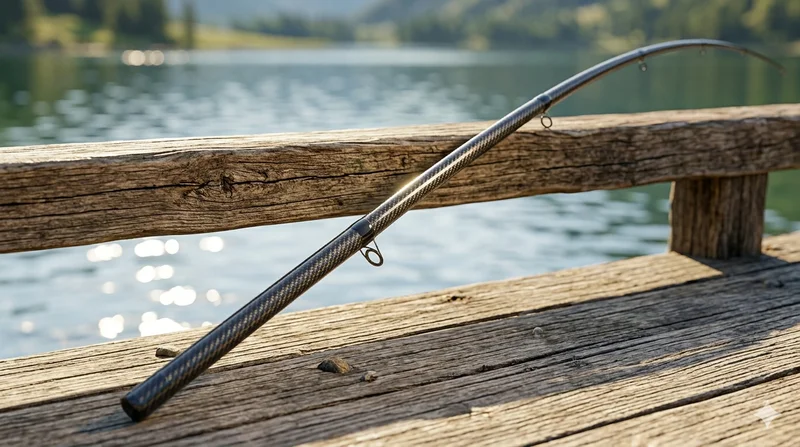
Carbon Fiber Fishing Rod Blank
High-quality carbon fiber fishing rod blank manufactured from multiple grades of Toray carbon fiber cloth. Available in a wide range of lengths, powers, and actions for freshwater and saltwater applications. Suitable for OEM rod building.

Carbon Fiber Plate — 3K Twill T700 3.0mm
Medium-thickness 3.0mm carbon fiber plate offering significantly higher load capacity while maintaining attractive 3K twill finish. Suitable for structural brackets, reinforcement plates, and load-bearing panels.

Carbon Fiber Plate — 3K Twill T700 1.5mm
Thin 1.5mm carbon fiber plate with 3K twill weave surface. Lightweight and stiff, commonly used for covers, panels, drone bodies, and applications requiring a premium aesthetic appearance.

Square Carbon Fiber Tube — 3K Twill T700
Square cross-section carbon fiber tube manufactured with 3K twill weave for torsional strength. Preferred for structural frames, trusses, and support columns where rectangular geometry offers design flexibility.
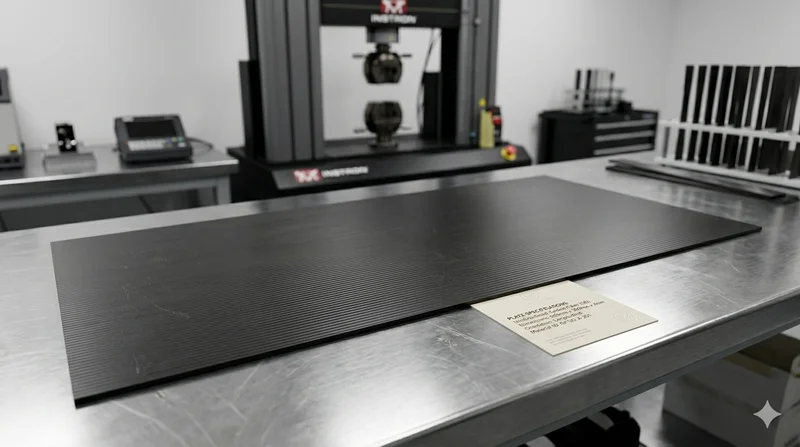
Carbon Fiber Plate — UD Unidirectional T700
Unidirectional carbon fiber plate with all fibers oriented in a single direction for maximum strength along the fiber axis. Essential for structural reinforcements, splints, and applications where load direction is predictable.