
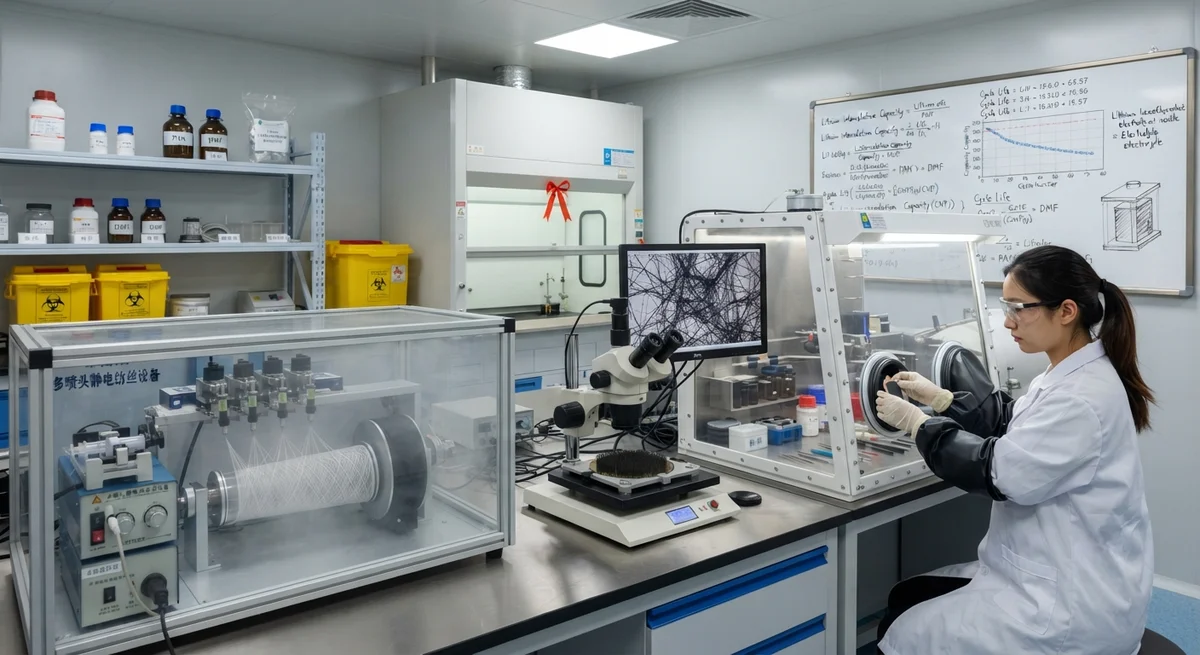
Carbon fiber is emerging as a promising anode material for next-generation lithium-ion batteries, offering theoretical capacities of 372-1200 mAh/g depending on structural configuration. This technical review examines current research on carbon fiber anodes — including electrospinning, CVD coating, and pre-lithiation strategies — and evaluates the commercialization timeline for structural battery composites that function as both load-bearing components and energy storage devices.
The Battery Anode Challenge
Lithium-ion battery technology has made remarkable progress over the past three decades, yet the graphite anode — the dominant commercial anode material since Sony introduced the first commercial Li-ion cell in 1991 — is approaching its theoretical capacity limit of 372 mAh/g. Meanwhile, demand for higher energy density drives research into alternative anode materials. Silicon offers a theoretical capacity of 4,200 mAh/g but suffers from extreme volume expansion of 300% during cycling, leading to rapid capacity fade. Carbon fiber occupies a unique and promising middle ground in this landscape, offering a balance of performance improvement and manufacturing scalability.
As a mature industrial material with established manufacturing infrastructure spanning precursor production, stabilization, carbonization, and surface treatment, carbon fiber provides electrical conductivity, mechanical integrity, and lithium intercalation capability that make it attractive for both conventional battery anodes and structural battery composites — laminates that simultaneously carry mechanical load and store electrical energy.
Electrochemical Performance by Fiber Type
The lithium storage capacity of carbon fiber depends critically on its microstructural characteristics including degree of graphitization, interlayer spacing (d002), surface area, and defect density. Research groups worldwide have reported widely varying capacities depending on fiber type and processing conditions.
| Fiber Type | Heat Treatment | d002 (nm) | Capacity (mAh/g) | 100-Cycle Retention |
|---|---|---|---|---|
| PAN-based T700 (Toray) | 2,400°C graphitized | 0.337 | 320-360 | 92-95% |
| PAN-based low-modulus fiber | 1,200-1,600°C | 0.348-0.365 | 420-510 | 85-90% |
| Electrospun PAN nanofiber mat | 800-1,200°C | 0.365-0.385 | 580-760 | 78-86% |
| Pitch-based carbon fiber | 2,800°C | 0.336-0.339 | 280-350 | 90-96% |
| Activated carbon fiber cloth | 800°C + KOH | 0.37-0.40 | 800-1200 | 65-75% |
| CNT-grafted carbon fiber hybrid | 700-900°C CVD | 0.34-0.36 | 650-900 | 82-90% |
Two important trends emerge: conventional high-modulus PAN fibers (T700, T800 grades) perform similarly to commercial graphite anodes but offer the unique advantage of structural integrity. The highest capacities come from disordered carbon structures with expanded interlayer spacing — though these suffer 15-30% first-cycle irreversible capacity loss versus 5-10% for graphite, primarily due to solid electrolyte interphase formation on high-surface-area materials. Processing pathway is critical: KOH activation significantly boosts capacity but at the expense of cycling stability and first-cycle efficiency.
Three Manufacturing Approaches
- Direct carbonization of electrospun nanofibers: PAN or other precursors are electrospun into nanofiber mats (100-800 nm diameter), stabilized at 200-300°C in air, and carbonized at 600-1,400°C in inert atmosphere. This process is compatible with roll-to-roll manufacturing but produces low tap density of 0.3-0.6 g/cm³ compared to 1.0-1.4 g/cm³ for conventional graphite, resulting in lower volumetric energy density.
- CVD coating of existing carbon fiber substrates: Commercial carbon fiber fabrics serve as substrates for chemical vapor deposition of carbon nanotubes, graphene, or pyrolytic carbon at 650-850°C using hydrocarbon precursors and transition metal catalysts. The CVD step adds 10-30% to substrate weight but can increase lithium storage capacity by 50-150%. Uniform coating across large-area substrates remains the primary manufacturing challenge.
- Structural battery composite integration: The most ambitious approach positions carbon fiber fabric as both the structural reinforcement and the anode current collector in a laminate that stores energy. Researchers at Chalmers University and Imperial College London have demonstrated structural battery composites with 25-75 Wh/kg energy density and 25-50 GPa elastic modulus — sufficient for drone fuselages, lightweight enclosures, and satellite panels.
Critical Performance Trade-offs
- First-cycle Coulombic efficiency: Carbon fiber anodes typically exhibit 60-85% CE versus 90-95% for commercial graphite. Pre-lithiation techniques including stabilized lithium metal powder and electrochemical pre-lithiation can raise first-cycle CE to 90-96% but add 8-15% to manufacturing cost.
- Rate capability: Disordered carbon structures provide faster lithium diffusion kinetics than graphite, enabling 60-75% capacity retention at 5C discharge rates versus 40-55% for standard graphite, making carbon fiber attractive for power-optimized applications like power tools.
- Volumetric energy density: The porous nature of non-woven carbon fiber anodes results in 30-50% lower volumetric energy density — a critical disadvantage for space-constrained applications including consumer electronics and electric vehicles.
Commercialization Timeline
| Phase | Timeframe | Application | TRL | Cost vs. Graphite |
|---|---|---|---|---|
| Research and pilot | 2023-2026 | Laboratory cells, prototypes | 3-5 | 50-100x |
| Early niche commercial | 2027-2029 | Aerospace structural batteries | 6-7 | 5-15x |
| Specialty applications | 2029-2032 | Drones, medical devices, power tools | 7-8 | 2-4x |
| Volume automotive structural | 2032-2035 | EV body panels with storage | 8-9 | 1.2-1.8x |
| Commodity anode material | 2035+ | General Li-ion cells | 9 | ≤1.2x |
The commercialization pathway follows early adoption in cost-insensitive aerospace and defense applications where structural functionality provides unique value, expanding into electric vehicles where structural battery body panels could increase effective range by 30-50% without adding weight. Patent filings have grown at 22% CAGR since 2020, led by the Chinese Academy of Sciences, Toray Industries, and CATL.
Frequently Asked Questions
Can existing carbon fiber lines be adapted for battery-grade anode fiber?
Yes, with key modifications. Stabilization and carbonization furnaces need expanded temperature profiling for the 800-1,400°C window that maximizes disordered carbon content. CVD reactors or activation furnaces must be added post-carbonization. Total capital expenditure for converting a 1,000-ton/year PAN line is estimated at $8-15 million versus $25-40 million for a greenfield electrospinning facility. Co-production — diverting a portion of standard fiber output through surface treatment steps — offers the fastest commercialization pathway.
What is the practical energy density ceiling for structural battery composites?
Current generation: 25-75 Wh/kg at the composite level. Theoretical ceiling: 150-200 Wh/kg, limited by active electrolyte volume fraction (maximum 40-60% in a structural laminate), practical carbon fiber electrode capacity (~500 mAh/g after pre-lithiation), and mechanical property trade-offs. Structural batteries will not replace conventional cells in energy-density-optimized applications but offer system-level weight savings of 15-30% where structural mass is already required.
How does carbon fiber anode cost compare to graphite and silicon?
Commercial graphite: $8-12/kg. Silicon-graphite composites (5-15% Si): $25-50/kg. Carbon fiber anodes (pilot scale): $25-80/kg. At 1,000 tons/year scale: $18-35/kg. At 10,000 tons/year: $12-22/kg. The cost crossover point with silicon alternatives is estimated at 2029-2031, assuming pre-lithiation and continuous CVD coating technologies mature as expected.
Part of topic
Related Articles
- Bio-Based Carbon Fiber Precursors: Lignin and Polyethylene for Low-Cost Production
- Large-Tow Carbon Fiber Cost Analysis: 48K vs 60K Price-Performance Comparison
- Carbon Fiber-Resin Interface Bonding: Surface Treatment and Coupling Agent Optimization
- Digital Twin for Carbon Fiber Manufacturing: Real-Time Process Monitoring and Defect Prevention
- Thermoplastic Carbon Fiber Welding for Automotive: Ultrasonic and Induction Welding Process Windows
- Large-Tow Carbon Fiber Wet Spinning: Process Optimization for 48K/60K Production Efficiency
Interested in Our Products?
Contact our team for competitive pricing and technical specifications.
Get a QuoteRelated Products
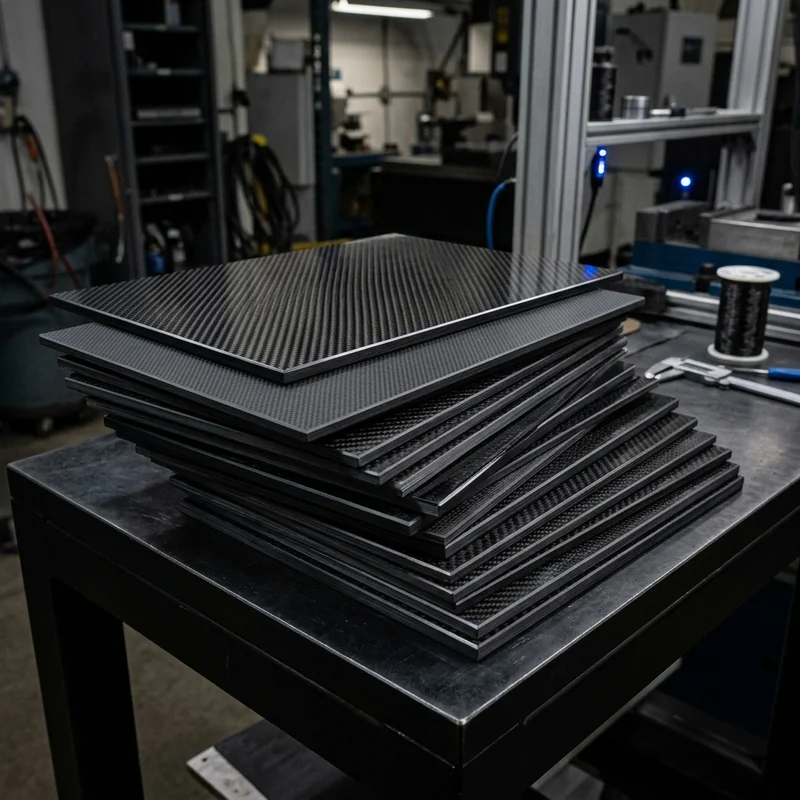
Carbon fiber standard plate-3k stripe
Lightweight, ultra-rigid standard sheets for drone fuselages, robot housings, facades and structural applications.

Carbon Fiber Plate — 3K Twill T700 3.0mm
Medium-thickness 3.0mm carbon fiber plate offering significantly higher load capacity while maintaining attractive 3K twill finish. Suitable for structural brackets, reinforcement plates, and load-bearing panels.

Carbon Fiber Plate — 3K Twill T700 1.5mm
Thin 1.5mm carbon fiber plate with 3K twill weave surface. Lightweight and stiff, commonly used for covers, panels, drone bodies, and applications requiring a premium aesthetic appearance.
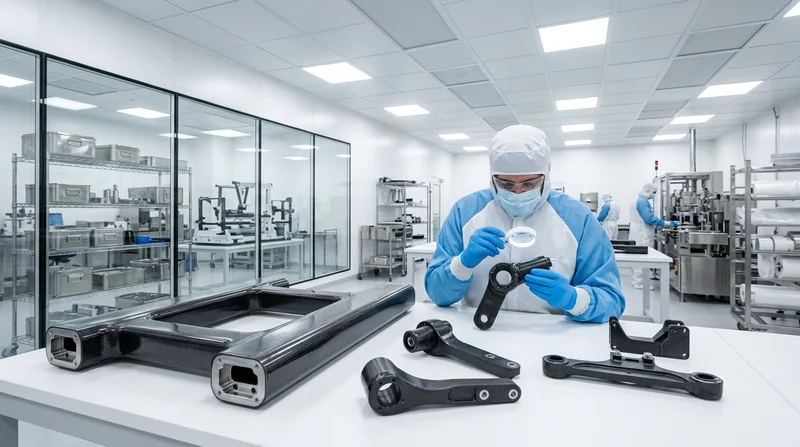
Custom Carbon Fiber Medical Device Components
Medical-grade carbon fiber components manufactured for imaging equipment, surgical instruments, and patient support systems. Carbon fiber's radiolucency (X-ray transparency) and high strength-to-weight ratio make it ideal for CT scanner beds, wheelchair frames, surgical robot arms, and MRI-compatible accessories. Biocompatible resin systems available.

Square Carbon Fiber Tube — 3K Twill T700
Square cross-section carbon fiber tube manufactured with 3K twill weave for torsional strength. Preferred for structural frames, trusses, and support columns where rectangular geometry offers design flexibility.