
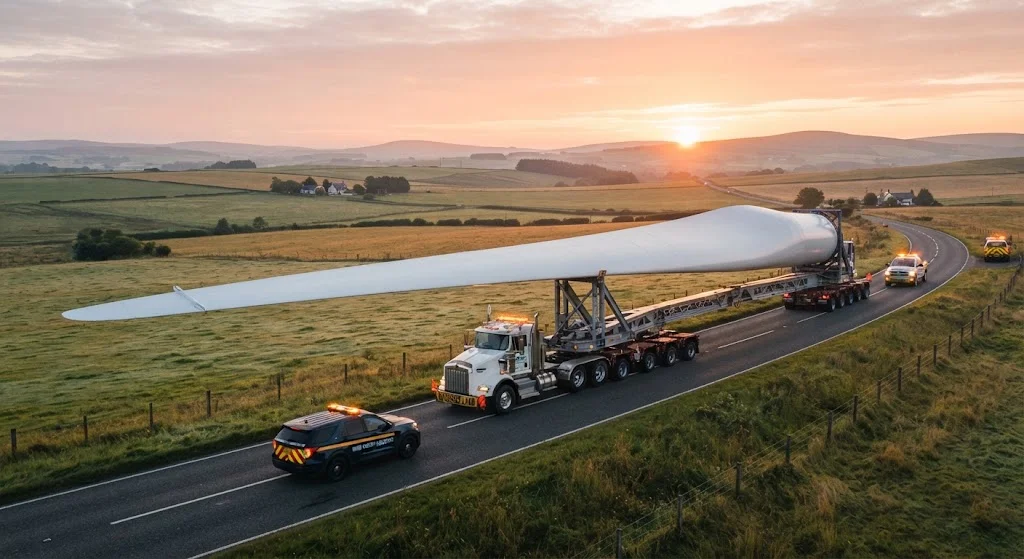
Transporting wind turbine blades exceeding 100 meters presents unique logistics challenges requiring specialized vehicles, route planning, and installation techniques. This article examines the engineering, infrastructure, and regulatory considerations that shape blade logistics for modern offshore and onshore wind projects.
Introduction
Modern wind turbine blades have grown dramatically in length over the past decade, with current offshore designs reaching 107-120 meters and next-generation concepts projecting 150+ meter blades. This exponential growth in blade dimensions has created unprecedented logistics challenges, transforming what was once a routine transportation task into one of the most complex engineering and planning exercises in the renewable energy sector. Transporting a single 100-meter blade requires specialized multi-axle vehicles, detailed route surveys, temporary infrastructure modifications, and coordination with multiple regulatory authorities — all while managing costs that can reach $200,000-500,000 per blade movement.
The logistics challenge extends beyond simple transportation. Blade geometry — thin, flexible, and aerodynamically shaped — creates handling risks that differ fundamentally from transporting rigid structural components. Wind loading during transport, ground clearance at road obstacles, turning radii at intersections, and bridge weight restrictions all impose constraints that limit route options and require innovative engineering solutions. This article examines the specialized equipment, route planning methodologies, and installation strategies that enable safe, cost-effective transport of ultra-large wind turbine blades.
Specialized Transport Vehicles
Transporting blades exceeding 80 meters requires purpose-built vehicles that address three core challenges: supporting blade length, managing blade flexibility, and enabling navigation through constrained road environments:
- Extendable trailer systems: Multi-axle extendable trailers (typically 60-120 axle lines) distribute blade weight across maximum road surface area while providing adjustable length to accommodate different blade dimensions. These trailers feature hydraulic steering on multiple axle lines, enabling negotiation of tight curves that fixed-length vehicles cannot navigate. Cost: $2-5 million per trailer set.
- Blade lifter adapters: Hydraulic blade lifting devices mount on trailer fronts, raising blade tips 10-20 meters above road level to clear obstacles (power lines, buildings, trees) without requiring temporary infrastructure removal. These systems add $50,000-100,000 per transport but eliminate weeks of route preparation work.
- Self-propelled modular transporters (SPMTs): For extreme-length blades (100m+), SPMT platforms provide independent steering on each axle line, enabling millimeter-precision positioning during installation. These 40-60 wheel units cost $1-3 million but are essential for the final placement operations where blade must be threaded through congested port areas or installed on elevated nacelle positions.
| Vehicle Type | Max Blade Length | Axle Lines | Typical Cost | Key Advantage |
|---|---|---|---|---|
| Extendable trailer | 80-100m | 40-80 | $2-4M | Cost-effective for standard oversized loads |
| Blade lifter adapter | 100-120m | 60-100 | $3-5M | Clears obstacles without infrastructure modification |
| SPMT platform | 120m+ | 60-120 | $1-3M (rental) | Independent steering for precision positioning |
| Combined system | 150m+ | 100-150 | $5-8M | Maximum flexibility for extreme logistics |
Route Planning and Infrastructure Assessment
Route planning for 100m+ blade transport involves comprehensive analysis of every kilometer between manufacturing facility and installation site. The planning process addresses multiple constraint categories:
- Horizontal clearance: Blade overhang during turns requires 8-15 meter lateral clearance beyond normal road width. Intersections, roundabouts, and road furniture (signs, barriers, lighting) must be assessed for temporary removal or modification. GPS-guided trailer steering systems can reduce required clearance by 20-30% through precise blade path control.
- Vertical clearance: Standard road bridges (4.5-5.0m clearance) require either temporary lowering of blade on lifter adapters or bridge modification. Power line crossings (typically 6-12m height) often require temporary de-energization and lifting by utility companies — a process adding $10,000-50,000 per crossing and 4-8 hours of coordination.
- Surface load limits: Bridge decks and road surfaces have weight-per-axle restrictions (typically 10-12 tonnes per axle in Europe, 8-10 tonnes in developing markets). Blade transport vehicles distribute load across 40-120 axles to remain within limits, but bridge structural assessments may be required for older infrastructure.
- Route timing: Most jurisdictions restrict oversized load movements to nighttime hours (10pm-5am) to minimize traffic disruption. This requires route lighting, police escorts, and advance public notification — adding $5,000-15,000 per journey in coordination costs.
Blade Handling and Loading Operations
Loading 100m+ blades from manufacturing facilities or port storage onto transport vehicles requires precision engineering and specialized equipment:
- Overhead crane systems: Manufacturing facilities use 50-100 tonne overhead cranes with custom blade lifting fixtures that distribute clamping force across the blade root section. Lifting operations require wind speed limits below 8-10 m/s to prevent uncontrolled blade swing. The loading process typically takes 2-4 hours including fixture attachment, lifting, trailer positioning, and securing.
- Tilt-up loading: For port operations where overhead cranes are unavailable, tilt-up systems use hydraulic frames that lift blade from horizontal to 30-45 degree angle, allowing transport trailer to reverse underneath. This method requires clear ground area of 150m × 25m and is limited to blades under 100m due to structural loading during tilt.
- Root-end first transport: Most blade transport operations position blade root (heavy end) toward transport vehicle front, with tip extending rearward. This configuration provides better weight distribution and allows blade tip to overhang road obstacles during turns. Some operations use tip-first orientation for extremely long blades where rear overhang must be minimized.
Regulatory and Permitting Requirements
Blade transport operations require coordination with multiple regulatory authorities and compliance with varying national and regional standards:
- Load permits: Oversized load permits (typically required for any dimension exceeding 3.0m width, 4.5m height, or 20m length) must be obtained from highway authorities along the entire route. Permit conditions specify travel windows, escort requirements, and speed restrictions. Permit costs range from $500-5,000 per journey depending on jurisdiction and load dimensions.
- Police and pilot vehicle escorts: Loads exceeding 3.5m width or 30m length typically require police escorts (1-2 vehicles) and pilot vehicles (1-2 vehicles) providing advance warning to other road users. Escort costs: $1,000-3,000 per police vehicle, $500-1,500 per pilot vehicle per journey.
- Infrastructure temporary modifications: Route modifications (temporary road sign removal, power line lifting, traffic signal relocation) require permits from multiple agencies (highways, utilities, municipal authorities). Lead times for these permits can extend to 3-6 months for complex routes.
- Insurance requirements: Blade transport operations typically require $5-20 million liability coverage and $1-5 million cargo insurance for blade value. Total insurance costs: $10,000-30,000 per blade transport operation.
Cost Analysis and Optimization
Total logistics cost for a single 100m blade transport ranges from $200,000-500,000, with cost breakdown varying by transport distance, route complexity, and regional labor rates:
| Cost Component | Short Route (<50km) | Medium Route (50-200km) | Long Route (>200km) |
|---|---|---|---|
| Vehicle rental | $15,000-25,000 | $25,000-40,000 | $40,000-60,000 |
| Escort services | $3,000-5,000 | $5,000-12,000 | $12,000-25,000 |
| Route preparation | $5,000-15,000 | $15,000-50,000 | $50,000-150,000 |
| Permits and insurance | $5,000-10,000 | $10,000-20,000 | $20,000-40,000 |
| Labor and operations | $10,000-20,000 | $20,000-40,000 | $40,000-80,000 |
| Total per blade | $38,000-75,000 | $75,000-162,000 | $162,000-355,000 |
Cost optimization strategies include: batching multiple blade transports on same route (reducing per-blade permit and escort costs by 30-40%), manufacturing facility location optimization (co-locating with port facilities reduces road transport distance), and route standardization across projects (reusing approved routes reduces permit lead times and preparation costs).
Emerging Trends and Technology
The blade logistics industry is adapting to ever-increasing blade dimensions through several technological and operational innovations:
- Blade segmentation: Some manufacturers are developing blades that separate into 2-3 segments for transport, with field assembly using structural adhesive bonding or mechanical fastening. This approach reduces transport length by 40-60% but adds field assembly costs ($50,000-100,000 per blade) and requires quality assurance for field joints.
- Vertical transport systems: For offshore installations, vertical blade lifting directly from transport vessel to nacelle position eliminates road transport constraints entirely. This approach requires purpose-built installation vessels ($200,000-500,000/day charter rate) but removes all road infrastructure limitations.
- Digital route planning: AI-powered route optimization software analyzes satellite imagery, GIS data, and infrastructure databases to automatically identify optimal routes and required modifications. These systems reduce planning time from weeks to days and improve accuracy of cost estimates.
Conclusion
Transporting 100m+ wind turbine blades represents one of the most complex logistics challenges in the renewable energy sector, requiring specialized equipment, detailed planning, and multi-agency coordination. As blade dimensions continue to grow, the logistics industry must innovate continuously to maintain safe, cost-effective transport capabilities. For wind project developers, understanding blade logistics constraints early in project planning — including manufacturing facility location, port infrastructure, and road route capabilities — is essential for accurate project cost estimation and schedule development.
YongXian CarbonFiber
YongXian manufactures carbon fiber tubes, sheets, and custom composite parts from our Dezhou, China factory. With over 15 years of composite manufacturing experience, we supply carbon fiber components to aerospace, automotive, energy, and industrial customers worldwide.
Contact us for custom carbon fiber solutions.
Part of topic
Related Articles
- Recycled Carbon Fiber Market Forecast 2030: Technology Maturity and Commercialization Path
- South Korea Carbon Fiber Market 2026: Hydrogen Economy and Shipbuilding Innovation
- Wind Turbine Blade Leading Edge Protection 2026: Polyurethane, Tape, and Metallic Shield Solutions
- China Carbon Fiber Overcapacity 2026: Price War Impact and Industry Consolidation
- India Carbon Fiber Market 2026: Wind Energy, Aerospace, and Defense Expansion
- PAN Precursor Market 2026: Acrylonitrile Supply and Carbon Fiber Cost Structure