
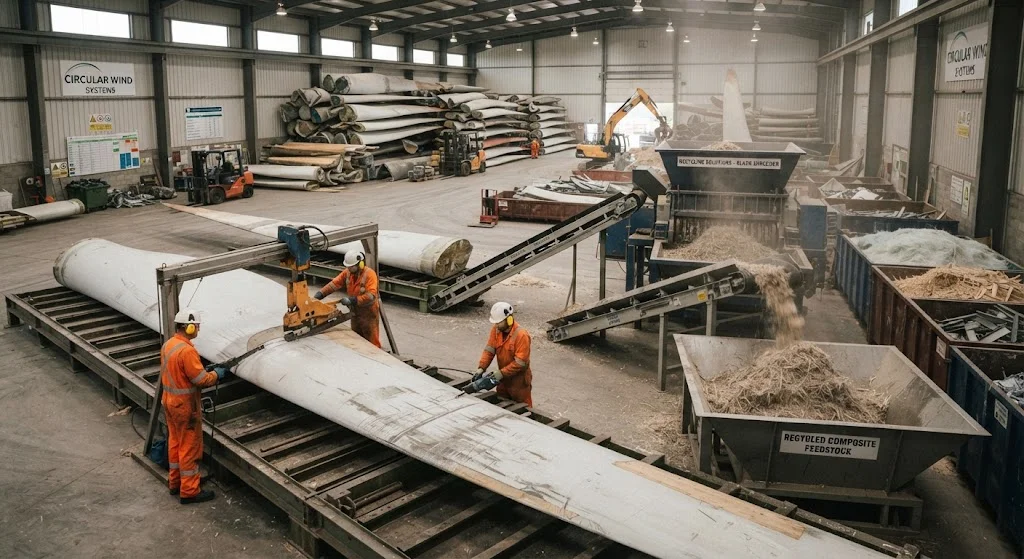
As the first generation of commercial wind turbines reaches end-of-life, the industry faces a growing challenge: decommissioning and recycling over 2.4 million tonnes of composite blade material by 2050. This article examines blade decommissioning methods, recycling technologies, and circular economy strategies reshaping wind energy sustainability.
Introduction
The global wind energy industry is approaching a critical inflection point. Between 2025 and 2035, approximately 800,000 wind turbines worldwide will reach the end of their 20-25 year operational lifetimes, representing over 2.4 million tonnes of composite blade material requiring disposal or recycling. Unlike steel, copper, or aluminum components that have established recycling markets, wind turbine blades — primarily constructed from glass fiber reinforced polymer (GFRP) and increasingly carbon fiber reinforced polymer (CFRP) composites — present unique end-of-life challenges that the industry is only now beginning to address systematically.
The decommissioning challenge is compounded by blade design evolution. Early wind turbine blades (1990s-2000s) were relatively simple glass fiber structures weighing 5-15 tonnes. Modern blades (2020s) are complex multi-material composites incorporating carbon fiber spar caps, balsa wood or foam cores, thermoplastic leading edge protection, and metal lightning protection systems — each requiring different recycling approaches. This article examines the decommissioning methods, emerging recycling technologies, and circular economy strategies that will define wind energy's environmental legacy.
Blade Decommissioning Methods
Removing wind turbine blades from operational sites involves three primary approaches, each with distinct cost, safety, and environmental implications:
- Crane-assisted removal: Conventional decommissioning uses mobile cranes (100-500 tonne capacity) to remove blades from the nacelle while the turbine is lowered or climbed by rope-access technicians. This method provides controlled handling but requires significant ground preparation (crane pad construction, road reinforcement) and weather windows of 24-48 hours. Cost: $15,000-40,000 per blade depending on turbine height and site access.
- In-situ blade cutting: For sites with limited access or where ground disturbance must be minimized, rope-access technicians cut blades into manageable sections (3-5 meter segments) while suspended from the nacelle or blade root. Segments are then lowered by crane or zip-line to ground level for transport. This method reduces crane requirements but generates composite dust requiring containment and adds 8-16 hours of technician time per blade.
- Helicopter removal: For remote or offshore sites where crane access is impossible, helicopters (Sikorsky S-64 Skycrane or Mil Mi-26) can lift complete blades or large sections directly from the nacelle. This approach costs $50,000-100,000 per blade but eliminates all ground infrastructure requirements and can operate in weather conditions that prevent crane operations.
| Method | Cost per Blade | Time Required | Ground Impact | Weather Sensitivity |
|---|---|---|---|---|
| Crane removal | $15,000-40,000 | 4-8 hours | High (crane pad, roads) | Moderate (wind <10 m/s) |
| In-situ cutting | $25,000-50,000 | 12-24 hours | Low (minimal ground work) | Low (technician work) |
| Helicopter lift | $50,000-100,000 | 2-4 hours | None (airlift) | High (helicopter operations) |
Composite Recycling Technologies
Four primary recycling technologies are emerging for wind turbine blade composites, each suited to different material compositions and end-market requirements:
- Mechanical grinding: Shredding and grinding blade material into fibers and powder for use as filler material in concrete, asphalt, or new composite products. This mature technology can process mixed composite streams but reduces fiber length and mechanical properties, limiting applications to non-structural uses. Throughput: 5-15 tonnes/hour for industrial shredders. Recycled fiber value: $0.20-0.50/kg (vs. $2-5/kg for virgin glass fiber).
- Thermal recovery (pyrolysis): Heating blade material to 400-700°C in oxygen-free environments to recover carbon fibers with 80-95% of original mechanical properties. Pyrolysis is particularly valuable for carbon fiber blades where recovered fibers retain significant value ($5-15/kg vs. $15-30/kg for virgin carbon fiber). Energy balance: 1-2 kg oil equivalent recovered per kg of composite processed.
- Chemical dissolution: Using solvents (supercritical water, organic acids, or ionic liquids) to dissolve polymer matrix and recover clean fibers with minimal property degradation. This emerging technology achieves 90-98% fiber recovery rates but faces scale-up challenges and solvent recycling costs. Current capacity: pilot scale (0.5-2 tonnes/batch).
- Fluidized bed combustion: Burning composites at 450-550°C in fluidized bed reactors to remove resin and recover fibers. This method handles contaminated or mixed-material blades better than pyrolysis but produces lower-quality fibers suitable mainly for reinforcement in concrete or asphalt applications.
Material Recovery and Market Development
The economic viability of blade recycling depends on developing markets for recovered materials. Several end-use applications are gaining traction:
- Concrete reinforcement: Ground glass fiber from blade recycling can replace 10-30% of virgin aggregate in concrete mixtures, improving compressive strength by 5-15% while diverting waste from landfill. Market potential: 500,000-1 million tonnes/year by 2030 in Europe alone.
- Automotive and consumer products: Recycled carbon fiber (rCF) from blade pyrolysis is finding applications in automotive interior panels, electronic housings, and sporting goods where properties can be tailored to less demanding specifications. Market growth: 15-25% annually for rCF in automotive applications.
- Composite regrind products: Shredded blade material processed into pellets or sheets for use in low-load structural applications (park benches, fencing, building panels). These products typically contain 30-50% recycled content and compete with virgin materials on cost rather than performance.
- Cement kiln co-processing: Blade material can be used as alternative fuel and raw material in cement production, with glass fiber providing silica and calcium components. This approach achieves 100% material utilization but sacrifices fiber value recovery.
Regulatory Framework and Extended Producer Responsibility
Governments are beginning to establish regulatory frameworks for wind turbine blade end-of-life management:
- European Union Waste Framework Directive: The EU classifies wind turbine blades as "end-of-life vehicles" equivalent, requiring 85% recycling rate by weight by 2030. National implementation varies — Germany requires blade recycling plans as part of wind farm permits, while Denmark has established a blade recycling fund financed by turbine operators.
- Extended Producer Responsibility (EPR): Several jurisdictions are implementing EPR schemes that require turbine manufacturers to finance end-of-life blade management. Vestas, Siemens Gamesa, and GE Renewable Energy have announced blade recycling commitments, with Vestas targeting 50% recycled blade content by 2030.
- Landfill restrictions: The UK, Netherlands, and several German states have banned or restricted landfill disposal of composite materials, driving development of alternative recycling pathways. Similar restrictions are expected in the US and Asia by 2030.
Design for Recycling
The wind industry is beginning to incorporate end-of-life considerations into blade design, following principles established in automotive and electronics manufacturing:
- Material selection: New blade designs increasingly use thermoplastic matrix systems (PET, PA, PEKK) that can be melted and reformed, unlike traditional thermoset epoxy that cannot be remelted. Thermoplastic blades represent 5-10% of new installations in 2026, projected to reach 30-40% by 2035.
- Modular construction: Some manufacturers are developing blades with bolted or adhesive-bonded joints that allow separation of carbon fiber spar caps from glass fiber shells at end-of-life, enabling targeted recycling of each material stream.
- Recycled content integration: Blade designs incorporating 10-30% recycled carbon fiber or glass fiber in non-critical sections reduce virgin material consumption while maintaining structural performance in primary load paths.
Conclusion
Wind turbine blade decommissioning and recycling represents both a significant environmental challenge and a growing business opportunity. As the first large wave of blade retirements accelerates through the 2030s, the industry must scale recycling technologies, develop end markets for recovered materials, and integrate circular economy principles into blade design. Companies that invest in decommissioning capabilities and recycling infrastructure today will be positioned to capture value from the estimated $5-10 billion blade recycling market emerging through 2040.
YongXian CarbonFiber
YongXian manufactures carbon fiber tubes, sheets, and custom composite parts from our Dezhou, China factory. With over 15 years of composite manufacturing experience, we supply carbon fiber components to aerospace, automotive, energy, and industrial customers worldwide.
Contact us for custom carbon fiber solutions.
Part of topic
Related Articles
- Recycled Carbon Fiber Market Forecast 2030: Technology Maturity and Commercialization Path
- South Korea Carbon Fiber Market 2026: Hydrogen Economy and Shipbuilding Innovation
- Wind Turbine Blade Leading Edge Protection 2026: Polyurethane, Tape, and Metallic Shield Solutions
- China Carbon Fiber Overcapacity 2026: Price War Impact and Industry Consolidation
- India Carbon Fiber Market 2026: Wind Energy, Aerospace, and Defense Expansion
- PAN Precursor Market 2026: Acrylonitrile Supply and Carbon Fiber Cost Structure