
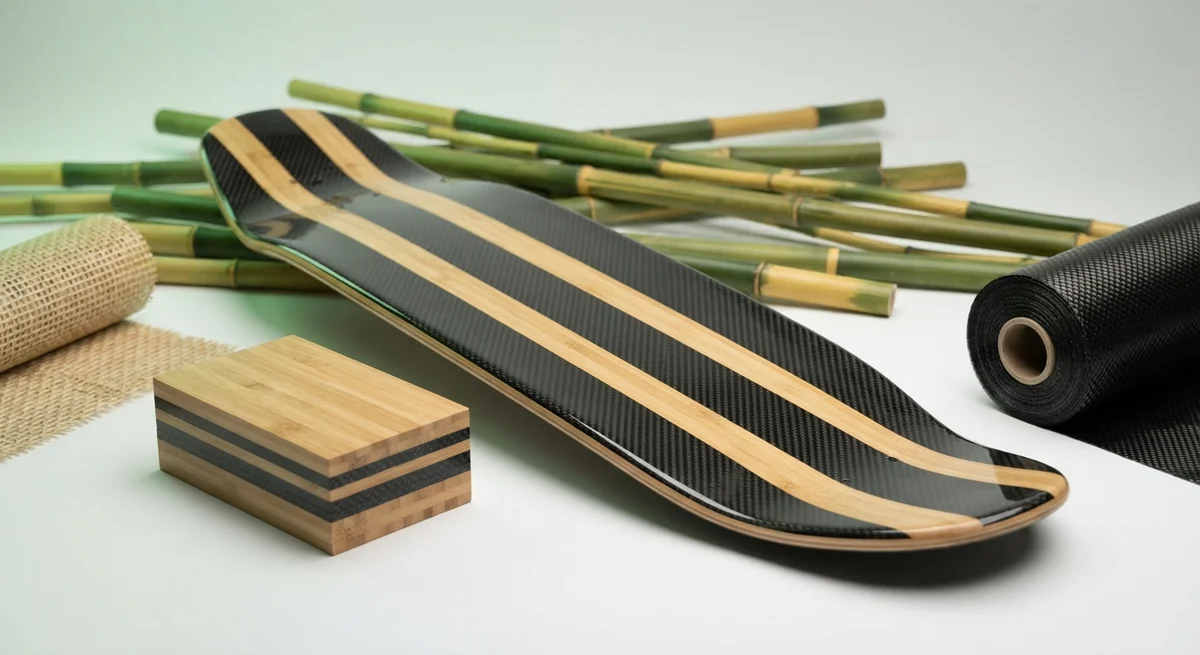
A detailed B2B analysis of bamboo-carbon fiber hybrid composite materials, covering mechanical properties, manufacturing processes, cost comparison, lifecycle assessment, and applications in sporting goods, consumer electronics, and sustainable product design.
Introduction
The global composites industry is under increasing pressure to reduce its environmental footprint while maintaining the exceptional mechanical performance that has made carbon fiber reinforced polymers (CFRP) indispensable in aerospace, automotive, sporting goods, and consumer products. Carbon fiber composites, for all their structural advantages, carry a significant environmental burden: the production of polyacrylonitrile (PAN)-based carbon fiber consumes approximately 200–300 MJ/kg of embodied energy and generates 22–35 kg CO₂-equivalent per kilogram of fiber produced (varying by precursor type and manufacturing process). With the global carbon fiber market projected to reach $8.9 billion by 2028 and annual production capacity exceeding 250,000 metric tons, the environmental impact of carbon fiber manufacturing has become a material concern for OEMs and brand owners seeking to meet corporate sustainability targets and increasingly stringent environmental regulations.
Bamboo is one of the fastest-growing renewable resources on the planet, with certain species (Moso bamboo, Phyllostachys edulis) achieving growth rates of 30–100 cm per day and reaching harvest maturity in 4–7 years — compared to 25–50 years for softwood trees used in traditional timber production. Bamboo fiber reinforced composites have been studied extensively over the past two decades, but their adoption has been limited by lower mechanical properties compared to glass and carbon fiber composites and by poor fiber-matrix adhesion in resin systems optimized for synthetic fibers. The emergence of bamboo-carbon fiber hybrid composites — where layers or sections of bamboo fiber reinforcement are strategically combined with carbon fiber in a single laminate — represents a promising approach to reducing the carbon fiber content of composite products by 20–50% while maintaining 70–90% of the mechanical performance of pure carbon fiber laminates, at a material cost reduction of 15–35%.
For B2B buyers in sporting goods manufacturing, consumer electronics, and sustainable product design, bamboo-carbon fiber hybrid composites offer a compelling value proposition: lower environmental impact, reduced material cost, distinctive aesthetic appearance, and — for consumer-facing products — a marketable "green" material story that resonates with environmentally conscious end consumers. This article provides a comprehensive technical analysis of bamboo-carbon fiber hybrid composite materials, covering fiber preparation and treatment, laminate architecture design, mechanical property characterization, manufacturing process adaptation, lifecycle assessment, cost economics, and specific applications in sporting goods and consumer products.
Bamboo Fiber Preparation and Surface Treatment
The mechanical properties of bamboo-carbon fiber hybrid composites depend critically on the quality and consistency of the bamboo fiber reinforcement. Unlike synthetic fibers (carbon and glass) which are manufactured to tightly controlled diameter and property specifications, bamboo fiber is a natural material with inherent variability in fiber diameter (10–40 µm for technical bamboo fibers, compared to 7–10 µm for carbon fiber in standard 3K tow), length (5–50 mm after mechanical extraction), and mechanical properties depending on the bamboo species, harvest age, stalk position (bottom, middle, top of the culm), and extraction method. For consistent composite manufacturing, bamboo fiber must undergo a standardized preparation process that includes mechanical extraction (stem crushing, scraping, and combing to separate fiber bundles from the parenchyma matrix), chemical treatment for hemicellulose and lignin removal (alkali treatment with 2–8% NaOH solution at 60–90°C for 2–6 hours, followed by acetic acid neutralization and water washing), and surface functionalization to improve fiber-matrix adhesion with the epoxy resin system used in the adjacent carbon fiber plies.
The most effective surface treatment for bamboo fibers in hybrid composites with carbon fiber is silane coupling agent treatment — applying a 0.5–2.0% solution of 3-aminopropyltriethoxysilane (APTES) or glycidoxypropyltrimethoxysilane (GPTMS) in ethanol-water (80:20) solution at pH 4–5, followed by drying at 100–120°C for 1–3 hours. The silane molecules form covalent bonds with the hydroxyl groups on the bamboo fiber surface (from cellulose and residual lignin) at one end, and with the epoxy resin matrix at the other end (through the epoxy-reactive amino or glycidoxy functional groups), improving the interlaminar shear strength (ILSS) by 25–45% compared to untreated bamboo fibers. Alternative treatment methods include alkali + enzymatic treatment (using 1–3% pectinase and xylanase enzyme cocktail at 50–55°C for 2–4 hours, followed by alkali treatment) which produces fibers with 25–30% higher elongation at break compared to alkali-only treatment, making them better suited for impact-loaded sporting goods applications; and maleic anhydride-grafted polypropylene (MAPP) coupling agent treatment for bamboo fibers used in polypropylene or polyethylene matrix hybrid composites (less common in structural applications due to the lower mechanical properties of thermoplastic matrices compared to epoxy).
Laminate Architecture Design for Bamboo-Carbon Hybrid Composites
The design principle for bamboo-carbon fiber hybrid composites is strategic material placement — using carbon fiber in the regions of highest stress (the outer plies of a sandwich or the tension and compression faces of a bending beam) and bamboo fiber in the regions of lower stress (the core or inner plies) where its lower modulus and strength are sufficient for the local stress demand. This functionally graded approach maximizes material efficiency: carbon fiber provides the stiffness and strength where it is most needed, while bamboo fiber reduces cost, weight, and environmental impact in the less critical regions. The most common laminate architectures for bamboo-carbon fiber hybrid composites are: Sandwich configuration [C/B/C]: Two outer layers of carbon fiber (1–3 plies of 200 gsm 3K twill, 0.5–1.5 mm total thickness per side) sandwiching a core of bamboo fiber reinforcement (2–8 plies, 2–8 mm total thickness). This configuration is optimal for panels and shells subjected to bending loads — the carbon fiber skins carry the tensile and compressive bending stresses, while the bamboo core carries shear stress and provides thickness for flexural rigidity. Interleaved configuration [C/B/C/B/C]: Alternating layers of carbon fiber and bamboo fiber, with carbon fiber on both exposed surfaces. This is used for thinner laminates (2–5 mm total) where the bamboo core in a sandwich configuration would be too thin for effective shear stress transfer, while still providing 30–50% bamboo fiber content by volume.
The following table presents comparative mechanical test data for various bamboo-carbon fiber hybrid laminate architectures (tested per ASTM D3039 for tension, ASTM D7264 for flexure, and ASTM D790 for flexural modulus), using 200 gsm 3K carbon fiber twill prepreg, treated bamboo fiber mats (220 gsm, silane-treated), and epoxy resin matrix at 55% fiber volume fraction.
| Laminate Architecture | CF Content (vol%) | Bamboo Content (vol%) | Tensile Strength (MPa) | Tensile Modulus (GPa) | Flexural Strength (MPa) | Flexural Modulus (GPa) | Impact Energy (kJ/m²) | Density (g/cm³) | Relative Cost |
|---|---|---|---|---|---|---|---|---|---|
| Pure CF (reference) | 55 | 0 | 780 | 68 | 650 | 62 | 45 | 1.55 | 1.0 |
| Sandwich [C/B/C] (3:1 ratio) | 41 | 14 | 580 | 52 | 510 | 48 | 52 | 1.42 | 0.78 |
| Sandwich [C/B/C] (1:1 ratio) | 28 | 27 | 410 | 38 | 360 | 35 | 48 | 1.32 | 0.65 |
| Interleaved [C/B/C/B/C] | 33 | 22 | 490 | 42 | 425 | 40 | 50 | 1.38 | 0.72 |
| Bamboo only (treated, reference) | 0 | 55 | 120 | 12 | 95 | 10 | 35 | 1.15 | 0.35 |
| Glass fiber (woven, reference) | 0 | 0 | 420 | 24 | 380 | 22 | 80 | 1.90 | 0.45 |
The data reveals several important design insights. The sandwich [C/B/C] configuration at 3:1 carbon-to-bamboo volume ratio retains 74% of the tensile strength and 76% of the flexural modulus of pure carbon fiber while reducing material cost by 22% and composite density by 8%. The impact energy of the hybrid laminates is actually 10–15% higher than pure carbon fiber, an effect attributed to the bamboo fiber core's higher strain-to-failure (2.5–4.0% versus 1.5–2.0% for carbon fiber), which allows the bamboo layer to arrest crack propagation from the carbon fiber skins through fiber bridging and energy dissipation at the bamboo-matrix interface. This improved impact resistance makes bamboo-carbon fiber hybrids particularly attractive for sporting goods applications where impact loads are frequent — skateboard decks, bicycle frames, canoe paddles, and protective gear components.
Manufacturing Process Adaptation
Bamboo-carbon fiber hybrid composites can be manufactured using most existing composite fabrication processes with process parameter adjustments to accommodate the different thermal and moisture characteristics of bamboo fiber. Compression molding is the preferred process for high-volume production of hybrid composite parts (cycle time 10–30 minutes, depending on part thickness and geometry). The key process modification is the inclusion of a controlled moisture release stage: bamboo fiber contains 6–12% equilibrium moisture content at ambient conditions (compared to < 0.1% for carbon fiber), which must be driven off during the molding cycle to prevent void formation in the cured composite. A two-stage cure cycle is recommended: Stage 1 at 80–100°C for 5–10 minutes with the press partially open (10–20% of full clamp force) to allow moisture vapor to escape, followed by Stage 2 at 120–140°C for 10–20 minutes at full clamp pressure (1–3 MPa) for final resin cure. The moisture release stage adds 5–10 minutes to the cycle time compared to pure carbon fiber compression molding but is essential for achieving void content below 2% in the bamboo fiber plies.
Resin transfer molding (RTM) and vacuum-assisted RTM (VARTM) are well-suited for hybrid composites because the dry bamboo fiber mat can be placed in the mold with the carbon fiber preform and infused together in a single injection cycle. The bamboo fiber mat must be pre-dried (2–4 hours at 80–100°C in a forced-air oven) before mold placement to prevent moisture from outgassing during resin infusion, which creates voids. The higher permeability of bamboo fiber mats (2–5 × 10⁻¹⁰ m² versus 1–3 × 10⁻¹¹ m² for carbon fiber fabric) actually improves resin flow through the hybrid preform, reducing infusion time by 15–30% compared to pure carbon fiber preforms of equivalent thickness. The optimal resin injection pressure for hybrid preforms is 1.5–3.0 bar (lower than the 2–5 bar for pure carbon fiber) to avoid displacing the bamboo fiber mat during infusion, as bamboo fibers, being shorter and less rigid than continuous carbon fiber tows, are more susceptible to fiber washout at high injection pressures. Manual wet layup — the simplest and most accessible process — is used for prototype and low-volume production, where the bamboo fiber mat and carbon fiber fabric are manually impregnated with epoxy resin using a roller, placed in a mold or on a flat surface, vacuum bagged, and cured at room temperature for 24 hours followed by a 4-hour post-cure at 60°C. While manual layup produces the highest waste (5–10% resin waste) and lowest fiber volume fraction (40–48%), it is the most accessible process for small-scale bamboo-carbon fiber composite producers and research groups.
Applications in Sporting Goods and Consumer Products
- Skateboard and longboard decks: Bamboo-carbon fiber hybrid decks are among the most commercially successful applications of this material system. A 7-ply hybrid deck (3 carbon fiber plies [200 gsm 3K twill, epoxy prepreg] + 4 bamboo fiber plies [220 gsm treated bamboo mat] in a [C/B/B/C/B/B/C] interleaved configuration) achieves a flexural modulus of 38 GPa and a flexural strength of 420 MPa — sufficient for professional-level skateboard use — at a total deck weight of 580–650 g (comparable to a 5-ply bamboo-only deck at 620–700 g) and at a material cost of $8.50–$12.00 per deck versus $14.00–$20.00 for a 3-ply pure carbon fiber deck. The hybrid deck provides 10–15% higher impact resistance than bamboo-only decks and exhibits a distinctive visual appearance — alternating stripes of carbon fiber's glossy black weave and bamboo fiber's warm tan-and-straw texture — that has become a marketable aesthetic in the premium longboard segment. Several European longboard manufacturers have adopted hybrid decks as their top-tier product line, priced at $180–$320 per complete board compared to $120–$220 for bamboo-only boards and $250–$450 for pure carbon fiber boards.
- Bicycle frame components: Bamboo-carbon fiber hybrid tubes — using a 0.3 mm carbon fiber inner skin, a 3–5 mm bamboo fiber core wound or laid-up at ±45° orientation for torsional stiffness, and a 0.3 mm carbon fiber outer skin — achieve 60–65% of the specific stiffness of a pure carbon fiber tube at 45–50% lower material cost. These hybrid tubes are commercially viable for bicycle top tubes, down tubes, and seat stays in hybrid city and touring bicycles where absolute weight minimization (achievable only with full carbon fiber frames at $800–$3,000+ per frame) is less critical than cost and sustainability messaging. A complete bamboo-carbon fiber hybrid bicycle frame (52 cm, including carbon fiber lugs at the tube junctions) weighs approximately 2.2–2.8 kg, compared to 1.2–1.8 kg for a full carbon fiber frame and 3.5–6.0 kg for a steel frame — placing it in the competitive lightweight segment while offering a sustainability narrative that resonates with environmentally conscious cyclists.
- Consumer electronics casings and accessories: Bamboo-carbon fiber hybrid laminates (1.0–2.0 mm total thickness, 2–4 plies of 200 gsm carbon fiber + 2–4 plies of 160–200 gsm bamboo fiber in alternating interleaved configuration) are being commercialized for premium laptop shells, tablet covers, and phone cases. The hybrid laminate achieves a flexural modulus of 30–40 GPa — sufficient for impact resistance in drops from 1.0–1.5 m — with a density of 1.20–1.35 g/cm³ (lighter than the 1.55 g/cm³ of pure carbon fiber and the 2.70 g/cm³ of aluminum alloy casings). The unique aesthetic of the bamboo layers creates a natural wood-like appearance that contrasts with the carbon fiber weave, producing a visual effect described as "nature meets technology" that has been adopted by several boutique consumer electronics accessory brands for premium pricing ($2.5–5.0× the cost of standard polycarbonate or aluminum cases).
- Paddle and oar shafts: Bamboo-carbon fiber hybrid paddle shafts for canoeing, kayaking, and stand-up paddleboarding (SUP) — using a sandwich configuration with 0.5 mm CF skin + 3 mm bamboo fiber core + 0.5 mm CF skin — achieve the same flexural rigidity as a pure carbon fiber shaft at 32% lower material cost and 18% lower weight (due to the lower density of the bamboo core, 1.15 g/cm³ vs. 1.55 g/cm³). The hybrid shaft additionally provides 25–40% better vibration damping than pure carbon fiber — a meaningful differentiator for paddle sports enthusiasts who report that "carbon fiber ping" (the high-frequency vibration transmitted through the shaft during each stroke) causes fatigue and discomfort during long paddling sessions.
Lifecycle Assessment and Environmental Impact
A cradle-to-gate lifecycle assessment (LCA) comparing a 1 kg bamboo-carbon fiber hybrid laminate (3:1 carbon-to-bamboo volume ratio) against a 1 kg pure carbon fiber laminate and a 1 kg aluminum alloy 6061 plate reveals significant environmental advantages for the hybrid composite. The hybrid laminate has an embodied energy of 178 MJ/kg — 35% lower than the 275 MJ/kg for pure carbon fiber and 42% lower than the 308 MJ/kg for primary aluminum production. The global warming potential (GWP) of the hybrid laminate is 18.2 kg CO₂-eq/kg — 34% lower than pure carbon fiber (27.5 kg CO₂-eq/kg) and 54% lower than primary aluminum (39.5 kg CO₂-eq/kg). The bamboo fiber component contributes only 1.8 kg CO₂-eq/kg of the total GWP, compared to the carbon fiber's contribution of 22.5 kg CO₂-eq/kg per kg of fiber produced. Critically, if the bamboo is grown in a managed plantation system (rather than wild harvest), the carbon sequestration during bamboo growth — which absorbs approximately 1.2–1.8 kg CO₂ per kg of bamboo biomass — can be credited against the total GWP, further reducing the hybrid laminate's net impact to 16.0–16.5 kg CO₂-eq/kg for a system that sources from certified bamboo plantations. Water consumption for bamboo fiber production is 320–580 L/kg, compared to 1,200–2,500 L/kg for PAN precursor fiber production for carbon fiber — a 60–80% reduction in water footprint.
End-of-life options for bamboo-carbon fiber hybrid composites include mechanical recycling (grinding and separation, with the carbon fiber recovered as short fiber filler for non-structural applications and the bamboo fiber composted or incinerated for energy recovery) and thermal recycling (fluidized bed pyrolysis at 450–550°C, which recovers the carbon fibers with 80–90% retention of tensile strength while completely combusting the bamboo fiber component, contributing to process heat). The bamboo fiber fraction (25–50% of the composite by volume) is fully biodegradable under industrial composting conditions (58°C, 50% moisture, 90 days) and contributes no microplastic pollution — a meaningful differentiator for consumer-facing products subject to extended producer responsibility (EPR) regulations in the EU and the growing regulatory framework around microplastic pollution from synthetic composite materials.
Frequently Asked Questions
How does the moisture sensitivity of bamboo fiber affect the long-term durability of hybrid composites?
Bamboo fiber's inherent hydrophilicity — equilibrium moisture content of 6–12% at 50% RH (compared to < 0.1% for carbon fiber) — is the primary durability concern for bamboo-carbon fiber hybrid composites. However, the carbon fiber skins in sandwich and interleaved configurations act as effective moisture barriers: a 0.5 mm carbon fiber laminate reduces the moisture diffusion coefficient of the composite by a factor of 15–25 compared to a bamboo-only laminate. Long-term immersion testing (ASTM D570, 1,000 hours in distilled water at 23°C) of [C/B/C] sandwich composites (3:1 CF-to-bamboo ratio) shows a moisture absorption of 1.8–2.5% by weight — compared to 8–12% for bamboo-only laminates — with a corresponding flexural modulus retention of 82–88% after saturation. For outdoor sporting goods applications (exposure to rain, humidity, and sweat), a protective topcoat (polyurethane or UV-cured acrylic, 80–150 µm) combined with end-grain sealing of exposed bamboo fiber edges is recommended. For consumer electronics applications (indoor use, controlled humidity), the moisture issue is less critical, and most hybrid composite cases operate below 0.5% moisture absorption in service without performance degradation over 3–5 years of use.
Can bamboo-carbon fiber hybrid composites replace pure carbon fiber in structural aerospace or automotive applications?
No — bamboo-carbon fiber hybrid composites are not suited for primary structural applications in aerospace or automotive safety-critical components. The 25–40% reduction in tensile and flexural strength compared to pure carbon fiber means that hybrid composites cannot meet the design allowables required for airframe primary structures (FAR 25.603, requiring B-basis allowables for composite materials) or automotive crash structures (requiring specific energy absorption of 50–80 kJ/kg, which hybrid composites achieve at 30–45 kJ/kg in current formulations). Bamboo-carbon fiber hybrids are appropriate for semi-structural and aesthetic applications in these sectors: interior trim panels, non-load-bearing fairings, cosmetic covers, and decorative components. The primary commercial market for hybrid composites remains sporting goods, consumer products, and secondary building structures where the weight (80–90% of pure CF weight) and strength (65–75% of pure CF strength) are sufficient for the design requirements and the sustainability and cost benefits are differentiating.
What is the consistency and quality control process for bamboo fiber in composite manufacturing?
Bamboo fiber, as a natural material, requires a more rigorous quality assurance process than synthetic fibers. Each batch of bamboo fiber mat should be tested for: (1) fiber areal weight per ASTM D3776 (±5% tolerance on nominal 220 gsm); (2) fiber tensile strength per ASTM D3822 (minimum 400 MPa for technical-grade bamboo fibers, tested on 20 individual fibers per batch); (3) moisture content per ASTM D1576 (certified at 6–8% at time of shipment; if moisture exceeds 10%, the batch must be pre-dried before use); (4) residual lignin content per TAPPI T222 (maximum 8% for silane-treated bamboo fibers — higher lignin content reduces fiber-matrix adhesion and increases moisture sensitivity); and (5) particle contamination (sieving through a 600 µm mesh, maximum 2% retained particles). B2B buyers should require their bamboo fiber supplier to provide a Certificate of Analysis (COA) for each batch, with the above test results, and should maintain a reference sample from each batch for traceability. Most established bamboo fiber suppliers (e.g., Bamboo Fiber Technologies, SWM/Bamboo) provide COAs as standard, but smaller suppliers may require the buyer to specify testing requirements in the purchase contract.
How do the manufacturing costs of bamboo-carbon fiber hybrid composites compare to pure carbon fiber and glass fiber alternatives?
On a per-kilogram basis, the raw material cost for bamboo-carbon fiber hybrid composites is $14–$22/kg (blended cost: carbon fiber prepreg at $35–$55/kg, treated bamboo fiber mat at $6–$12/kg, at typical 3:1 carbon-to-bamboo volume ratio), compared to $30–$55/kg for pure carbon fiber prepreg and $3–$7/kg for glass fiber composite materials. On a per-part basis, the cost advantage is proportionally smaller because the processing cost (mold amortization, labor, energy, finishing) represents 40–60% of the total part cost for both hybrid and pure CF parts of similar complexity. A hybrid skateboard deck using 58% of the carbon fiber content of a pure CF deck achieves a 22–30% part cost reduction (from $14–$20 to $8.50–$14.00 in material cost per deck, with comparable processing costs). Compared to glass fiber composites, the hybrid composite is 2–3× more expensive per part but offers 2–4× higher specific stiffness and a distinctive aesthetic that supports premium product pricing. For consumer products where manufacturing volumes are below 50,000 units per year, the higher raw material cost of the hybrid composite is typically offset by the 25–50% premium retail price that the "sustainable carbon fiber" or "natural high-performance composite" narrative commands in the marketplace.
Part of topic
Related Articles
- Bio-Based Carbon Fiber Precursors: Lignin and Polyethylene for Low-Cost Production
- Large-Tow Carbon Fiber Cost Analysis: 48K vs 60K Price-Performance Comparison
- Carbon Fiber-Resin Interface Bonding: Surface Treatment and Coupling Agent Optimization
- Digital Twin for Carbon Fiber Manufacturing: Real-Time Process Monitoring and Defect Prevention
- Thermoplastic Carbon Fiber Welding for Automotive: Ultrasonic and Induction Welding Process Windows
- Large-Tow Carbon Fiber Wet Spinning: Process Optimization for 48K/60K Production Efficiency
Interested in Our Products?
Contact our team for competitive pricing and technical specifications.
Get a QuoteRelated Products
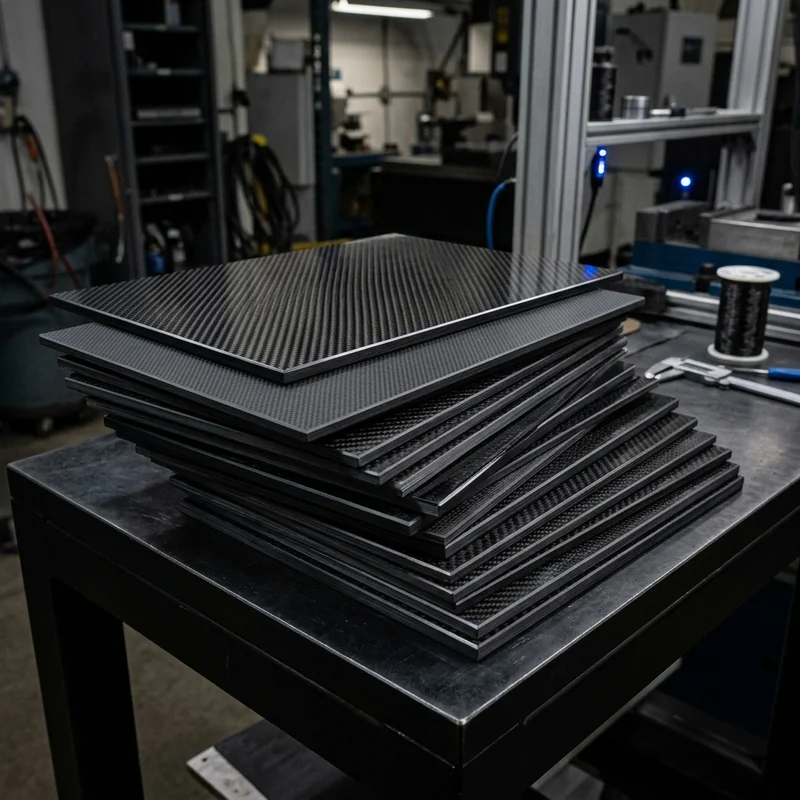
Carbon fiber standard plate-3k stripe
Lightweight, ultra-rigid standard sheets for drone fuselages, robot housings, facades and structural applications.

Carbon Fiber Plate — 3K Twill T700 1.5mm
Thin 1.5mm carbon fiber plate with 3K twill weave surface. Lightweight and stiff, commonly used for covers, panels, drone bodies, and applications requiring a premium aesthetic appearance.

Square Carbon Fiber Tube — 3K Twill T700
Square cross-section carbon fiber tube manufactured with 3K twill weave for torsional strength. Preferred for structural frames, trusses, and support columns where rectangular geometry offers design flexibility.

Carbon Fiber Plate — 3K Twill T700 3.0mm
Medium-thickness 3.0mm carbon fiber plate offering significantly higher load capacity while maintaining attractive 3K twill finish. Suitable for structural brackets, reinforcement plates, and load-bearing panels.
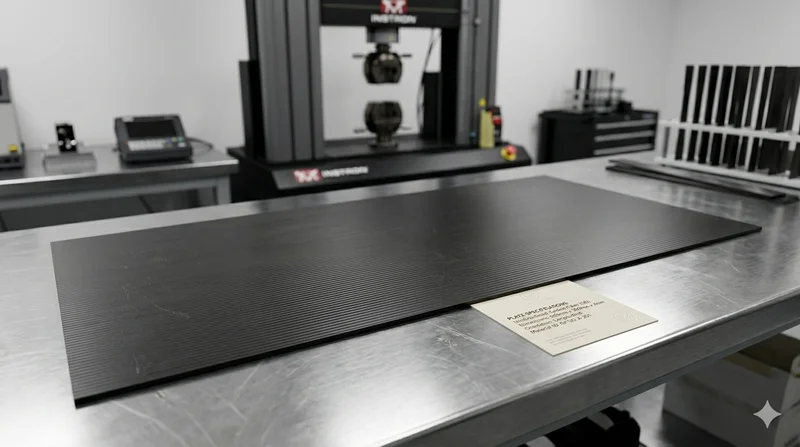
Carbon Fiber Plate — UD Unidirectional T700
Unidirectional carbon fiber plate with all fibers oriented in a single direction for maximum strength along the fiber axis. Essential for structural reinforcements, splints, and applications where load direction is predictable.