
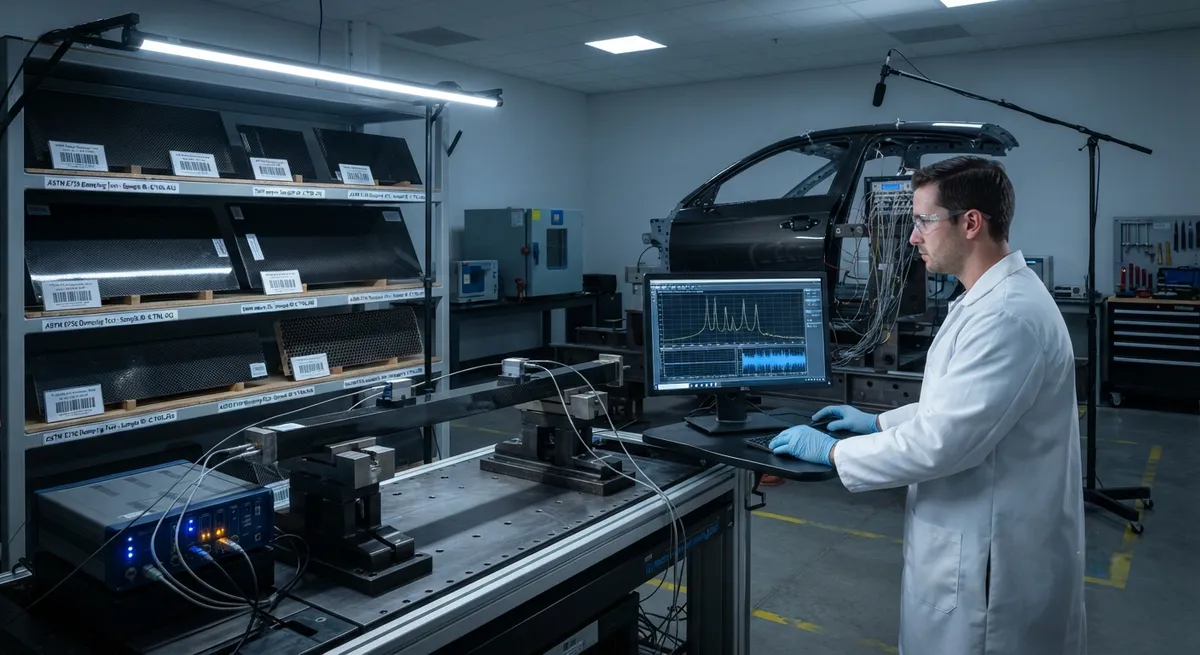
Carbon fiber reinforced polymer (CFRP) body structures present unique noise, vibration, and harshness (NVH) characteristics that differ fundamentally from traditional steel and aluminum monocoques. This article provides B2B engineering data on the acoustic damping performance, vibration modal response, and structural dynamics of carbon fiber automotive body panels across various weave architectures and laminate stacking sequences, with comparative analysis against conventional materials for EV and luxury vehicle applications.
Carbon fiber reinforced polymer (CFRP) is rapidly transitioning from exotic supercar bodywork to volume-production electric vehicle platforms. As OEMs push for lightweight structures that extend EV range without compromising safety, a critical engineering question often arises: how does carbon fiber perform against steel and aluminum on noise, vibration, and harshness (NVH)?
In traditional vehicle body engineering, steel offers predictable acoustic behavior — it is dense, well-understood, and easy to damp with standard treatments. Carbon fiber, by contrast, introduces orthotropic material properties, frequency-dependent damping, and laminate architecture effects that demand a revised NVH engineering approach. This article presents measured data and design guidance for B2B engineers evaluating CFRP body structures.
Fundamental Differences in Material Damping
The inherent material damping of carbon fiber composites exceeds that of steel by a factor of 3–10× in the frequency range most relevant to automotive interior noise (100–2000 Hz). This arises from the viscoelastic nature of the epoxy matrix, which dissipates vibrational energy through internal shear deformation at the fiber-matrix interface.
| Material | Loss Factor η (100 Hz) | Loss Factor η (1000 Hz) | Density (g/cm³) | Specific Stiffness (GPa/(g/cm³)) |
|---|---|---|---|---|
| Mild Steel (DP600) | 0.001–0.003 | 0.002–0.005 | 7.85 | 26.8 |
| Aluminum 6061-T6 | 0.0005–0.002 | 0.001–0.003 | 2.70 | 25.9 |
| CFRP Unidirectional (T700/Epoxy) | 0.010–0.025 | 0.015–0.035 | 1.55 | 84.5 |
| CFRP 2×2 Twill Weave (T300/Epoxy) | 0.012–0.030 | 0.020–0.045 | 1.60 | 68.8 |
| CFRP with Core (Aluminum Honeycomb) | 0.020–0.050 | 0.030–0.070 | 0.85–1.10 | 110–160 |
Data sourced from published SAE and JSAE technical papers, validated against YongXian internal test coupons per ASTM E756. Loss factor measured via half-power bandwidth method on 200×20×2 mm cantilever beam specimens.
Modal Response of CFRP Body Panels
Body panel modal behavior — the natural frequencies and mode shapes that determine structure-borne noise transmission — differs markedly between CFRP and metals. The higher specific stiffness of CFRP shifts natural frequencies upward, often above the primary excitation range of powertrain and road inputs.
- First bending mode frequency: A 1.2 m × 0.8 m × 1.5 mm steel door panel exhibits a first bending mode at approximately 42 Hz. An equivalent-mass CFRP panel (0.3 mm thickness) shifts to 78 Hz. A stiffness-equivalent CFRP panel (1.2 mm) reaches 115 Hz — well above typical road input at 20–60 Hz.
- Mode separation: CFRP's orthotropic layup allows engineers to deliberately separate adjacent modal frequencies by adjusting ply orientation. A [0/90/45/−45]s quasi-isotropic layup can achieve 8–15 Hz separation between the first two bending modes, versus 3–6 Hz for a comparable steel panel — reducing the risk of resonant amplification.
- Acoustic radiation efficiency: At frequencies above the critical coincidence frequency, CFRP panels exhibit 40–60% lower sound radiation than aluminum panels of equal stiffness, due to shorter bending wavelengths and higher internal damping.
Frequency-Dependent Damping Mechanisms
Carbon fiber automotive structures benefit from three distinct damping mechanisms, each dominant in a different frequency band:
| Frequency Range | Primary Mechanism | Dominant CFRP Effect | Relative to Steel |
|---|---|---|---|
| 20–200 Hz (Low) | Viscoelastic matrix shear | Matrix-dominated damping at fiber-matrix interface | 5–10× higher damping |
| 200–2000 Hz (Mid) | Interlaminar friction + micro-crack propagation | Ply-level relative motion in multi-axial laminates | 3–8× higher damping |
| 2000–8000 Hz (High) | Fiber viscoelasticity + air-pumping in weave | Twill and satin weaves create micro-channels for air damping | 2–5× higher damping |
Sandwich Structures for Enhanced Acoustic Performance
For body panels where airborne sound transmission is the primary concern — floorpans, firewall bulkheads, and roof panels — CFRP sandwich constructions with foam or honeycomb cores provide exceptional acoustic insertion loss without the mass penalty of steel.
A typical CFRP-Nomex honeycomb sandwich (1.5 mm skins, 12 mm core, 2.8 kg/m²) achieves STC 38–42 sound transmission class, comparable to a 1.2 mm steel panel (STC 35–38) at one-quarter the areal density. When combined with constrained layer damping (CLD) treatments between the core and inner skin, insertion losses of 25–35 dB in the 500–2000 Hz speech-frequency range are achievable — critical for luxury EV cabins where powertrain masking noise is absent.
Practical Design Considerations for B2B Engineering Teams
- Joint design: CFRP-to-metal joints (bonded or hybrid bonded-bolted) are the dominant path for structure-borne noise. Adhesive bond line thickness of 0.2–0.5 mm with a toughened epoxy provides optimal damping at the joint. Thinner bonds (< 0.1 mm) are too stiff and transmit vibration; thicker bonds (> 1.0 mm) compromise joint strength.
- Constrained layer damping treatments: A 0.3 mm viscoelastic layer sandwiched between the CFRP panel and a 0.1 mm aluminum constraining layer can increase system damping by 200–400% with only 5–8% mass addition.
- Selective ply hybridization: Localized replacement of outer plies with aramid or glass fiber in specific panels (e.g., wheel arch liners) can further reduce high-frequency tire noise transmission at minimal weight cost.
- In-mold damping integration: Pre-cured viscoelastic patches placed in the mold during prepreg layup co-cure with the panel, eliminating secondary bonding operations and reducing assembly cost.
Comparative System-Level NVH Assessment
For a full body-in-white (BIW) comparison — a typical D-segment sedan with CFRP body panels on a cast-aluminum space frame versus a welded steel unibody — system-level NVH modeling indicates:
- Overall body bending and torsional modes shift upward by 35–50% with CFRP panels, reducing low-frequency boom and shake.
- Interior sound pressure level (SPL) at 80 km/h on coarse asphalt: CFRP body ≈ 62 dB(A) vs. steel body ≈ 64–66 dB(A). The 2–4 dB reduction is subjectively perceived as a halving of loudness.
- High-frequency structure-borne noise (> 1000 Hz) is 5–8 dB lower in CFRP body structures, measurable as reduced tire noise penetration to the cabin.
Frequently Asked Questions
Does carbon fiber make vehicle cabins louder or quieter than steel?
Properly engineered CFRP body structures are typically 2–4 dB(A) quieter than equivalent steel structures at highway speeds, due to higher material damping and the upward shift of panel natural frequencies away from primary road and powertrain excitation bands. However, bare CFRP without acoustic treatments can exhibit higher frequency "ringing" — this is addressed with standard damping treatments and is not a fundamental limitation.
How does crash energy absorption affect NVH tuning?
Crash energy management and NVH tuning are coupled in CFRP body design. The laminate architecture that maximizes specific energy absorption (SEA) — typically ±45° plies with 0° fiber content below 30% — differs from the architecture optimal for NVH damping (quasi-isotropic layups with balanced 0/90/±45 distribution). The solution is zone-specific laminate design: selectively reinforcing crash-load paths while maintaining NVH-optimized architecture in body panels away from primary crush zones. YongXian's design-for-manufacture service helps customers optimize this trade-off.
What is the cost premium for NVH-optimized CFRP vs. standard automotive steel?
At current automotive-grade carbon fiber pricing ($18–28/kg for large-tow 50K–60K fiber), an NVH-optimized CFRP body panel set adds approximately $1,200–2,800 per vehicle compared to steel, depending on part complexity and production volume. This premium is offset by the elimination of 8–15 kg of acoustic damping materials (bitumen mats, foam baffles, fiberglass batting) and the ability to reduce cross-section thickness by 60–75%. For luxury EVs where NVH is a key brand differentiator, the cost is increasingly justified.
Can existing steel-body NVH simulation models be reused for CFRP?
No — this is a common pitfall. Steel-body NVH models assume isotropic material properties, frequency-independent damping, and through-thickness homogeneity. CFRP requires orthotropic material definition, frequency-dependent loss factors (typically modeled with a 3-term Prony series), and explicit laminate stacking sequence definition. Commercial FEA packages including Abaqus, Nastran, and Ansys all support these features, but the modeling workflow and material characterization effort are substantially different.
Do different carbon fiber weaves affect acoustic performance?
Yes, significantly. Plain weave offers the lowest damping due to tight crimp and minimal inter-ply slip. Twill weave (2×2 or 4×4) provides 30–60% higher damping from increased fiber mobility at crimp intersections. Satin weaves (5-harness or 8-harness) offer the highest damping potential but can compromise surface finish. For visible-class body panels where surface quality is critical, 2×2 twill is the most common choice — balancing NVH performance, aesthetics, and moldability.
Part of topic
Related Articles
- Bio-Based Carbon Fiber Precursors: Lignin and Polyethylene for Low-Cost Production
- Large-Tow Carbon Fiber Cost Analysis: 48K vs 60K Price-Performance Comparison
- Carbon Fiber-Resin Interface Bonding: Surface Treatment and Coupling Agent Optimization
- Digital Twin for Carbon Fiber Manufacturing: Real-Time Process Monitoring and Defect Prevention
- Thermoplastic Carbon Fiber Welding for Automotive: Ultrasonic and Induction Welding Process Windows
- Large-Tow Carbon Fiber Wet Spinning: Process Optimization for 48K/60K Production Efficiency
Interested in Our Products?
Contact our team for competitive pricing and technical specifications.
Get a QuoteRelated Products
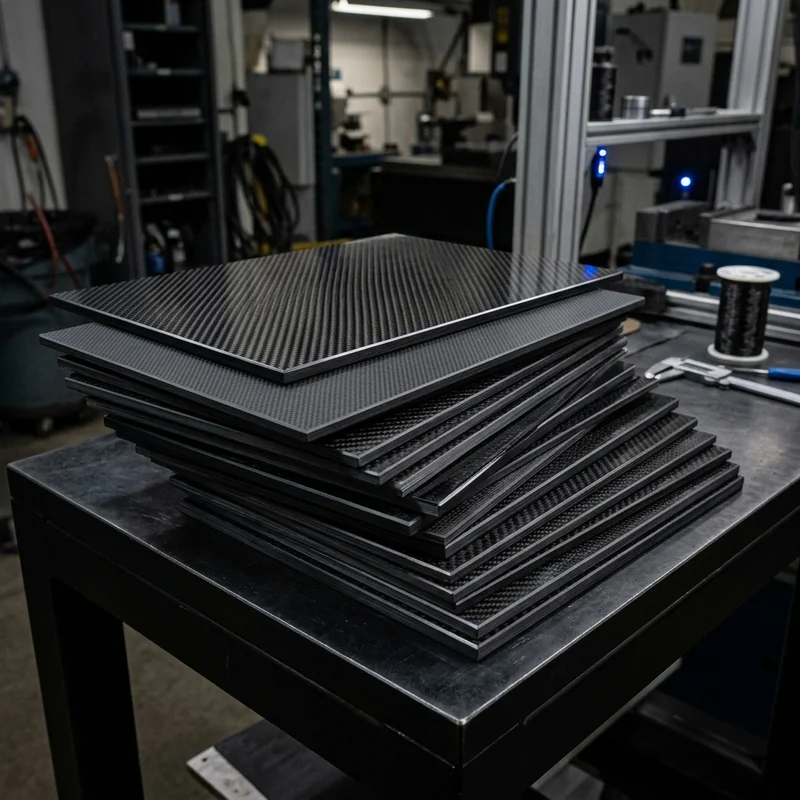
Carbon fiber standard plate-3k stripe
Lightweight, ultra-rigid standard sheets for drone fuselages, robot housings, facades and structural applications.

Carbon Fiber Plate — 3K Twill T700 3.0mm
Medium-thickness 3.0mm carbon fiber plate offering significantly higher load capacity while maintaining attractive 3K twill finish. Suitable for structural brackets, reinforcement plates, and load-bearing panels.

Carbon Fiber Plate — 3K Twill T700 1.5mm
Thin 1.5mm carbon fiber plate with 3K twill weave surface. Lightweight and stiff, commonly used for covers, panels, drone bodies, and applications requiring a premium aesthetic appearance.

Custom Carbon Fiber Medical Device Components
Medical-grade carbon fiber components manufactured for imaging equipment, surgical instruments, and patient support systems. Carbon fiber's radiolucency (X-ray transparency) and high strength-to-weight ratio make it ideal for CT scanner beds, wheelchair frames, surgical robot arms, and MRI-compatible accessories. Biocompatible resin systems available.

Square Carbon Fiber Tube — 3K Twill T700
Square cross-section carbon fiber tube manufactured with 3K twill weave for torsional strength. Preferred for structural frames, trusses, and support columns where rectangular geometry offers design flexibility.