
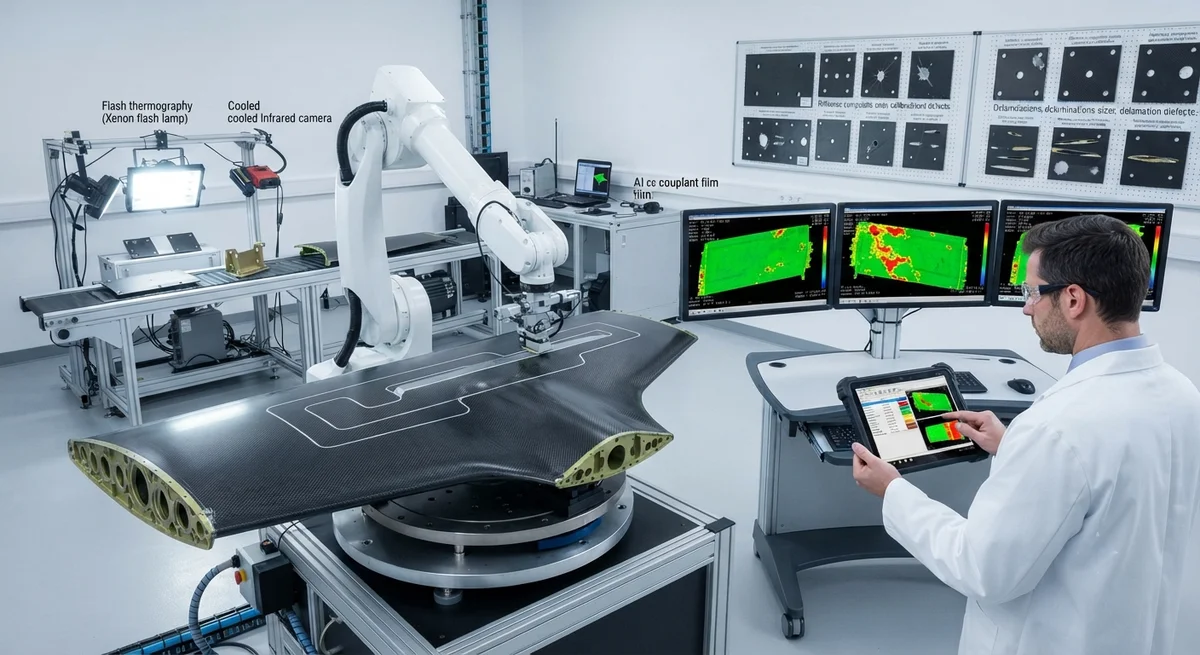
Learn how AI-powered non-destructive testing revolutionizes carbon fiber quality control through automated defect detection, real-time monitoring, and machine learning analysis of ultrasonic and thermographic data.
Introduction: The Quality Control Challenge in Composites Manufacturing
Non-destructive testing (NDT) is a critical bottleneck in carbon fiber composite manufacturing. Unlike metallic components, where defects are often visible or detectable through simple visual inspection and dimensional measurements, composite materials harbor hidden internal defects — delaminations, porosity, fiber waviness, disbonds, and inclusions — that can drastically reduce structural performance without any external indication. Traditional NDT methods, including ultrasonic testing, X-ray computed tomography, and thermography, require trained operators to manually interpret complex data streams, a process that is slow, subjective, and increasingly inadequate for high-volume production. The emergence of AI-powered NDT systems is transforming this landscape, enabling automated defect detection, classification, and quantification at speeds and accuracies that surpass human capability. This article examines the state of the art in AI-driven non-destructive testing for carbon fiber composites, covering the underlying technologies, real-world implementation case studies, economic impact analysis, and future development trajectories that are reshaping quality assurance in composites manufacturing.
NDT Modalities and AI Integration Approaches
Several NDT modalities are being enhanced with artificial intelligence, each suited to different defect types and production stages. Ultrasonic testing (UT), the most widely used NDT method for composites, uses high-frequency sound waves (1–50 MHz) to detect internal flaws. AI-enhanced UT systems employ convolutional neural networks (CNNs) to analyze C-scan images, achieving defect detection accuracies of 95–99% for delaminations and porosity, compared to 80–90% for human operators. Thermographic testing captures infrared images of composite structures as they cool after thermal excitation — AI algorithms analyze thermal contrast patterns to identify subsurface defects at rates of 0.5–2 m² per minute, enabling 100% inline inspection. X-ray CT scanning produces volumetric data that AI systems can segment and classify in minutes rather than the hours required for manual analysis. Shearography, laser-based vibration analysis, and acoustic emission monitoring are also being integrated with machine learning pipelines to provide comprehensive, multi-modal defect detection coverage.
Performance Comparison: AI-NDT vs. Traditional Methods
| Parameter | AI-Enhanced UT | Traditional UT | AI Thermography | Manual Visual Inspection |
|---|---|---|---|---|
| Defect Detection Accuracy | 97–99% | 80–90% | 93–97% | 60–75% |
| False Positive Rate | 1–3% | 5–15% | 3–5% | 8–20% |
| Inspection Speed | 0.5–2 m²/min | 0.1–0.3 m²/min | 0.5–2 m²/min | 0.05–0.15 m²/min |
| Minimum Detectable Defect Size | 0.2–0.5 mm | 0.5–1.0 mm | 0.5–1.5 mm | 1.0–3.0 mm (surface only) |
| Operator Training Required | 2–4 weeks (AI tool) | 6–12 months (certified) | 1–3 weeks | 2–4 weeks |
| Defect Classification Capability | 10–15 types (delam, porosity, waviness, etc.) | 5–8 types | 6–10 types | 3–5 types (surface only) |
| Quantitative Porosity Measurement | ±0.5% accuracy | ±2–3% accuracy | ±1–2% | Not possible |
| Inline Production Integration | Yes (robotic scanner) | Limited (manual scan) | Yes (stationary array) | Yes (labor-intensive) |
| Per-Part Inspection Cost | $3–12 | $15–45 | $2–8 | $5–20 |
| Data Storage per Part | 50–200 MB | 100–500 MB (raw) | 10–50 MB | Minimal (paper records) |
Deep Learning Architectures for Defect Detection
The application of deep learning to composite NDT has advanced rapidly over the past five years, with several architectural approaches proving particularly effective. Convolutional neural networks (CNNs) remain the workhorse for image-based NDT data — architectures such as U-Net, ResNet, and EfficientNet have been adapted for composite inspection, achieving pixel-level segmentation of defects in ultrasonic C-scans and thermographic images. More recently, transformer-based architectures have demonstrated superior performance on volumetric data from X-ray CT scans, capturing long-range spatial relationships that CNNs struggle with. Generative adversarial networks (GANs) are being used for data augmentation — generating synthetic defect images to train models on rare defect types that are underrepresented in production data. Transfer learning, where models pre-trained on large natural image datasets (ImageNet, etc.) are fine-tuned on relatively small NDT datasets, has proven particularly valuable for composite manufacturers who lack the millions of labeled images typically required for deep learning. Active learning frameworks that identify the most informative samples for human labeling have reduced the annotation burden by 60–80%, making AI-NDT deployment feasible for small and medium-sized composite manufacturers.
Real-World Implementation Case Studies
Leading aerospace composite manufacturers have been at the forefront of AI-NDT adoption. Boeing has deployed AI-enhanced ultrasonic inspection systems at its composite wing production facilities for the 787 Dreamliner and 777X programs, reporting a 40% reduction in inspection time and a 60% reduction in false positive calls that previously required expensive secondary inspections. Airbus has implemented AI-based thermographic inspection for its A350 fuselage panel production line in Illescas, Spain, achieving 100% inline inspection coverage at full production speed. In the automotive sector, carbon fiber wheel manufacturers including Carbon Revolution and ESE Carbon have adopted AI-powered vision inspection systems that combine visible-light, ultraviolet, and thermographic imaging to detect surface and subsurface defects at rates of one wheel every 30–45 seconds. Wind turbine blade manufacturers — including Vestas, Siemens Gamesa, and LM Wind Power — are deploying AI-UT systems for blade spar cap inspection, where the large inspection areas (up to 100 m² per blade) make manual inspection impractical. The wind energy sector has been a particularly strong adopter, with AI-NDT systems reducing blade inspection time from 8–12 hours to 45–90 minutes per blade.
Economic Impact and ROI Analysis
The economic case for AI-powered NDT in carbon fiber manufacturing is compelling across multiple value drivers. Direct labor cost reduction is the most immediately quantifiable benefit — automated inspection systems can replace 2–4 NDT technicians per shift, saving $150,000–300,000 annually per inspection station. Scrap reduction is a larger value driver: AI systems catch defects earlier in the production process, before expensive downstream operations (machining, painting, assembly) have been performed on defective parts. Early defect detection reduces manufacturing scrap costs by 25–40%, which for a facility producing 10,000 composite parts annually at an average value of $500 per part translates to $1.25–2 million in annual savings. Reduced rework costs, improved first-pass yield (from 85% to 95%+ in documented cases), and lower warranty and liability exposure provide additional economic benefits. Total ROI for AI-NDT system deployment is typically achieved within 8–14 months for high-volume production facilities, with annual returns of 200–400% on the initial investment over the system's 5–7 year operating life.
Implementation Challenges and Solutions
- Data scarcity and annotation burden: Defect datasets in composites are inherently limited — defects are rare events in well-controlled production environments. Synthetic data generation and transfer learning address this, reducing required real defect images from thousands to hundreds.
- Model generalization across geometries: A model trained on flat panel inspections may not perform well on curved or complex-geometry parts. Multi-modal training approaches that incorporate CAD geometry data alongside inspection data are improving cross-geometry generalization.
- Regulatory and certification hurdles: Aerospace and defense applications require NDT processes to be certified and validated — AI systems face additional scrutiny because their decision-making is not fully transparent. Explainable AI techniques (saliency maps, gradient-weighted class activation mapping) are being developed to address certification requirements.
- Integration with existing MES and ERP systems: AI-NDT outputs must feed into manufacturing execution systems for real process adjustment. Standardized data interchange formats (e.g., DICONDE for NDT data) and API-driven integration frameworks are critical for seamless deployment.
- Operator trust and workflow integration: Experienced NDT technicians are often skeptical of AI systems. Gradual deployment approaches that position AI as a decision support tool rather than a replacement, combined with transparent confidence metrics, improve adoption rates.
Future Directions: Next-Generation AI-NDT Technologies
Several emerging technologies promise to further advance AI-powered NDT for carbon fiber composites. In-process monitoring — integrating sensors directly into the composite manufacturing process for real-time defect detection during layup, cure, and consolidation — is moving from research labs to early industrial deployment. Dielectric sensors, fiber optic strain sensors, and embedded ultrasonic transducers can feed continuous data streams to AI models that detect anomalies as they occur, enabling closed-loop process correction before defects are locked into the final part. Digital twin frameworks that combine physics-based process simulation with real-time sensor data and AI defect prediction models are being developed by major aerospace OEMs. Edge computing architectures that perform AI inference directly on the inspection device — rather than sending data to cloud servers — are reducing latency and addressing data security concerns. Multi-modal fusion models that simultaneously analyze data from ultrasonic, thermographic, and visual inspection cameras promise to achieve defect detection accuracies approaching 99.9% while reducing inspection cycle times by an additional 30–50% over current AI-NDT systems. As carbon fiber production volumes continue to grow across aerospace, automotive, wind energy, and consumer goods sectors, AI-powered NDT will become an increasingly essential component of cost-effective, high-quality composites manufacturing.
Frequently Asked Questions
How accurate is AI-based defect detection compared to human inspectors?
AI-enhanced NDT systems achieve 97–99% defect detection accuracy for common defect types including delaminations and porosity, compared to 80–90% for experienced human operators. AI systems also maintain consistent performance throughout long production runs, while human accuracy degrades with fatigue.
What types of defects can AI-powered NDT detect in carbon fiber composites?
AI systems can detect and classify 10–15 distinct defect types including delaminations, porosity, fiber waviness, disbonds, inclusions, thickness variations, impact damage, matrix cracking, fiber breakage, and thermal degradation. Classification capabilities are continuously expanding as training datasets grow.
How much does an AI-NDT system cost to deploy?
A complete AI-NDT workcell for composites inspection costs $80,000–250,000 depending on the NDT modality (UT, thermography, or multi-modal), scanning area, and automation level. The investment is typically recovered within 8–14 months through labor savings and scrap reduction.
Can AI-NDT systems be certified for aerospace applications?
Yes, but certification requires additional validation steps compared to traditional NDT. Several AI-NDT systems have received aerospace certification (NAS 410, EN 4179) for specific inspection applications. Explainable AI techniques are being developed to address transparency requirements in the certification process.
Part of topic
Related Articles
- Bio-Based Carbon Fiber Precursors: Lignin and Polyethylene for Low-Cost Production
- Large-Tow Carbon Fiber Cost Analysis: 48K vs 60K Price-Performance Comparison
- Carbon Fiber-Resin Interface Bonding: Surface Treatment and Coupling Agent Optimization
- Digital Twin for Carbon Fiber Manufacturing: Real-Time Process Monitoring and Defect Prevention
- Thermoplastic Carbon Fiber Welding for Automotive: Ultrasonic and Induction Welding Process Windows
- Large-Tow Carbon Fiber Wet Spinning: Process Optimization for 48K/60K Production Efficiency
Interested in Our Products?
Contact our team for competitive pricing and technical specifications.
Get a QuoteRelated Products
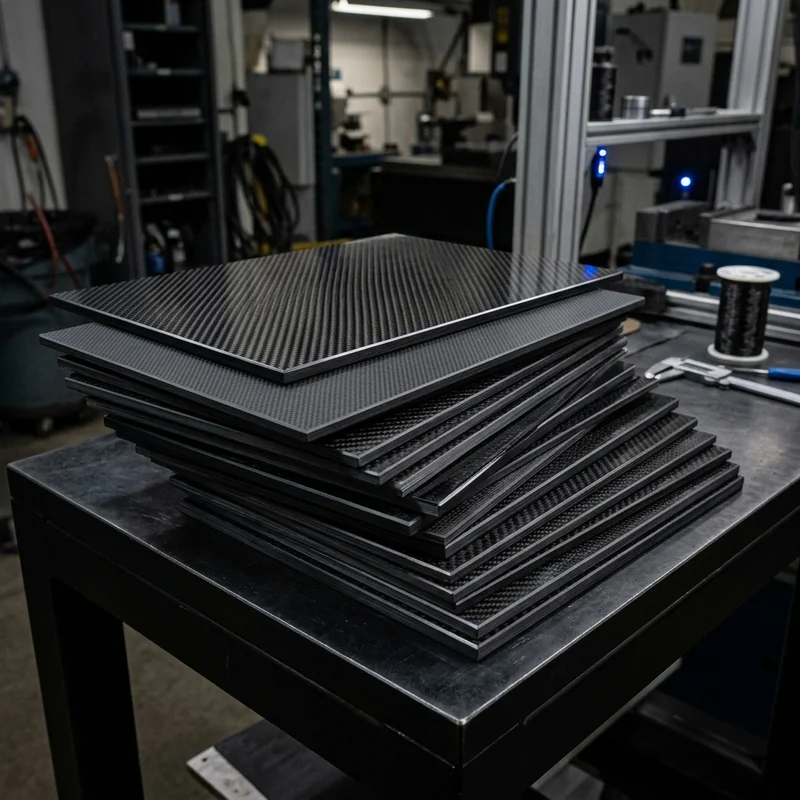
Carbon fiber standard plate-3k stripe
Lightweight, ultra-rigid standard sheets for drone fuselages, robot housings, facades and structural applications.

Carbon Fiber Plate — 3K Twill T700 1.5mm
Thin 1.5mm carbon fiber plate with 3K twill weave surface. Lightweight and stiff, commonly used for covers, panels, drone bodies, and applications requiring a premium aesthetic appearance.

Square Carbon Fiber Tube — 3K Twill T700
Square cross-section carbon fiber tube manufactured with 3K twill weave for torsional strength. Preferred for structural frames, trusses, and support columns where rectangular geometry offers design flexibility.

Carbon Fiber Plate — 3K Twill T700 3.0mm
Medium-thickness 3.0mm carbon fiber plate offering significantly higher load capacity while maintaining attractive 3K twill finish. Suitable for structural brackets, reinforcement plates, and load-bearing panels.
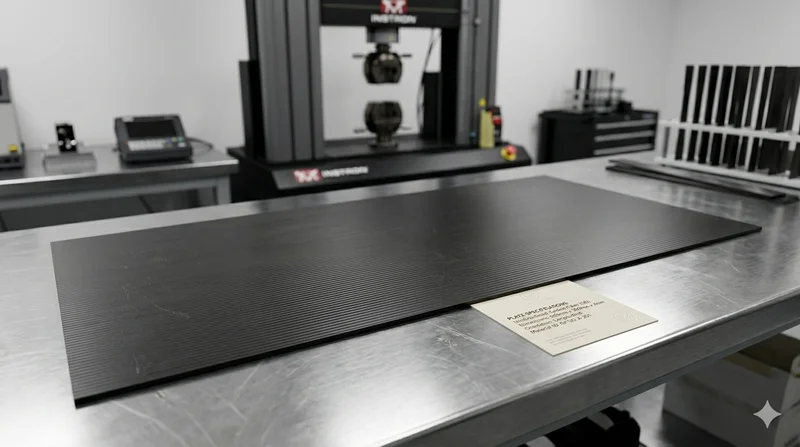
Carbon Fiber Plate — UD Unidirectional T700
Unidirectional carbon fiber plate with all fibers oriented in a single direction for maximum strength along the fiber axis. Essential for structural reinforcements, splints, and applications where load direction is predictable.