
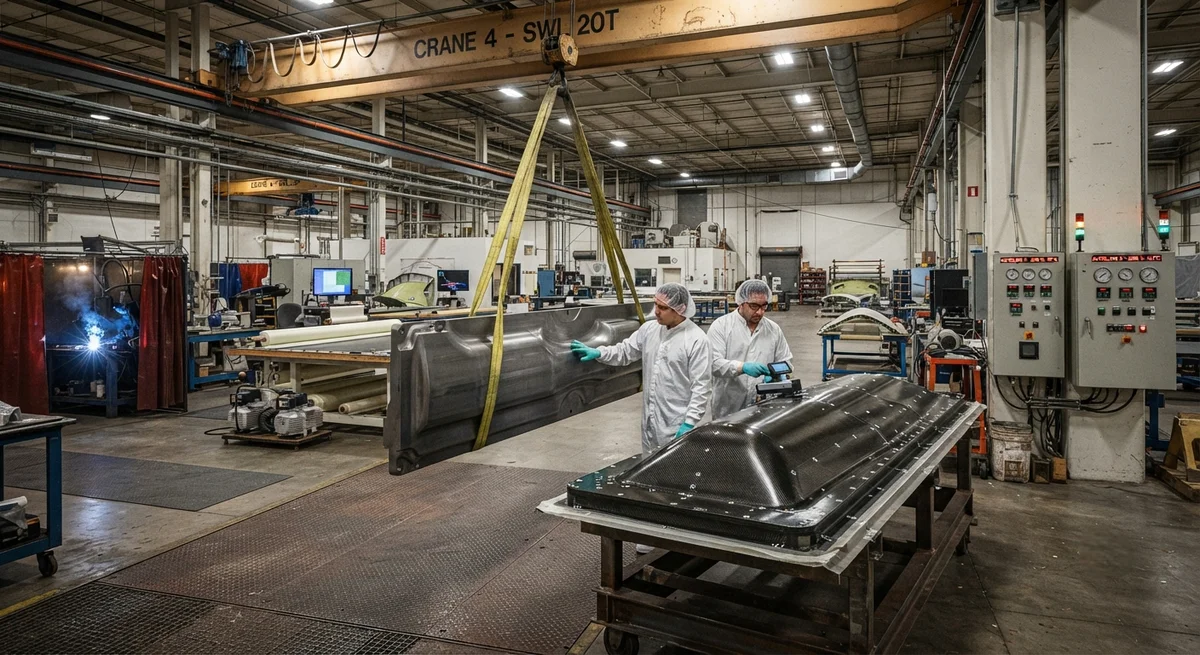
Aerospace autoclave curing requires tooling that can withstand 180–400°C thermal cycles while maintaining dimensional stability within ±0.1 mm/m. This article compares Invar 36 and carbon fiber composite tooling across material properties, cost, lead time, and total cost of ownership for procurement engineers.
Introduction
Aerospace autoclave curing of carbon fiber composites requires tooling that can withstand repeated thermal cycles at 180–400°C while maintaining dimensional stability within ±0.1 mm per metre. For decades, Invar 36 (Fe-36Ni alloy) has been the industry-standard tooling material due to its exceptionally low coefficient of thermal expansion (CTE) of approximately 1.2–1.5 ppm/°C — closely matching carbon fiber composites. However, carbon fiber composite tooling has emerged as a compelling alternative, offering significant reductions in weight, thermal mass, and lead time.
This article provides a rigorous technical and economic comparison of Invar 36 and carbon fiber composite tooling for aerospace autoclave curing applications, enabling procurement engineers and manufacturing managers to make data-driven decisions for their specific production requirements.
Material Property Comparison
| Property | Invar 36 | Carbon Fiber Composite Tooling | Advantage |
|---|---|---|---|
| Density (g/cm³) | 8.05 | 1.55–1.65 | CF — 5× lighter |
| CTE (ppm/°C, 20–200°C) | 1.2–1.5 | 0.5–2.0 (ply-orientation dependent) | Comparable with proper design |
| Thermal conductivity (W/m·K) | 10–11 | 0.5–0.8 (through-thickness), 5–40 (in-plane) | Invar — more uniform heat transfer |
| Maximum service temperature (°C) | 400+ | 200–350 (resin dependent) | Invar — higher limit |
| Tensile modulus (GPa) | 141 | 70–230 (quasi-isotropic to unidirectional) | Application dependent |
| Thermal mass (kJ/kg·K) | 0.515 | 0.80–1.00 | Invar — faster heat-up |
| Fatigue life (cycles at 200°C) | >10⁶ | >10⁶ (with proper matrix selection) | Comparable |
| Surface hardness | HB 140-200 | Variable (coating dependent) | Invar — more durable |
Cost and Lead Time Comparison
| Factor | Invar 36 | CF Composite Tooling | Cost Impact |
|---|---|---|---|
| Raw material cost ($/kg) | $25–45 | $60–120 (prepreg) | Invar raw material lower |
| Fabrication labour (hours) | 400–800 | 200–350 | CF — 50–60% less labour |
| Lead time (weeks) | 12–20 | 6–10 | CF — 40–50% faster |
| Tool weight for 2m×1m part (kg) | 800–1,200 | 150–250 | CF — 75–80% lighter |
| Autoclave cycle energy (MJ/cycle) | 3,200–4,800 | 600–1,000 | CF — 75–80% less energy |
| Repair cost (% of initial cost) | 15–25% | 10–20% | Comparable |
| Expected tool life (cycles) | 500–1,000+ | 200–500 (resin dependent) | Invar — longer life |
Key Selection Criteria
When to Choose Invar 36
- High-temperature cure cycles (>200°C): BMI and cyanate ester prepregs requiring cure temperatures above 200°C demand Invar tooling, as most epoxy-based composite tooling materials degrade above 200°C.
- Extremely high production volumes (>500 cure cycles): The longer tool life of Invar (500–1,000+ cycles versus 200–500 for CF composite) justifies the higher initial investment in high-rate production programs such as narrow-body aircraft fuselage sections.
- Complex geometries with tight tolerances: Invar's isotropic CTE behaviour provides more predictable dimensional control for intricate tool shapes with compound curvatures.
- Existing handling equipment designed for heavy tools: Facilities already equipped with overhead cranes and heavy-duty tool carts can accommodate Invar tooling without capital expenditure on new material handling systems.
When to Choose Carbon Fiber Composite Tooling
- Low-to-medium production volumes (50–300 cycles): The shorter tool life of CF composite tooling is acceptable for prototyping, pre-production, and low-rate production programs.
- Large, simple-geometry parts: For parts such as wing skins, fuselage panels, and fairings, the weight savings (75–80%) translate to significantly reduced autoclave energy consumption and faster heat-up/cool-down rates.
- Programs with compressed development schedules: Six-to-ten-week lead times versus 12–20 weeks for Invar are critical for new aircraft development programs and aftermarket part qualification.
- Energy-conscious manufacturing operations: The 75–80% reduction in autoclave energy consumption per cycle aligns with sustainability targets and reduces operating costs by $12,000–$25,000 per year per large tool.
Case Study: Wing Skin Tooling Comparison
A Tier 1 aerospace supplier evaluated both Invar and CF composite tooling for a 4-metre wing skin for a business jet program with an anticipated production run of 300 units over 5 years. The Invar tool weighed 1,050 kg with a 16-week lead time and a fabrication cost of $185,000. The CF composite tool weighed 210 kg with an 8-week lead time and a fabrication cost of $148,000. Total cost of ownership over the program life, factoring in energy costs, handling costs, and tool refurbishment, was $296,000 for Invar and $207,000 for CF composite — a 30% saving with the composite tool.
FAQ
Q: Can carbon fiber composite tooling withstand BMI cure cycles at 210°C?
Yes, but only if the composite tooling is fabricated using a high-temperature BMI or cyanate ester resin system rated for the intended cure temperature. Epoxy-based tooling prepregs typically have a maximum service temperature of 190–200°C. For BMI cycles at 210°C, a BMI-based tooling prepreg such as CYCOM® 5250-4 or HexPly® M61 is required, which increases tooling material cost by 30–50% over standard epoxy tooling prepreg.Q: How many vacuum bagging cycles can a CF composite tool endure before needing refurbishment?
With proper surface coating (nickel or aluminium spray metal coating), CF composite tools typically achieve 200–500 cycles. Uncoated tools may require surface rework after 50–100 cycles due to porosity and surface degradation. Invar tools, by comparison, routinely achieve 1,000+ cycles before major refurbishment.Q: What is the recommended surface coating for CF composite tooling?
The most common surface coatings are: (1) nickel spray metal coating (0.3–0.5 mm), offering excellent abrasion resistance and surface finish; (2) aluminium-filled epoxy surfacing film, applied during tool fabrication; and (3) CVD diamond-like carbon (DLC) coating for ultra-high release performance. The selection depends on cure temperature, required surface finish, and budget.Q: How does the CTE mismatch between CF tooling and the composite part affect dimensional accuracy?
When both the tool and the part are made from carbon fiber composites with matched fibre architecture, the CTE can be tuned to be nearly identical (within ±0.3 ppm/°C), minimising thermal stress during cool-down. This is one of the key advantages of CF composite tooling — the tool CTE and part CTE can be designed to match, whereas Invar tooling and a carbon fiber part have a CTE mismatch of approximately 0.2–0.5 ppm/°C that must be accounted for in the part dimensional tolerance budget.Q: Is CF composite tooling suitable for out-of-autoclave (OOA) curing processes?
Yes, CF composite tooling is particularly well-suited for OOA processes such as vacuum-bag-only (VBO) curing and Quickstep, where the lower thermal mass of the tool enables rapid temperature ramps (3–5°C/min vs 1–2°C/min for Invar), reducing overall cycle time by 30–45%.Part of topic
Related Articles
- Bio-Based Carbon Fiber Precursors: Lignin and Polyethylene for Low-Cost Production
- Large-Tow Carbon Fiber Cost Analysis: 48K vs 60K Price-Performance Comparison
- Carbon Fiber-Resin Interface Bonding: Surface Treatment and Coupling Agent Optimization
- Digital Twin for Carbon Fiber Manufacturing: Real-Time Process Monitoring and Defect Prevention
- Thermoplastic Carbon Fiber Welding for Automotive: Ultrasonic and Induction Welding Process Windows
- Large-Tow Carbon Fiber Wet Spinning: Process Optimization for 48K/60K Production Efficiency
Interested in Our Products?
Contact our team for competitive pricing and technical specifications.
Get a QuoteRelated Products
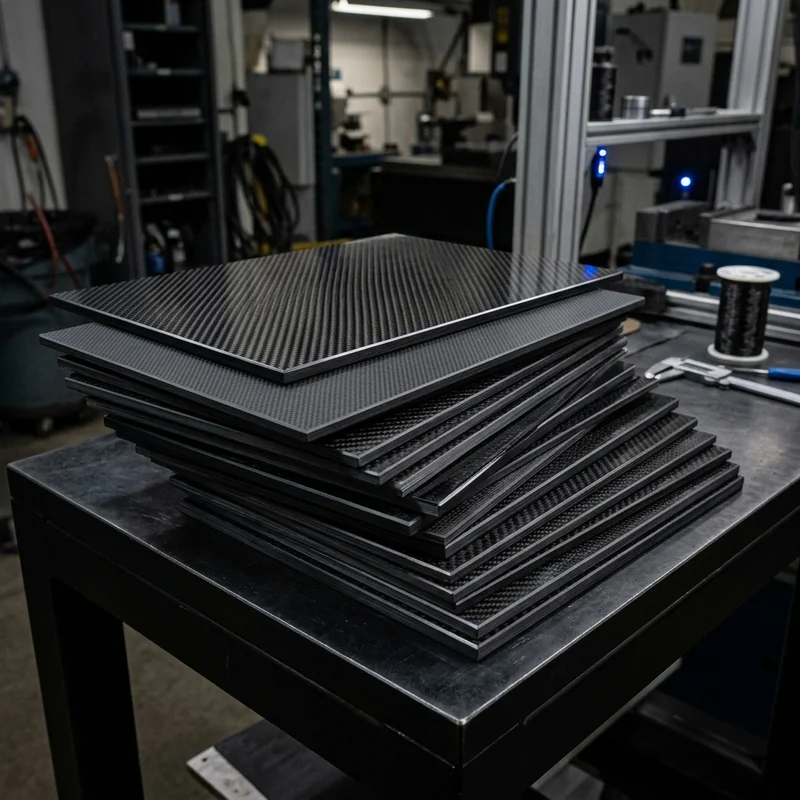
Carbon fiber standard plate-3k stripe
Lightweight, ultra-rigid standard sheets for drone fuselages, robot housings, facades and structural applications.

Carbon Fiber Plate — 3K Twill T700 1.5mm
Thin 1.5mm carbon fiber plate with 3K twill weave surface. Lightweight and stiff, commonly used for covers, panels, drone bodies, and applications requiring a premium aesthetic appearance.

Square Carbon Fiber Tube — 3K Twill T700
Square cross-section carbon fiber tube manufactured with 3K twill weave for torsional strength. Preferred for structural frames, trusses, and support columns where rectangular geometry offers design flexibility.

Carbon Fiber Plate — 3K Twill T700 3.0mm
Medium-thickness 3.0mm carbon fiber plate offering significantly higher load capacity while maintaining attractive 3K twill finish. Suitable for structural brackets, reinforcement plates, and load-bearing panels.
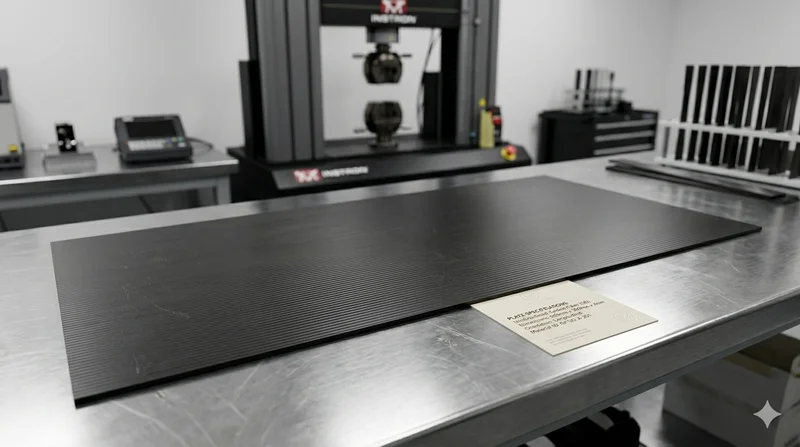
Carbon Fiber Plate — UD Unidirectional T700
Unidirectional carbon fiber plate with all fibers oriented in a single direction for maximum strength along the fiber axis. Essential for structural reinforcements, splints, and applications where load direction is predictable.