
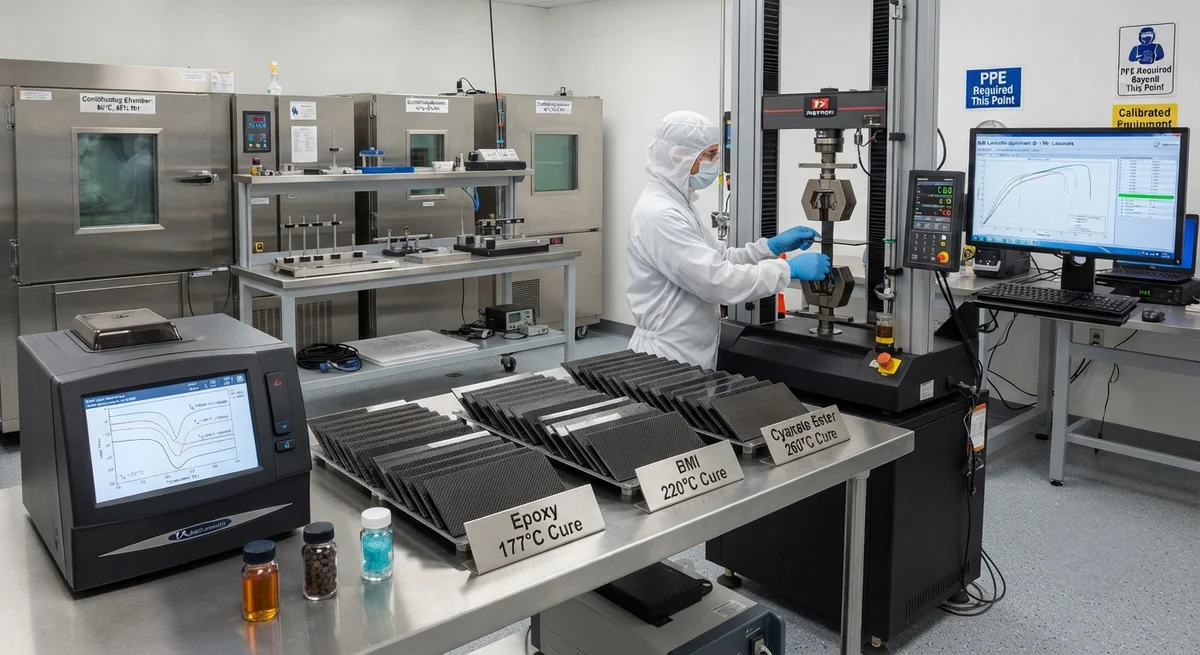
For aerospace-grade carbon fiber composites, three resin families dominate: epoxy, bismaleimide (BMI), and cyanate ester. Each offers a distinct balance of thermal performance, mechanical toughness, moisture resistance, and processing cost.
Introduction
The resin matrix is the silent partner in every carbon fiber composite: it transfers load between fibres, protects them from environmental degradation, and determines the composite's maximum service temperature, toughness, and manufacturing processability. For aerospace-grade carbon fiber composites, three resin families dominate: epoxy, bismaleimide (BMI), and cyanate ester. Each offers a distinct balance of thermal performance, mechanical toughness, moisture resistance, and processing cost.
This article provides a structured comparison of these three matrix systems for procurement engineers, design authorities, and composite process engineers evaluating materials for airframe, engine nacelle, satellite, and hypersonic vehicle applications.
Comparative Property Analysis
| Property | Epoxy (175°C Cure) | BMI (200°C Cure) | Cyanate Ester (250°C Cure) |
|---|---|---|---|
| Tg (dry, DMA) | 190–220°C | 250–320°C | 280–400°C |
| Service temp (hot-wet) | 130–177°C | 200–230°C | 200–350°C |
| Tensile modulus | 3.5–4.0 GPa | 3.8–4.5 GPa | 2.8–3.3 GPa |
| Fracture toughness (G1c) | 200–600 J/m² | 150–300 J/m² | 100–200 J/m² |
| Moisture uptake (saturation) | 1.2–2.0% | 0.8–1.5% | 0.4–0.8% |
| Dielectric constant (10 GHz) | 3.0–3.8 | 2.9–3.4 | 2.5–2.8 |
| Outgassing (TML, ASTM E595) | 0.8–1.2% | 0.5–0.8% | 0.2–0.5% |
Epoxy: Best for Primary Airframe Structure
- Advantage: Highest toughness; longest out-life (15–30 days); most extensive processing database; lowest capital tooling cost
- Limitation: Upper service temperature limited to 177°C hot-wet; higher moisture uptake than BMI or CE
- Best suited for: Fuselage, wing skins, spars, ribs, floor beams, control surfaces (subsonic)
BMI: Best for High-Temperature Engine-Area Structures
- Advantage: Hot-wet service up to 230°C; low moisture uptake (0.8–1.5%); good retention of mechanical properties after 1,000+ thermal cycles
- Limitation: Lower fracture toughness than epoxy (150–300 J/m²); shorter out-life (10–20 days); requires higher autoclave temperatures and INVAR tooling
- Best suited for: Engine nacelles, thrust reversers, fan cowls, APU doors, supersonic airframe skins
Cyanate Ester: Best for Space, Radome, and Hypersonic Applications
- Advantage: Highest Tg (280–400°C); lowest moisture uptake (0.4–0.8%); lowest dielectric constant (2.5–2.8); lowest outgassing (TML < 0.5%)
- Limitation: Lowest fracture toughness (100–200 J/m²); highest cure temperature (250–280°C); most expensive — typically 3–8× the cost of aerospace epoxy per kg
- Best suited for: Satellite structures, radomes, antenna housings, cryogenic tanks, hypersonic vehicle skins, electronic enclosures
Cost Comparison
| Cost Factor | Epoxy | BMI | Cyanate Ester |
|---|---|---|---|
| Raw material cost (prepreg, $/kg) | $45–90 | $90–200 | $250–700 |
| Tooling cost (normalised) | 1.0× | 1.3–1.6× | 1.8–3.0× |
| Autoclave cycle cost ($/hour) | $120–250 | $150–320 | $200–450 |
| Scrap/rework rate | 3–6% | 5–10% | 8–15% |
| Estimated total cost per kg cured composite | $120–280 | $250–500 | $550–1,200 |
Selection Decision Matrix
Q: What is the maximum hot-wet service temperature I need?
If below 177°C, epoxy meets the requirement at lowest cost. Between 177°C and 230°C, BMI is appropriate. Above 230°C, cyanate ester is necessary.Q: Is the composite part in a RF-transparent zone?
If yes, cyanate ester is almost always the correct choice. Its dielectric constant (2.5–2.8) is significantly lower than epoxy (3.0–3.8), resulting in 15–25% lower RF signal loss.Q: What is my budget per kg of cured composite?
If under $300/kg, epoxy is the choice. Between $300–500/kg, both epoxy and BMI are options. Above $500/kg, all three families are available.Q: Does the structure require survivability after lightning strike?
Epoxy systems with thermoplastic toughening offer the best damage tolerance. BMI and cyanate ester have lower fracture toughness.Q: Can I use different matrices for co-cured assemblies?
Co-curing different resin systems is generally not recommended due to mismatched cure kinetics and thermal expansion behaviour.Part of topic
Related Articles
- Bio-Based Carbon Fiber Precursors: Lignin and Polyethylene for Low-Cost Production
- Large-Tow Carbon Fiber Cost Analysis: 48K vs 60K Price-Performance Comparison
- Carbon Fiber-Resin Interface Bonding: Surface Treatment and Coupling Agent Optimization
- Digital Twin for Carbon Fiber Manufacturing: Real-Time Process Monitoring and Defect Prevention
- Thermoplastic Carbon Fiber Welding for Automotive: Ultrasonic and Induction Welding Process Windows
- Large-Tow Carbon Fiber Wet Spinning: Process Optimization for 48K/60K Production Efficiency
Interested in Our Products?
Contact our team for competitive pricing and technical specifications.
Get a QuoteRelated Products
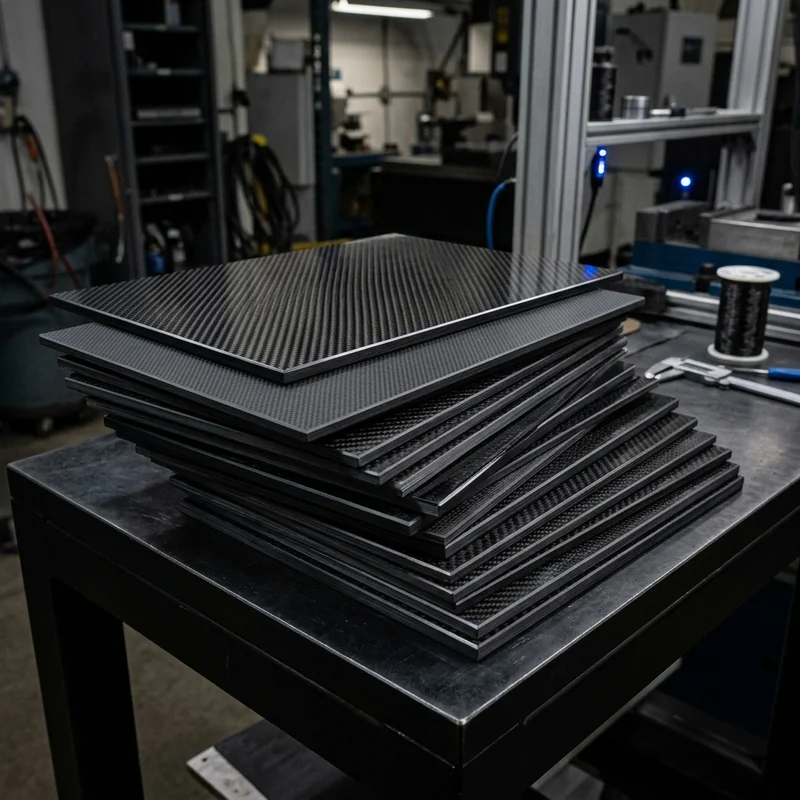
Carbon fiber standard plate-3k stripe
Lightweight, ultra-rigid standard sheets for drone fuselages, robot housings, facades and structural applications.

Carbon Fiber Plate — 3K Twill T700 1.5mm
Thin 1.5mm carbon fiber plate with 3K twill weave surface. Lightweight and stiff, commonly used for covers, panels, drone bodies, and applications requiring a premium aesthetic appearance.

Square Carbon Fiber Tube — 3K Twill T700
Square cross-section carbon fiber tube manufactured with 3K twill weave for torsional strength. Preferred for structural frames, trusses, and support columns where rectangular geometry offers design flexibility.

Carbon Fiber Plate — 3K Twill T700 3.0mm
Medium-thickness 3.0mm carbon fiber plate offering significantly higher load capacity while maintaining attractive 3K twill finish. Suitable for structural brackets, reinforcement plates, and load-bearing panels.
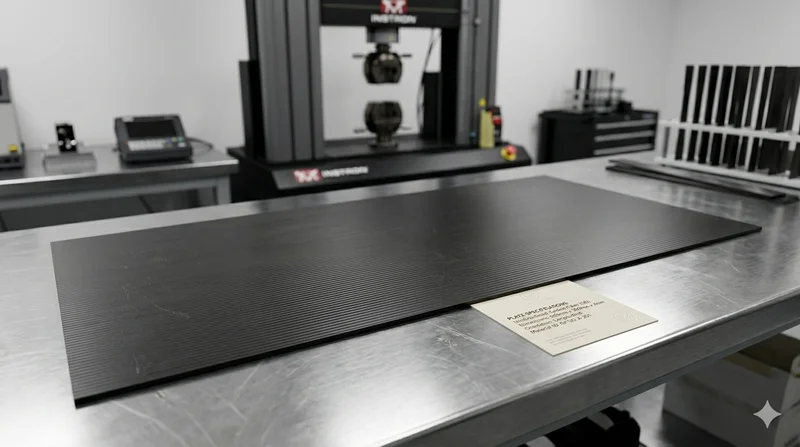
Carbon Fiber Plate — UD Unidirectional T700
Unidirectional carbon fiber plate with all fibers oriented in a single direction for maximum strength along the fiber axis. Essential for structural reinforcements, splints, and applications where load direction is predictable.