
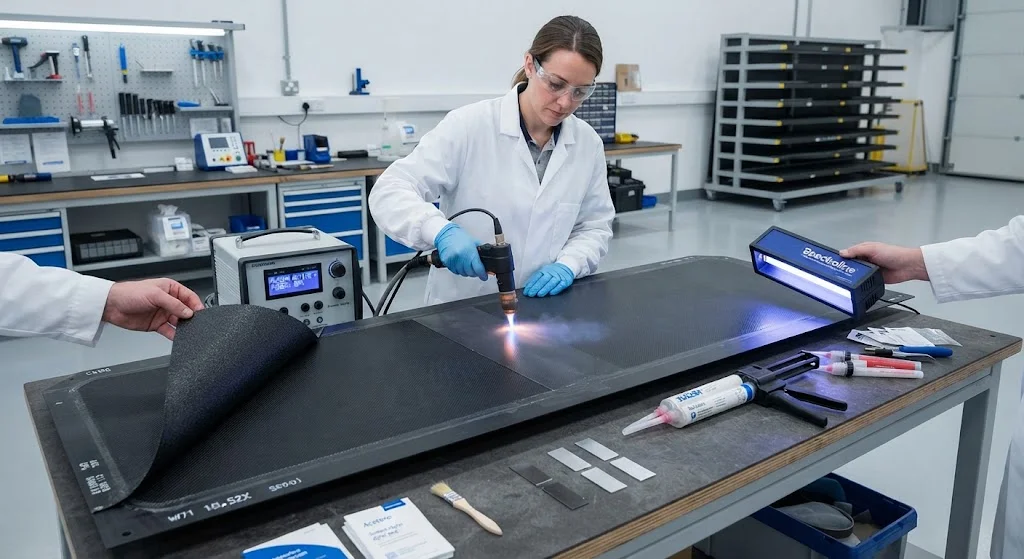
Structural adhesive bonding of carbon fiber composites requires careful surface preparation to achieve reliable, durable joints. This article covers surface treatment methods — plasma, corona, peel ply, chemical — and their effects on bond strength and environmental durability.
Introduction
Adhesive bonding is the preferred joining method for carbon fiber composite structures, offering uniform stress distribution, fatigue resistance, and the ability to join dissimilar materials without stress concentrations from mechanical fasteners. However, bond reliability depends critically on surface preparation — the most common cause of adhesive joint failure is inadequate surface treatment.
Carbon fiber composite surfaces present unique bonding challenges: the as-molded surface often contains mold release agents, surface contaminants, and a weak boundary layer of resin-rich material that does not represent the bulk laminate properties. Effective surface preparation removes this weak layer and creates a surface chemistry and topography optimized for adhesive wetting and bonding.
Surface Characterization
Before selecting a surface preparation method, the composite surface must be characterized to understand its condition and requirements:
Contact angle measurement: Water contact angle indicates surface energy — lower contact angles (below 40°) indicate higher surface energy and better adhesive wetting. As-molded composites typically show contact angles of 60–90°, requiring surface treatment to improve wettability.
Surface roughness: Profilometry or atomic force microscopy (AFM) measures surface topography. Moderate roughness (Ra 1–5 μm) improves mechanical interlocking without creating stress concentrations. Very smooth surfaces (< 0.5 μm) may not provide adequate mechanical keying.
Surface chemistry: X-ray photoelectron spectroscopy (XPS) or time-of-flight secondary ion mass spectrometry (ToF-SIMS) identifies surface functional groups and contaminants. Ideal bonding surfaces show high oxygen-to-carbon ratios indicating polar functional groups that promote adhesive adhesion.
Surface Treatment Methods
Several surface preparation methods are used for carbon fiber composite bonding, each with specific advantages:
Abrasive treatment: Manual or mechanical abrasion with 120–320 grit sandpaper removes surface contaminants and creates mechanical keying. Simple, low-cost, and effective for many applications. Must be followed by thorough cleaning to remove abrasion debris.
Plasma treatment: Atmospheric or low-pressure plasma treatment modifies surface chemistry by introducing polar functional groups (hydroxyl, carboxyl, carbonyl) that improve adhesive wetting and chemical bonding. Treatment effects are temporary — bonding should occur within hours of plasma treatment.
Corona discharge: Similar to plasma but uses high-voltage discharge in air. Effective for large-area treatment and continuous processing. Common in automated production lines for composite panels.
Peel ply removal: Composite laminates processed with nylon or polyester peel plies have a textured surface after removal that is generally favorable for bonding. However, peel ply type and removal technique significantly affect surface quality.
Chemical etching: Acid etching (chromic acid, permanganate) or alkaline treatment modifies surface chemistry and creates controlled roughness. Effective but requires careful chemical handling and waste disposal.
Environmental Durability
Surface preparation affects not only initial bond strength but also long-term durability under environmental exposure:
Moisture resistance: Properly prepared surfaces maintain bond strength after water immersion or high-humidity exposure. Inadequate surface preparation leads to interfacial debonding as water displaces the adhesive from the composite surface.
Temperature cycling: Thermal cycling between operating temperature extremes creates differential expansion stresses at the bond line. Good surface preparation ensures the adhesive-composite interface can withstand these cyclic stresses without degradation.
Chemical exposure: In applications involving fuel, hydraulic fluids, or de-icing chemicals, the surface preparation method must ensure the bond line maintains integrity under chemical exposure conditions.
Quality Control
Consistent surface preparation requires systematic quality control:
Process monitoring: Parameters — treatment time, power, distance — must be recorded and controlled within specified limits. Deviations can cause inconsistent surface quality.
Surface inspection: Visual inspection under UV light can detect surface contamination. Contact angle measurements provide quantitative verification of surface energy. Dyepenetrant inspection reveals surface porosity and defects.
Witness panels: Bonded test panels processed alongside production parts provide destructive test data for surface preparation quality verification. Lap shear and peel test results correlate with production joint quality.
Conclusion
Surface preparation is the most critical step in achieving reliable adhesive bonds on carbon fiber composites. The choice of method depends on production requirements, joint performance specifications, and environmental durability needs. Regardless of the method selected, consistent process control and quality verification are essential for producing bonds that meet structural performance requirements throughout the service life of the component.
Part of topic
Related Articles
- Bio-Based Carbon Fiber Precursors: Lignin and Polyethylene for Low-Cost Production
- Large-Tow Carbon Fiber Cost Analysis: 48K vs 60K Price-Performance Comparison
- Carbon Fiber-Resin Interface Bonding: Surface Treatment and Coupling Agent Optimization
- Digital Twin for Carbon Fiber Manufacturing: Real-Time Process Monitoring and Defect Prevention
- Thermoplastic Carbon Fiber Welding for Automotive: Ultrasonic and Induction Welding Process Windows
- Large-Tow Carbon Fiber Wet Spinning: Process Optimization for 48K/60K Production Efficiency
Interested in Our Products?
Contact our team for competitive pricing and technical specifications.
Get a QuoteRelated Products
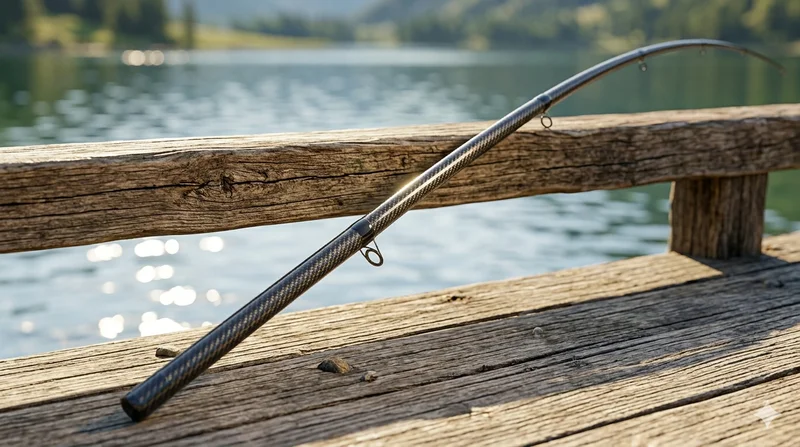
Carbon Fiber Fishing Rod Blank
High-quality carbon fiber fishing rod blank manufactured from multiple grades of Toray carbon fiber cloth. Available in a wide range of lengths, powers, and actions for freshwater and saltwater applications. Suitable for OEM rod building.

Carbon Fiber Plate — 3K Twill T700 3.0mm
Medium-thickness 3.0mm carbon fiber plate offering significantly higher load capacity while maintaining attractive 3K twill finish. Suitable for structural brackets, reinforcement plates, and load-bearing panels.

Carbon Fiber Plate — 3K Twill T700 1.5mm
Thin 1.5mm carbon fiber plate with 3K twill weave surface. Lightweight and stiff, commonly used for covers, panels, drone bodies, and applications requiring a premium aesthetic appearance.

Square Carbon Fiber Tube — 3K Twill T700
Square cross-section carbon fiber tube manufactured with 3K twill weave for torsional strength. Preferred for structural frames, trusses, and support columns where rectangular geometry offers design flexibility.
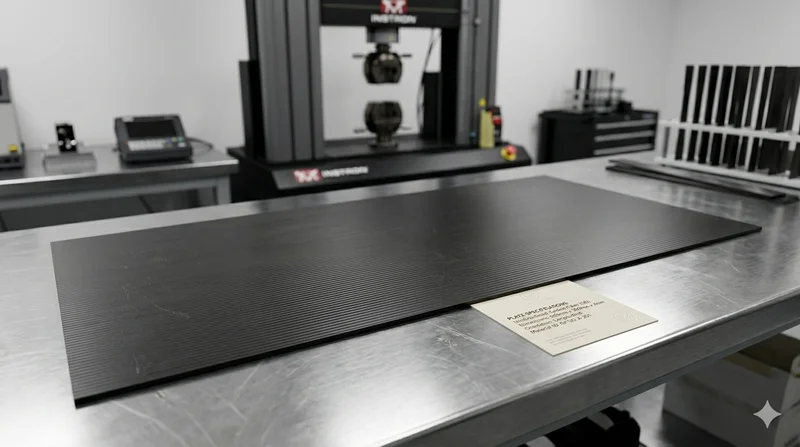
Carbon Fiber Plate — UD Unidirectional T700
Unidirectional carbon fiber plate with all fibers oriented in a single direction for maximum strength along the fiber axis. Essential for structural reinforcements, splints, and applications where load direction is predictable.