
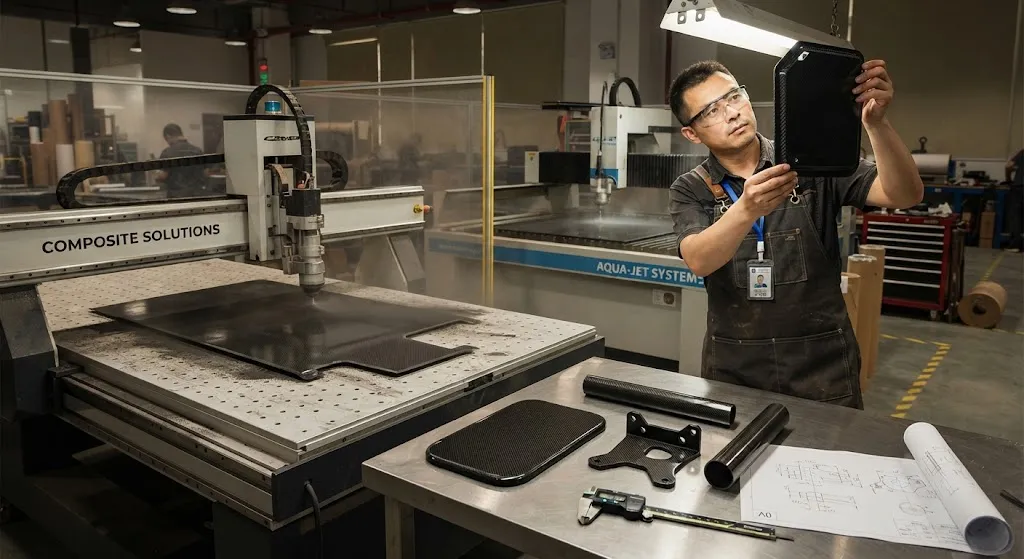
Custom carbon fiber cutting is the fastest way to move from a design file to a usable composite part without buying dedicated tooling. Instead of ordering molded or machined components with long lead times, buyers send a 2D profile or 3D model to a cutting shop, and receive finished pieces cut to si
Introduction
Custom carbon fiber cutting is the fastest way to move from a design file to a usable composite part without buying dedicated tooling. Instead of ordering molded or machined components with long lead times, buyers send a 2D profile or 3D model to a cutting shop, and receive finished pieces cut to size, edge-sealed and ready for assembly. Because carbon fiber is abrasive, electrically conductive and prone to delamination, the cutting method matters more than with most materials — the wrong process produces frayed edges, burnt resin or cracked laminates.
This guide covers the three production processes used for custom carbon fiber cutting — CNC routing, abrasive waterjet and laser — compares their tolerances and costs, explains how suppliers quote work, and walks through the specification details that prevent expensive mistakes. Whether you need a single prototype panel or a production run of thousands of parts, the same evaluation criteria apply.
The Three Processes for Custom Carbon Fiber Cutting
Three cutting technologies dominate custom carbon fiber cutting in commercial practice. Each removes material differently, and each has a clear envelope of thickness, edge quality and cost where it wins.
| Process | Typical Thickness | Dimensional Tolerance | Edge Quality | Relative Cost per Part |
|---|---|---|---|---|
| CNC routing | 0.5-25 mm | ±0.1 mm | Clean, slight fuzz on woven fabric | Low-medium |
| Abrasive waterjet | 1-100 mm | ±0.25 mm | Excellent, no heat-affected zone | Medium |
| Laser cutting | 0.1-3 mm | ±0.05 mm | Risk of resin charring at edge | Low |
CNC routing is the workhorse of custom carbon fiber cutting. A router with diamond-coated tooling spins at 18,000-30,000 rpm and cuts dry with compressed air cooling, producing tolerances of ±0.1 mm on panels up to 25 mm thick. It is the most economical option for sheet goods and for nesting many parts from one board, which is why most suppliers quote this process first.
Abrasive waterjet cuts with a high-pressure stream of water and garnet abrasive, generating no heat at all. That makes it the safest method for thick laminates and for finished parts where a heat-affected zone is unacceptable. The trade-off is slower cycle times and a wider kerf, so waterjet is best for thick plates, large panels and one-off heavy parts rather than high-volume nesting of small components.
Laser cutting offers the tightest geometry but is limited to thin thermoset laminates, typically 3 mm or less, where the resin content is low enough to avoid burning. For thin cosmetic panels and quick prototypes it is fast and cheap; for structural parts or woven fabrics it is rarely the right choice because the heat can degrade the resin matrix at the cut edge.
How Custom Carbon Fiber Cutting Is Priced
Suppliers price custom carbon fiber cutting work as a combination of three components: machine time, material and setup. Understanding the split lets you compare quotes from different custom carbon fiber cutting suppliers on an equal basis.
- Machine time: CNC routers typically bill at $40-90 per hour; waterjet at $60-120 per hour; laser at $30-60 per hour. Small parts with complex geometry cost more per part because positioning time dominates.
- Material: You pay for the stock board plus scrap. A standard 1,000 x 2,000 mm panel of 1.5 mm carbon fiber laminate costs roughly $80-150 depending on grade, and nesting efficiency determines how much of it you actually consume.
- Setup and programming: Most shops charge a one-time programming and fixture fee of $50-250 per job, which amortizes to near zero on large runs but dominates single-piece pricing.
As a rule of thumb, a simple 300 x 300 mm panel cut from a standard sheet runs $8-25 per part at quantities above 50 pieces, dropping to $4-12 per part at 500 pieces or more. Prototype quantities of one to five parts usually carry a $30-80 premium because the setup cost is spread over very few pieces. Nesting multiple designs on one board is the single most effective way to reduce per-part cost, so send all of your profiles in one batch rather than in separate orders.
Specifications That Prevent Cutting Mistakes
Custom carbon fiber cutting fails most often not in the cutting itself but in the information supplied before it starts. Four details determine whether you get parts that fit on the first attempt.
First, provide a dimensioned DXF or STEP file with the outside profile, holes and cutouts clearly on separate layers, and state whether dimensions are net or pre-machining. Carbon fiber panels are typically delivered with a machined edge, so hole diameters and slot widths in the file must match the final dimensions you actually need. Second, confirm the laminate construction: weave style, fiber areal weight and resin system all influence edge behavior. A twill 3K fabric cuts differently from a unidirectional prepreg, and a shop that assumes the wrong construction will set the wrong feeds and speeds. Third, specify the edge treatment — dry-cut edges are standard, but for marine or outdoor applications a sealed edge (epoxy or acrylic coating) is recommended to prevent moisture wicking into the laminate. Fourth, agree on the tolerance and surface finish class up front, because a ±0.05 mm cosmetic cut costs more than a ±0.2 mm functional cut.
For buyers in the United States, working with a custom carbon fiber cutting supplier that stocks domestic material and ships finished parts directly avoids double freight and customs friction. Many custom carbon fiber cutting services also offer a fast-turn option for nearby customers who need parts the next day, which is worth asking about before committing to a longer lead time.
Frequently Asked Questions
What is the minimum order quantity for custom carbon fiber cutting?
Most suppliers accept single-piece prototypes, but pricing is strongly volume-dependent. At one to five pieces you pay a setup premium of $30-80 per part; from 50 pieces the per-part price drops into the $8-25 range; at 500 pieces and above, $4-12 per part is typical. If you only need a few parts, ask whether the shop can nest your parts with another customer's board to share the setup cost.
Can custom carbon fiber cutting handle thick laminates?
Yes. CNC routing comfortably handles panels up to 25 mm, and abrasive waterjet cuts laminates up to 100 mm without heat damage. Laser cutting is the only one of the three that is thickness-limited, and it should be avoided above about 3 mm for thermoset carbon fiber. For thick structural plates, waterjet is the most reliable choice because it produces no heat-affected zone and no tool wear on the composite.
How do I choose between CNC, waterjet and laser for my part?
Choose CNC routing when you need economical nested production from sheet stock at tolerances of ±0.1 mm. Choose abrasive waterjet for thick plates, large panels or parts where a heat-affected zone is unacceptable. Choose laser only for thin cosmetic panels under 3 mm where the tightest geometry matters. If in doubt, ask the supplier which process they recommend for your thickness and material construction — reputable shops steer you to the process that protects edge quality rather than the one that is cheapest to run.
How long does a typical custom cutting order take?
Standard lead times are 5-10 business days including material sourcing, programming and cutting. Rush service of 24-72 hours is commonly available at a 25-50 percent surcharge for in-stock material. The longest lead time component is usually the material itself: non-stock weaves, prepregs with a shelf-life window, or panels over 10 mm often need to be ordered in before cutting can start.
Conclusion
Custom carbon fiber cutting is the lowest-risk way to obtain finished composite parts: no tooling investment, no minimums that force over-ordering, and the freedom to iterate designs between batches. CNC routing covers most jobs at the best cost, waterjet protects thick and heat-sensitive parts, and laser suits thin cosmetic work. Whatever process you choose, define the profile, laminate construction, edge treatment and tolerance in writing before the job starts.
YongXian offers custom carbon fiber cutting for sheets, panels and tubes with CNC and waterjet capability, domestic material stock and fast-turn options. Browse our carbon fiber cutting services or send us your drawing for a same-day quote with a written tolerance and lead-time commitment.
Part of topic
Related Articles
Interested in Our Products?
Contact our team for competitive pricing and technical specifications.
Get a QuoteRelated Products

Carbon Fiber Plate — 3K Twill T700 3.0mm
Medium-thickness 3.0mm carbon fiber plate offering significantly higher load capacity while maintaining attractive 3K twill finish. Suitable for structural brackets, reinforcement plates, and load-bearing panels.

Carbon Fiber Plate — 3K Twill T700 1.5mm
Thin 1.5mm carbon fiber plate with 3K twill weave surface. Lightweight and stiff, commonly used for covers, panels, drone bodies, and applications requiring a premium aesthetic appearance.
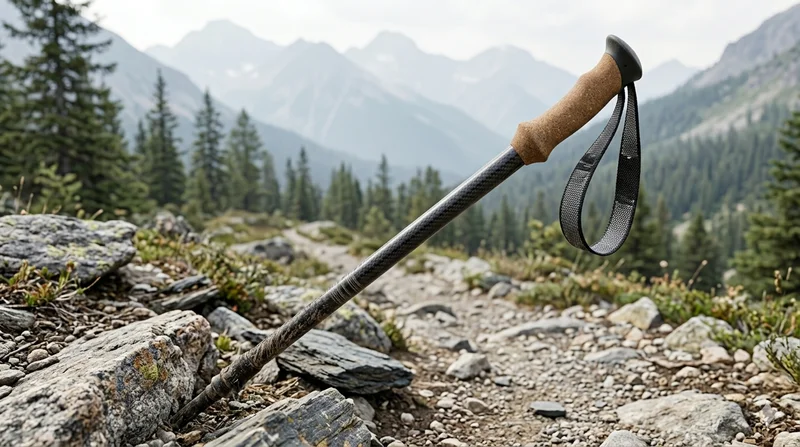
Carbon Fiber Trekking Pole
Lightweight carbon fiber trekking pole manufactured from high-grade carbon fiber tube. Weighs only 160g per pole while providing superior shock absorption and durability for hiking, trail running, and backpacking.
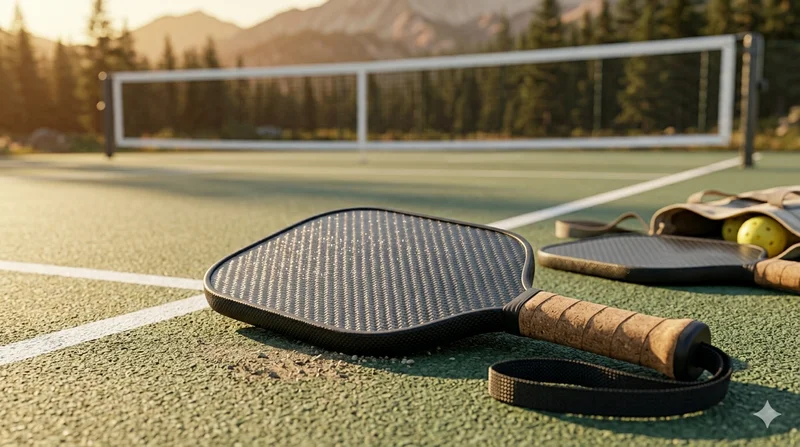
Carbon Fiber Pickleball Paddle
High-performance pickleball paddle with Toray T700 carbon fiber face and polypropylene honeycomb core. Delivers excellent power-to-weight ratio, spin generation, and vibration dampening for competitive play.

Square Carbon Fiber Tube — 3K Twill T700
Square cross-section carbon fiber tube manufactured with 3K twill weave for torsional strength. Preferred for structural frames, trusses, and support columns where rectangular geometry offers design flexibility.