
The most economical wind energy in Europe is often the wind that is already being harvested. Across Germany, Spain and the rest of the onshore fleet, thousands of turbines built in the early 2000s still stand on prime wind sites with functional foundations, proven grid connections and d
Introduction
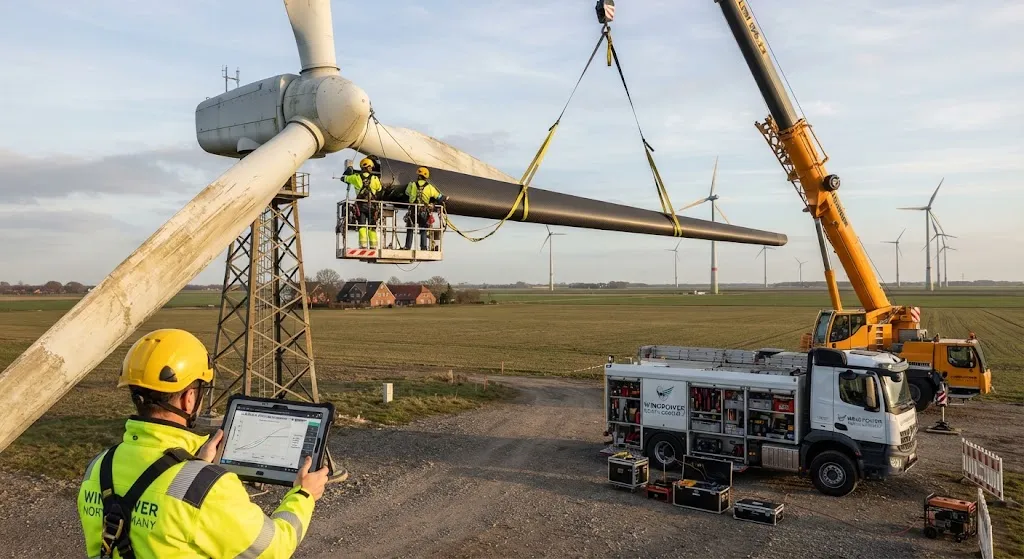
The most economical wind energy in Europe is often the wind that is already being harvested. Across Germany, Spain and the rest of the onshore fleet, thousands of turbines built in the early 2000s still stand on prime wind sites with functional foundations, proven grid connections and decades of structural life remaining in their towers. The blades, however, were sized for the design conditions of an earlier era — shorter, lighter and less aerodynamically efficient than the rotor blades that would be speced for the same site today. Blade extension retrofits close that gap: instead of replacing the turbine or the entire rotor, operators bolt or bond a 10-15 meter tip extension onto the existing blade, enlarging the swept area and capturing more energy from the same wind resource.
This article examines the wind blade extension retrofit market from the perspective of carbon fiber demand. It explains the economic case that drives operators toward extensions rather than repowering, the structural and certification constraints that determine how far a blade can be extended, and the specific role of intermediate-modulus carbon fiber in making longer rotors feasible without overloading the existing drivetrain.
The Retrofit Value Case: More Energy, Same Asset Base
The economics of blade extensions are attractive because they monetize spare capacity in assets that are already paid for. Annual energy production of a wind turbine scales roughly with rotor swept area — physics that favor longer blades at constant hub height. For a typical aging onshore turbine, an extension that lengthens the blade by 10-15 meters increases the swept area by 15-25% and delivers a corresponding gain in annual energy production that operators typically quote in the 5-10% range after accounting for the additional mass and any derating at the top of the wind speed range.
Compared to the alternatives, the retrofit case is compelling. Full repowering — replacing the turbine with a new, larger machine — costs millions of euros per site and requires new permitting, new grid agreements and months of construction downtime. Blade extensions cost a fraction of that, avoid the permitting cycle entirely in most jurisdictions, and can be installed in days during a scheduled maintenance window. In Germany and Spain, where repowering is constrained by approval timelines and grid queues, operators are increasingly choosing extensions as the fastest path to more yield from sites they already operate.
The table below summarizes the three strategic options an operator faces for an aging onshore turbine.
| Option | Typical Investment | Energy Gain | Permitting | Downtime |
|---|---|---|---|---|
| Blade extension retrofit | 100-300 thousand EUR per turbine | 5-10% | Generally none | Days |
| Partial repowering (drivetrain and rotor) | 1-2 million EUR per turbine | 15-30% | Variable by region | Weeks |
| Full repowering (new turbine) | 3-5 million EUR per turbine | 50-100%+ | Full cycle | Months |
The extension option occupies a distinct niche: the largest return per euro invested when the constraint is time and permitting, and a complement to full repowering when operators extend the rotor in the final years before a complete replacement is financed.
Structural Constraints: Why Blade Stiffness Is the Limit
Adding length to a blade is not merely an aerodynamic exercise — it is a structural change that ripples through the entire turbine. A longer blade increases the bending moment at the blade root, which must be carried by the existing pitch bearings, hub and main shaft; it increases the gravity fatigue loads as the heavier rotor rotates; and it increases the risk of tower clearance issues, since the deflected blade tip sweeps closer to the tower when the rotor accelerates. The binding constraint for most retrofits is stiffness rather than strength: the extension must not increase the loads on the existing drivetrain beyond its design envelope, and the extended blade must keep its tip away from the tower at the extreme expected deflection.
This is where materials selection becomes decisive. The stiffness-to-weight ratio of the tip extension determines how much of the added length translates into energy versus how much is consumed by extra structural mass that would worsen the very loads the retrofit is trying to avoid. Glass fiber extensions reach practical limits beyond a certain length, because the added mass begins to erode the aerodynamic gains. Intermediate-modulus carbon fiber — with a modulus roughly double that of high-strength glass and about two-thirds higher than standard modulus carbon — allows lighter, stiffer extension sections that add less rotating mass, preserve the drivetrain load margin and mitigate tip deflection. In Germany and Spain, suppliers such as the blade-extension specialist MarkWide have brought carbon-reinforced extension products to market precisely because the structural math on longer retrofits does not close with glass alone.
Certification and Engineering Requirements
Blade extensions are safety-critical modifications to certified equipment, and they trigger a formal engineering review under the supervision of an accredited certification body rather than an ad hoc field modification. The applicable standard — IEC 61400 design assessment requirements for wind turbines — treats the extended rotor as a modified configuration that must be re-assessed against the same load cases as a new design:
- Extreme wind: extreme gust and operating and parked conditions at the site's reference wind speeds.
- Environmental effects: temperature effects on materials and, where relevant, icing loads on the longer blade sections.
- Fatigue spectrum: the accumulated load cycles the extended blades will experience over their remaining service life.
The assessment covers the extension joint itself — the bolted or bonded interface between the original blade and the new tip — the blade root load increase passed to the hub and main shaft, tower clearance at maximum deflection, and the yaw and pitch system response to the changed mass distribution.
The practical consequence is that an extension project is as much an engineering program as a component purchase. The operator must supply the turbine's load documentation and structural models to the assessor, the extension vendor must provide test data on the joint and the extension section, and the certification body must issue a statement confirming that the modified turbine continues to comply with its design basis and any applicable grid and insurance requirements. This process drives the cost premium of carbon-reinforced extensions over glass ones down in relative terms, because the expensive certification effort is amortized over a longer, more valuable rotor.
Carbon Fiber Demand: A New Channel for Intermediate Modulus
For carbon fiber manufacturers, blade extensions represent a demand channel with characteristics that differ from new-blade production. The volumes per turbine are modest — a single extension set for a 60-80 meter rotor consumes on the order of one to two metric tons of carbon fiber — but the demand is distributed across the installed onshore fleet rather than concentrated in new factory orders, and it is driven by retrofit economics that are resilient to wind market cycles. Eurostat and industry data on the onshore fleet suggest that a meaningful share of the turbines currently operating in Germany and Spain are within the age and size windows for which extension kits are available, making retrofits a repeatable, mid-volume market rather than a one-off project stream.
Two further characteristics matter for suppliers. The first is geometry: tip extension sections are long, slender and increasingly produced as single-piece parts using intermediate-modulus fiber formats — unidirectional tapes and pultruded laminates that deliver the stiffness at low mass. The second is qualification: because the extension is a certified component, the fiber supply chain feeding it is subject to the same traceability and documentation requirements as aerospace-grade material, even though the turbine market prices differently. Carbon fiber suppliers that can document intermediate-modulus product quality, provide consistent batch traceability and support the certification data packages will capture the retrofit channel as it scales.
Frequently Asked Questions
How much additional energy does a blade extension retrofit deliver?
Operators typically quote annual energy production gains of 5-10% for a 10-15 meter tip extension on an aging onshore turbine, with the exact figure depending on the original blade length, the site's wind distribution and any derating applied at high wind speeds. The gain comes from the enlarged rotor swept area, which scales energy capture roughly with blade length squared. Extensions are therefore most attractive at sites where the turbine is often operating at partial load — precisely the conditions that characterize many aging onshore assets.
Why is carbon fiber used in blade extensions rather than glass fiber?
Blade extensions face a stiffness constraint: the added length increases root bending moment and tip deflection, and the extension must add minimal rotating mass to avoid overloading the existing drivetrain. Carbon fiber's modulus is roughly double that of high-strength glass fiber, so a carbon-reinforced extension achieves the same stiffness with significantly less mass. For longer retrofits above a certain tip extension length, the mass of an all-glass extension begins to erode the aerodynamic gains and can violate tower clearance margins — which is why intermediate-modulus carbon fiber is becoming the material of choice for the largest extension sections.
What certification is required for a blade extension retrofit?
An accredited certification body must re-assess the turbine as a modified configuration under the applicable design assessment standard, typically IEC 61400. The assessment covers the extension joint, the increased blade root loads transferred to the hub and main shaft, tower clearance at maximum deflection, and the response of the yaw and pitch systems to the changed rotor mass. The operator supplies the turbine's load documentation, the vendor provides joint and component test data, and the certification body issues a statement confirming continued compliance with the turbine's design basis. The process typically takes several months and is a major reason retrofits are planned as multi-month projects rather than quick field modifications.
Conclusion
Wind blade extension retrofits are establishing a durable, mid-volume demand channel for intermediate-modulus carbon fiber at the precise moment when the onshore fleet's age profile makes rotor upgrades one of the fastest available yield improvements. The retrofit case is economic first — more energy from a paid-for asset with minimal permitting and days of downtime — and structural second, with stiffness and mass constraints that increasingly favor carbon reinforcement as extensions grow past 10-15 meters. For operators in Germany, Spain and beyond, extensions complement repowering rather than replace it; for carbon fiber suppliers, the retrofit channel offers repeatable volume, aerospace-grade documentation requirements and resilience to new-turbine market cycles.
For turbine owners evaluating extensions, the first steps are obtaining the turbine's load documentation, commissioning a structural assessment from an accredited body, and comparing carbon-reinforced extension options against glass alternatives using a full load-and-lifecycle analysis. Explore our intermediate-modulus carbon fiber range for blade applications, or contact our technical team to discuss material supply and qualification support for your retrofit program.