
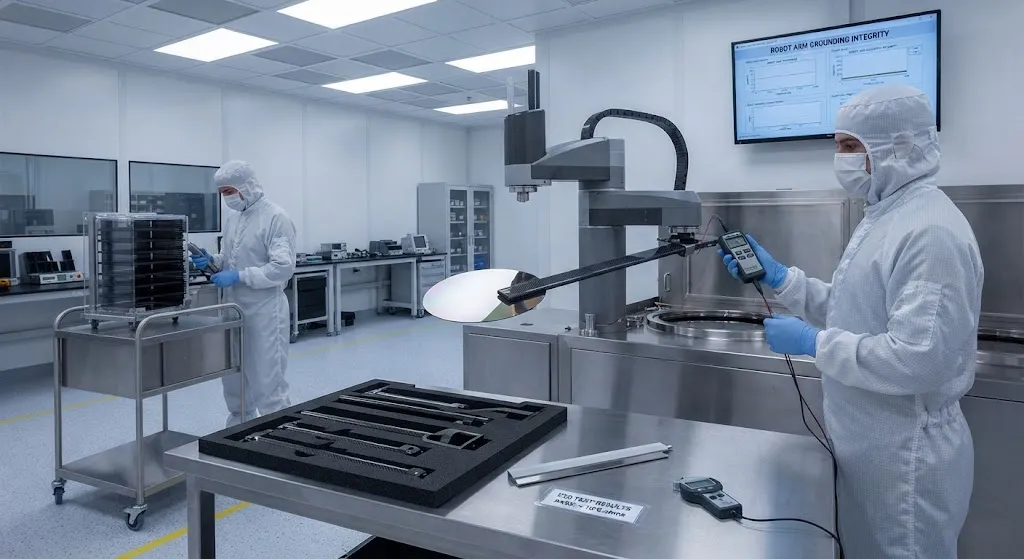
Every silicon wafer in a modern fab is picked up, moved, and set down dozens of times between process steps, and each transfer must position the wafer within tens of micrometers relative to the tool while generating essentially no particles and no static discharge. The machines that do
Introduction
Every silicon wafer in a modern fab is picked up, moved, and set down dozens of times between process steps, and each transfer must position the wafer within tens of micrometers relative to the tool while generating essentially no particles and no static discharge. The machines that do this work, vacuum-compatible robotic transfer arms with carbon fiber end effectors, are invisible but critical: a single dropped or damaged wafer at the 300-millimeter scale can cost thousands of dollars, and a single electrostatic discharge can destroy a chip before it is ever powered on.
Carbon fiber has become the material of choice for several of these components because it combines properties that no single metal or ceramic offers: stiffness-to-weight ratio that keeps fast-moving arms accurate, a coefficient of thermal expansion near zero that keeps geometry stable across temperature swings, and electrical conductivity that can be tuned deliberately for static control. This article explains how carbon fiber wafer handling components are designed, why ESD safety drives the material selection, and how the material is qualified for clean-room service.
Why Wafer Handling Is So Demanding
Wafer handling components operate under a set of constraints that rule out most engineering materials. The wafer itself is a thin disk of brittle silicon, up to 300 millimeters in diameter and under a millimeter thick, weighing only about 125 grams, yet it must be supported with its backside out of contact wherever possible to avoid particle generation and scratching. The robot that carries it must accelerate and decelerate quickly to keep fab throughput high, so the end effector must be light; and the whole system runs in chemically clean atmospheres, in vacuum, or under controlled purge, where outgassing and particle shedding are unacceptable.
Thermal stability matters equally. Wafer transfer equipment sits in proximity to heated process chambers, and temperature drift during handling changes the position of the wafer relative to the tool's optical alignment. Traditional metal end effectors expand measurably with temperature, while carbon fiber laminates can be engineered to near-zero thermal expansion along the handling axis, holding the wafer's position stable across the temperature profile of the transfer.
The Material Comparison
| Property | Carbon fiber composite | Aluminum 6061 | Alumina ceramic |
|---|---|---|---|
| Density (g/cm³) | 1.55-1.60 | 2.70 | 3.90 |
| Axial modulus (GPa) | 120-160 | 69 | 300-380 |
| CTE (ppm/°C) | Near zero, -1 to +1 (tailored) | 23 | 6-8 |
| Electrical resistivity | Tunable, 0.01-10 ohm-cm | Conductive | Insulating |
| Machinability / formability | Molded net shape, light | Excellent | Hard, brittle, heavy |
Aluminum fails on thermal expansion and particle generation. Ceramics win on stiffness and thermal stability but are heavy, brittle, and expensive to machine into thin intricate forks. Carbon fiber composites come with engineered conductivity, a near-zero CTE designable into the laminate, and a density low enough that a long slender end effector supports the wafer without sagging and without burdening the robot wrist.
ESD-Safe Design: The Core Discipline
Static electricity is a first-class reliability problem in wafer fabrication. A charge accumulation on a plastic or insulative handling surface can discharge through a wafer pattern and destroy the metal layers, producing failures that may not be detected until final test. The semiconductor industry therefore specifies static-dissipative and conductive behavior for all surfaces that touch or come near wafers, governed by standards such as ANSI/ESD S541 for the packaging materials used around electrostatic discharge sensitive devices.
Carbon fiber gives the designer two independent levers to hit a target surface resistance. The primary lever is the fiber itself: carbon fiber is intrinsically conductive, with resistivity in the range of 10 to 30 micro-ohm meters, so a composite with a sufficiently high fiber volume fraction becomes a conductive material in its own right. The secondary lever is the resin and the laminate architecture: by controlling fiber volume fraction, adding conductive fillers, and designing the surface layer, manufacturers tune surface resistance across the static-dissipative band, typically aiming at values in the range of 10 to the fifth to 10 to the ninth ohms per square for handling tools, low enough to drain charge slowly without creating a discharge spark.
Grounding completes the discipline. The end effector, cassette, or arm is electrically bonded to the robot through a conductive path, so that any charge is drained to the tool ground rather than accumulating. The ESD test qualification for a handling component includes measuring surface resistance at defined probe spacing, verifying continuity to ground, and repeating the measurements after the cleaning cycles the part will see in service, because residues and wear can raise resistance over time.
Where Carbon Components Are Used in the Fab
Carbon fiber and carbon-fiber-reinforced carbon appear across the wafer handling chain, each component exploiting a different balance of the material's properties:
- End effectors and wafer paddles: the forks that support the wafer underneath. Carbon's specific stiffness lets very thin forks hold a 300-millimeter wafer flat, its low mass keeps robot accelerations high, and surface resistance is tuned to the static-dissipative band.
- Wafer cassettes and transfer boats: the racks that hold multiple wafers during transport and wet processing. Carbon cassettes are light, dimensionally stable, and tolerant of the aggressive chemicals used in wet benches.
- Vacuum end effectors: forks with vacuum ports that grip the wafer backside; carbon's smooth machined surface and dimensional stability hold the vacuum seal while avoiding contact with the device side.
- Thermal process fixtures: carbon-fiber-reinforced carbon components in furnace and CVD applications, where the material's high-temperature stability and low thermal expansion hold wafer positioning inside hot process zones.
- Robotic arm links and wrists: the structural members of the transfer robot itself, following the same stiffness-to-weight logic as industrial robot arms, and critical to settling fast under precise placement tolerances.
In each location the qualification baseline is the same: surface resistance in spec, no particle shedding above the fab's limits, no outgassing that destabilizes the process, and dimensional stability through repeated thermal and cleaning cycles.
Cleanliness, Coating, and Life in Service
Raw carbon fiber composite surfaces are not clean-room ready by default; the porosity of a laminate can trap moisture and process chemicals, and machining can leave loose fibers. Components intended for wafer contact are therefore coated or sealed. A thin hard coating, often a silicon-carbide-like or parylene film, or a resin-rich gel-coat style surface, closes the porosity, provides a smooth particle-free surface, and can be formulated to maintain the target electrical resistance.
Service life is long when the part is correctly specified. An end effector handling a wafer per transfer sees millions of cycles, and carbon's fatigue endurance and wear resistance keep it accurate over years, unlike aluminum forks, which accumulate deformation and surface wear. The maintenance routine is the cleaning cycle itself: parts are washed, dried, and periodically re-checked for surface resistance and dimensional alignment, then returned to service.
Frequently Asked Questions
Why must wafer handling components be ESD-safe, and how does carbon fiber achieve it?
Electrostatic discharge can destroy semiconductor devices even when the charge is invisible and the voltage is only a few hundred volts; the semiconductor industry classifies devices as electrostatic discharge sensitive and requires all touching and nearby surfaces to be conductive or static-dissipative per standards such as ANSI/ESD S541. Carbon fiber achieves this naturally because the fiber itself is electrically conductive, and the laminate's surface resistance is tuned to the static-dissipative band by controlling fiber volume fraction, resin formulation, and surface coatings. The component is then bonded to ground so charge drains gradually instead of sparking.
How does carbon fiber compare with aluminum for wafer handling end effectors?
Carbon fiber wins on three fronts that matter in the fab. Its near-zero coefficient of thermal expansion keeps the wafer position stable across temperature changes, where aluminum's 23 ppm per degree Celsius drifts measurably. Its specific stiffness allows thinner, lighter forks that keep the robot fast and accurate without sagging. And its electrical conductivity is tunable, so the same structural material carries the required ESD property, whereas aluminum must be handled for contamination and particles and its conductivity is a given rather than a design parameter.
Is carbon fiber clean enough for semiconductor cleanrooms?
Carbon fiber is used in cleanrooms precisely because it can be made clean, but only after proper surface treatment. A laminate is sealed with a hard, porosity-free coating and machined with techniques that avoid loose fibers, then qualified for particle generation and outgassing under the fab's standards. In this coated form, carbon components are proven in wafer handling at scale worldwide, and their low wear life means they do not degrade the cleanroom environment over millions of transfer cycles the way softer materials do.
Conclusion
Carbon fiber has earned its place in semiconductor manufacturing because it is the only material that simultaneously meets the four hard requirements of wafer handling: extreme stiffness-to-weight for fast accurate robots, near-zero thermal expansion for positional stability, tunable electrical conductivity for ESD safety, and a clean, low-wear surface for million-cycle service in the fab. The design discipline is the ESD and cleanliness qualification as much as the mechanics, which is why the material's adoption has followed the industry's formal standards for handling sensitive devices.
For equipment builders and fab engineers specifying wafer handling components, the selection criteria start with surface resistance targets, dimensional tolerance across temperature, and cleanroom certification of the surface system. Explore our carbon fiber sheets, tubes, and precision machined components for semiconductor equipment, or contact our engineering team to discuss material qualification and supply for your tooling program.
Part of topic
Related Articles
- Carbon Fiber Sheets for Sale: A Buyer Checklist for Thickness, Weave and Finish
- Carbon Fiber Plate Running Shoes: Manufacturing Process and Material Specifications
- Carbon Fiber Tubes for Sale: Spec Sheet Fields That Actually Matter
- Carbon Fiber Sheets Near Me: Local Dealers and Quick Turnaround Procurement
- Carbon Fiber Tubes Near Me: Local Stock Availability and Same-Day Delivery Options
- Carbon Fiber Plate Orthotic: Lightweight Prosthetic and Medical Device Applications
Interested in Our Products?
Contact our team for competitive pricing and technical specifications.
Get a QuoteRelated Products

Carbon Fiber Plate — 3K Twill T700 1.5mm
Thin 1.5mm carbon fiber plate with 3K twill weave surface. Lightweight and stiff, commonly used for covers, panels, drone bodies, and applications requiring a premium aesthetic appearance.

Carbon Fiber Plate — 3K Twill T700 3.0mm
Medium-thickness 3.0mm carbon fiber plate offering significantly higher load capacity while maintaining attractive 3K twill finish. Suitable for structural brackets, reinforcement plates, and load-bearing panels.

Square Carbon Fiber Tube — 3K Twill T700
Square cross-section carbon fiber tube manufactured with 3K twill weave for torsional strength. Preferred for structural frames, trusses, and support columns where rectangular geometry offers design flexibility.
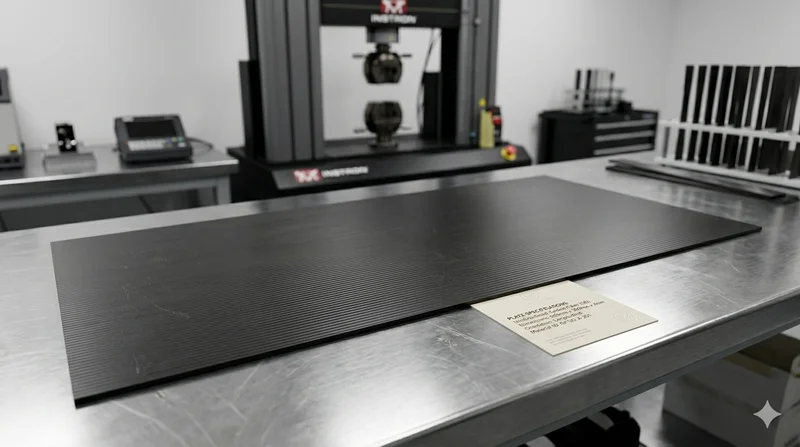
Carbon Fiber Plate — UD Unidirectional T700
Unidirectional carbon fiber plate with all fibers oriented in a single direction for maximum strength along the fiber axis. Essential for structural reinforcements, splints, and applications where load direction is predictable.
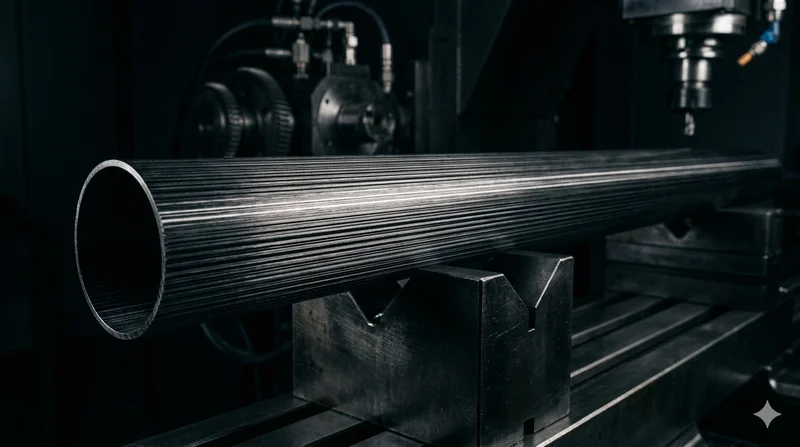
Round Carbon Fiber Tube — UD Unidirectional T700
Unidirectional (UD) round tube with all fibers aligned axially for maximum longitudinal stiffness. Ideal for applications requiring high bending rigidity with minimal weight, such as shafts, struts, and structural reinforcements.