
Small satellites have changed the economics of space. Where a conventional communications or Earth observation spacecraft might take years to design and months to assemble, a modern small satellite constellation is built in batches, on a schedule closer to automotive production than to
Introduction
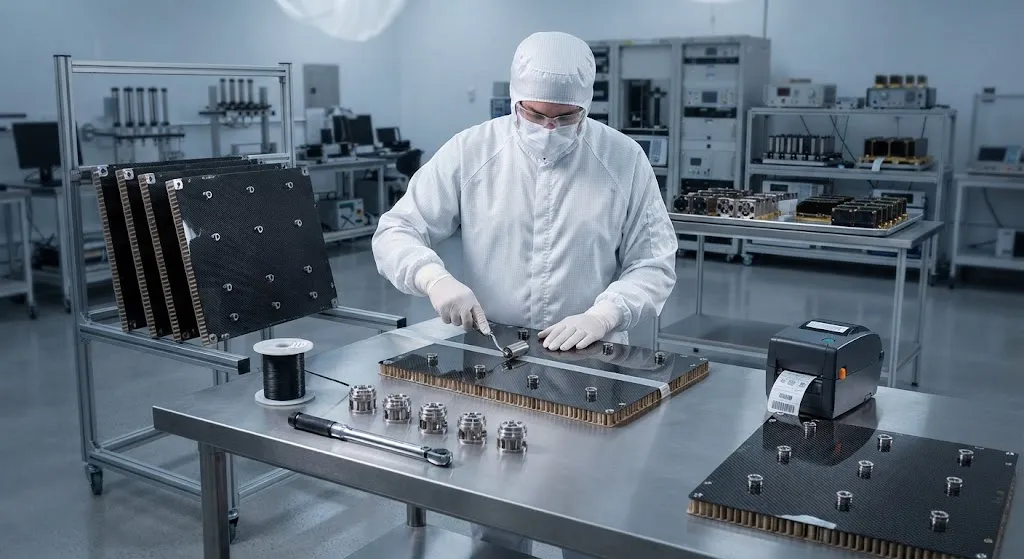
Small satellites have changed the economics of space. Where a conventional communications or Earth observation spacecraft might take years to design and months to assemble, a modern small satellite constellation is built in batches, on a schedule closer to automotive production than to traditional aerospace manufacturing. That shift has forced a redesign of the spacecraft structure itself. The dominant solution to emerge is the panelized baseline: a spacecraft built from flat or gently curved sandwich panels that are manufactured in parallel, integrated with inserts and interface fittings, and assembled like a precision cabinet rather than a welded shell.
The material of choice for these panels is no longer exclusively aluminum. Carbon fiber composite cellular core panels — thin carbon fiber/polymer skins bonded to a CFRP honeycomb or grid core — combine the dimensional stability required by payloads with mass savings that compound across a constellation of hundreds of satellites. This article explains how low-CTE carbon fiber panels work, why they suit mass production, and what designers must consider when specifying them for small satellite platforms.
Why Cellular Core Panels for Small Satellites
A spacecraft structure must do four things: carry launch loads, hold precision instruments in alignment, provide a thermal path, and enclose the spacecraft in a protective envelope. Sandwich panel construction addresses all four efficiently. Two thin, stiff skins separated by a lightweight core create a panel with excellent bending stiffness per unit mass, because bending stiffness scales with the cube of the panel thickness while mass grows only with the skins and core density.
Carbon fiber skins add two decisive advantages over aluminum in space applications. First, they can be engineered to a near-zero coefficient of thermal expansion in the panel plane, minimizing thermal distortion as the spacecraft cycles between sunlight and shadow. Second, they are lighter at equal stiffness. For an Earth observation satellite whose imaging payload demands stable geometry between the telescope and the focal plane, a panel that barely changes dimension across the orbital temperature range simplifies the instrument design and improves pointing accuracy.
For a constellation of several hundred spacecraft, a saving of one to two kilograms per panel repeats across every body panel and deck, compounding into a material reduction in total launch mass — and launch mass is priced per kilogram from the ground.
Low-CTE Carbon Fiber Laminate Design
The coefficient of thermal expansion of a carbon fiber laminate is an engineered property rather than a material constant. Individual carbon fibers have a negative coefficient of thermal expansion along their length, and by balancing ply angles — typically quasi-isotropic layups of 0, 45, 90 and negative 45 degree plies — the laminate's net in-plane CTE can be tuned to near zero, or even slightly negative. Standard modulus fibers achieve laminate CTE values close to zero, while intermediate-modulus fibers offer a combination of lower CTE and higher stiffness for critical panels.
This tunability is central to the cellular core panel concept. Because the skins dominate the in-plane properties of a sandwich panel, the near-zero CTE of the laminate is preserved at panel level. The core, meanwhile, handles the through-thickness role: it resists shear, stabilizes the skins against buckling, and transfers loads between them. A CFRP honeycomb core avoids the CTE mismatch that arises when aluminum honeycomb is bonded to carbon skins — a mismatch that can induce thermal distortion and stress at the bondline during on-orbit thermal cycling.
Panel Architecture and Mass Production Considerations
The modularity that constellation programs need comes from a deliberately small set of standardized panel types. A typical small satellite baseline uses a handful of panel geometries — body panels, shear webs, equipment decks and instrument mounting plates — each produced on dedicated tooling in parallel batches. Inserts are placed in the core before bonding, and interface fittings are integrated at predictable locations, so that every panel of a given type is interchangeable.
Manufacturing follows a sequence suited to rate production: the core is machined or faced from CFRP honeycomb block, the skins are laid up and cured flat, the sandwich is bonded in a light fixture, and the finished panel is trimmed, inspected and delivered to stock. Nondestructive inspection is streamlined because the panel geometry is repeatable and the same acceptance criteria apply to a hundred identical panels. This stands in contrast to traditional spacecraft practice, where each structure is a one-off assembly validated by an extensive dedicated test campaign.
Trade-Offs and Design Considerations
Specifying CFRP cellular core panels involves engineering trade-offs that mission designers should weigh carefully.
- Outgassing and cleanliness: Polymer materials must be selected for low outgassing to protect optics and solar arrays, and venting paths must be provided through the core to avoid trapped gas.
- Thermal conductivity: Through-thickness conductivity of a composite sandwich is lower than aluminum, so thermal management must account for conduction through inserts and edge frames.
- Launch loads and insert pull-out: Insert design and bond quality govern strength under vibration and shock loads, and load paths must be validated by tests representative of the flight environment.
- Grounding and charge dissipation: A metallic mesh or secondary path may be required for grounding, since CFRP skins are far less conductive than aluminum.
- Cost at volume: CFRP panels amortize their higher material cost through lower mass, fewer assembly steps and reduced spacecraft-level testing, which favors constellations with large unit counts.
Comparison: CFRP Cellular Core vs Aluminum Honeycomb Panels
| Property | CFRP Cellular Core Panel | Aluminum Honeycomb Panel |
|---|---|---|
| In-plane coefficient of thermal expansion | Near zero — engineered laminate, roughly 0 to 1 ppm per degree Celsius | About 23 ppm per degree Celsius |
| Density | Approximately 1.6 g/cm³ for the fiber-dominated structure | Approximately 2.7 g/cm³ |
| Bending stiffness per unit mass | High, controlled by skin laminate and core shear modulus | High, slightly lower specific stiffness at equal mass |
| Thermal distortion under cycling | Minimal at panel level | Significant unless compensated |
| Insert compatibility | Established bonded-insert practice | Well-established, mature practice |
| Typical role | High-stability instrument decks, optical benches, bus panels | General bus panels and structural decks |
Both panel families remain in use across the industry. The comparison above reflects why dimensionally sensitive surfaces increasingly default to CFRP cellular core panels in constellation baselines, particularly where optical or RF payloads demand stability.
Frequently Asked Questions
Why does a satellite structure need a low coefficient of thermal expansion?
Spacecraft experience wide temperature swings as they move between direct sunlight and shade, and an Earth observation or communications payload must keep its optics and antennas aligned within tight tolerances. If the structure grows or shrinks with temperature, the instrument geometry shifts, degrading image quality or pointing accuracy. A panel with near-zero CTE maintains its dimensions across the thermal cycle, simplifying instrument design and improving performance margin.
How is mass production different from traditional spacecraft manufacturing?
Traditional spacecraft structures are one-off assemblies: each panel is designed, manufactured and tested individually, with a dedicated qualification campaign. Mass production changes the model: a small set of standardized panel types is produced in parallel batches on dedicated tooling, then assembled into interchangeable spacecraft. The economics work only at volume — the tooling and process investment is amortized across hundreds of units in a constellation, which is why the approach emerged with small satellite constellations.
What are the main risks with CFRP cellular core panels in space?
The main risks are outgassing of the polymer matrix, limited through-thickness thermal conductivity, and insert bond quality under launch vibration. Each is addressed in design: low-outgassing materials and venting paths for gases, conduction paths through inserts and edge frames for thermal management, and coupon tests plus flight-representative vibration testing to validate insert strength and load paths.
Conclusion
Carbon fiber cellular core panels have become the structural backbone of small satellite mass production because they solve the equations that matter most in a constellation program: dimensional stability under thermal cycling, low mass that compounds across hundreds of units, and standardized manufacturing that turns spacecraft structure from a bespoke engineering effort into a repeatable process. The near-zero in-plane CTE of the engineered laminate, combined with the shear stiffness of the CFRP core, delivers a panel that holds instruments in alignment through every eclipse and illumination cycle.
YongXian supplies carbon fiber fabrics, unidirectional tapes and reinforcement materials for aerospace and space-qualified composite structures. Explore our carbon fiber product range or contact our engineering team to discuss material systems for satellite panel production.