
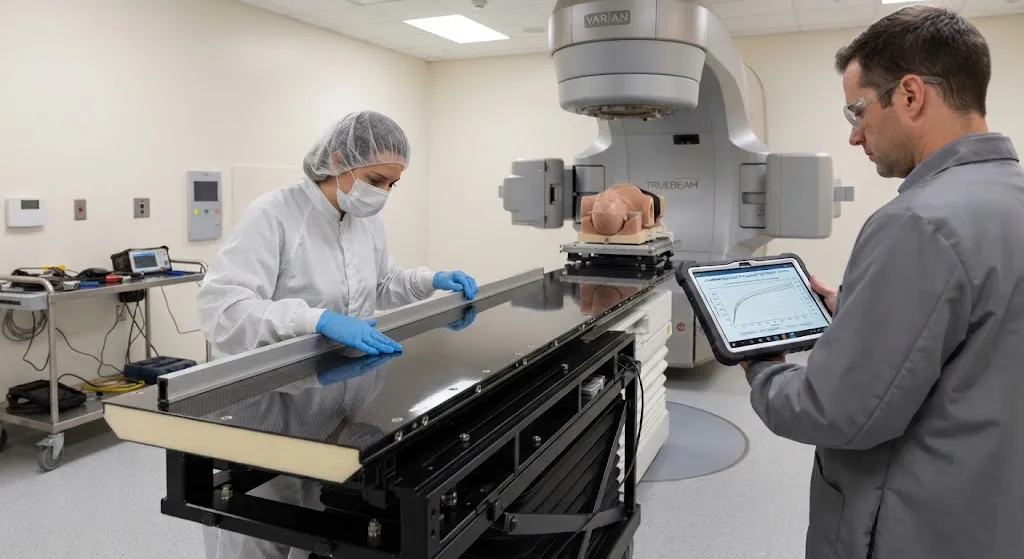
A radiotherapy couch does two jobs at once, and the second one silently decides whether the first one succeeds. It must hold a patient in a precisely planned position during a treatment that can last several minutes, and it must interfere as little as possible with the megavoltage photo
Introduction
A radiotherapy couch does two jobs at once, and the second one silently decides whether the first one succeeds. It must hold a patient in a precisely planned position during a treatment that can last several minutes, and it must interfere as little as possible with the megavoltage photon beam aimed at the tumor. Every gram of couch material in the beam path scatters and absorbs radiation, slightly degrading the dose distribution that the treatment plan was built around. Carbon fiber composites solve this conflict better than any other structural material: a carbon fiber sandwich panel is stiff enough to support a 250 kg patient load with only a few millimeters of deflection, yet thin and light enough to present a radiation attenuation equivalent of roughly 1-2 mm of aluminum at 6 MV.
This article is written for radiation oncology departments, linac integrators, and medical device buyers who need to specify or procure a treatment couch. We cover the physics of beam attenuation, the sandwich panel architecture that makes carbon fiber couches work, the manufacturing tolerances that separate good couches from bad ones, and the specification criteria to check before you purchase. The same carbon fiber expertise behind our industrial product lines applies here, and the material data in this article reflects what a well-made clinical couch actually delivers.
Why Carbon Fiber Replaced Metal Couch Tops
Early radiotherapy tables were machined from aluminum or steel because nothing else carried the load. The problem is that every metal structure in the beam path attenuates and hardens the photon beam, shifting the depth-dose curve and forcing the treatment planning system to compensate with correction factors. With carbon fiber, the beam transparency problem largely disappears. The key parameters are usually reported as aluminum-equivalent attenuation: the thickness of aluminum that would absorb the same fraction of the beam.
| Material | Attenuation Equivalent at 6 MV | Areal Weight | Flexural Stiffness | Typical Use |
|---|---|---|---|---|
| Solid aluminum plate | 3-5 mm Al equivalent per 10 mm plate | 27 kg per square meter per 10 mm | High | Legacy tables, base frames |
| Steel plate | 6-10 mm Al equivalent per 10 mm plate | 78 kg per square meter per 10 mm | Very high | Bearing structures, rail systems |
| Solid carbon fiber laminate | 1.5-2.5 mm Al equivalent | 12-16 kg per square meter | Moderate | Thin imaging boards |
| Carbon fiber sandwich (foam core) | 1.0-2.0 mm Al equivalent | 6-9 kg per square meter | Very high | Modern treatment couches |
Two consequences follow from this table. First, the carbon fiber sandwich delivers the stiffness of a much heavier metal assembly at a fraction of the weight, which also makes the motorized couch easier to move and position. Second, the low attenuation means the treatment planning system needs fewer correction factors, which improves dose accuracy at the target. These two benefits together explain why carbon fiber is now the default specification for modern linac couches from every major manufacturer.
Sandwich Panel Architecture
A clinical couch top is not a flat carbon fiber sheet; it is a sandwich panel engineered from three functional zones:
- Face sheets: Two thin carbon fiber laminate skins, typically 0.5-1.5 mm thick, woven from 3K or 6K tow fabric in an epoxy matrix. The weave pattern and ply orientation are chosen to maximize bending stiffness in the longitudinal direction while keeping the panel thin.
- Core: A low-density foam core, usually cross-linked PVC or PMI foam 20-40 mm thick, that separates the face sheets and carries the shear loads. The core is what converts a flexible pair of skins into a stiff panel, exactly as in aircraft floor panels.
- Edge and insert zones: Localized buildups around mounting holes, hinge points, and accessory rails, where solid laminate or higher-density core prevents crushing and distributes the concentrated loads from patient positioning accessories.
The resin system is a quiet but critical decision. The matrix must be radiation-stable over the couch's service life, dimensionally stable under repeated patient loading, and compatible with the disinfectant chemicals used between patients. Standard aerospace-grade epoxy systems satisfy all three requirements, which is why couch manufacturers rely on the same prepreg technology used in aircraft interiors. The cured panel must also maintain a flatness tolerance of roughly plus or minus 1 mm over its full length, because a warped couch top makes reproducible patient positioning impossible.
Beam Attenuation and Imaging Considerations
The attenuation requirement changes depending on where in the beam path the couch sits and which imaging modality the linac uses. Modern linacs combine the treatment beam with kilovoltage cone-beam CT and megavoltage portal imaging, and the couch must be compatible with all of them.
- Megavoltage treatment beam (6-18 MV): Attenuation scales roughly with electron density, and carbon fiber's low density keeps aluminum-equivalent attenuation around 1-2 mm. This level is small enough that most treatment planning systems handle it with a single couch attenuation correction.
- Kilovoltage imaging (cone-beam CT): Photoelectric absorption dominates at kV energies, and here carbon fiber's advantage is even larger because low atomic number materials attenuate kV beams far less per unit of stiffness than metals.
- Electron beams: Electron beams are attenuated and scattered more strongly by any material, so couch tops used for electron treatments are kept as thin as the structure allows, and the sandwich construction helps keep the effective thickness low.
Carbon fiber does have one limitation that buyers should know about: the fibers are electrically conductive, so an uncoated carbon fiber couch can create artifacts in some imaging setups and requires proper grounding design. Reputable manufacturers address this with a thin insulating or surface-sealing layer and an explicit grounding scheme. This is a specification point worth asking about during procurement, because it affects image quality on the same system.
Manufacturing Tolerances and Quality Control
The difference between a couch that holds position for ten years and one that drifts within six months is decided in the mold. High-quality carbon fiber couch tops are manufactured in matched metal or composite tooling with autoclave or press curing, which controls three things that matter clinically:
| Parameter | Typical Specification | Why It Matters |
|---|---|---|
| Surface flatness | Within plus or minus 1 mm over full length | Reproducible patient positioning |
| Deflection under load | Less than 5 mm at rated patient weight | Dose targeting accuracy |
| Fiber volume fraction | 55-65% | Consistent stiffness and attenuation |
| Void content | Below 2% | Uniform strength, no weak zones |
| Attenuation uniformity | Within 0.2 mm Al equivalent across panel | Consistent dose corrections |
Every production panel should be accompanied by documented quality control data: ultrasonic inspection results, cured thickness and flatness measurements, and attenuation verification on a reference linac. When you evaluate a supplier, ask for this documentation rather than trusting a marketing specification. The manufacturing process also determines long-term behavior; a properly cured and sealed panel resists moisture ingress, maintains dimensional stability, and survives the daily disinfectant wiping that clinical use demands.
Frequently Asked Questions
How much radiation does a carbon fiber couch attenuate?
A well-designed carbon fiber sandwich couch top presents an attenuation equivalent of roughly 1-2 mm of aluminum at 6 MV, compared with 3-10 mm for the metal plates used on older tables. At kilovoltage imaging energies the advantage is larger still, because carbon's low atomic number absorbs kV photons far less than metals do per unit of stiffness. The exact value depends on panel thickness and construction, which is why manufacturers publish aluminum-equivalent attenuation figures for their specific products and why the treatment planning system uses a couch-specific correction rather than a generic one.
Why is stiffness as important as radiation transparency for a couch?
Because dose accuracy depends on geometry. If the couch top deflects under the patient's weight, the tumor moves relative to the planned beam position, and the delivered dose distribution no longer matches the plan. A carbon fiber sandwich panel achieves the bending stiffness of a much thicker metal plate because the separated face sheets carry bending loads with a large moment arm, while the low-density core carries the shear. The result is a couch that deflects only a few millimeters at full rated load, at a fraction of the weight of a metal equivalent, with far better beam transparency.
Can a carbon fiber couch be repaired if it is damaged?
Yes, within limits. Small edge chips and surface damage can be repaired with aerospace-grade patch procedures: the damaged area is removed, a stepped patch of matching prepreg is laid in, and the repair is cured under vacuum pressure. Structural repairs that affect a load-bearing insert or a large area typically require returning the panel to the manufacturer, because the stiffness and attenuation properties of the repaired zone must match the original. Because clinical couches carry safety-critical patient loads, most facilities replace rather than field-repair a seriously damaged top, and this is one reason to buy from a manufacturer that can supply a documented replacement with the same mechanical and attenuation profile.
What should I check when buying a carbon fiber radiotherapy couch?
Five specification points matter most: the published aluminum-equivalent attenuation at the beam energies you use, the rated patient load and deflection at that load, the flatness tolerance and how it is measured, the quality control documentation for the panels (fiber volume fraction, void content, ultrasonic inspection), and the grounding and surface treatment for imaging compatibility. You should also verify that the couch integrates with your specific linac and patient positioning accessories, and ask about the manufacturer's clinical reference installations. A low price on a couch without documented QC data is a false saving in a department where reproducibility is the entire point.
Conclusion
Carbon fiber radiotherapy couches dominate modern linac rooms for a clear reason: they combine the beam transparency that dose accuracy demands with the stiffness that patient safety requires, in a package light enough for motorized positioning systems. The sandwich panel architecture, radiation-stable resin systems, and documented manufacturing tolerances are the difference between a couch that contributes to accurate treatment and one that silently degrades it.
For medical device integrators and oncology departments specifying couches or imaging boards, the practical questions are attenuation data, structural certification, and manufacturing documentation. Explore our carbon fiber sheet and sandwich panel range with published mechanical properties, or contact our engineering team to discuss radiation-transparent composite solutions for your medical program.
Related Articles
- Carbon Fiber Tubes for Sale: Spec Sheet Fields That Actually Matter
- Carbon Fiber Sheets Near Me: Local Dealers and Quick Turnaround Procurement
- Carbon Fiber Tubes Near Me: Local Stock Availability and Same-Day Delivery Options
- Carbon Fiber Plate Orthotic: Lightweight Prosthetic and Medical Device Applications
- Carbon Fiber Sheets 6mm: Specifications, Load Ratings and Application Guide
- Carbon Fiber Rod Grips: Ergonomic Handle Design for Industrial and Sport Applications
Interested in Our Products?
Contact our team for competitive pricing and technical specifications.
Get a QuoteRelated Products

Carbon Fiber Plate — 3K Twill T700 1.5mm
Thin 1.5mm carbon fiber plate with 3K twill weave surface. Lightweight and stiff, commonly used for covers, panels, drone bodies, and applications requiring a premium aesthetic appearance.

Carbon Fiber Plate — 3K Twill T700 3.0mm
Medium-thickness 3.0mm carbon fiber plate offering significantly higher load capacity while maintaining attractive 3K twill finish. Suitable for structural brackets, reinforcement plates, and load-bearing panels.

Square Carbon Fiber Tube — 3K Twill T700
Square cross-section carbon fiber tube manufactured with 3K twill weave for torsional strength. Preferred for structural frames, trusses, and support columns where rectangular geometry offers design flexibility.
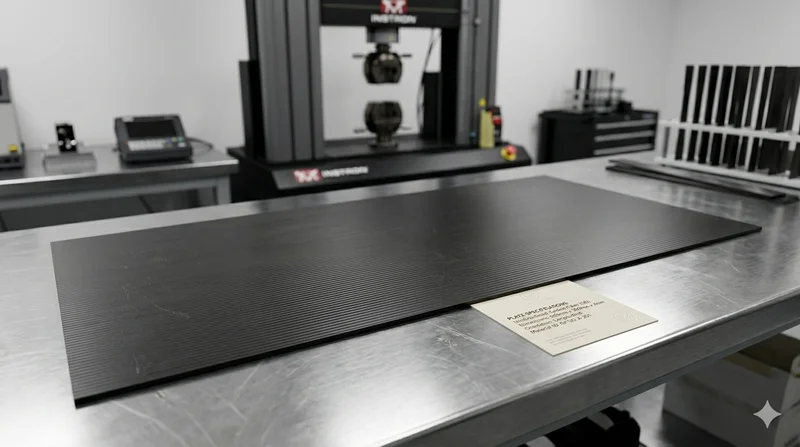
Carbon Fiber Plate — UD Unidirectional T700
Unidirectional carbon fiber plate with all fibers oriented in a single direction for maximum strength along the fiber axis. Essential for structural reinforcements, splints, and applications where load direction is predictable.
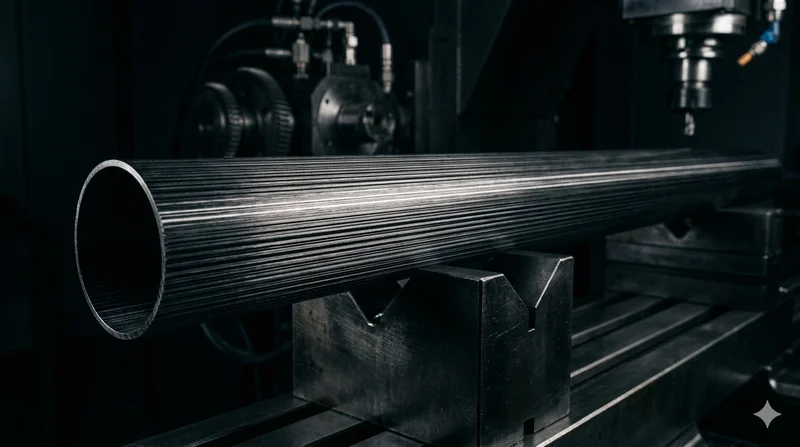
Round Carbon Fiber Tube — UD Unidirectional T700
Unidirectional (UD) round tube with all fibers aligned axially for maximum longitudinal stiffness. Ideal for applications requiring high bending rigidity with minimal weight, such as shafts, struts, and structural reinforcements.