
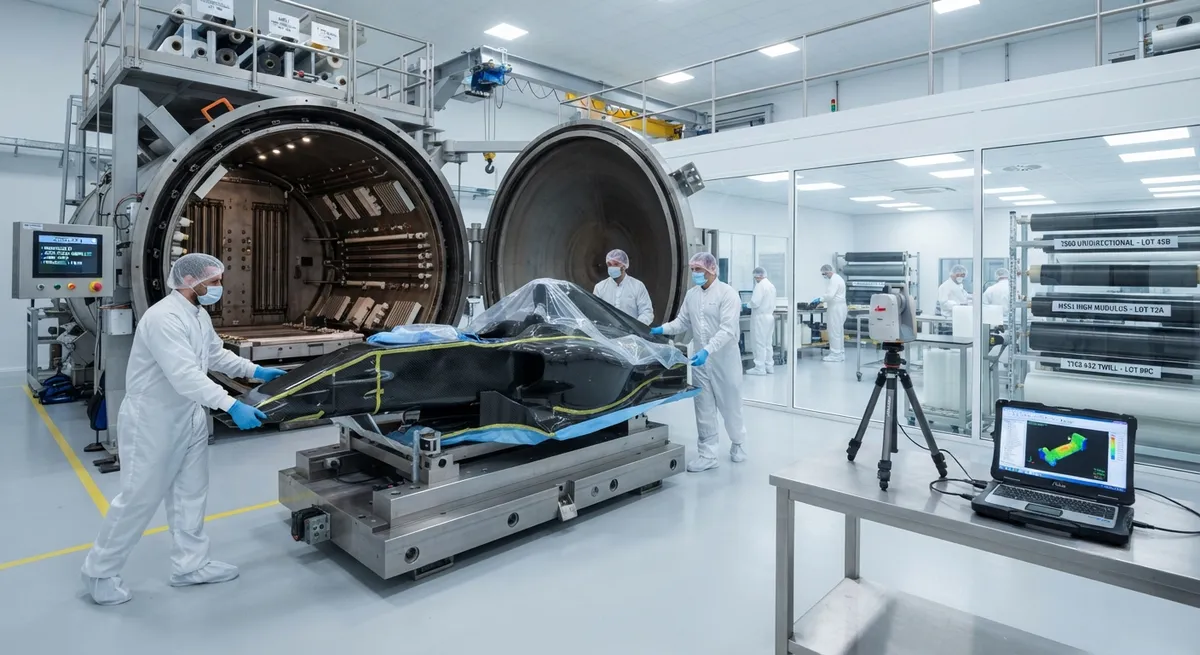
In-depth technical guide to carbon fiber monocoque chassis manufacturing for Formula 1 and motorsport: prepreg materials, laminate architecture, hand layup process, autoclave cure cycle design, tooling, co-cured inserts, QA/NDT protocol, and cost analysis.
The Evolution of Carbon Fiber Monocoque Chassis in Motorsport
The carbon fiber monocoque chassis represents the single most significant structural innovation in motorsport history since the rear-mounted engine. First introduced by McLaren in the 1981 Formula 1 MP4/1 — designed by John Barnard and built in collaboration with Hercules Aerospace — the carbon fiber monocoque transformed racing car safety and performance. Compared to the aluminum honeycomb monocoques of the era, the carbon fiber monocoque offered a 40-50% weight reduction while providing 3-5× higher torsional stiffness. In the four decades since, every Formula 1 car, virtually every IndyCar, and an increasing number of GT, LMP, and road-legal hypercars rely on carbon fiber monocoque construction.
Modern F1 monocoques weigh approximately 35-40 kg while supporting loads exceeding 150 kN in a crash pulse — an extraordinary strength-to-weight ratio of approximately 3,800-4,300 N·m/kg. To put this in perspective, an equivalent steel monocoque would weigh 180-220 kg, and an aluminum monocoque would weigh 90-120 kg. This weight saving is achieved through precise fiber orientation, high fiber volume fraction (58-62%), and autoclave consolidation at 6-8 bar pressure and 180°C cure temperature for epoxy systems.
Prepreq Materials and Laminate Architecture
The monocoque is fabricated from carbon fiber epoxy prepreg — unidirectional and woven fabrics pre-impregnated with a precisely formulated epoxy resin system. The prepreg must be stored at -18°C to prevent premature cross-linking, with a maximum out-life of 14-21 days at room temperature depending on the resin formulation. A typical F1 monocoque uses 8-12 different prepreg material specifications, each selected for specific local requirements: high-modulus fibers (M55J, 540 GPa modulus) for stiffness-critical regions, intermediate-modulus fibers (T800, 294 GPa) for general structure, and standard-modulus fibers (T700, 230 GPa) for non-structural inserts and brackets.
The laminate architecture follows a highly engineered sequence. The inner surface — forming the driver cockpit — uses 2-4 plies of 200 g/m² twill weave fabric oriented at 0°/90° for impact and abrasion resistance. The primary structural skin uses 40-60 plies of unidirectional prepreg (300 g/m² ply weight) in a quasi-isotropic layup sequence: 0°, +45°, 90°, -45°, repeated in blocks of 16-20 plies. Regions of highest load — the side impact structures, the front bulkhead, the engine mount area — receive additional doublers of 10-20 plies at optimized orientations. The total laminate thickness ranges from 2.5 mm in lightly loaded body panels to 12-18 mm in the side impact structures and roll hoop area.
Manufacturing Process: From Tooling to Demold
| Stage | Duration | Temperature | Pressure | Key Quality Check |
|---|---|---|---|---|
| Tool preparation & release agent | 4-6 h | Ambient | N/A | Contact angle > 90° (water break test) |
| Prepreg thawing & kitting | 12-24 h | 18-22°C | N/A | Tack test per ASTM D2979 |
| Hand layup (8-12 operators) | 24-48 h | 20-22°C, 45-55% RH | N/A | Each ply: position accuracy ±1 mm, no bridging, no wrinkles |
| Debulking (every 4-6 plies) | 15 min per cycle | Ambient | 95% vacuum | Gap gauge < 0.1 mm at ply drop-offs |
| Bagging & leak check | 4-8 h | Ambient | 95% vacuum | Leak rate < 0.5 mbar/min |
| Autoclave cure cycle | 6-10 h | 180°C (epoxy) | 6-8 bar | Thermocouple within ±2°C of ramp profile |
| Cool-down to 60°C | 3-5 h | 60°C → ambient | 3 bar minimum | DSC degree of cure > 95% |
| Demold | 1-2 h | Ambient | N/A | Visual inspection for release, tool-side surface finish |
The total manufacturing cycle for a single monocoque — from tool prep to final NDT — spans 7-14 days, depending on the complexity of the part and the number of co-cured inserts. On an annual basis, an F1 team typically produces 10-16 monocoques (including spares and development parts) requiring 3,000-4,500 kg of prepreg carbon fiber material per season.
Autoclave Cure Cycle Design
The autoclave cure cycle for monocoque structures is one of the most precisely controlled processes in composite manufacturing. A typical cycle for an 80 kg prepreg layup proceeds through five phases:
- Phase 1 — Heat ramp to gelation (1-2°C/min): The temperature rises from ambient to 110-130°C at 1.5°C/min. Vacuum is maintained at 95% throughout. The pressure is applied at 0.5-1.0 bar during the early heat ramp and increased to full 6-8 bar when the resin viscosity reaches its minimum (50-200 Pa·s for epoxy at 80-100°C).
- Phase 2 — Gelation hold (30-60 min at 110-130°C): The resin reaches gelation (tan δ crossover from DMA). This hold allows consistent through-thickness temperature equilibration. Differential scanning calorimetry (DSC) samples are extracted from breather material at the edge of the layup to confirm the degree of cure at gelation (typically 15-25%).
- Phase 3 — Final heat ramp to cure (1-2°C/min to 180°C): Temperature increases to the final cure temperature. Exothermic heat generation during this phase peaks at 5-15°C above the oven setpoint for thick sections (10+ mm), requiring careful thermal management to prevent thermal runaway.
- Phase 4 — Cure hold (120-180 min at 180°C): Full cure is achieved. The degree of cure at the end of this phase exceeds 95% (DSC). The thermal mass of the monocoque tool (typically 400-800 kg of Invar or steel) means the center of the laminate lags behind the tool surface temperature by 15-25°C during the heat ramp — corrected through thermocouple feedback at 8-12 locations.
- Phase 5 — Controlled cool-down: The part is cooled at 2-3°C/min to below 60°C before pressure release. Faster cooling rates (>5°C/min) generate through-thickness thermal gradients exceeding 40°C, which can introduce residual stress and spring-in distortion of 2-5 mm at the monocoque edges.
Tooling Design for Monocoque Manufacturing
Monocoque tooling is fabricated from Invar 36 (an iron-nickel alloy with a coefficient of thermal expansion of 1.2×10⁻⁶/°C, matching carbon fiber's near-zero CTE) or from carbon fiber composite tooling materials. Invar tooling costs $150,000-300,000 per tool half and has a service life of 50-200 cure cycles before requiring refurbishment. Composite tooling costs $50,000-100,000 but is limited to 10-30 cycles due to surface degradation at the cure temperature.
The monocoque mold splits into two or three sections: a female cavity mold for the outer surface (driver cockpit and external aero surfaces) and a male mandrel or inflatable bladder for the inner surface. The female mold is machined from a 5-axis CNC milled Invar block with ±0.05 mm surface tolerance and surface finish of 0.4 µm Ra in the cockpit area. The male tool must be collapsible inside the closed mold to facilitate demolding — typically using a segmented Invar or inflatable silicone rubber mandrel that reduces in volume by 10-15% when depressurized.
Co-Cured Inserts and Metallic Bonding
Modern monocoques integrate 50-70 metallic inserts co-cured during the layup process. These include threaded bushings for suspension pickups (steel or titanium, 8-16 mm diameter), hard points for engine and gearbox mounting (7075-T6 aluminum), and harness anchorage points (stainless steel). Each insert is individually designed with scalloped external geometry or knurled surface to provide mechanical interlock with the composite — achieving pull-out forces of 20-50 kN depending on insert diameter and embedment depth.
- Suspension inserts: Titanium (Ti-6Al-4V) machined bushings with a 12-18 mm outer diameter and 25-40 mm embedment length, placed at ±0.2 mm positional accuracy using a laser-tracked drilling and potting jig.
- Engine mount points: Steel or aluminum inserts co-cured at the rear bulkhead, designed to transfer 80-120 kN of powertrain load into the composite structure. Aramid fiber isolation plies (2-4 layers of Kevlar 49 fabric) prevent galvanic corrosion at the titanium-composite interface.
- Roll hoop hard points: Inconel 718 threaded inserts at the roll structure attachment region, capable of withstanding 80 kN of lateral load per FIA Article 259 requirements.
Quality Assurance and Nondestructive Testing Protocol
| Test Method | Application | Scan/Test Rate | Defect Detectability | Acceptance Criteria |
|---|---|---|---|---|
| Tap test (coin tap) | Every accessible surface area | 2-4 s per 100 cm² | Disbonds > 12 mm diameter | No change in audible response |
| Ultrasonic C-scan (through-transmission) | Primary structure (cockpit, side impact) | 20-50 cm²/min at 5 MHz | Delamination > 5 mm, porosity > 1.5% | No > 5 mm defects, porosity < 1.5% |
| Phased array UT | Thick sections (roll hoop, bulkheads) | 10-30 cm²/min | Delamination > 3 mm at 10 MHz | No > 3 mm defects in critical zones |
| Shearography (electronic speckle) | Full monocoque surface | 0.5-1 h per complete scan | Disbonds > 8 mm, kissing bonds | No disbonds > 8 mm in bonded joints |
| Dimensional inspection (laser tracker) | All suspension and mounting points | 4-8 h per monocoque | Positional accuracy ±0.2 mm | All inserts within ±0.5 mm of CAD |
In addition to NDT, each monocoque undergoes a proof load test — typically 1.5× the design load at the front and rear bulkheads — with strain gauge data recorded at 40-60 channels. Permanent set after load removal must be below 0.1 mm across any axis. The entire QA protocol for a single monocoque requires 40-80 person-hours of inspection and testing labor.
Cost Analysis and Production Economics
The manufacturing cost of a Formula 1 carbon fiber monocoque is estimated at $150,000-250,000 per unit for a top-tier team. The material cost breakdown is approximately:
- Prepreg carbon fiber materials: $25,000-40,000 (15-20% of total)
- Honeycomb core and inserts: $5,000-10,000
- Tooling amortization (20 monocoques per tool set): $15,000-25,000
- Labor (layup, bagging, NDT, machining): $70,000-120,000 (45-50% of total)
- Autoclave and facility overhead: $20,000-40,000
- QA testing and certification: $15,000-25,000
For lower-series production (hypercars such as the Aston Martin Valkyrie or Ferrari LaFerrari derivatives, producing 100-500 units), the cost per monocoque can be reduced to $40,000-80,000 through larger production runs, simplified tooling, and reduced hand-labor with automated ply cutting and laser projection systems.
FAQ
How long does it take to manufacture a single carbon fiber monocoque for an F1 car?
The total manufacture cycle from tool preparation to final NDT completion is 7-14 days for a single monocoque. The hand layup process alone requires 24-48 hours with 8-12 composite laminators working simultaneously. The autoclave cure cycle takes 10-14 hours including heat-up, gelation hold, final cure, and controlled cool-down. Tool preparation and prepreg thawing/kitting consume an additional 1-2 days before layup begins, and NDT plus dimensional inspection takes 2-3 days after demold.
What happens to an F1 monocoque after a crash?
After any significant crash, the monocoque undergoes a rigorous inspection protocol: (1) visual inspection for surface cracking or delamination at all impact zones, (2) ultrasonic C-scan of the entire cockpit survival cell, (3) shearography of bonded joints and insert interfaces, (4) dimensional laser tracking of all suspension pickup points. If any damage exceeds the permissible limits — typically a crack greater than 5 mm, delamination beyond a 20 mm diameter zone, or any permanent deformation — the monocoque is retired. F1 monocoques are single-impact structures: even a repaired monocoque is not permitted to race because the residual strength after repair cannot be guaranteed to meet the original FIA crash test certification. Retired monocoques are retained for 3-5 years for forensic analysis and then typically destroyed or used for show and display purposes.
Can carbon fiber monocoques be repaired after minor damage?
Minor surface damage — scratches, abrasion, small cosmetic dents — can be repaired using a documented composite repair process. The repair involves: (1) identifying the repair boundary by tap test and thermography, (2) scarf grinding the damaged area with a 20:1 or 30:1 taper ratio, (3) vacuum drying at 60-80°C for 2-4 hours to remove absorbed moisture, (4) layup of matching prepreg plies with staggered ply terminations, (5) vacuum bagging and hot bonder cure at 120-180°C for 2-6 hours depending on the repair size. The repair must be validated by the same NDT methods used for production. For F1 monocoques, repairs are only permitted on non-structural surfaces — any damage to the primary survival cell, side impact structure, roll hoop, or suspension pickups requires monocoque replacement.
Related Articles
- Bio-Based Carbon Fiber Precursors: Lignin and Polyethylene for Low-Cost Production
- Large-Tow Carbon Fiber Cost Analysis: 48K vs 60K Price-Performance Comparison
- Carbon Fiber-Resin Interface Bonding: Surface Treatment and Coupling Agent Optimization
- Digital Twin for Carbon Fiber Manufacturing: Real-Time Process Monitoring and Defect Prevention
- Thermoplastic Carbon Fiber Welding for Automotive: Ultrasonic and Induction Welding Process Windows
- Large-Tow Carbon Fiber Wet Spinning: Process Optimization for 48K/60K Production Efficiency