The wind energy industry is experiencing unprecedented demand for larger, more efficient turbines, with offshore installations now reaching 15 MW+ capacity. As blade lengths exceed 100 meters, the spar cap — the primary load-bearing structure running along the blade's length — has becom
Introduction
The wind energy industry is experiencing unprecedented demand for larger, more efficient turbines, with offshore installations now reaching 15 MW+ capacity. As blade lengths exceed 100 meters, the spar cap — the primary load-bearing structure running along the blade's length — has become the critical manufacturing bottleneck. Traditional hand layup and vacuum infusion processes struggle to meet the volume, quality, and cost requirements of modern blade production. Pultrusion technology offers a transformative solution by enabling continuous, automated production of carbon fiber spar caps with consistent mechanical properties and dramatically reduced cycle times.
This article examines how pultrusion technology is revolutionizing spar cap manufacturing, comparing the process parameters, mechanical performance, and economics against traditional approaches. For blade manufacturers and wind farm developers evaluating material and process decisions, the data presented here provides a foundation for assessing pultrusion's fit in their production strategies.
Pultrusion Process Fundamentals
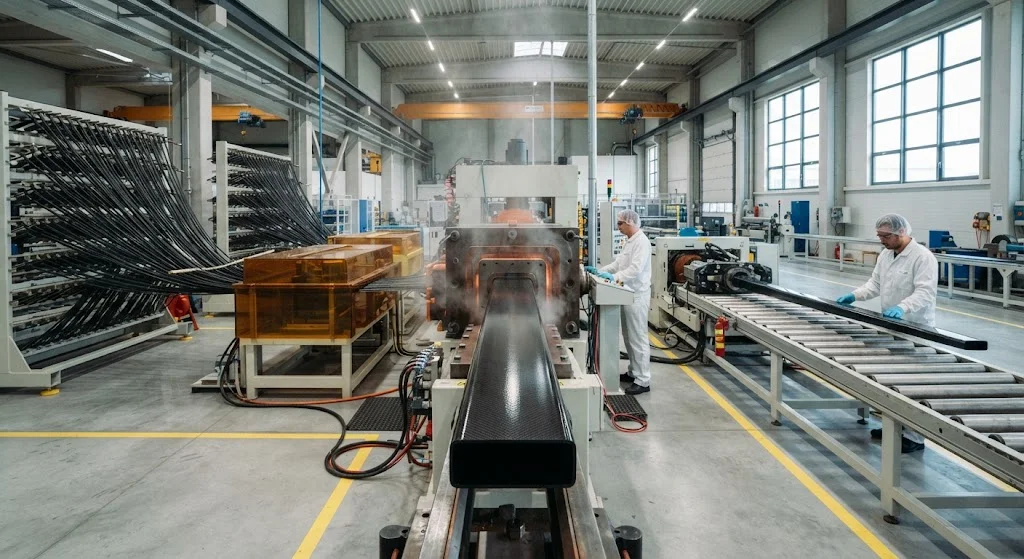
Pultrusion is a continuous composite manufacturing process where reinforcing fibers are pulled through a resin bath, shaped by a heated die, and cured in a single pass. For spar caps, the process uses unidirectional carbon fiber tows or tapes that maintain straight fiber alignment — the optimal orientation for the primarily axial loading experienced by spar caps during turbine operation.
- Fiber preparation: Carbon fiber tows (typically 24K or 48K) are organized into a flat band with controlled tension. Some systems use pre-impregnated towpregs to reduce resin bath variability.
- Resin impregnation: The fiber band passes through an epoxy resin bath with controlled temperature and viscosity. Modern systems use vacuum-assisted impregnation to ensure complete wetout with minimal void content (typically < 1%).
- Die forming and cure: The impregnated band enters a heated steel die at 120-180°C. The die geometry defines the spar cap cross-section (typically rectangular or trapezoidal), while the temperature profile controls gelation and cure. Cycle time through the die is 5-15 minutes depending on cross-section thickness.
- Continuous pull and cut: A hydraulic puller draws the cured profile at 0.5-2.0 m/min. A flying saw cuts the continuous profile to specified lengths (typically 30-60 meters for modern offshore blades).
The entire process operates as a continuous line, producing spar cap sections at rates of 10-30 meters per hour depending on cross-section size and resin system.
Mechanical Performance Comparison
The mechanical advantages of pultruded carbon fiber spar caps stem from the continuous fiber architecture and controlled cure environment. The table below compares typical properties of pultruded spar caps against vacuum-infused alternatives:
| Property | Pultruded Carbon Fiber | Vacuum Infused Carbon Fiber | Hand Layup Glass Fiber | Advantage |
|---|---|---|---|---|
| Tensile strength (0°, MPa) | 1,800-2,200 | 1,400-1,700 | 800-1,000 | 25-30% higher than infused |
| Tensile modulus (GPa) | 135-145 | 120-135 | 40-45 | 10-15% higher than infused |
| Fiber volume fraction (%) | 60-65 | 50-55 | 35-40 | Consistent, higher density |
| Void content (%) | 0.5-1.5 | 1.5-3.0 | 2.0-5.0 | Lower voids = better fatigue |
| Fatigue life (10⁷ cycles, R=0.1) | 65-70% UTS retention | 55-65% UTS retention | 40-50% UTS retention | Superior fatigue performance |
| Dimensional tolerance (mm) | ±0.5 | ±2.0-3.0 | ±5.0 | Tighter control |
| Production rate (m/hr) | 10-30 | 2-4 (per mold) | 1-2 (per mold) | 5-10x faster |
The higher fiber volume fraction achievable in pultrusion (60-65% vs 50-55% for infusion) directly translates to superior mechanical properties. The controlled die environment eliminates the variability inherent in vacuum infusion, where resin flow patterns, temperature gradients, and bag sealing quality introduce process variations that affect final part performance.
Production Economics and Scalability
The economic case for pultruded spar caps strengthens with production volume. While the initial capital investment for a pultrusion line ($2-5 million) exceeds that of infusion tooling ($500K-1.5M), the per-meter cost advantage becomes decisive at scale:
- Material cost savings: Continuous fiber utilization reduces waste to 3-5% compared to 10-20% for cut-and-place infusion processes. At $15-25/kg for aerospace-grade carbon fiber, this represents $50-150 per meter of spar cap.
- Labor reduction: Automated pultrusion requires 2-3 operators per shift versus 8-12 for hand layup infusion. Annual labor savings of $400K-800K per production line.
- Cycle time advantage: Pultrusion produces finished spar caps continuously; infusion requires 8-24 hours of cure time per batch. A single pultrusion line can supply 3-5 infusion molding stations.
- Quality consistency: Automated process control reduces reject rates from 5-10% (infusion) to 1-2% (pultrusion), directly improving yield and reducing scrap costs.
For blade manufacturers producing 500+ blades per year, pultrusion typically achieves 25-40% total cost reduction for spar cap production compared to infusion, with the advantage increasing as blade size and production rates grow.
Integration with Blade Manufacturing
Pultruded spar caps integrate into existing blade manufacturing workflows through several approaches:
- Direct bonding: Pultruded sections are adhesively bonded into blade shells during the infusion process, becoming an integral structural element. This is the most common approach for blades under 80 meters.
- Co-curing: For larger blades, spar caps are placed in the mold and infused along with the rest of the blade structure, creating a seamless bond between spar cap and skin. This eliminates secondary bonding operations but requires careful thermal management.
- Mechanical fastening: Some designs use bolted connections between spar caps and blade shells, enabling modular assembly and easier inspection. This approach is gaining interest for offshore blades requiring in-field repair capability.
The key integration challenge is maintaining alignment during blade assembly. Pultruded spar caps' dimensional consistency (±0.5 mm tolerance) actually simplifies this process compared to hand-shaped infused alternatives, reducing assembly time by 15-25%.
Frequently Asked Questions
How does pultrusion affect spar cap fatigue performance in 20+ year wind turbine applications?
Pultruded carbon fiber spar caps demonstrate superior fatigue performance compared to infused alternatives, primarily due to higher fiber volume fraction (60-65% vs 50-55%) and lower void content (0.5-1.5% vs 1.5-3.0%). At 10 million cycles with R=0.1 loading typical of wind turbine operation, pultruded carbon fiber retains 65-70% of ultimate tensile strength compared to 55-65% for infused carbon fiber. This 10-15% fatigue advantage translates to extended blade service life or reduced spar cap cross-section requirements, both of which improve the overall economics of wind turbine operation.
What are the limitations of pultrusion for very large offshore blade spar caps?
Three main limitations emerge for blades exceeding 100 meters. First, the maximum practical cross-section width is limited by die design and resin flow, typically capping rectangular spar caps at 300-400 mm width. Second, pultrusion produces constant cross-section profiles; tapered spar caps required for some blade designs require secondary machining or multi-stage pultrusion systems. Third, the logistics of transporting 60+ meter pultruded sections to blade factories near coastal assembly ports can add significant cost. These limitations are being addressed through segmented pultrusion approaches and factory siting strategies that locate pultrusion lines near blade assembly facilities.
What quality control measures are specific to pultruded spar cap production?
Pultruded spar cap quality control focuses on four critical parameters: (1) die temperature profile — monitored by multiple thermocouples along the die length to ensure complete cure without thermal degradation; (2) pull speed — directly controls cure time and must be synchronized with resin gel characteristics; (3) fiber tension — balanced across the tows to prevent misalignment or resin-rich zones; and (4) dimensional verification — continuous laser measurement of width, height, and straightness. In-process monitoring typically includes ultrasonic inspection of the cured profile and periodic destructive testing for fiber volume fraction and void content. Aerospace-grade pultrusion facilities implement statistical process control with real-time feedback loops that automatically adjust pull speed or temperature to maintain specification limits.
Conclusion
Pultrusion technology addresses the fundamental challenges of spar cap manufacturing for modern wind turbines — delivering higher mechanical performance, tighter quality control, and dramatically improved production economics compared to traditional infusion processes. The 25-30% improvement in tensile strength, 60-80% reduction in labor content, and 25-40% total cost savings at scale make pultrusion the clear choice for high-volume blade production. As wind turbine sizes continue to grow and production rates accelerate to meet renewable energy targets, pultruded carbon fiber spar caps will become the standard structural solution for next-generation blades.
For blade manufacturers and wind energy developers evaluating spar cap material and process options, understanding pultrusion's capabilities and limitations is essential for making informed production decisions. Explore our carbon fiber pultrusion materials and technical support services, including customized resin systems and fiber architectures optimized for wind energy applications, or contact our engineering team to discuss spar cap design and manufacturing solutions for your blade program.
Part of topic
Related Articles
- Bio-Based Carbon Fiber Precursors: Lignin and Polyethylene for Low-Cost Production
- Large-Tow Carbon Fiber Cost Analysis: 48K vs 60K Price-Performance Comparison
- Carbon Fiber-Resin Interface Bonding: Surface Treatment and Coupling Agent Optimization
- Digital Twin for Carbon Fiber Manufacturing: Real-Time Process Monitoring and Defect Prevention
- Thermoplastic Carbon Fiber Welding for Automotive: Ultrasonic and Induction Welding Process Windows
- Large-Tow Carbon Fiber Wet Spinning: Process Optimization for 48K/60K Production Efficiency
Interested in Custom Carbon Fiber Products?
Contact our team for competitive pricing and technical specifications.
Get a Quote