
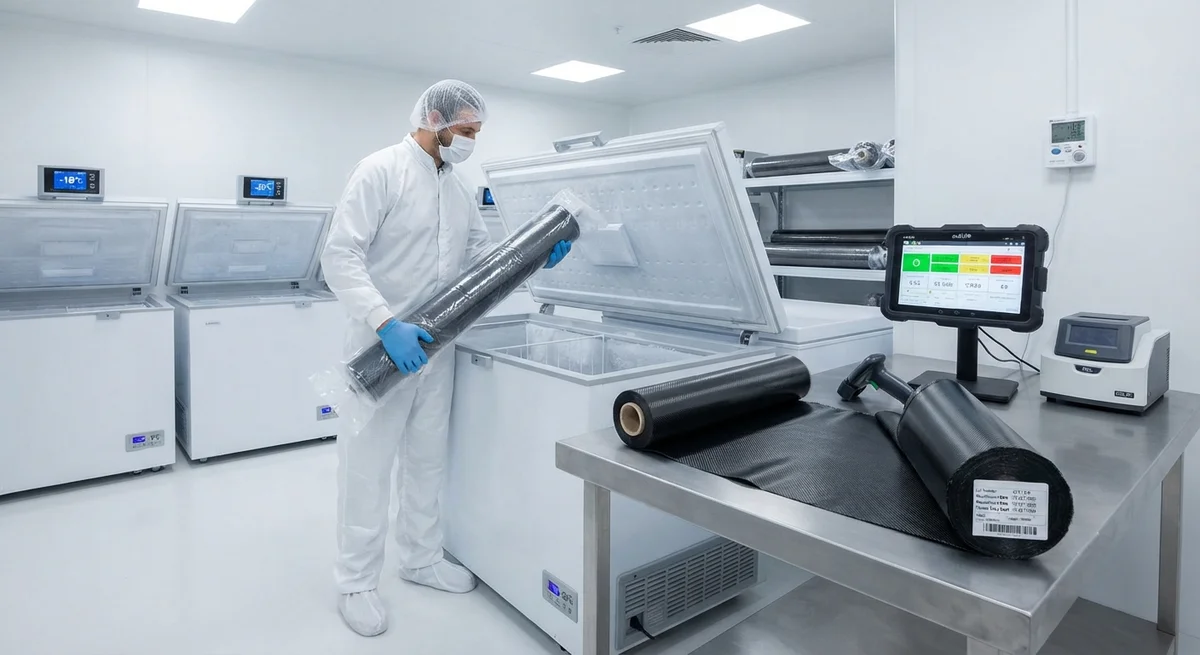
Effective management of carbon fiber prepreg outlife and shelf life is critical for composite manufacturers — uncontrolled resin advancement can reduce mechanical properties by 15–40%, increase scrap rates to 8–12%, and add $50,000–200,000 annually in material waste for a mid-volume facility. This article provides practical procedures for freezer storage, outlife tracking, resin advancement testing, and cost optimization strategies.
Introduction to Prepreg Shelf Life and Outlife
Carbon fiber prepregs — continuous fibre reinforcements pre-impregnated with partially cured thermosetting resin — are a cornerstone material for high-performance composite manufacturing in aerospace, automotive, and renewable energy applications. Unlike dry fibre or wet lay-up systems, prepregs are supplied in a controlled, B-stage (partially crosslinked) resin state that requires strict temperature management to maintain processability and final cured properties. The two critical time-temperature parameters that govern prepreg usability are shelf life — the total storage duration at a specified low temperature (typically −18°C to −24°C) during which the prepreg retains its specified handling, processing, and mechanical properties — and outlife (also called "tack life" or "working life") — the cumulative time the prepreg can be exposed to ambient shop floor conditions (typically 18–25°C) without the resin advancing beyond acceptable limits for lay-up, debulking, and cure.
Mismanagement of these parameters is one of the most costly sources of waste in composite manufacturing. A mid-volume aerospace-tier composite facility (processing 50,000–100,000 kg of prepreg annually) typically experiences 3–5% scrap rates from expired or degraded prepreg under well-managed conditions. Facilities without systematic outlife tracking report scrap rates of 8–15%, representing $150,000–500,000 in wasted material annually. This article provides a comprehensive technical and operational guide to prepreg shelf life and outlife management, covering freezer storage best practices, outlife tracking methods, resin advancement testing, scrap reduction strategies, and cost optimization through inventory rotation.
Shelf Life and Outlife Specifications by Resin System
| Resin System Type | Typical Freezer Shelf Life (−18°C) | Typical Outlife at 21°C | Resin Tg (B-stage, °C) | Max Cure Temperature | Common Applications |
|---|---|---|---|---|---|
| Standard epoxy (350°F / 177°C cure) | 12 months | 10–30 days | −10 to 0 | 177°C | Aerospace primary structures, automotive body panels |
| Standard epoxy (250°F / 121°C cure) | 6–9 months | 10–21 days | −15 to −5 | 121°C | Automotive, marine, secondary aerospace structures |
| Fast-cure epoxy (automotive grade) | 3–6 months | 3–10 days | −5 to +5 | 150–170°C | High-volume automotive compression moulding |
| Bismaleimide (BMI) | 3–6 months | 10–20 days | 0 to +10 | 220–250°C | High-temperature aerospace (engine nacelles, radomes) |
| Cyanate ester | 6–12 months | 14–28 days | −5 to +5 | 180–250°C | Space structures, antenna reflectors, radomes |
| Phenolic | 6–9 months | 14–30 days | −10 to 0 | 160–180°C | Aircraft interiors (fire-resistant), mass transit |
| Epoxy-based VBO (Vacuum Bag Only) | 9–12 months | 14–30 days | −15 to −5 | 121–177°C | Wind turbine blades, marine, large structures |
| Polyurethane (PU) prepreg | 3–6 months | 5–14 days | −10 to 0 | 120–150°C | Automotive, sporting goods, consumer products |
Freezer Storage Best Practices
Facility Requirements
- Temperature control: Freezer units must maintain a uniform temperature of −18°C ± 3°C. Temperature stratification within a freezer can vary by 6–10°C between the door area (warmsest) and the rear/bottom (coldest). Use forced-air circulation fans to minimise stratification. Never store prepreg in a frost-free (auto-defrost) domestic freezer — the defrost cycling to 0°C to +4°C causes micro-advancement of B-stage resin with each cycle, reducing usable shelf life by 30–50%.
- Moisture control: When warm prepreg (room temperature) is placed into a −18°C freezer, moisture in the air condenses on the prepreg surface and freezes. Upon removal, this ice melts and the liquid water can cause porosity in the cured laminate (0.5–2.0% void content increase). Mitigate by: (a) sealing prepreg rolls in polyethylene bags with desiccant packs before freezer entry, (b) allowing sealed bags to equilibrate for 2–4 hours before opening, and (c) maintaining freezer relative humidity below 60%.
- Organised storage: Implement a First-In First-Out (FIFO) inventory system. Each prepreg roll or kit should be labelled with: material type and lot number, date of manufacture (DOM), date of freezer entry, original shelf life expiration date, and cumulative outlife used (days at ambient). Barcode or RFID tracking systems reduce manual logging errors by 90%+ in facilities with >50 prepreg SKUs.
- Temperature monitoring: Install continuous temperature monitoring with remote alerts (email/SMS) for temperature excursions exceeding −15°C for more than 30 minutes. Data loggers (e.g., MadgeTech, Testo) placed at three locations (door, centre, rear) provide spatial temperature distribution data for audit trails. FAA and EASA audit requirements (AC 21-29, AMC 20-29) mandate temperature excursion records for aerospace-grade prepreg storage.
Freeze-Thaw Cycle Management
| Parameter | Recommendation | Rationale |
|---|---|---|
| Maximum freeze-thaw cycles per roll | 3–5 cycles maximum | Each freeze-thaw cycle causes moisture condensation and thermal micro-stress in the resin matrix |
| Thaw time (roll out of freezer, sealed) | 8–16 hours (depending on roll size) | Allows roll core temperature to reach ambient without condensation on fibres |
| Maximum time out of freezer per cycle | 5 working days (40 hours) | Limits cumulative ambient exposure to within typical outlife limits |
| Return-to-freezer requirement | If >4 hours of ambient exposure, must log outlife time | Prevents unaccounted resin advancement on partially used rolls |
| Refreeze temperature equilibration | 4 hours minimum in freezer before next removal | Ensures uniform temperature recovery and prevents partial cure gradients |
Outlife Tracking Methods
Accurate tracking of cumulative outlife is the single most effective waste-reduction measure in prepreg manufacturing. Three principal methods are used in the industry, with increasing sophistication and accuracy:
Method 1: Manual Log-Based Tracking
Each prepreg roll or kit is accompanied by a paper or digital "outlife passport" that records every removal from and return to freezer storage. The operator logs the date, time out, time in, and calculates cumulative outlife. This method is suitable for facilities processing fewer than 20 prepreg lots per week but is error-prone — audit studies show 15–30% of manual outlife logs contain errors exceeding 20% of actual outlife. Recommended only as a backup to automated systems.
Method 2: RFID or Barcode Scanning with Software
Commercial prepreg management systems — including TOR composites software, SAP ME/OEE prepreg modules, and custom barcode-based solutions — automatically track outlife by scanning each prepreg roll upon removal from and return to the freezer. The software maintains a real-time database of cumulative outlife per roll, triggers alerts when outlife reaches 60%, 80%, and 100% of specification, and can block non-compliant rolls from being released to production. Facility implementations report outlife tracking accuracy improvement from 70–85% (manual) to 97–99% with automated systems, and scrap rate reductions of 40–60%.
Method 3: Thermal Analysis Verification (DMA/DSC)
For critical aerospace structures where material pedigree documentation is mandatory (FAA Form 8130-3, EN 9100), thermal analysis provides definitive outlife status. Dynamic Mechanical Analysis (DMA) and Differential Scanning Calorimetry (DSC) measure the glass transition temperature (Tg) and residual exothermic heat of reaction (ΔH_residual) of the B-stage resin. As the resin advances during ambient exposure, Tg increases and ΔH_residual decreases. A prepreg roll is considered at end-of-outlife when its advanced Tg exceeds the specification limit by 10–15°C or when residual reactivity falls below 80% of the initial value. DMA/DSC testing costs $150–400 per sample and adds 2–4 hours to the verification cycle, making it impractical for routine lot release but essential for outlife extension programmes and root-cause investigations.
Resin Advancement and Its Effect on Mechanical Properties
| Outlife State | % of Specified Outlife | Tg Increase (°C) | % Residual Reactivity | Laminate Void Content | Tensile Strength Retention | ILSS Retention | Recommended Action |
|---|---|---|---|---|---|---|---|
| Fresh | 0% | 0 | 100% | <0.5% | 100% | 100% | Normal use |
| Good | 25–50% | 2–5 | 85–95% | <1.0% | 95–100% | 95–100% | Normal use |
| Acceptable | 50–75% | 5–10 | 75–85% | 1.0–2.0% | 85–95% | 85–95% | Non-critical applications only |
| Marginal | 75–100% | 10–15 | 65–75% | 2.0–4.0% | 75–85% | 70–85% | Testing required before use |
| Expired | >100% | >15 | <65% | >4.0% | <75% | <70% | Discard or requalify |
Cost Optimization Strategies for Prepreg Inventory Management
- Right-size freezer capacity: A common mistake is over-investing in large freezers that encourage bulk purchasing beyond actual consumption rates. Calculate minimum holding stock as 2× monthly consumption (for supply chain resilience) plus 15% buffer. Freezer size beyond 3× monthly consumption increases the risk of material expiry before use. Target freezer utilisation of 65–80% — below 50% suggests over-capacity; above 90% compromises air circulation and temperature uniformity.
- Implement outlife extension programmes: Many aerospace prepreg manufacturers (Hexcel, Solvay, Toray) offer outlife extension options based on thermal analysis requalification. If DSC analysis shows ≥80% residual reactivity after the nominal outlife has been exceeded, the manufacturer may issue an outlife extension certificate for an additional 5–15 days (at a fee of $500–2,000 per lot). For a facility processing 300 lots annually, this can save $30,000–80,000 in avoided scrap vs the 2–5% of lots that would otherwise be discarded at the nominal outlife limit.
- Downgrade cascade system: Establish a material downgrade policy: aerospace-grade prepreg that reaches 75% of its outlife is cascaded to automotive or industrial applications where property retention requirements are less stringent. Automotive-grade prepreg at 75% outlife is cascaded to prototyping, R&D, or tooling applications. This cascading approach can reduce overall scrap by 50–70% in facilities serving multiple market tiers.
- Negotiate short-lead-time supply agreements: Rather than carrying 6–12 months of prepreg inventory (which risks expiry), negotiate with prepreg suppliers for 4–8 week rolling delivery schedules with a maximum freezer holding period of 3 months before use. Most major prepreg manufacturers — given a reliable consumption forecast — can produce and deliver within 4 weeks for standard epoxy/carbon systems. The cost premium for expedited delivery (5–10%) is typically offset by the 20–40% reduction in scrap from expired material.
- Invest in thermal analysis capability: A benchtop DSC system (TA Instruments Discovery DSC 25, Netzsch DSC 300, Mettler Toledo DSC 3+) costs $40,000–80,000 and pays for itself within 12–18 months for facilities consuming >20,000 kg of prepreg annually, through outlife extension verification, incoming inspection, and root-cause analysis of cure anomalies.
Quality Standards and Compliance
| Standard/Specification | Title | Relevance to Outlife/Shelf Life |
|---|---|---|
| ASTM D3530/D3530M | Standard Test Method for Volatiles Content of Prepreg | Monitors volatiles retention during outlife — loss indicates resin advancement |
| ASTM D3532 | Standard Test Method for Gel Time of Prepreg | Gel time changes correlate directly with resin advancement state |
| ASTM D7028 | Standard Test Method for Tg by DMA | Primary method for tracking B-stage advancement |
| SAE AMS 3894/3898 | Tape and Fabric Prepreg Specifications | Defines shelf life and outlife requirements for aerospace prepregs |
| Nadcap AC7114/1 | Composite Manufacturing Audit Criteria | Requires documented shelf life/outlife control procedures for certification |
| ISO 9001:2015 / AS9100D | Quality Management Systems | Section 7.1.5.1 (monitoring resources) requires calibration of freezer temp. sensors and outlife logs |
Frequently Asked Questions
Q: Can expired prepreg be used if it still feels tacky and lays up normally?
A: No — tactile assessment (tack, drape) is not a reliable indicator of resin advancement. As prepreg resin advances, the viscosity increases and tack reduces, but the changes are gradual and operator-dependent. A prepreg that feels acceptable by hand may have already lost 20–30% of its interlaminar shear strength or developed a 2–3% void content, rendering it unsuitable for structural applications. Only DSC/DMA thermal analysis can determine the actual cure state. Many manufacturers have reported instances of in-service debonding or delamination traced back to the use of expired but apparently "good" prepreg. If the recorded outlife exceeds the manufacturer's specification, requalify by thermal analysis before use, or discard for non-structural applications.
Q: How does the outlife of prepreg vary with ambient temperature and humidity?
A: Outlife is highly temperature-dependent but only weakly humidity-dependent for most epoxy systems. The general rule: for every 10°C increase in ambient temperature, the resin advancement rate approximately doubles (a 2× acceleration factor). At 30°C ambient, a prepreg with a 21-day outlife at 21°C will have only 8–10 days of usable outlife. At 15°C, outlife extends to 35–42 days. High relative humidity (>70%) can increase moisture absorption in the resin, which may accelerate resin advancement marginally (5–15% reduction in outlife) and increase cured laminate void content. The combined worst case — 30°C + 80% RH — can reduce outlife by 60–70% compared to the standard 21°C / 50% RH condition at which manufacturers specify outlife. Facilities in tropical or summer-peak climates should implement climate-controlled layup rooms at 20±2°C / 45–55% RH, which adds approximately $15,000–30,000 in annual HVAC operating cost but extends usable outlife by 40–60% compared to unconditioned shop floor conditions.
Q: What is the difference between "technical outlife" and "practical outlife"?
A: Technical outlife is the manufacturer-specified cumulative time at 21°C during which all mechanical properties (tensile, compression, ILSS, and Tg after cure) remain within the material qualification data. Practical outlife, as used in production environments, incorporates additional working time allowances for debulking cycles, vacuum hold periods, and lag time between layup completion and autoclave cure initiation. For complex aerospace parts with 3–5 debulking cycles (each 30–60 minutes) and overnight vacuum holds before cure, the practical outlife consumed before the part reaches the autoclave can be 30–50% longer than the actual layup time. Manufacturers should specify whether their quoted outlife includes vacuum hold time. If not specified, assume the quoted outlife covers only active layup time, and additional time spent under vacuum (which retards resin advancement due to reduced oxygen and volatile off-gassing) may be counted at 50–70% of the clock time for outlife tracking purposes.
Q: What are the root causes of prepreg scrap — and how can they be addressed systematically?
A: Analysis of scrap data from 12 composite manufacturing facilities (2023–2025) reveals the following root-cause distribution: (1) Outlife exceeded during layup (38% of scrap) — addressed by automated outlife tracking systems, radio-frequency (RF) scanners at each workstation, and real-time dashboard alerts to production supervisors. (2) Freezer temperature excursion damage (22%) — addressed by redundant freezer units with independent temperature monitoring and SMS alerts for excursions exceeding 30 minutes. (3) Improper thawing procedure (18%) — addressed by written thaw protocols, operator training, and thaw timers. (4) Moisture contamination from condensation (14%) — addressed by sealed bags with desiccant, pre-opening equilibration, and maintaining freezer RH below 60%. (5) Manufacturing defect rendering material unsuitable for use (8%) — addressed by enhanced incoming inspection (visual, gel time, and volatiles content per ASTM D3530/D3532). A systematic corrective action programme targeting the top three root causes typically reduces total prepreg scrap by 55–70% within 6–9 months, representing $75,000–200,000 in annual savings for a mid-volume facility.
Conclusion
Effective management of carbon fiber prepreg outlife and shelf life is a foundational competency for profitable composite manufacturing. The difference between a facility that treats outlife as a passive tracking exercise and one that manages it as an active cost-optimisation lever is often 5–10 percentage points of scrap rate — representing hundreds of thousands of dollars annually at scale. By implementing systematic freezer management, automated outlife tracking, resin advancement verification via thermal analysis, and a tiered cascading policy for approaching-expiry material, manufacturers can reduce prepreg scrap to below 3%, extend usable material life by 15–30%, and improve cured laminate quality consistency. For B2B buyers evaluating composite manufacturing partners, a supplier's prepreg management discipline — evidenced by documented outlife tracking procedures, freezer monitoring logs, and thermal analysis capabilities — is a strong leading indicator of overall manufacturing quality and cost competitiveness.
Part of topic
Related Articles
- Bio-Based Carbon Fiber Precursors: Lignin and Polyethylene for Low-Cost Production
- Large-Tow Carbon Fiber Cost Analysis: 48K vs 60K Price-Performance Comparison
- Carbon Fiber-Resin Interface Bonding: Surface Treatment and Coupling Agent Optimization
- Digital Twin for Carbon Fiber Manufacturing: Real-Time Process Monitoring and Defect Prevention
- Thermoplastic Carbon Fiber Welding for Automotive: Ultrasonic and Induction Welding Process Windows
- Large-Tow Carbon Fiber Wet Spinning: Process Optimization for 48K/60K Production Efficiency