
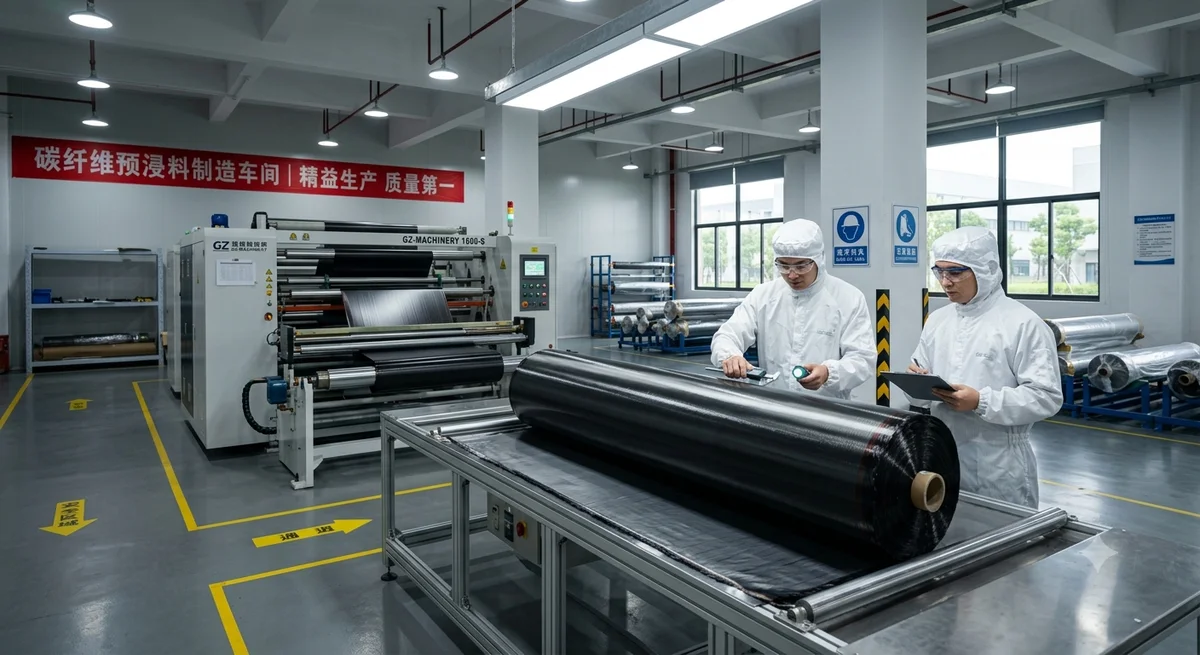
Learn the critical quality control parameters in carbon fiber prepreg manufacturing — resin content, tack, areal weight, and out-life — to make informed B2B sourcing decisions.
Introduction
Carbon fiber prepreg — pre-impregnated unidirectional or woven fabric combined with a partially cured resin matrix — is the foundational material for high-performance composite manufacturing. For B2B buyers sourcing prepreg for aerospace, automotive, or sporting goods applications, understanding the quality control (QC) parameters that govern prepreg consistency is essential. Inconsistent prepreg leads to rejected parts, production delays, and increased scrap rates. This article examines the five most critical QC parameters that every procurement engineer should verify before approving a prepreg supplier.
Key Quality Control Parameters
| Parameter | Typical Specification | Measurement Method | Impact on Final Part |
|---|---|---|---|
| Resin Content | 32–42% by weight | Acid digestion (ASTM D3171) | Mechanical properties, void content |
| Areal Weight | 100–650 g/m² | Cut-and-weigh per ASTM D3776 | Laminate thickness, fiber volume fraction |
| Tack Level | Grade 3–5 (1–10 scale) | Peel adhesion test (in-house) | Layup conformity, bagging ease |
| Gel Time at 120°C | 8–20 minutes | DSC per ASTM E2160 | Cure cycle window, processing margin |
| Out-Life at 21°C | 10–30 days | Dynamic viscosity tracking | Shelf usability, storage cost |
Resin Content Consistency
Resin content is the single most important QC parameter for prepreg. A deviation of ±2% from the target resin weight fraction can alter cured laminate mechanical properties by 10–15%. Premium aerospace-grade prepreg holds resin content to ±1% across the roll and from roll to roll. B2B buyers should request a resin content uniformity chart covering at least three samples per roll — one from the start, middle, and end. If the supplier cannot provide this data, it indicates insufficient process control.
Areal Weight and Fiber Placement
Areal weight defines the mass of carbon fiber per square meter before resin addition. Tighter areal weight tolerance means more predictable laminate thickness after cure. For woven prepregs, buyers must also verify fabric style (plain, twill, satin) and crimp percentage, as these influence drapeability on complex molds. Key questions to ask suppliers:
- What is the areal weight tolerance across a full roll (beginning, middle, end)?
- Is the areal weight verified using ASTM D3776 or an equivalent standard?
- How does the supplier handle roll-to-roll variability in multi-roll orders?
- Are fiber counts per tow consistent with the declared tow specification (e.g., 3K, 6K, 12K, 24K)?
Tack, Gel Time, and Out-Life Management
Tack — the stickiness of the prepreg surface — determines how well layers adhere during hand layup or automated tape placement. Too little tack causes ply slippage; too much makes repositioning impossible. Temperature-controlled prepreg storage at −18°C is standard, and suppliers should provide a tack retention curve showing tack score versus days at room temperature. Gel time indicates the usable processing window at elevated temperature. A prepreg with a gel time of 10 minutes at 120°C gives the operator sufficient time to apply vacuum and achieve full compaction before crosslinking begins. Out-life at 21°C (room temperature) defines how many days the prepreg remains processable after removal from freezer storage. Suppliers typically certify 15–30 days, but real out-life depends on ambient humidity and handling frequency.
Frequently Asked Questions
What tests should I request in a prepreg certificate of conformance?
Request at minimum: resin content (%), areal weight (g/m²), volatile content (%), gel time at specified temperature, out-life at 21°C, and moisture pickup after 24 hours ambient exposure. For aerospace applications, also request DSC thermogram showing Tg onset, cure exotherm peak, and residual exotherm.
How do I verify prepreg quality upon receipt?
Upon receipt, check freezer temperature logs (should be −18°C or below), inspect packaging for freezer burn or moisture condensation, and take a visual sample for tack assessment. Within 24 hours, run a DSC gel time test and weigh a 100×100 mm coupon to verify areal weight matches the CoC. Document all findings for supplier audit trail.
Can different prepreg batches be used in the same cure cycle?
Mixing batches is not recommended without qualification. Different batches may have slightly different cure kinetics, leading to uneven crosslinking within the same part. If batch mixing is unavoidable, request blended qualification test panels (tensile, flexural, ILSS) from the supplier before production use.
Conclusion
Consistent prepreg quality is the foundation of reliable composite manufacturing. By verifying resin content uniformity, areal weight tolerance, tack characteristics, gel time, and out-life, B2B buyers can reduce scrap rates, maintain production schedules, and build stronger supplier partnerships. YongXian CarbonFiber supplies certified prepreg with full QC documentation. Visit www.yongxian.co to discuss your prepreg specifications with our technical team.
Part of topic
Related Articles
- Bio-Based Carbon Fiber Precursors: Lignin and Polyethylene for Low-Cost Production
- Large-Tow Carbon Fiber Cost Analysis: 48K vs 60K Price-Performance Comparison
- Carbon Fiber-Resin Interface Bonding: Surface Treatment and Coupling Agent Optimization
- Digital Twin for Carbon Fiber Manufacturing: Real-Time Process Monitoring and Defect Prevention
- Thermoplastic Carbon Fiber Welding for Automotive: Ultrasonic and Induction Welding Process Windows
- Large-Tow Carbon Fiber Wet Spinning: Process Optimization for 48K/60K Production Efficiency