
Organic sheet thermoforming represents the most promising pathway for carbon fiber reinforced polymers to enter high-volume automotive production. Unlike aerospace-grade prepreg layup and autoclave curing — which are optimized for performance at low production rates — organic sheet ther
Introduction
Organic sheet thermoforming represents the most promising pathway for carbon fiber reinforced polymers to enter high-volume automotive production. Unlike aerospace-grade prepreg layup and autoclave curing — which are optimized for performance at low production rates — organic sheet thermoforming leverages established thermoplastic forming infrastructure to produce CFRP components at cycle times of 60-90 seconds, volumes exceeding 100,000 parts per year, and per-part costs approaching economic viability for premium vehicle programs.
An organic sheet is a semi-finished product consisting of continuous carbon fiber reinforcement (typically non-crimp fabric or woven fabric) consolidated with a thermoplastic matrix — most commonly polyamide 6 (PA6), polypropylene (PP), or polyether ether ketone (PEEK) — into flat panels of controlled thickness (0.5-4.0 mm). These sheets are produced on consolidated belt lamination lines at fiber volume fractions of 50-60%, then shipped flat to the thermoforming facility where they are heated, formed, trimmed, and assembled into structural automotive components. The process chain eliminates the autoclave entirely, replacing it with press-based forming that aligns with existing metal stamping infrastructure.
The Thermoforming Process Chain: Step by Step
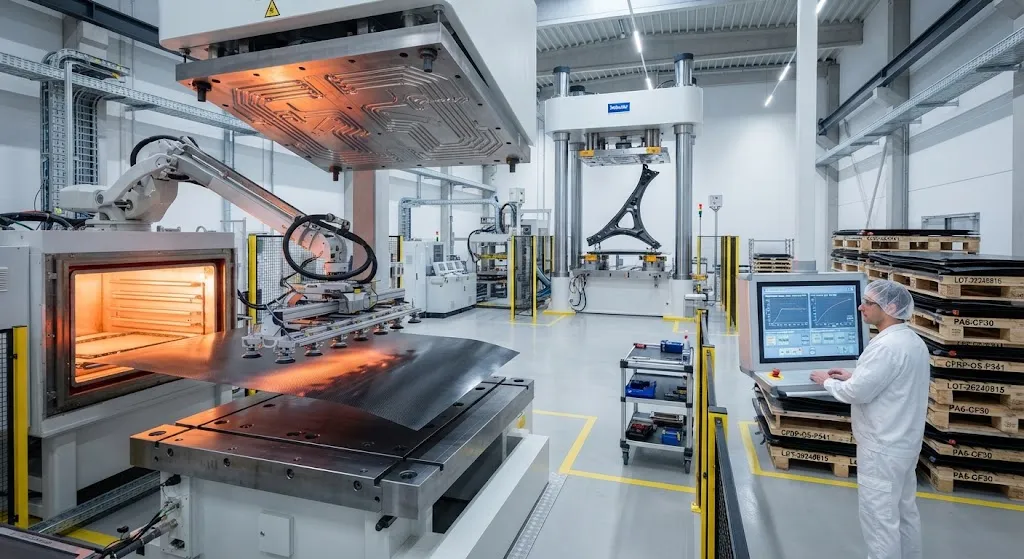
The organic sheet thermoforming process follows a sequential chain that determines both part quality and production throughput. Each step has specific parameter windows that must be controlled for consistent output:
- Sheet storage and conditioning: Organic sheets are stored at room temperature (PA6 grades) or refrigerated (PEEK grades) and must be dried to <0.02% moisture content before forming. Moisture in PA6 causes hydrolysis during heating, degrading molecular weight and mechanical properties. Typical drying: 80°C for 4-6 hours in a desiccant dryer.
- Heating: The sheet is heated in a convection or infrared oven to 10-30°C above the matrix melting point (220-250°C for PA6, 165-190°C for PP, 340-380°C for PEEK). Heating time depends on thickness: 1 mm sheet requires 30-45 seconds; 3 mm sheet requires 90-120 seconds. Uniform temperature distribution across the sheet ±5°C is critical — cold spots cause incomplete forming, hot spots cause fiber degradation.
- Transfer: The heated sheet is transferred from the oven to the press in 3-5 seconds using a robotic gripper or vacuum transfer system. This is the most time-critical step — every second of delay causes 5-10°C temperature loss, narrowing the forming window.
- Forming: The press closes at 200-500 mm/s, applying 50-200 tonnes of force depending on part projected area. Forming pressure typically ranges from 5-15 MPa. The male-female tool pair shapes the flat sheet into a 3D geometry in a single stroke. Springback compensation of 2-5% is incorporated into the tool geometry.
- Cooling: The formed part is cooled in the tool using integrated water channels (for PA6 and PP) or air cooling (for PEEK). Cooling to below the matrix crystallization temperature takes 15-30 seconds for PA6 with conformal cooling channels. Tool temperature is maintained at 80-120°C for PA6 to control crystallinity and surface finish.
- Trimming: Excess material (flash and datum surfaces) is trimmed using CNC routing, water-jet cutting, or hemming dies. Trimming is typically performed offline to avoid adding cycle time to the forming press.
Total cycle time from sheet load to part removal is typically 60-120 seconds for PA6-based systems, compared to 300-600 seconds for thermoset RTM processes and 1,800+ seconds for aerospace prepreg autoclave cycles.
Material Selection: Matrix and Reinforcement Choices
The choice of thermoplastic matrix and fiber reinforcement directly determines the mechanical properties, forming behavior, and cost of the finished part. The matrix-reinforcement combination must be matched to the application requirements.
| Matrix | Melting Point | Typical Fiber | Fiber Volume | Tensile Strength | Cost Index | Primary Application |
|---|---|---|---|---|---|---|
| PA6 (Nylon 6) | 220°C | UD or NCF carbon | 50-55% | 800-1,100 MPa | 1.0 (baseline) | Structural brackets, seat frames |
| PA66 (Nylon 66) | 260°C | UD or NCF carbon | 50-55% | 850-1,150 MPa | 1.1 | Under-hood components |
| PP (Polypropylene) | 165°C | Woven or NCF carbon | 45-50% | 600-850 MPa | 0.7 | Exterior panels, semi-structural |
| PA6 + GF | 220°C | Hybrid C/G fiber | 40-45% | 450-650 MPa | 0.8 | Cost-optimized structural parts |
| PEEK | 343°C | IM carbon UD | 55-60% | 1,200-1,600 MPa | 8-12 | Aerospace-grade structural |
PA6-based organic sheets dominate the automotive thermoforming market due to their balance of forming window, mechanical properties, and cost. PA6 absorbs moisture during service (2-3% equilibrium content), which increases impact toughness but reduces stiffness — a trade-off managed through design thickness and surface coating. PP-based sheets offer the lowest material cost and are preferred for exterior body panels where paint-grade surface finish is required, but their lower forming temperature window and reduced stiffness limit structural applications.
Tooling Design and Press Requirements
Organic sheet forming tooling shares design principles with metal stamping dies but incorporates features specific to composite forming. The key design considerations include:
- Tool material: P20 or H13 tool steel for production volumes above 100,000 parts; aluminum tooling for prototyping and low volumes (1,000-10,000 parts). Aluminum tools heat up and cool down faster, reducing cycle time by 15-20%.
- Surface texture: Class-A surface finish (Ra 0.05-0.1 μm) for exterior panels is achievable with polished chrome-plated tooling. Textured tool surfaces (VDI 27-33) provide controlled matte finish for interior structural parts.
- Ventilation: Trapped air between the sheet and tool surface causes surface defects. Vent holes (0.5-1.0 mm diameter) at 15-25 mm spacing in concave tool regions are essential for defect-free forming.
- Heating/cooling integration: Conformal cooling channels (3D-printed or drilled) in the tool maintain uniform temperature. For PA6, the tool must be maintained at 80-120°C during forming to control crystallization rate and prevent surface void formation.
- Blank holder system: For deep-draw parts (draw ratio >2:1), a blank holder applies controlled force to the sheet edge, preventing wrinkling while allowing material flow. Hydraulic or servo-driven blank holders with 4-8 independently controlled zones provide the best forming control.
The forming press must deliver high speed (200-500 mm/s closing), high force (100-500 tonnes), and precise position control (±0.1 mm). Servo-hydraulic or all-electric presses with programmable motion profiles are preferred over traditional hydraulic presses for their ability to implement multi-stage forming — initial rapid closure followed by controlled slow-down near the forming zone to prevent fiber breakage.
Production Economics: Cost Breakdown
Understanding the cost structure of organic sheet thermoforming is essential for B2B buyers evaluating CFRP against aluminum and steel alternatives. The cost breakdown for a typical automotive structural component (0.8 kg finished weight, 2.0 mm wall thickness, 150 × 200 mm plan area) at 50,000 parts per year:
| Cost Element | Organic Sheet (PA6/CF) | Aluminum 6061-T6 (Stamped) | Steel DP980 (Stamped) |
|---|---|---|---|
| Raw material | ¥38-45/part | ¥12-15/part | ¥5-8/part |
| Forming (per-part amortized) | ¥8-12/part | ¥6-10/part | ¥5-8/part |
| Trimming and finishing | ¥5-8/part | ¥3-5/part | ¥3-5/part |
| Tooling amortization (over 50K parts) | ¥6-10/part | ¥4-6/part | ¥3-5/part |
| Total per-part cost | ¥57-75/part | ¥25-36/part | ¥16-26/part |
| Weight saving vs steel | 55-65% | 40-50% | Baseline |
| Weight saving vs aluminum | 25-35% | Baseline | — |
The cost premium for CFRP organic sheet over aluminum is typically 2.0-2.5× at 50,000 parts per year. However, this gap narrows significantly at higher volumes (200,000+ parts) where tooling amortization and forming cycle time improvements reduce per-part cost by 30-40%. For electric vehicles where every kilogram of weight reduction translates to 0.5-1.0 km of additional range, the CFRP premium can be justified when the weight savings replace battery capacity that would otherwise cost ¥80-120/kWh.
Frequently Asked Questions
What is the minimum production volume where organic sheet thermoforming becomes cost-competitive?
The economic crossover point depends on the comparison material and the specific component. Against aluminum stampings, organic sheet thermoforming typically becomes competitive at 80,000-120,000 parts per year when tooling amortization and cycle time improvements are fully realized. Against steel, the crossover is higher — approximately 200,000 parts per year — due to the significant raw material cost advantage of steel. However, the value proposition changes when weight reduction is monetized through fuel efficiency gains or battery cost reduction. For EV manufacturers, the effective crossover can be as low as 30,000-50,000 parts per year when the weight savings are valued at the battery pack level.
How does organic sheet thermoforming compare to injection overmolding for CFRP parts?
Organic sheet thermoforming and injection overmolding are complementary, not competing, processes. Thermoforming produces the primary structural shell from continuous-fiber organic sheet, while injection overmolding adds ribs, bosses, clips, and connection features using short-fiber or unfilled thermoplastic. The combination — sometimes called "organosheet + overmolding" — produces near-net-shape parts with both structural performance and functional integration. Thermoforming alone cannot create the complex 3D features (threaded inserts, snap fits, living hinges) that injection molding provides. Most production CFRP automotive components use both processes: the organic sheet forms the load-bearing structure, and overmolding creates the interface features.
What are the main quality challenges in organic sheet thermoforming?
The three most common quality challenges are: (1) fiber wrinkling in deep-draw regions where the sheet is compressed rather than stretched, addressed through blank holder optimization and pre-heating temperature profiling; (2) surface porosity caused by trapped air or insufficient forming pressure, resolved through tool venting design and increased press tonnage; and (3) fiber washout in areas with high local strain rates, mitigated by controlling press closing speed and optimizing the heating profile to maintain uniform viscosity. In-line quality monitoring using thermal cameras and force-displacement sensors enables real-time detection of these defects, with statistical process control reducing scrap rates from 5-8% to below 2% in mature production environments.
Conclusion
Organic sheet thermoforming is the enabling technology that bridges the gap between carbon fiber's performance advantages and the cost and cycle-time requirements of high-volume automotive production. With cycle times of 60-120 seconds, production volumes of 100,000+ parts per year, and a material platform that spans PA6, PP, and PEEK matrices, thermoformed CFRP components are entering production on premium vehicle programs and increasingly on mainstream EV platforms where lightweighting directly impacts range and battery cost.
For automotive OEMs, Tier 1 suppliers, and CFRP material producers evaluating thermoforming capabilities, the process chain requires careful integration of material specification, tooling design, and press selection. Browse our carbon fiber product range for organic sheet materials and semi-finished reinforcements suited to thermoforming applications, or contact our engineering team for process optimization consultation and material qualification support.
Part of topic
Related Articles
- Bio-Based Carbon Fiber Precursors: Lignin and Polyethylene for Low-Cost Production
- Large-Tow Carbon Fiber Cost Analysis: 48K vs 60K Price-Performance Comparison
- Carbon Fiber-Resin Interface Bonding: Surface Treatment and Coupling Agent Optimization
- Digital Twin for Carbon Fiber Manufacturing: Real-Time Process Monitoring and Defect Prevention
- Thermoplastic Carbon Fiber Welding for Automotive: Ultrasonic and Induction Welding Process Windows
- Large-Tow Carbon Fiber Wet Spinning: Process Optimization for 48K/60K Production Efficiency