
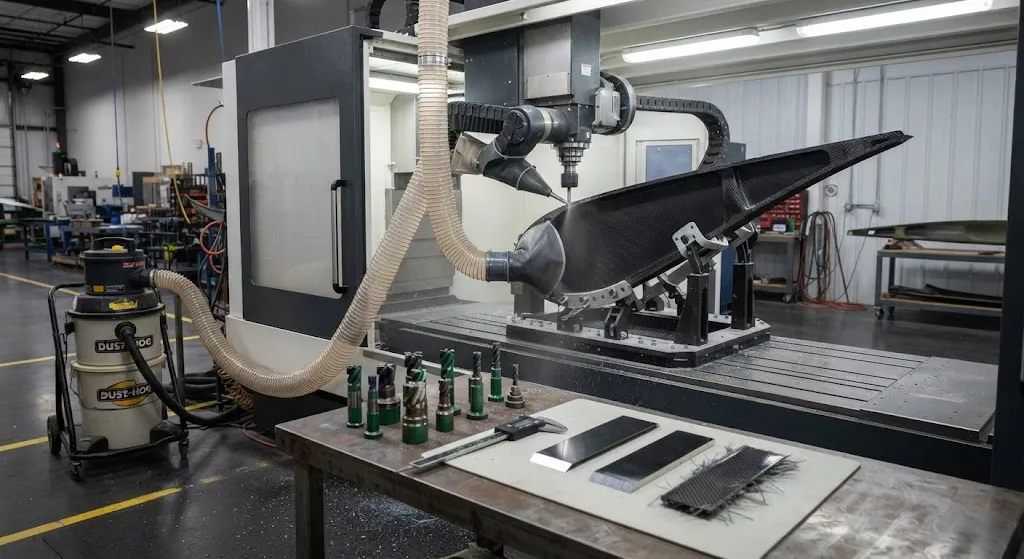
Most carbon fiber composite parts leave the autoclave or press with excess material at the edges — trim allowance, flash, and fastener prepreg that must be removed before the part enters service. Milling and trimming are the operations that remove this material, and they are also the op
Introduction
Most carbon fiber composite parts leave the autoclave or press with excess material at the edges — trim allowance, flash, and fastener prepreg that must be removed before the part enters service. Milling and trimming are the operations that remove this material, and they are also the operations where defects appear: burned or rounded cutting edges, exit-side delamination, fiber pullout, and fuzzing. Add the health and safety dimension of carbon fiber dust, and finishing becomes the most demanding step in the entire composite manufacturing sequence.
This article examines the three pillars of successful CFRP milling — tool selection for abrasive wear, process parameters for clean edges, and dust extraction for a safe workshop — and provides practical guidance for job shops and production lines alike.
Why CFRP Destroys Cutting Tools
Carbon fibers are harder than tool steel, and a cured carbon fiber reinforced plastic acts on a cutting edge like a continuous abrasive belt. During milling, each fiber is sheared, bent, and pulled rather than cleanly cut, and the broken fiber ends scour the tool flank and face. Three wear mechanisms dominate: abrasive flank wear, which rounds the cutting edge; edge chipping, caused by intermittent impacts of hard fibers; and coating delamination, when the wear-resistant layer is locally knocked off the substrate.
The practical consequence is that uncoated carbide end mills lose their edge within a few minutes of machining CFRP. Production shops therefore choose between diamond-coated carbide and polycrystalline diamond tooling, trading initial cost against tool life and edge quality.
| Tool Type | Relative Tool Life | Best Edge Quality | Relative Cost | Best Use |
|---|---|---|---|---|
| Uncoated carbide | Baseline (minutes) | Good initially, degrades fast | Lowest | Prototyping, soft abrasive systems |
| Diamond-coated carbide | 10 to 15 times carbide | Consistent with reconditioning | Medium | Production trimming and profiling |
| PCD (polycrystalline diamond) | Up to 100 times carbide | Best sustained edge sharpness | Highest | High-volume, high-tolerance trimming |
Tool wear is not just a cost item; it is a quality driver. A rounded cutting edge increases cutting force, which raises process temperature, smears the matrix resin, and promotes exit-side damage. Most shops replace or recondition tools based on cutting force monitoring or a fixed length of cut, rather than visual inspection alone.
Controlling Edge Chipping and Delamination
Delamination at the part exit is the signature defect of CFRP milling. As the flute approaches the exit surface, the remaining laminate is thin and deflects under the cutting force; instead of shearing cleanly, the top plies peel upward. The severity depends on fiber orientation, tool sharpness, and process parameters.
- Climb milling over conventional: Climb (down) milling throws the chip toward the exit face with the tool pushing the laminate down, which measurably reduces exit delamination compared with conventional milling on the same setup.
- Sharp, well-balanced tools: A diamond-coated cutter with low runout cuts with lower force variation; runout above roughly 10-15 micrometers measurably worsens exit chipping.
- Moderate chip loads: Feed per tooth in the range of 0.05 to 0.15 mm keeps plastic deformation ahead of the edge small; higher chip loads tear fibers rather than shear them.
- Radial engagement control: Keeping the radial depth of cut below 30-50% of tool diameter reduces the peak force per fiber interaction and stabilizes the cut.
- Exit edge support: Machining with a backing plate or leaving net-shape tabs until the final pass prevents the unsupported edge from deflecting and delaminating.
Fiber orientation also matters: plies running at roughly 45 degrees to the tool path tend to fuzz and pull out, while 0-degree plies shear more cleanly. Trimming programs that mix climb milling with small radial passes, and that schedule the final clean-up pass with a sharp tool, consistently produce the cleanest edges.
Cutting Parameters That Matter
CFRP milling operates well outside the familiar steel-cutting envelope. Composite trimming is done with high spindle speeds and modest feeds to keep chip loads low while controlling heat:
- Spindle speed: 12,000 to 24,000 rpm is typical for small-diameter end mills; the limiting factor is surface speed on the tool periphery, not machine power.
- Feed rate: 1,500 to 4,000 mm/min for 6-10 mm tools, selected to hold the feed-per-tooth target of 0.05-0.15 mm.
- Axial depth of cut: Full-depth passes through the laminate are common in trimming; where exit damage is an issue, reduce to the final millimeters and finish with a separate pass.
- Air blast or minimum quantity lubrication: Dry machining with an air blast is standard; flood coolant is avoided because it complicates dust collection and can swell the matrix at the cut line.
Heat is the hidden enemy: resin softens above roughly 150-200 degrees Celsius for standard aerospace epoxies, and a hot tool smears resin over the cut surface, blunting the edge and leaving burn marks. Keeping chip loads moderate and using sharp tools keeps temperatures in the safe band far better than adding coolant.
Dust Extraction and Workshop Safety
Carbon fiber dust is a serious workshop hazard because it is electrically conductive, abrasive, and respirable. Conductive dust migrates into machine controls, motors, and electronics, causing shorts and premature failure; airborne particles below 10 micrometers can be inhaled deep into the lungs, and the respirable fraction of carbon fiber dust is a recognized occupational concern.
- Capture at the source: Local extraction hoods and shrouded spindles pull dust directly from the cut zone, before it disperses through the workshop.
- HEPA filtration: Vacuum systems for composite dust use HEPA filters rated for fine particulates; standard shop vacuums recirculate the smallest particles.
- Wet machining where possible: Misting or flood systems suppress airborne dust but add cleanup and matrix-leaching concerns, so they are used selectively.
- Enclosed machines: CNC trimming cells with full enclosures and negative pressure capture most of the dust that hand-held routing would release.
- Personal protection: Workers performing hand trimming wear FFP2 or N95-equivalent respirators and protective clothing, and follow hygiene procedures to avoid carrying conductive dust home.
Shop-level housekeeping matters as much as extraction: compressed-air blowing spreads dust rather than removing it, and dry sweeping re-suspends settled particles. Vacuum-based cleanup, daily filter checks, and periodic air monitoring keep both equipment and people safe.
Frequently Asked Questions
Why do carbide tools wear out so fast when machining carbon fiber?
Carbon fibers are harder than steel and behave like an abrasive belt against the cutting edge. Every fiber that is sheared, bent, or pulled scours the tool, so the flank wears and the edge rounds within minutes on uncoated carbide. Diamond-coated carbide and PCD resist this abrasion and extend tool life by orders of magnitude, which is why they are standard in production trimming.
What causes fuzzing and fiber pullout on machined CFRP edges?
Fuzzing is loose, unbonded fibers left on the machined surface, and fiber pullout happens when fibers are torn out ahead of a blunt cutting edge instead of being sheared. Both are driven by dull tools, high chip loads, and unfavorable fiber angles at the cut line. Sharp diamond-coated tools, moderate feed per tooth, and climb milling are the standard remedies.
Is carbon fiber dust dangerous, and how should it be collected?
Carbon fiber dust is conductive, which damages electronics, and the respirable fraction can be inhaled. Collection should happen at the source with shrouded tooling and local extraction, using HEPA-filtered vacuums, and hand trimming should be done with respirator protection. Airborne dust should be monitored and settled dust removed by vacuum, never by blowing or dry sweeping.
Should CFRP be machined dry or with coolant?
Dry machining with an air blast is the standard practice for CFRP trimming, because the matrix resin softens at relatively low temperature and coolant complicates both dust collection and edge quality. Where heat is a concern, the correct response is a sharper tool and lower chip load — not flood coolant.
Conclusion
Successful CFRP milling and trimming come down to three coordinated decisions: selecting diamond-coated or PCD tooling that survives abrasive wear, running climb milling with moderate chip loads and sharp edges to suppress chipping and delamination, and extracting the conductive dust at the source with HEPA filtration. Parts that are trimmed correctly reach the customer with clean edges and full structural integrity, while uncontrolled finishing erodes both margins and reputation. For shops establishing a composite finishing cell, investing in tooling and extraction up front pays back in reject rate, tool spend, and worker safety within the first year.
Browse YongXian's carbon fiber materials for machined-part programs, or contact our engineering team for material grades, fabric formats, and supply programs suited to your trimming and finishing operation.
Related Articles
- How Are Carbon Fiber Parts Made: Complete Guide
- Filament Wound Tube: Complete Guide
- Filament Wound FRP Pipe: Complete Guide
- Filament Wound Epoxy Tubes: Complete Guide
- Pultruded Carbon Fibre Rods: Cross-Sectional Properties and Standard Sizes
- Carbon Fiber Tube Fittings and Connectors: Joining Solutions for Structural Assemblies
Interested in Custom Carbon Fiber Products?
Contact our team for competitive pricing and technical specifications.
Get a QuoteRelated Products

Custom Carbon Fiber Medical Device Components
Medical-grade carbon fiber components manufactured for imaging equipment, surgical instruments, and patient support systems. Carbon fiber's radiolucency (X-ray transparency) and high strength-to-weight ratio make it ideal for CT scanner beds, wheelchair frames, surgical robot arms, and MRI-compatible accessories. Biocompatible resin systems available.
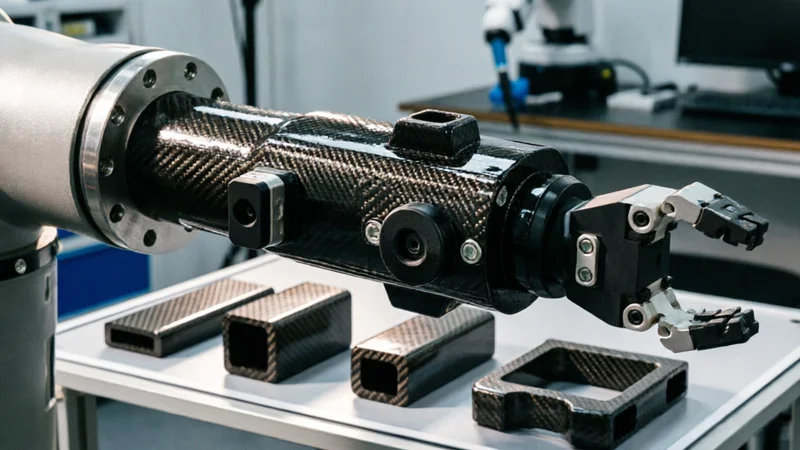
Carbon Fiber Robot End Effector Link — Custom Shape & Sensor Integration
Custom-shaped carbon fiber end effector links for robotic arms. Designed for automation integrators and research labs requiring lightweight, rigid connections between the robot wrist and gripper/tool. Can incorporate sensor mounting bosses, cable routing channels, and quick-change interfaces.

Custom Carbon Fiber Musical Instrument Parts
Carbon fiber components for musical instrument manufacturing offering superior dimensional stability, low weight, and consistent acoustic properties. We produce carbon fiber bows, guitar necks, violin chin rests, drum shells, and wind instrument bodies. Carbon fiber instruments are immune to humidity changes and temperature fluctuations that affect wooden instruments.
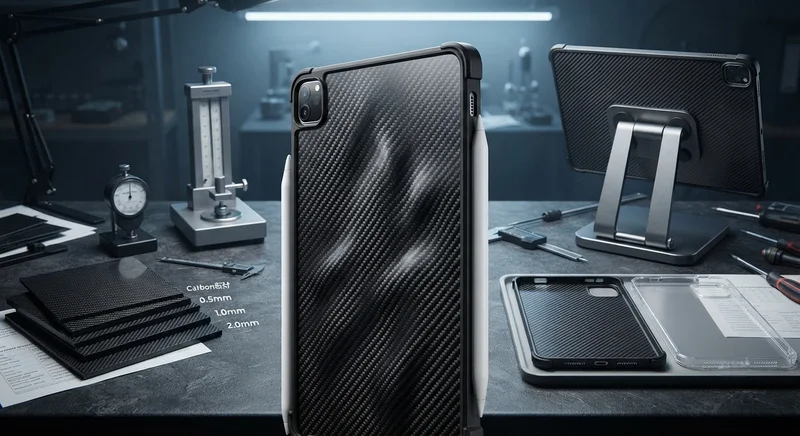
Carbon Fiber Tablet Case — Ultra-Light Protective Shell
Lightweight carbon fiber protective case for tablets and iPads. Molded from T700 3K prepreg with reinforced corner protection. Adds minimal weight while providing superior rigidity and drop protection compared to polycarbonate or silicone cases. Ideal for field workers, enterprise deployments, and professionals requiring durable tablet protection.

Custom Carbon Fiber Drone Arm — Lightweight & Vibration-Damping
High-modulus carbon fiber drone arms designed for industrial, agricultural, and surveying UAVs. Replace heavy aluminum arms with our custom-molded CFRP arms — 40-60% lighter with superior vibration damping for stable flight and sharper imaging.