The CIRCLE4WIN project, initiated by the Netherlands Organisation for Applied Scientific Research (TNO) in partnership with industrial collaborators including Siemens Gamesa and Nijhuis Industries, is the largest dedicated pyrolysis demonstration facility for wind turbine blade recyclin
Introduction
The CIRCLE4WIN project, initiated by the Netherlands Organisation for Applied Scientific Research (TNO) in partnership with industrial collaborators including Siemens Gamesa and Nijhuis Industries, is the largest dedicated pyrolysis demonstration facility for wind turbine blade recycling in the world. With a target processing capacity of 10,000 tonnes per year of mixed composite blade waste, the plant is designed to bridge the gap between laboratory-scale pyrolysis research and commercial-scale recycling operations — a gap that has prevented pyrolysis from contributing meaningfully to the 914,000 tonnes per year of European thermoset composite waste.
The significance of CIRCLE4WIN extends beyond its throughput capacity. The facility is specifically engineered to handle mixed glass fiber reinforced polymer (GFRP) and carbon fiber reinforced polymer (CFRP) feedstock — the material composition of most decommissioned wind blades — rather than the pure CFRP streams that previous pyrolysis demonstrations have processed. This mixed-feed capability is essential because wind blade waste is overwhelmingly glass fiber dominant (60-70% GFRP by weight), and any recycling solution that requires material separation before processing will fail at commercial scale due to the cost and complexity of sorting.
Process Design and Thermal Engineering
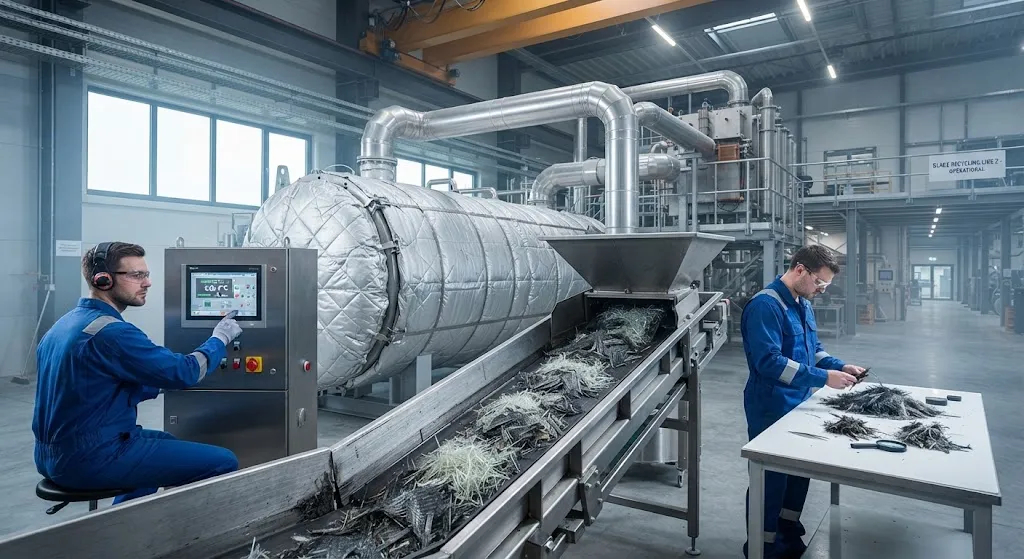
The CIRCLE4WIN pyrolysis process operates in three stages: feedstock preparation, thermal decomposition, and post-processing. Each stage incorporates design choices specifically adapted to the characteristics of wind blade composite waste:
- Feedstock preparation: Incoming blade sections are mechanically shredded to a target particle size of 20-50 mm, then screened to remove metal fasteners, adhesive residue, and non-composite contaminants. The shredding stage reduces blade sections — which can be up to 80 meters in length — to a feedstock suitable for continuous pyrolysis processing. A magnetic separator and eddy current system recover ferrous and non-ferrous metals from the shredded stream.
- Thermal decomposition: The pyrolysis reactor operates at 450-550°C in a nitrogen-purged atmosphere with a residence time of 30-60 minutes. The temperature window is critical: below 400°C, resin decomposition is incomplete, leaving carbonaceous char on the fiber surface; above 600°C, glass fiber begins to soften and lose mechanical properties. The reactor design uses a continuous screw conveyor system rather than batch processing, enabling steady-state operation at the target throughput of approximately 3 tonnes per hour.
- Post-processing: Pyrolysis gases are quenched and routed to an energy recovery system that generates process heat, reducing external energy input requirements. The solid output — a mixture of recovered fiber, char, and glass cullet — is separated using a combination of air classification, sieving, and electrostatic separation. The recovered carbon fiber retains 70-80% of its original tensile strength, while glass cullet is recovered as a secondary raw material for construction applications.
The thermal energy balance is a key economic driver. The pyrolysis of GFRP/CFRP blade waste is mildly exothermic — the resin decomposition releases energy that partially offsets the heating requirement. TNO's process design targets a net energy consumption of 2-3 kWh per kilogram of processed material, compared to 3-5 kWh per kilogram for conventional pyrolysis of pure CFRP. The energy recovery from off-gas treatment further reduces operating costs by generating steam that can be used in adjacent industrial processes.
Feedstock Characterization and Logistics
The challenge of processing 10,000 tonnes per year of blade waste is as much a logistics problem as a chemical engineering one. European wind farms are geographically dispersed, and decommissioned blades must be transported to the CIRCLE4WIN facility — currently planned for a site in the northern Netherlands — from across the continent. The table below summarizes the feedstock supply chain parameters:
| Parameter | Value / Target | Notes |
|---|---|---|
| Annual feedstock volume | 10,000 tonnes | Year 1 target; scalable to 20,000 t/yr |
| Feedstock composition | 65% GFRP, 25% CFRP, 10% adhesive/core | Typical modern blade mix |
| Average transport distance | 350-500 km | Estimated from major European wind clusters |
| Transport mode | Road (primary), barge (secondary) | Inland waterway access via Dutch ports |
| Blade section size at intake | ≤ 80 m length, ≤ 4 m width | Pre-cut at wind farm site |
| Moisture content limit | ≤ 15% by weight | Wet blades require pre-drying |
| Target processing rate | 3 tonnes/hour | Continuous operation, 8,000 hours/year |
The logistics model relies on a hub-and-spoke collection network. Regional pre-processing centers — located near major wind farm clusters in Germany, Denmark, and the UK — perform initial cutting and shredding, reducing blade sections to a standardized feedstock size before road transport to the central pyrolysis facility. This distributed model reduces transport costs by approximately 30% compared to shipping whole blade sections, and enables the pre-processing centers to recover valuable metals (copper cabling, steel bolts) before the composite material enters the pyrolysis stream.
Output Quality and Market Validation
The commercial viability of CIRCLE4WIN depends on the quality and marketability of its outputs. The facility targets three primary output streams:
- Recovered carbon fiber: Short-fiber recycled carbon fiber with 70-80% retention of original tensile strength, suitable for injection molding compounds, non-woven mats, and concrete reinforcement. The target price point is €8-12 per kilogram, positioning it at a 40-60% discount to virgin carbon fiber while remaining competitive with mechanically recycled fiber.
- Glass cullet: Recycled glass granules from the GFRP fraction, suitable for use as aggregate in construction materials, road base, and fiberglass production. The glass cullet stream is expected to generate modest revenue (€20-40 per tonne) but is essential for the overall process economics.
- Process energy: Off-gas combustion generates steam and electricity that offset facility operating costs. The net energy credit is estimated at €15-25 per tonne of processed material.
Market validation is underway through partnerships with composite compounders, automotive Tier-1 suppliers, and construction material producers. The critical qualification step is demonstrating that recycled fiber from mixed GFRP/CFRP feedstock meets the consistency and purity requirements of injection molding applications — a market that currently consumes approximately 30,000 tonnes per year of recycled carbon fiber globally, predominantly from aerospace prepreg scrap rather than wind blade waste.
Scaling Economics and Risk Factors
The CIRCLE4WIN economic model projects a capital expenditure of approximately €35-45 million for the 10,000 tonne per year facility, with an operating cost of €180-250 per tonne of processed material. At full capacity, the facility is projected to generate revenue of €280-350 per tonne through fiber sales, glass cullet, and energy credits — yielding an operating margin of 30-50% and a payback period of 5-7 years. However, several risk factors could alter this trajectory:
- Feedstock availability uncertainty: Wind blade decommissioning rates are difficult to predict, as operators may choose to repower (replace turbines with newer, larger units) rather than decommission, or may delay blade removal due to disposal cost concerns.
- Output quality variability: Mixed GFRP/CFRP feedstock produces recycled fiber with more variable properties than pure CFRP streams, potentially limiting market acceptance in quality-sensitive applications.
- Regulatory support dependency: The economic model assumes partial subsidy support through EU Innovation Fund or similar mechanisms. Without policy support, the recycling cost may exceed the value of recovered materials in years when virgin fiber prices are low.
- Competing technology routes: Solvolysis and dissolution-based recycling may offer higher-quality output at comparable or lower cost as they scale, potentially displacing pyrolysis for premium applications.
Frequently Asked Questions
What makes CIRCLE4WIN different from previous pyrolysis demonstrations for composite recycling?
Three features distinguish CIRCLE4WIN. First, it is designed for mixed GFRP/CFRP feedstock rather than pure CFRP, reflecting the actual composition of wind blade waste — this is the critical scaling challenge that previous demonstrations avoided by using aerospace-grade prepreg scrap. Second, the 10,000 tonne per year capacity is approximately five times larger than any existing pyrolysis facility for composites, making it the first true industrial-scale demonstration. Third, the process incorporates integrated energy recovery and a hub-and-spoke logistics model designed for European-scale feedstock collection, rather than processing waste from a single manufacturing site.
How does the recycled fiber quality from CIRCLE4WIN compare to mechanically recycled fiber?
Pyrolysis-recovered fiber from CIRCLE4WIN is expected to retain 70-80% of original tensile strength, compared to 50-70% for mechanically recycled fiber. The advantage comes from the thermal decomposition process, which removes the resin matrix without mechanically damaging the fiber structure. However, pyrolysis fiber has a char residue on the surface that may require post-treatment (oxidation or sizing application) for certain applications. Mechanically recycled fiber is typically shorter and more fragmented but has a cleaner surface, making it suitable for different end-use markets. The two recycling routes are complementary rather than competitive, serving different segments of the recycled fiber market.
When will CIRCLE4WIN be fully operational, and what happens to the output?
The CIRCLE4WIN demo facility is expected to begin trial operations in late 2027, with full 10,000 tonne per year capacity targeted by mid-2028. Initial output will be used for market development and qualification with partner companies. Siemens Gamesa has committed to off-take agreements for recycled glass cullet in construction applications, while several automotive compounders are evaluating recycled carbon fiber for non-structural components. The facility's first two years will focus on demonstrating consistent output quality and establishing the logistics network, with commercial-scale operation dependent on successful market validation.
Conclusion
The CIRCLE4WIN project represents the most credible pathway to industrial-scale pyrolysis for wind blade recycling, addressing the mixed-feedstock challenge that has limited previous demonstrations. Its 10,000 tonne per year capacity would nearly double the current global operational CFRP recycling capacity if successfully scaled. The economic model — projecting 30-50% operating margins at full capacity — is viable if feedstock supply can be secured and output quality meets market specifications. The critical milestones are the trial operations beginning in late 2027 and the market qualification of recycled fiber from mixed GFRP/CFRP streams.
For manufacturers evaluating recycled carbon fiber supply options, CIRCLE4WIN offers a potential source of pyrolysis-recovered fiber at scale. Explore our carbon fiber product range to understand how recycled fiber integrates with conventional materials, or contact our engineering team to discuss qualification pathways for recycled fiber in your applications.
Part of topic
Related Articles
- Bio-Based Carbon Fiber Precursors: Lignin and Polyethylene for Low-Cost Production
- Large-Tow Carbon Fiber Cost Analysis: 48K vs 60K Price-Performance Comparison
- Carbon Fiber-Resin Interface Bonding: Surface Treatment and Coupling Agent Optimization
- Digital Twin for Carbon Fiber Manufacturing: Real-Time Process Monitoring and Defect Prevention
- Thermoplastic Carbon Fiber Welding for Automotive: Ultrasonic and Induction Welding Process Windows
- Large-Tow Carbon Fiber Wet Spinning: Process Optimization for 48K/60K Production Efficiency