
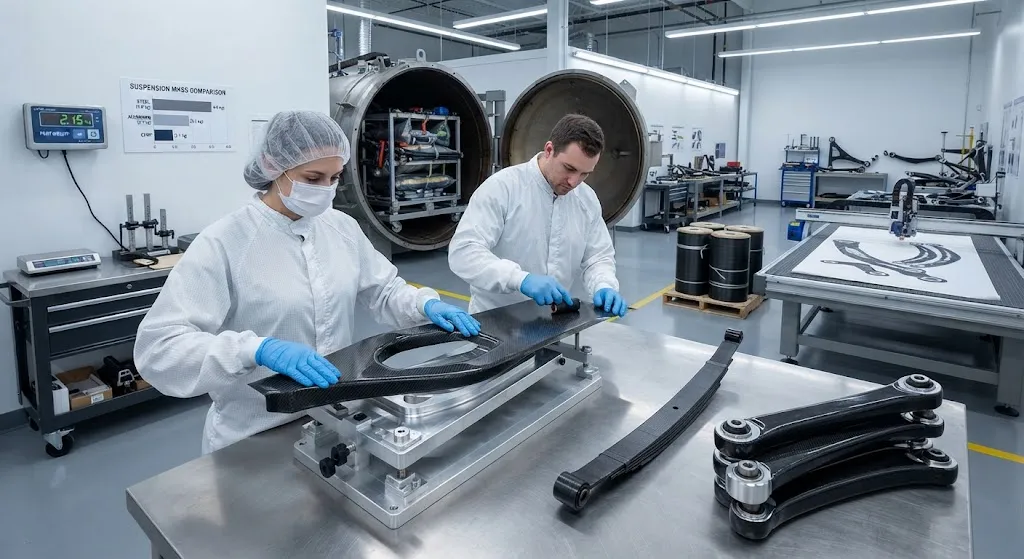
Suspension components sit on the wrong side of the vehicle mass equation. A kilogram of sprung mass — the body, the battery, the cabin — is carried by the springs and dampers, which isolate the occupants from the road. A kilogram of unsprung mass — the wheels, hubs, brakes, and the susp
Introduction
Suspension components sit on the wrong side of the vehicle mass equation. A kilogram of sprung mass — the body, the battery, the cabin — is carried by the springs and dampers, which isolate the occupants from the road. A kilogram of unsprung mass — the wheels, hubs, brakes, and the suspension links themselves — must be controlled by the springs and dampers, and every gram of it degrades the tire's ability to follow the road surface.
Carbon fiber is now entering this demanding territory through two proven routes: composite leaf springs, a mature commercial vehicle technology, and carbon fiber control arms, a newer application that is moving into production for premium electric vehicles. This article explains why unsprung mass matters so much on EVs, reviews the design of carbon fiber leaf springs and control arms, compares materials with real data, and outlines manufacturing and cost considerations for B2B buyers evaluating suspension programs.
Why Unsprung Mass Matters on Electric Vehicles
The physics is straightforward: an unsprung mass that cannot follow the road surface loses grip, and lost grip on a heavy EV means energy is dissipated as heat in the tires rather than delivered as forward motion. Industry studies typically credit a 10% reduction in unsprung mass with a 2-4% improvement in ride comfort indices and measurable gains in road-holding, with the effect growing at higher road roughness frequencies. On a 2.2-tonne EV, shaving 20 kg of unsprung mass from the four corners is roughly equivalent in ride and handling terms to removing 40-60 kg from the body structure.
Electric vehicles amplify the problem in two ways. First, the battery pack adds 400-700 kg of sprung mass, so the suspension must work harder to control wheel motion against a heavier body. Second, EV wheels are themselves heavier: larger diameter wheels, stiffer sidewalls, and integrated brake and motor components push unsprung mass upward.
Carbon Fiber Leaf Springs: A Proven Commercial Vehicle Technology
Composite leaf springs are the most mature carbon fiber suspension application, with more than three decades of production history in commercial vehicles. A conventional multi-leaf steel spring pack for a light truck weighs 25-40 kg; a CFRP mono-leaf spring of equivalent rated load weighs 7-12 kg — a 60-70% reduction that removes exactly the kind of mass that degrades ride quality. The composite spring is a single tapered leaf made from unidirectional carbon fiber in an epoxy matrix, wound or laid up to carry the bending load along the spring axis.
The fatigue story is the technology's strongest asset. Steel leaf springs fatigue through cyclic bending and are vulnerable to corrosion-initiated cracks in road-salt environments, which is why rusted spring packs are a common replacement item on commercial fleets. Carbon fiber springs exhibit fatigue endurance an order of magnitude higher under equivalent cyclic loading, do not corrode, and retain their rate characteristics across a wide temperature band. Their failure mode is also progressive — fibers break and stiffness degrades gradually rather than fracturing suddenly — providing warning before loss of function.
The spring is retained in a urethane or elastomer bushing at the center, with sliding or shackled ends that accommodate the longitudinal movement of the spring under deflection. Natural rubber and polyurethane spacers prevent galvanic contact between carbon fiber and the steel axle attachment, a standard detail in composite spring design.
Control Arms: The New Frontier
Control arms (wishbones) locate the wheel in its fore-aft and lateral position while transferring braking and cornering loads into the body. A conventional forged aluminum control arm for a mid-size vehicle weighs 2.5-4.0 kg; a carbon fiber version engineered for equivalent stiffness weighs 1.4-2.2 kg, a 35-45% reduction. The mass removed is almost pure unsprung mass, located at the outermost point of the suspension geometry where its influence on wheel control is largest.
The engineering challenge is load introduction. Control arms carry concentrated loads at the ball joint and bushing interfaces, exactly where fiber composites are weakest without careful design. Production CFRP arms use a hybrid strategy: continuous carbon fiber reinforced body, with metal or hybrid inserts at the ball joint, bushing sleeves, and attachment points where local bearing loads dominate.
A carbon fiber control arm can be designed with high lateral stiffness and tuned compliance in the fore-aft direction by orienting fiber plies differently along the arm — a degree of freedom unavailable in isotropic aluminum or steel.
Material and Manufacturing Comparison
- Prepreg compression molding: Unidirectional carbon prepreg is cut, stacked, and compression molded at 130-160 C, delivering the highest stiffness-to-weight for structural arms and spring leaves. Cycle times of 10-25 minutes suit medium volumes and premium platforms.
- Resin transfer molding (RTM): Dry fiber preforms are injected with epoxy under pressure, offering complex 3D shapes, good surface quality, and cycle times of 15-40 minutes. Well suited to control arms with integrated inserts.
- Filament winding: Continuous fiber is wound around a mandrel, ideal for constant-section spring leaves and torsion elements where fiber follows the load path directly. High fiber alignment delivers maximum rate for minimum weight.
- Compression molding with structural foam core: A sandwich construction using a lightweight core between carbon skins increases bending stiffness at low mass, applied to arms and spring brackets where section depth is available.
| Property | Steel Leaf Spring | CFRP Leaf Spring | Aluminum Control Arm | CFRP Control Arm |
|---|---|---|---|---|
| Density (g/cm³) | 7.85 | 1.55-1.60 | 2.70 | 1.55-1.60 |
| Tensile modulus (GPa) | 200-210 | 130-150 (unidirectional) | 69-72 | 130-150 (unidirectional) |
| Specific stiffness (GPa/(g/cm³)) | 26-27 | 85-95 | 26 | 85-95 |
| Typical part mass, mid-size vehicle (kg) | 25-40 (spring pack) | 7-12 (mono-leaf) | 2.5-4.0 | 1.4-2.2 |
| Mass saving vs baseline | Baseline | 60-70% | Baseline (arm) | 35-45% |
| Fatigue endurance (cycles) | 10⁶-10⁷ (corrosion-limited) | 10⁷-10⁸ | 10⁶-10⁷ | 10⁷-10⁸ |
| Corrosion behavior | Requires coating, salt-sensitive | Inherently resistant | Requires anodizing or coating | Inherently resistant |
| Tooling cost index | 0.6x (stamped) | 1.2-1.6x | 0.7x (forged) | 1.3-1.8x |
| Cycle time | Seconds (stamping) | 10-25 min | Forged, seconds | 10-40 min |
The table clarifies the trade: carbon fiber delivers 35-70% mass savings and superior fatigue and corrosion behavior at the cost of longer cycle times and higher tooling investment. The application that justifies the premium is unsprung mass on EV platforms, where the mass saving compounds into range, ride, and handling benefits that consumers feel and marketing departments sell.
Cost and Lifecycle Considerations
Carbon fiber suspension components cost 2-4 times their steel or aluminum counterparts at the component level, but the system-level accounting is more favorable. For a production EV program, a 20 kg unsprung mass saving contributes to a lighter, simpler suspension tune, reduces damper requirements, and can support a marginally smaller battery pack for the same dynamic range — savings that offset a portion of the component premium. Material costs are also falling: carbon fiber pricing has declined steadily over the past decade, and high-volume automotive grades are substantially cheaper than aerospace grades.
Qualification is the gating factor for adoption. Suspension components are safety-critical, so CFRP arms and springs must pass full vehicle-level durability, corrosion, stone-impact, and thermal cycling validation before series production. The industry now has the reference data to support these qualifications — composite leaf springs have decades of fleet service, and control arm programs are completing the same validation cycles. For buyers, the practical entry point is a hybrid approach: introduce carbon fiber where the unsprung mass benefit is highest, such as front lower arms on a performance EV, while retaining conventional materials elsewhere.
Frequently Asked Questions
How much range does unsprung mass reduction actually add to an EV?
Range gains are indirect but real. A 20 kg unsprung mass reduction improves rolling resistance by reducing tire slip energy on rough surfaces, and lowers the parasitic losses from suspension motion — typically translating to a 0.5-1.5% range improvement on combined cycles, or roughly 3-9 km on a 600 km-rated vehicle. The larger benefits are dynamic: better ride comfort, reduced wheel hop, and improved high-speed stability, which are often more valuable to OEMs than the range increment itself.
Why have leaf springs remained relevant if control arms are the new application?
Leaf springs are the load-carrying and locating element for the solid axles still dominant in trucks, vans, and light commercial vehicles, where the axle is driven and the spring doubles as a structural link. The CFRP mono-leaf spring replaces a 25-40 kg steel pack with a 7-12 kg part at equal rated load, and its fatigue and corrosion advantages directly reduce fleet maintenance costs. Control arms, by contrast, serve independent suspension geometries on passenger EVs. The two applications are complementary: leaf springs address the commercial vehicle segment, control arms address premium passenger platforms.
Can carbon fiber suspension components be repaired or replaced in service?
Replacement follows the same service model as metal parts: a damaged spring or arm is removed and exchanged as an assembly, and the vehicle is realigned. In-service repair of the composite part itself is not standard practice, but the progressive failure mode of carbon fiber provides earlier warning than metal, and fleet experience with composite leaf springs shows replacement intervals governed by ride and load criteria rather than hidden corrosion. Bushes, spacers, and lugs remain replaceable service items, so the surrounding hardware does not need to change when a composite component is specified.
Conclusion
Carbon fiber suspension components convert the oldest rule of vehicle dynamics — unsprung mass is more expensive than sprung mass — into a manufacturable advantage. CFRP leaf springs deliver a proven 60-70% weight reduction in commercial vehicles with superior fatigue and corrosion behavior, and carbon fiber control arms bring a 35-45% reduction to EV platforms while adding directional stiffness tuning that metal cannot match. As material costs decline and qualification data accumulates, the technology is moving from premium and commercial niches toward broader automotive adoption.
For B2B buyers evaluating suspension programs, the decision criteria are load capacity, stiffness-to-weight, fatigue life, and validated durability under road-salt and stone-impact exposure. Explore our carbon fiber sheet and profile range suited to spring leaf and control arm applications, or contact our engineering team for material selection guidance and prototype support for your next suspension program.
Part of topic
Related Articles
- Carbon Fiber Sheets for Sale: A Buyer Checklist for Thickness, Weave and Finish
- Carbon Fiber Plate Running Shoes: Manufacturing Process and Material Specifications
- Carbon Fiber Tubes for Sale: Spec Sheet Fields That Actually Matter
- Carbon Fiber Sheets Near Me: Local Dealers and Quick Turnaround Procurement
- Carbon Fiber Tubes Near Me: Local Stock Availability and Same-Day Delivery Options
- Carbon Fiber Plate Orthotic: Lightweight Prosthetic and Medical Device Applications
Interested in Our Products?
Contact our team for competitive pricing and technical specifications.
Get a QuoteRelated Products

Carbon Fiber Plate — 3K Twill T700 1.5mm
Thin 1.5mm carbon fiber plate with 3K twill weave surface. Lightweight and stiff, commonly used for covers, panels, drone bodies, and applications requiring a premium aesthetic appearance.

Carbon Fiber Plate — 3K Twill T700 3.0mm
Medium-thickness 3.0mm carbon fiber plate offering significantly higher load capacity while maintaining attractive 3K twill finish. Suitable for structural brackets, reinforcement plates, and load-bearing panels.

Square Carbon Fiber Tube — 3K Twill T700
Square cross-section carbon fiber tube manufactured with 3K twill weave for torsional strength. Preferred for structural frames, trusses, and support columns where rectangular geometry offers design flexibility.
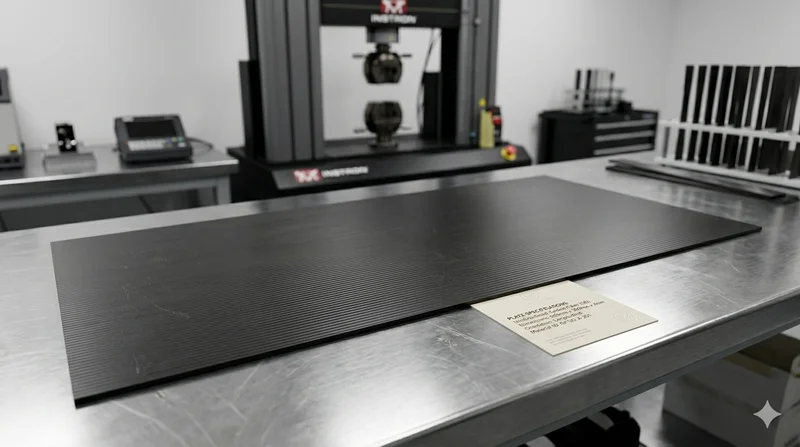
Carbon Fiber Plate — UD Unidirectional T700
Unidirectional carbon fiber plate with all fibers oriented in a single direction for maximum strength along the fiber axis. Essential for structural reinforcements, splints, and applications where load direction is predictable.
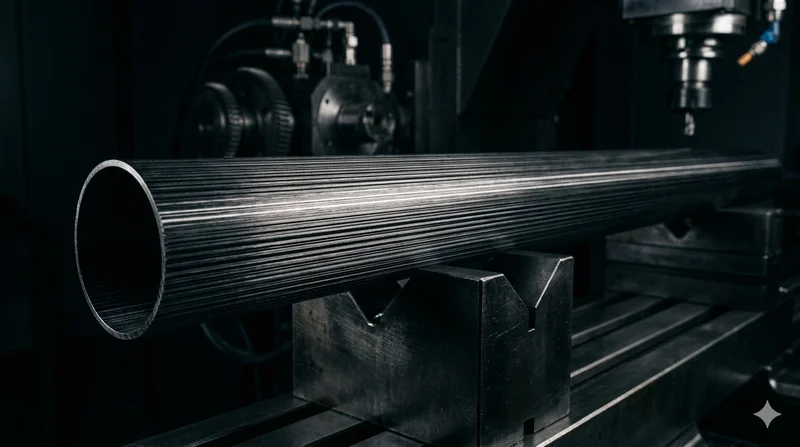
Round Carbon Fiber Tube — UD Unidirectional T700
Unidirectional (UD) round tube with all fibers aligned axially for maximum longitudinal stiffness. Ideal for applications requiring high bending rigidity with minimal weight, such as shafts, struts, and structural reinforcements.