
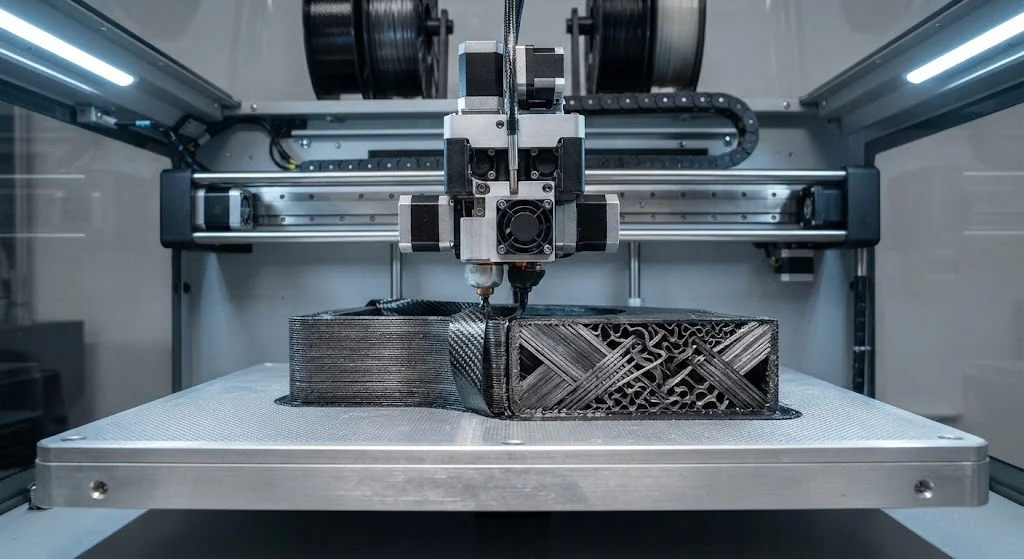
Carbon fiber 3D printing is advancing from simple fiber-reinforced filaments to voxel-level control of fiber placement and density. This article examines voxel-based manufacturing approaches, core architecture optimization, and the technical implications for high-performance composite structures in aerospace, automotive, and industrial applications.
Introduction
Additive manufacturing of carbon fiber reinforced polymers (CFRP) has evolved significantly since the introduction of chopped fiber-reinforced filaments for fused deposition modeling (FDM) in the early 2010s. The technology has progressed through three distinct generations: short fiber composite printing (2010-2015), continuous fiber reinforcement (2015-2020), and the current frontier of voxel-level fiber architecture control (2020-present). This third generation represents a fundamental shift from treating 3D-printed composites as homogeneous materials to engineering them as spatially heterogeneous structures where fiber volume fraction, orientation, and material composition can vary continuously throughout the part volume.
Voxel-based carbon fiber 3D printing enables the creation of structures with locally optimized mechanical properties — high fiber density in load-bearing regions, reduced density in connection zones, and graded transitions between material systems. This capability bridges the gap between the geometric freedom of additive manufacturing and the performance optimization traditionally associated with automated fiber placement (AFP) and automated tape laying (ATL) processes. This article examines the technical approaches to voxel-level control, core architecture design principles, and the performance implications for high-value applications.
Voxel-Level Manufacturing Approaches
Three primary manufacturing approaches enable voxel-level control of carbon fiber architecture in 3D-printed structures:
- Multi-material continuous fiber printing: Systems like Markforged FX20 and Anisoprint AISA use multiple print heads to deposit continuous carbon fiber (or carbon/glass hybrid) tows alongside thermoplastic matrix material, with digital control of fiber placement path, spacing, and density. Resolution: 0.5-2mm lateral positioning accuracy, 0.1-0.3mm layer height. Fiber volume fraction range: 15-55% depending on deposition strategy.
- Inchworm-style discrete fiber placement: Research systems from institutions like MIT and ETH Zurich use robotic arms with end-effectors that place discrete carbon fiber rovings (tows) at precise 3D coordinates, enabling truly arbitrary fiber architectures. These systems achieve fiber placement accuracy of 0.1-0.5mm but currently operate at 10-100x lower throughput than industrial AFP systems.
- Voxel-by-voxel material deposition: Experimental approaches using multi-material jetting (PolyJet) or binder jetting with carbon fiber-filled resins enable per-voxel control of material composition. Resolution: 0.05-0.5mm voxel size, but limited to short fiber composites with fiber volume fractions below 30%. These systems enable functional grading but cannot achieve the continuous fiber reinforcement needed for structural applications.
| Technology | Fiber Type | Voxel Resolution | Fiber Volume Fraction | Throughput |
|---|---|---|---|---|
| Multi-material continuous fiber | Continuous CF/GF | 0.5-2.0mm | 15-55% | 50-200 cm³/hr |
| Discrete fiber placement | Continuous CF tows | 0.1-0.5mm | 20-60% | 5-20 cm³/hr |
| Multi-material jetting | Chopped CF | 0.05-0.5mm | 5-30% | 20-100 cm³/hr |
| Binder jetting + infiltration | Chopped CF | 0.1-1.0mm | 10-25% | 100-500 cm³/hr |
Core Architecture Design Principles
Voxel-level fiber control enables core architectures that replicate or improve upon traditional composite sandwich structures:
- Graded density cores: Instead of uniform-density foam or honeycomb cores, voxel-based printing creates cores with continuously varying density — higher density near load introduction points, lower density in unloaded regions. This approach reduces stress concentrations by 20-40% compared to uniform cores while maintaining equivalent stiffness with 10-15% less material.
- Functionally graded transitions: Voxel control enables smooth transitions between skin and core regions, eliminating the discrete bond line that creates interlaminar stress concentrations in traditional sandwich structures. These graded transitions improve peel strength by 30-50% and delamination resistance by 40-60% compared to abrupt material changes.
- Internal channel architectures: Voxel-based manufacturing enables internal cooling channels, sensor pathways, and fluid routing within structural components without assembly operations. These integrated features reduce part count by 60-80% and assembly time by 40-70% in aerospace and automotive applications.
- Variable stiffness paths: By varying fiber density and orientation continuously throughout a structure, voxel-based designs create variable stiffness load paths that distribute stress more efficiently than constant-stiffness designs. Finite element analysis shows 15-25% weight reduction potential for equivalent structural performance compared to conventional constant-stiffness CFRP designs.
Material Systems and Process Parameters
Voxel-based carbon fiber 3D printing requires careful optimization of material systems and process parameters to achieve desired mechanical properties:
- Fiber-matrix interface: The interfacial bond between carbon fibers and thermoplastic matrix (typically nylon, PEEK, or ULTEM) is critical for load transfer. Surface treatments (plasma, sizing agents) improve interfacial shear strength by 30-60% compared to untreated fibers. Optimal processing temperatures: 380-420°C for PEEK matrix, 250-280°C for nylon matrix.
- Void content control: Voxel-based printing must minimize void content (target: <2%) to achieve mechanical properties approaching those of conventionally manufactured CFRP. Process parameters affecting void content include extrusion temperature, layer adhesion pressure, and build chamber atmosphere control (nitrogen purge reduces oxidation-related voids by 40-60%).
- Fiber waviness and crimp: Maintaining fiber straightness during deposition is critical for achieving theoretical stiffness and strength. Automated fiber placement systems achieve fiber waviness below 1% (vs. 3-5% for manual layup), translating to 10-15% higher compressive strength in printed components.
- Post-processing requirements: Voxel-printed CFRP components typically require heat treatment (annealing at 200-300°C for 2-4 hours) to relieve residual stresses and improve crystallinity in thermoplastic matrices. This step improves interlaminar shear strength by 15-25% and fatigue life by 2-3x.
Performance Comparison with Conventional Manufacturing
Voxel-based carbon fiber 3D printing achieves mechanical properties approaching but not yet matching those of conventional CFRP manufacturing:
| Property | Voxel-Printed CFRP | Conventional CFRP (AFP) | Ratio |
|---|---|---|---|
| Tensile strength (0°) | 800-1200 MPa | 1500-2000 MPa | 50-65% |
| Tensile modulus (0°) | 80-120 GPa | 130-180 GPa | 60-70% |
| Compressive strength | 500-800 MPa | 1000-1500 MPa | 45-55% |
| Interlaminar shear | 30-50 MPa | 60-90 MPa | 45-60% |
| Fatigue life (10⁶ cycles) | 60-75% of static | 70-85% of static | 85-90% |
The performance gap is primarily attributable to higher void content (2-5% vs. <1%), lower fiber volume fraction (35-50% vs. 55-65%), and fiber waviness in printed structures. However, voxel-based designs can compensate through geometric optimization — using topology optimization to place material exactly where needed — achieving equivalent structural performance with 20-30% less total material.
Applications and Industry Adoption
Voxel-based carbon fiber 3D printing is gaining traction in several high-value application areas:
- Aerospace tooling and fixtures: The most mature application, with aerospace manufacturers using voxel-printed CFRP for assembly jigs, inspection fixtures, and production tooling. These applications benefit from geometric freedom and reduced lead time (2-5 days vs. 4-8 weeks for machined metal tooling) while meeting dimensional stability requirements.
- Custom medical implants: Patient-specific cranial plates, spinal cages, and orthopedic implants with graded porosity for bone integration. Voxel control enables surface porosity of 60-80% transitioning to solid load-bearing regions, matching the mechanical properties of surrounding bone tissue.
- Racing and performance vehicles: Lightweight structural components (seat shells, dashboard structures, aerodynamic elements) where geometric complexity and weight reduction justify higher material costs. Formula 1 and Formula E teams report 15-25% weight reduction compared to conventional CFRP components.
- Drone and UAV structures: Custom frames and structural components optimized for specific payload and flight requirements. Voxel-based designs enable integrated wire routing, antenna mounting, and sensor integration that would require multiple assembly operations with conventional manufacturing.
Conclusion
Voxel-level carbon fiber 3D printing represents a significant advancement in composite manufacturing, enabling spatially optimized structures that approach the performance of conventionally manufactured CFRP while offering geometric freedom impossible with traditional processes. As printing speeds increase, material systems mature, and process control improves, voxel-based manufacturing will enable new design paradigms in aerospace, automotive, medical, and industrial applications where performance and geometric complexity justify the current cost premium.
YongXian CarbonFiber
YongXian manufactures carbon fiber tubes, sheets, and custom composite parts from our Dezhou, China factory. With over 15 years of composite manufacturing experience, we supply carbon fiber components to aerospace, automotive, energy, and industrial customers worldwide.
Contact us for custom carbon fiber solutions.
Related Articles
- Bio-Based Carbon Fiber Precursors: Lignin and Polyethylene for Low-Cost Production
- Large-Tow Carbon Fiber Cost Analysis: 48K vs 60K Price-Performance Comparison
- Carbon Fiber-Resin Interface Bonding: Surface Treatment and Coupling Agent Optimization
- Digital Twin for Carbon Fiber Manufacturing: Real-Time Process Monitoring and Defect Prevention
- Thermoplastic Carbon Fiber Welding for Automotive: Ultrasonic and Induction Welding Process Windows
- Large-Tow Carbon Fiber Wet Spinning: Process Optimization for 48K/60K Production Efficiency