
Carbon fibre car parts have moved from Formula 1 paddocks to everyday performance and styling builds, and understanding them is simpler than the marketing suggests. A carbon fibre car part is a composite component manufactured from woven carbon fibre fabric impregnated with epoxy resin and cured und
Introduction
Carbon fibre car parts have moved from Formula 1 paddocks to everyday performance and styling builds, and understanding them is simpler than the marketing suggests. A carbon fibre car part is a composite component manufactured from woven carbon fibre fabric impregnated with epoxy resin and cured under heat and pressure. The material delivers tensile strength of 3,500-6,000 MPa in the fibre direction at a density of only 1.6 g/cm³, which produces a strength-to-weight ratio roughly five times that of steel and three times that of aluminium. Whether you are a tuner upgrading a road car or a purchasing engineer sourcing production parts, the same principles apply: the process determines the strength, the layup determines the weight, and the documentation determines whether the part is worth what you pay.
This guide covers how carbon fibre car parts are manufactured, which parts deliver the biggest weight savings, what they cost, how to tell structural parts from cosmetic trim, and what to check when evaluating carbon fibre car parts suppliers.
Why Carbon Fibre Wins in Cars
Weight in a car is never neutral. Mass removed from rotating and unsprung components improves acceleration, braking, steering response and ride comfort simultaneously, while mass removed from the body shell lowers the centre of gravity and improves turn-in. Carbon fibre car parts exploit this directly: a composite part can match the stiffness of a steel part at 40-60% of the weight, or exceed it at the same weight. The table below summarises typical weight savings for the most common carbon fibre car parts compared with the standard factory component.
| Part | Stock Material | Carbon Fibre Weight | Weight Saved | Main Benefit |
|---|---|---|---|---|
| Bonnet (hood) | Steel, 18-22 kg | 6-9 kg | 55-65% | Lower nose weight, sharper turn-in |
| Boot lid (trunk) | Steel, 12-16 kg | 4-6 kg | 55-65% | Less rear mass, faster transitions |
| Roof panel | Steel, 15-18 kg | 5-7 kg | 55-65% | Lower centre of gravity |
| Drive shaft | Steel, 8-10 kg | 3-4 kg | 55-65% | Less driveline inertia, faster revs |
| Seats (fixed shell) | Fabric frame, 20-25 kg | 7-9 kg | 60-70% | Huge unsprung-adjacent saving |
| Spoiler / splitter | ABS or fibreglass, 4-6 kg | 2-3 kg | 40-50% | Real downforce with less weight |
A full exterior package on a typical sports saloon removes 40-60 kg — roughly the weight of a passenger — while a carbon drive shaft and fixed-back seats push the total saving towards 80-100 kg. These numbers are the reason carbon fibre car parts remain the most effective single upgrade for lap time and feel.
How Carbon Fibre Car Parts Are Made
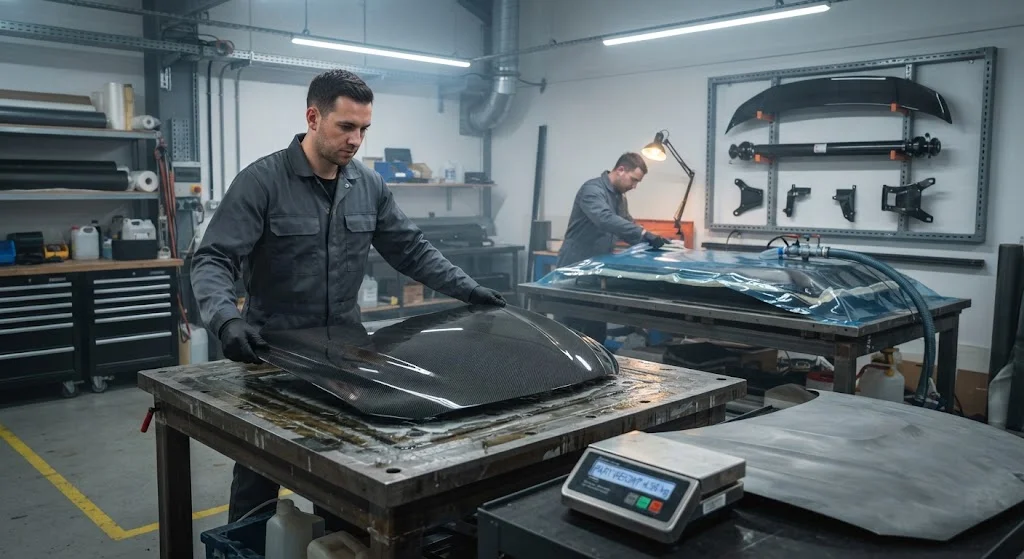
Every carbon fibre car part starts as carbon fibre tow — bundles of 1,000 to 24,000 filaments — which is woven into fabric, combined with resin, and formed into a shape. The manufacturing route chosen by a supplier determines the strength, surface quality and price of the finished part. The four dominant processes are:
- Prepreg autoclave: pre-impregnated carbon fabric is laid into a mould, vacuum-bagged and cured in an autoclave under heat and pressure. This yields the highest strength, best surface finish and lowest void content, which is why motorsport and OEM structural parts use it.
- Resin transfer moulding (RTM): dry fabric is placed in a closed mould and epoxy is injected under pressure. RTM produces strong, void-free parts with shorter cycles, making it the standard for medium-volume production runs.
- Compression moulding: chopped carbon fibre or sheet moulding compound is pressed in heated dies. This is the lowest-cost route for interior trims and semi-structural parts, but fibre length and orientation limit its strength.
- Dry carbon layup: hand-laminated fabric is vacuum-bagged and cured at room temperature or in an oven. It suits custom one-off panels and repairs, and the result depends heavily on the laminator's skill.
All four processes produce genuine carbon fibre car parts, yet the mechanical properties and price differ by an order of magnitude. A prepreg bonnet and a compression-moulded trim panel are both carbon, but only the prepreg part is structural.
Structural vs. Cosmetic Carbon Fibre Car Parts
Buyers frequently encounter two very different product categories under the same name. Structural carbon fibre car parts — bonnets, roofs, drive shafts, diffusers — carry real loads and must be manufactured with engineered layups, autoclave or RTM curing, and documented strength data. Cosmetic parts — mirror caps, pillar covers, interior trims — are usually made with cheaper wet-lay or compression processes and are safe because they carry almost no load. The distinction matters because a cosmetic part priced like a structural part is a bad deal, while a structural part built with cosmetic processes is a safety risk. Always ask the supplier which process was used and whether the part is load-bearing before comparing prices.
| Category | Typical Process | Price Range (per part) | Fit Standard |
|---|---|---|---|
| Cosmetic trim (mirror caps, pillars) | Wet layup / compression | $50-250 | Visual fit, light duty |
| Panels (bonnets, boot lids, spoilers) | Prepreg or RTM | $400-2,000 | OEM-fit with hardware |
| Structural (drive shafts, cages) | Autoclave prepreg / RTM | $1,000-5,000+ | Engineered, load-tested |
The price bands above are indicative for 2026; judge a part by its process, fibre quality and testing rather than by price alone.
Cost Expectations
The cost of carbon fibre car parts scales with process, size and production volume. A cosmetic mirror cap may cost $50-150, while a full prepreg bonnet for a modern sports car typically runs $800-2,000 and a carbon drive shaft $900-1,800. Add fitment work to the part price: panel-gap adjustment, bonnet pins or latch modifications, and paint matching if the part is not left exposed. Two further costs are often overlooked. First, exposed carbon fibre degrades and yellows in sunlight unless the clear coat contains UV inhibitors, so ask whether the finish is UV-stable. Second, carbon fibre is brittle against point impacts, so stone-chip protection on leading edges matters for road cars. A slightly more expensive part with a UV-stable clear coat is cheaper over five years than a bargain part that needs refinishing.
Quality Checks When Comparing Suppliers
Whether you search for carbon fibre car parts near me or evaluate overseas factories, run the same checks before ordering:
- Weave and surface: inspect the weave for distortion, pinholes and dry spots; a good part shows uniform weave with no exposed fibre ends.
- Process documentation: ask whether the part is prepreg, RTM or wet-lay, and whether it is structural or cosmetic.
- Weight verification: weigh the delivered part against the stated weight; an unexpectedly heavy part suggests a thick resin layer, not more fibre.
- Fit trial: structural panels need a test fit; slight warpage is common in cheap moulds and ruins panel gaps.
- UV protection: confirm the clear coat contains UV inhibitors if the part will see sunlight.
- Batch traceability: for production parts, request material certificates and process records so the quality is repeatable across batches.
A reputable supplier answers all six without hesitation and provides photos of the mould and layup process on request. For buyers in the United States, this also means confirming the supplier ships with proper packaging and offers the same documented quality whether the order is a single bonnet or a production run.
Frequently Asked Questions
How much weight can carbon fibre car parts actually save?
Realistic savings are 40-65% per replaced body panel and 55-65% for rotating parts such as drive shafts. A full exterior package on a typical saloon removes 40-60 kg, and adding a carbon drive shaft and fixed-back seats pushes the total towards 80-100 kg. Cosmetic trim saves little weight but reduces visual mass. The exact figure depends on the original part's material and the layup quality of the carbon part.
Are carbon fibre car parts safe for road use?
Yes, when they are manufactured with the correct process for their function. Structural parts such as bonnets, roofs and drive shafts must be built with engineered layups and proper curing to carry loads reliably, and installed with the correct hardware. Cosmetic parts carry negligible load. Buy from suppliers who state the process and load rating, and have structural parts inspected if you are unsure of the build quality.
What is the difference between wet carbon and dry carbon?
Wet carbon parts are made from pre-preg or wet-laminated fabric and then clear-coated, producing a glossy, deep-looking weave that is the classic motorsport aesthetic. Dry carbon parts are cured without a final gel coat and show a matte, textured weave; they are lighter and preferred in motorsport because the visible weave allows surface inspection for delamination. Neither finish indicates strength by itself — the layup schedule and curing process determine that.
Conclusion
Carbon fibre car parts deliver the largest weight savings in body panels and rotating components, and the quality of the result depends on the manufacturing process, fibre quality and installation. Decide which parts are structural and which are cosmetic, verify the process and UV protection before buying, and compare suppliers on documentation rather than price alone. The right supplier will tell you exactly how a part is made and what it is rated for.
YongXian manufactures carbon fibre car parts including bonnets, boot lids, spoilers, drive shafts and custom panels using prepreg and RTM processes with full batch traceability. View our carbon fibre product range or request a quote with your vehicle model and part list.