
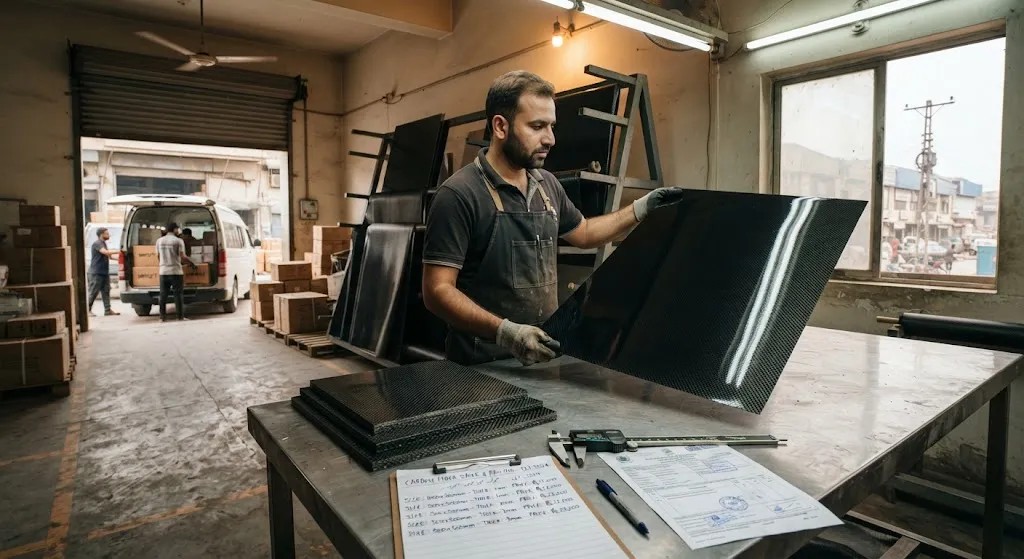
The carbon fiber sheet price in Pakistan varies more than in most markets because the country has no domestic carbon fiber production, and every sheet on sale is imported and passes through duty, freight and local markup. As a result, the same 1,000 x 1,000 mm panel can be quoted at very different p
Introduction
The carbon fiber sheet price in Pakistan varies more than in most markets because the country has no domestic carbon fiber production, and every sheet on sale is imported and passes through duty, freight and local markup. As a result, the same 1,000 x 1,000 mm panel can be quoted at very different prices by two dealers in the same city, and the gap is usually explained by grade, thickness, import route and payment terms rather than by profit margin alone.
This guide gives realistic carbon fiber sheet price in Pakistan ranges in Pakistani rupees, explains what drives the numbers, and lays out a sourcing process that lets buyers compare carbon fiber sheet price in Pakistan offers from suppliers on an equal basis. It is written for the textile machinery, automotive, drone, defense and sporting goods buyers who form the core of Pakistan's composite demand.
What Drives the Carbon Fiber Sheet Price In Pakistan
Four factors set the carbon fiber sheet price in Pakistan, and each one is larger than in most other markets because of the import structure.
- Import duty and taxes: Carbon fiber products generally enter Pakistan under HS 6815.10, carrying customs duty in the range of 5-11 percent depending on the tariff classification, plus sales tax of 18 percent and additional levies. These taxes stack onto every sheet, raising the effective landed cost well above the ex-works price.
- Currency movement: Carbon fiber is priced and traded internationally in US dollars, while local dealers buy with PKR. The exchange rate has moved substantially in recent years, and sheets priced before a rate shift are repriced quickly. The dollar-to-rupee rate directly multiplies into the final sheet price.
- Grade and construction: A T300 sheet is significantly cheaper than a T700 sheet of the same dimensions, and a solid laminate panel costs more than the same area of unidirectional fabric. Because most Pakistani buyers order small quantities, dealers stock only the most common grades, and special grades are quoted with longer lead times and higher unit prices.
- Size, thickness and quantity: Sheet price scales with weight and cutting effort. A 500 x 500 mm, 1 mm panel is the entry size; 1,000 x 1,000 mm panels cost roughly three to four times more because area and thickness multiply. Quantity discounts exist but start at volumes most Pakistani buyers do not reach.
These four factors explain most price differences between dealers. A quote that ignores duty or assumes an old exchange rate is not comparable with one that includes both.
Realistic Carbon Fiber Sheet Prices In Pakistan
The table below shows realistic price ranges for the carbon fiber sheet price in Pakistan in 2026. These are indicative ranges in Pakistani rupees for standard-modulus T300-grade solid laminate sheets, purchased through local dealers or distributors, and they vary with the exchange rate and import duty at the time of purchase.
| Sheet Size and Thickness | Typical Price Range (PKR) | Typical Use |
|---|---|---|
| 500 x 500 mm, 1 mm | 8,000-14,000 | Prototypes, small brackets, drone parts |
| 500 x 500 mm, 3 mm | 18,000-30,000 | Machined structural parts, jigs |
| 1,000 x 1,000 mm, 1 mm | 28,000-48,000 | Panels, covers, automotive trim |
| 1,000 x 1,000 mm, 3 mm | 65,000-110,000 | Structural panels, molds and fixtures |
| 1,000 x 2,000 mm, 1.5 mm | 70,000-120,000 | Large panels, machine guards, housings |
Three practical notes apply to every figure above. First, T700 and T800 grades cost 30-80 percent more than T300 at the same size and thickness, so confirm the grade in writing before comparing prices. Second, prices from international suppliers, quoted in US dollars, usually work out 20-40 percent below local dealer prices even after shipping and duty, because dealers carry inventory risk, financing cost and local margin. Third, prices move with the exchange rate — a quote that is several months old is no longer a reliable baseline.
Where Pakistani Buyers Buy Carbon Fiber Sheets
Pakistani buyers purchase carbon fiber sheets through three channels, and each has a different price structure. Local dealers and stockists in Karachi, Lahore and Islamabad hold limited stock of common sizes, deliver in days, accept small orders and offer the convenience of inspecting material before buying, but they charge the highest per-sheet prices because they buy in small volumes and hold inventory in a market with volatile currency. Industrial distributors serving the textile and automotive sectors offer better prices for regular buyers and can import specific sizes, but they usually require larger minimum orders and longer lead times. Direct import from manufacturers or overseas distributors gives the lowest carbon fiber sheet price in Pakistan when the volume justifies the freight, customs clearance and payment process.
The buying decision is a trade-off between speed and price. For a single prototype panel needed this week, a local dealer is usually the only practical option. For a production program consuming dozens of sheets a year, direct import or a distribution agreement can cut material cost by 20-40 percent, which on a 1,000 x 1,000 mm panel means tens of thousands of rupees saved per sheet. Buyers who mix channels — local for urgent small lots, direct import for planned volume — get the best of both.
How to Compare Carbon Fiber Sheet Price In Pakistan Offers
Comparing carbon fiber sheet price in Pakistan offers requires converting every quote to the same basis before looking at the number. Four steps make the comparison fair.
First, confirm the specification in writing: grade (T300, T700 or higher), sheet size, thickness, surface finish and whether the sheet is a solid laminate or a fabric product. Two offers that say "carbon fiber sheet" can be different products entirely. Second, ask for the delivered price, not the ex-works price, and confirm whether it includes duty, sales tax and local delivery — a delivered quote that includes taxes can be higher than a competitor's bare ex-works number and still be the better deal. Third, state the payment terms, because advance-payment quotes are typically 3-8 percent lower than credit terms, and bank transfer costs and L/C charges change the effective price. Fourth, request a sample or a batch certificate, because the cheapest sheet is worthless if the grade or thickness does not match the specification.
For buyers who import directly, compare total landed cost: the ex-works price plus freight, insurance, customs duty, sales tax, clearing charges and local transport, all converted to PKR at the current rate. That total is the number that matters, and it is the number that separates a genuinely good carbon fiber sheet price in Pakistan from a superficially attractive quote that grows during shipping.
Frequently Asked Questions
How much does a carbon fiber sheet cost in Pakistan in 2026?
A 500 x 500 mm, 1 mm T300 sheet typically costs PKR 8,000-14,000 through a local dealer; a 1,000 x 1,000 mm, 1 mm sheet runs PKR 28,000-48,000; and a 1,000 x 1,000 mm, 3 mm sheet ranges from PKR 65,000-110,000. Prices vary with the exchange rate and current duty rates, so confirm a written quote at the time of purchase rather than relying on published figures.
Why is carbon fiber more expensive in Pakistan than in China or the US?
Pakistan imports all of its carbon fiber, and the landed cost stacks freight, customs duty of roughly 5-11 percent, 18 percent sales tax and local dealer margin on top of the factory price. Currency depreciation against the US dollar has also pushed PKR prices up over time. The international ex-works price is usually 20-40 percent below the local dealer price, which is why volume buyers often import directly despite the longer lead time.
Can I import carbon fiber sheets directly to Pakistan?
Yes. Carbon fiber sheets are freely importable for commercial use, subject to standard customs procedures and duty payment under the applicable HS code. You need a valid import documentation setup, a freight forwarder, and a payment route such as advance transfer or an L/C. Direct import is economical when you consume dozens of sheets per year; for occasional single sheets, the freight and clearing costs outweigh the price saving, and a local dealer is the better option.
Which carbon fiber sheet is best for drone and sporting goods applications in Pakistan?
For drone frames and arms, a 1-2 mm solid laminate T300 sheet balances cost and stiffness, and 3K twill fabric with wet layup suits custom curved parts. For sporting goods such as bicycle parts and paddles, T700-grade material gives a better strength-to-weight ratio but costs 30-80 percent more. Start with T300 for prototypes and cost-sensitive production, and step up to T700 only where measured performance demands it.
Conclusion
The carbon fiber sheet price in Pakistan is driven by import duty, the exchange rate, grade, size and the buying channel, and it changes with the currency market. Local dealers offer speed and small quantities at the highest price; direct import offers the lowest carbon fiber sheet price in Pakistan for volume buyers who can manage freight, customs and payment. Whatever channel you choose, confirm grade and thickness in writing, compare delivered prices that include taxes, and validate the material with a sample or certificate before committing to volume.
YongXian supplies carbon fiber sheets in T300, T700 and higher grades with cut-to-size service, batch documentation and export packaging suitable for shipping to Pakistan. Browse our carbon fiber sheet range or request a quote for delivered pricing with duty documentation and lead time.
Part of topic
Related Articles
Interested in Our Products?
Contact our team for competitive pricing and technical specifications.
Get a QuoteRelated Products
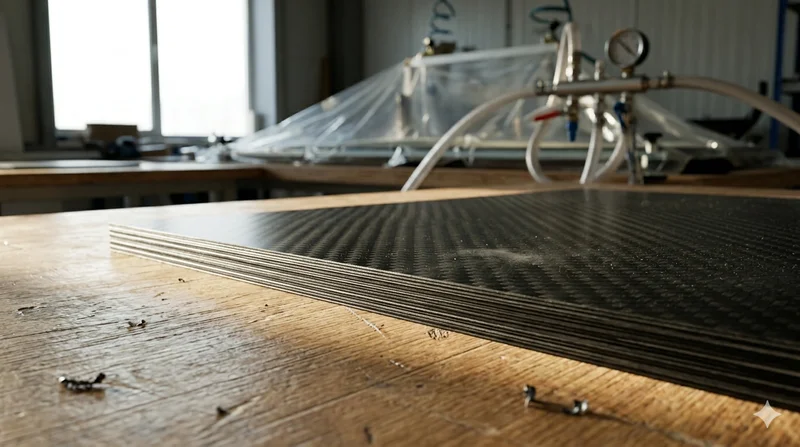
Carbon Fiber Plate — 3K Twill T700 3.0mm
Medium-thickness 3.0mm carbon fiber plate offering significantly higher load capacity while maintaining attractive 3K twill finish. Suitable for structural brackets, reinforcement plates, and load-bearing panels.

Carbon Fiber Plate — 3K Twill T700 1.5mm
Thin 1.5mm carbon fiber plate with 3K twill weave surface. Lightweight and stiff, commonly used for covers, panels, drone bodies, and applications requiring a premium aesthetic appearance.
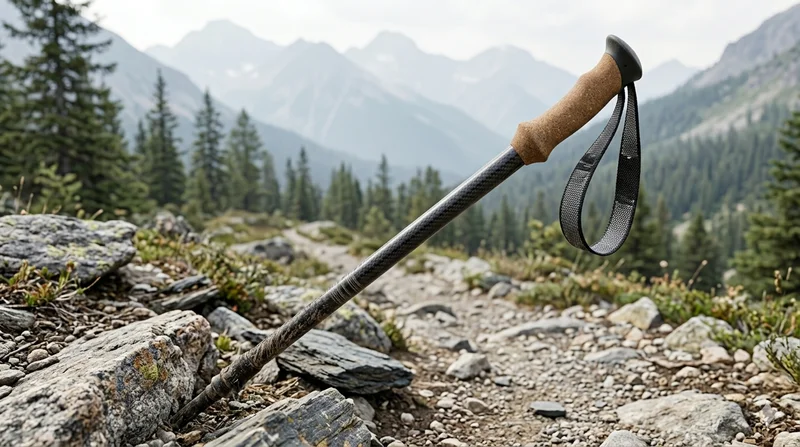
Carbon Fiber Trekking Pole
Lightweight carbon fiber trekking pole manufactured from high-grade carbon fiber tube. Weighs only 160g per pole while providing superior shock absorption and durability for hiking, trail running, and backpacking.
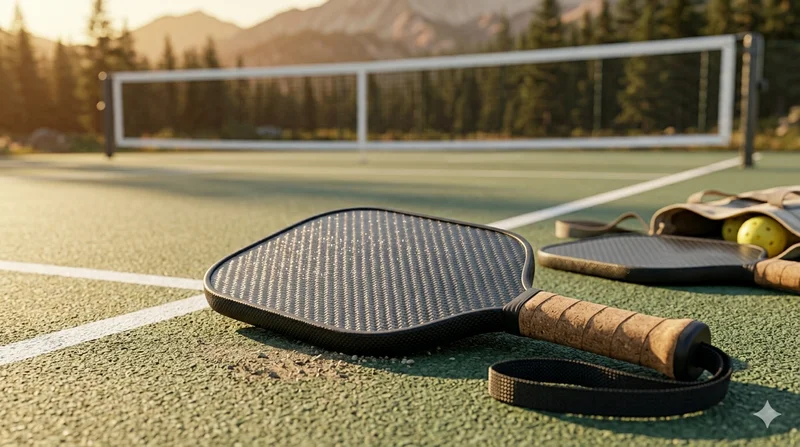
Carbon Fiber Pickleball Paddle
High-performance pickleball paddle with Toray T700 carbon fiber face and polypropylene honeycomb core. Delivers excellent power-to-weight ratio, spin generation, and vibration dampening for competitive play.
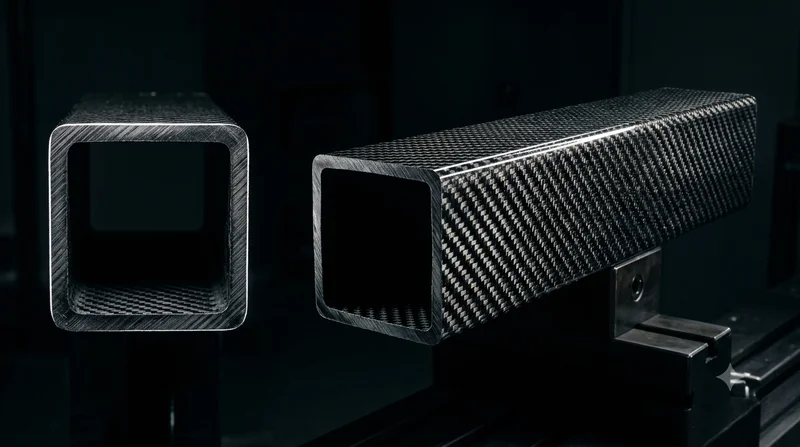
Square Carbon Fiber Tube — 3K Twill T700
Square cross-section carbon fiber tube manufactured with 3K twill weave for torsional strength. Preferred for structural frames, trusses, and support columns where rectangular geometry offers design flexibility.