
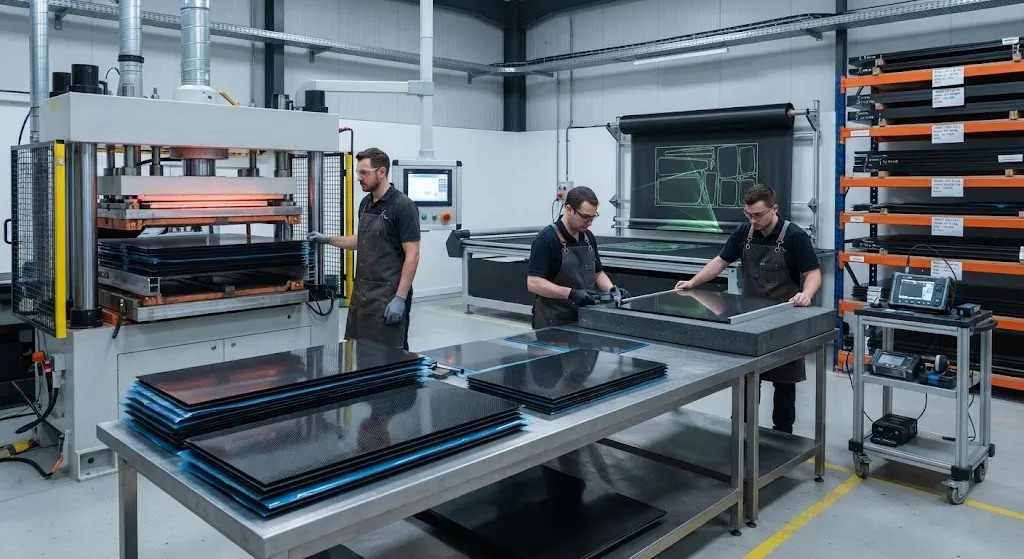
Choosing the right carbon fiber sheet manufacturer determines whether your project receives consistent panels at a sensible price or a stream of rejected parts. A carbon fiber sheet manufacturer converts woven or unidirectional carbon fabric into flat laminate panels through controlled layup, curing
Introduction
Choosing the right carbon fiber sheet manufacturer determines whether your project receives consistent panels at a sensible price or a stream of rejected parts. A carbon fiber sheet manufacturer converts woven or unidirectional carbon fabric into flat laminate panels through controlled layup, curing and trimming. Because sheet quality depends on fiber volume fraction, cure temperature and surface finish, process discipline matters far more than the price list.
This guide explains how carbon fiber sheet manufacturers actually produce panels, the quality checks that protect your components, and the criteria that separate a reliable carbon fiber sheet manufacturer from a broker who merely resells imported stock. Whether you need aerospace-grade laminates or cost-driven industrial panels, the same fundamentals apply.
How Carbon Fiber Sheet Manufacturers Produce Panels
Most carbon fiber sheet manufacturers build panels using one of three production routes. Each delivers a different balance of fiber volume, dimensional accuracy and cost, so the right choice depends on the grade your application needs.
| Process | Fiber Volume | Typical Thickness | Dimensional Tolerance | Relative Cost |
|---|---|---|---|---|
| Prepreg layup + autoclave | 58-65 percent | 0.2-25 mm | ±0.1 mm | High |
| Wet layup + heated press | 45-55 percent | 0.5-12 mm | ±0.2 mm | Low-medium |
| VARTM vacuum infusion | 55-62 percent | 1-40 mm | ±0.3 mm | Medium |
Prepreg layup is the premium route. The manufacturer cuts epoxy-preimpregnated carbon fabric, stacks plies in a controlled orientation, and cures the laminate in an autoclave at 120-180 °C under 5-7 bar pressure. This delivers the highest fiber volume fraction and the tightest thickness control, which is why aerospace and high-end automotive panels are almost always autoclave-cured. The penalty is cost: prepreg material and autoclave cycles make these panels the most expensive per square metre.
Wet layup with a heated press is the workhorse for industrial panels. Liquid resin is applied to the fabric by hand or by roller, the stack is closed in a press, and heat accelerates the cure. Fiber volume sits lower because manual wetting traps more air, but for 1-6 mm decorative and semi-structural panels the trade-off is acceptable and the price is the most competitive.
Vacuum-assisted resin transfer (VARTM) balances the two. Dry fabric is sealed under a vacuum bag and resin is drawn through the laminate by vacuum, producing fiber volumes close to prepreg without the autoclave. VARTM is the usual choice for thick panels, large-area plates and parts up to 40 mm where autoclave capacity would be the bottleneck.
Quality Control at a Carbon Fiber Sheet Manufacturer
Sheet panels fail in predictable ways: surface porosity, internal voids, thickness drift across the plate, and warp after demoulding. A professional carbon fiber sheet manufacturer checks every one of these on a defined schedule, not just on the first sample.
- Incoming material: fabric roll numbers, weave style and resin batch are recorded, and prepreg shelf life is verified before layup.
- Process records: ply count, orientation, cure temperature and pressure are logged per panel, so a defect can be traced to a specific batch.
- Ultrasonic or tap testing: thick and structural panels are scanned for voids and delamination before they leave the line.
- Thickness and flatness measurement: readings are taken across the plate; good manufacturers hold ±0.1 mm on autoclave panels and ±0.2 mm on press-cured parts.
- Certification: ISO 9001 is the baseline for industrial supply, while AS9100 indicates an aerospace-grade system suitable for flight-critical parts.
Ask any prospective supplier how many panels they scrap per month and what the top three defect causes are. A manufacturer that cannot answer from process data is relying on luck rather than control.
How to Choose a Carbon Fiber Sheet Manufacturer
Buyers searching for a carbon fiber sheet manufacturer near me often start with geography, but location is only one of four factors that determine success. Evaluate candidates in this order.
- Capability match: confirm the manufacturer can produce your thickness, panel size and fiber grade. A 3 mm twill sheet is a different job from a 20 mm aerospace laminate, and not every shop does both.
- Minimum order and lead time: industrial manufacturers typically quote 3-6 week lead times and minimums from 5 to 50 sheets. Prototype-friendly suppliers accept single panels at a premium.
- Quality system: request the QC records from a recent production run, including thickness measurements and void inspection results.
- Logistics: a domestic supplier, for example a carbon fiber sheet manufacturer in the USA, shortens freight and simplifies warranty handling, while overseas manufacturing only wins when volume is large enough to absorb shipping cost.
When you compare quotes from different carbon fiber sheet manufacturer suppliers, ask for the same specification sheet: grade, thickness, panel size, tolerance and edge condition. Otherwise you are comparing price lists that describe different products.
Secondary Operations and Cost Drivers
Beyond the bare laminate, most carbon fiber sheet manufacturers offer secondary operations that turn a panel into a ready part. Cut-to-size service removes the need for you to machine blanks, edge sealing protects the laminate from moisture ingress, and drilling or countersinking adds mounting holes to a documented pattern. Surface finish is another option: matte panels reduce glare in interior applications, while glossy panels with a clear coat present a cosmetic face. Decide which operations you need before requesting quotes, because each one changes the unit price.
Sheet pricing follows three drivers. Material grade dominates: T700 panels typically cost 20-40 percent more than equivalent T300 panels at the same thickness. Thickness scales the weight, and carbon fiber sheets are priced per kilogram of laminate, so a 6 mm panel costs roughly four times a 1.5 mm panel of the same area. Quantity is the final lever — most manufacturers step their pricing at 10, 50 and 200 sheets, with the largest bracket typically 30-50 percent below the smallest. Nesting multiple part profiles onto one panel size is the most effective way to capture the volume discount early.
Frequently Asked Questions
What thickness range can a carbon fiber sheet manufacturer produce?
Most manufacturers produce panels from 0.2 mm to 25 mm in autoclave and press routes, and up to 40 mm with VARTM. Thin panels below 1 mm need careful resin control to avoid surface porosity, while panels above 15 mm are usually infused rather than pressed because of heat penetration limits. Specify the finished thickness and tolerance, and let the manufacturer choose the process that can hold it.
What is the difference between T300 and T700 carbon fiber sheets?
T300 is a standard-modulus fiber with a tensile strength around 3,500 MPa and a modulus of 230 GPa, commonly used for decorative and semi-structural panels. T700 offers roughly 4,900 MPa strength at the same 230 GPa modulus, giving better fatigue and impact resistance at a higher material price. For most industrial panels T300 twill is sufficient; choose T700 or intermediate-modulus grades when the panel carries real load.
How do I verify the quality of delivered carbon fiber sheets?
Check thickness with a caliper at several points, confirm the panel lies flat on a reference surface, and inspect both faces for porosity under raking light. For structural use, request the manufacturer's ultrasonic test report. A simple field check is the weight: a 3 mm twill panel should weigh roughly 4.5-5 kg per square metre; large deviations indicate the wrong fiber volume fraction.
What is the minimum order quantity for carbon fiber sheets?
This varies widely. Stock-item manufacturers may sell a single 1,000 x 2,000 mm sheet, while custom-grade producers typically set minimums of 5-10 sheets per order. Prototype quantities are usually available at a premium, often 30-50 percent above the volume price. Ask about cut-to-size options: ordering one panel size and having it nested into multiple smaller blanks can satisfy a small first order economically.
Conclusion
A carbon fiber sheet manufacturer earns your business with process control, not promises. Confirm the production route matches your grade, review the quality records, and compare quotes against an identical specification. Whether you buy a single prototype panel or a pallet of production sheets, the evaluation framework is the same.
YongXian produces carbon fiber sheets from 0.2 mm to 25 mm in twill and unidirectional grades, with ISO 9001 process records and cut-to-size service. View our carbon fiber sheet range or request a quote with your thickness, grade and panel size.
Part of topic
Related Articles
Interested in Our Products?
Contact our team for competitive pricing and technical specifications.
Get a QuoteRelated Products

Carbon Fiber Plate — 3K Twill T700 3.0mm
Medium-thickness 3.0mm carbon fiber plate offering significantly higher load capacity while maintaining attractive 3K twill finish. Suitable for structural brackets, reinforcement plates, and load-bearing panels.

Carbon Fiber Plate — 3K Twill T700 1.5mm
Thin 1.5mm carbon fiber plate with 3K twill weave surface. Lightweight and stiff, commonly used for covers, panels, drone bodies, and applications requiring a premium aesthetic appearance.
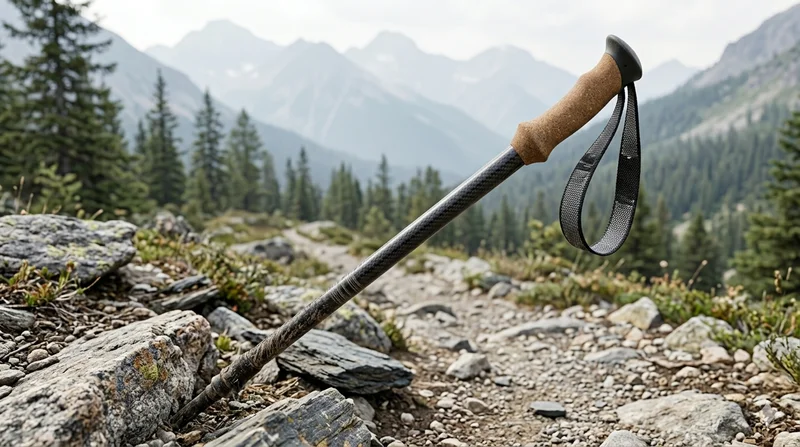
Carbon Fiber Trekking Pole
Lightweight carbon fiber trekking pole manufactured from high-grade carbon fiber tube. Weighs only 160g per pole while providing superior shock absorption and durability for hiking, trail running, and backpacking.
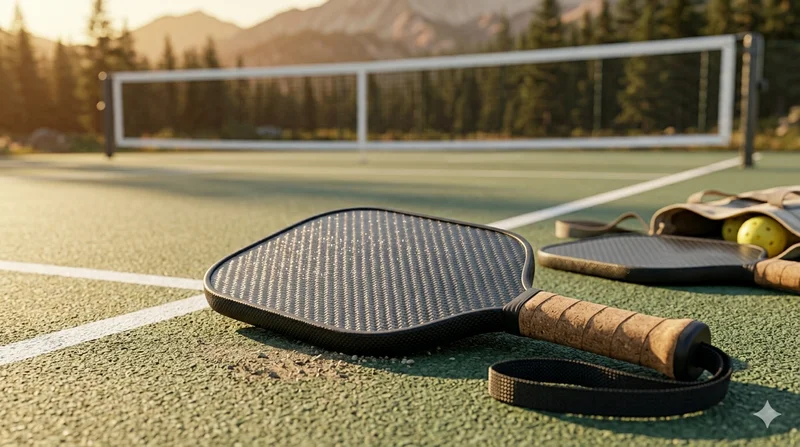
Carbon Fiber Pickleball Paddle
High-performance pickleball paddle with Toray T700 carbon fiber face and polypropylene honeycomb core. Delivers excellent power-to-weight ratio, spin generation, and vibration dampening for competitive play.

Square Carbon Fiber Tube — 3K Twill T700
Square cross-section carbon fiber tube manufactured with 3K twill weave for torsional strength. Preferred for structural frames, trusses, and support columns where rectangular geometry offers design flexibility.