
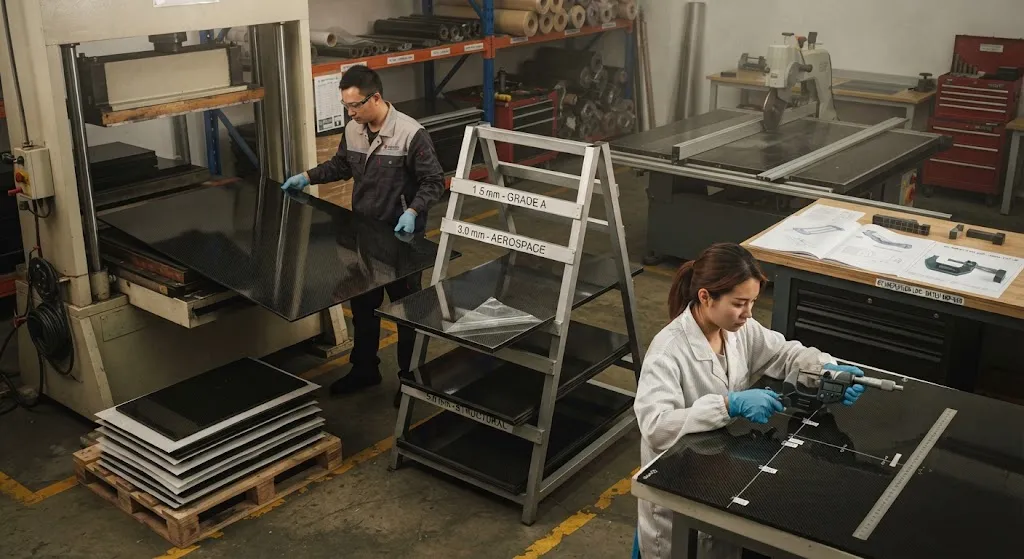
A carbon fiber plate supplier converts raw carbon fiber into flat laminate sheets used across aerospace, automotive, medical and industrial applications. Plates are sold either from stock in standard thicknesses or manufactured to order with a specific layup, weave and resin. Because the flat lamina
Introduction
A carbon fiber plate supplier converts raw carbon fiber into flat laminate sheets used across aerospace, automotive, medical and industrial applications. Plates are sold either from stock in standard thicknesses or manufactured to order with a specific layup, weave and resin. Because the flat laminate market spans everything from one-off prototype plaques to aerospace-grade production sheets, the supplier you choose determines not just the price you pay but whether the plate is structurally fit for its purpose.
This guide explains the types of carbon fiber plate supplier available, the specification fields that prevent expensive mistakes, how plate pricing is built up, and the quality checks worth asking for. Whether you need a single sheet for a drone part or a regular supply for a production line, the same framework applies.
Types of Carbon Fiber Plate Suppliers
The market for carbon fiber plates divides into three supplier types, and each serves a different order profile. Matching your requirement to the right type is the single fastest way to reduce cost and lead time.
| Supplier Type | Process | Typical Lead Time | Typical MOQ | Best For |
|---|---|---|---|---|
| Stockist / distributor | Resells manufactured laminate from stock | 1-5 days | 1 sheet | Prototypes, small quantities, standard thicknesses |
| Compression-molding manufacturer | Lays up prepreg or fabric, cures under heat and pressure | 2-4 weeks | 5-50 sheets | Custom layups, large panels, controlled thickness |
| Autoclave / aerospace manufacturer | Prepreg layup cured in autoclave under vacuum | 4-8 weeks | 10+ sheets | High-performance parts, low void content, certifications |
Stockists are the fastest route for standard sizes. A distributor holding imported laminate can cut and despatch a 3 mm or 5 mm plate the same day, which makes them ideal for prototypes, jigs and repairs. The trade-off is range: stockists carry common thicknesses and weave styles, not custom layups or aerospace grades. For buyers searching carbon fiber plate supplier near me options, a local stockist is usually the quickest way to inspect material before committing to a larger order.
Compression-molding manufacturers serve the bulk of custom plate demand. Pre-impregnated fabric or dry fibre is stacked to the required thickness and cured under controlled heat and pressure, producing a dense laminate with consistent thickness across the panel. This route delivers custom dimensions, thickness tolerance and resin systems, at the cost of a longer lead time and a minimum quantity to justify the tooling and press time.
Autoclave manufacturers operate at the top of the market. Plates are cured in an autoclave under vacuum and pressure, which drives void content down and mechanical properties up. Aerospace buyers typically require this route because the resulting laminate meets the documented mechanical and traceability standards that certification demands. The premium is significant, so autoclave supply is reserved for parts where documented performance is a hard requirement.
Carbon Fiber Plate Specifications That Prevent Costly Mistakes
The most common plate order failures are dimensional: a plate that is 0.2 mm over thickness, a panel that warps after machining, or a weave direction that does not match the loading direction. Every order to a carbon fiber plate supplier should include the following fields.
- Length, width and thickness: give the nominal dimensions plus the thickness tolerance. Compression-molded plates typically hold ±0.1 mm; stock laminate varies by grade.
- Weave style: plain weave for stability and machining, twill for drape and cosmetics, or unidirectional for stiffness in one axis.
- Fibre grade and modulus: T300 for general work, T700 for higher strength, or high-modulus (HM) grades for stiffness-critical parts.
- Resin system: epoxy for structural use, or specialised systems for flame retardancy, high temperature or marine exposure.
- Surface finish: one-sided cosmetic for visible parts, two-sided cosmetic, or matte for bonding applications.
- Quantity and delivery: required date, cutting tolerance and whether edges need sealing against moisture ingress.
Writing these fields down prevents the three disputes that dominate plate orders: thickness outside tolerance, warp after machining, and a weave orientation that does not match the drawing. Ask the supplier for their standard specification sheet before you send an order — most disputes are avoided simply by filling it in.
How Carbon Fiber Plate Supplier Pricing Works
Plate pricing is built from three components: material cost, process cost and quantity. Material dominates, because carbon fibre is expensive relative to the resin that surrounds it. Process cost reflects how the plate is cured and finished, and quantity spreads tooling and setup over the order. The result is a wide price spread across construction types.
| Plate Specification | Typical Price Range (per sq m) | Note |
|---|---|---|
| Pultruded / roll-pressed laminate, 1.5 mm, standard weave | $60-110 | Economical, consistent thickness |
| Compression-molded plate, 3 mm, twill 2x2 | $120-220 | Custom layup, controlled tolerance |
| Autoclave aerospace plate, 2 mm, documented properties | $350-650 | Low void content, full traceability |
Buyers in North America comparing carbon fiber plate supplier usa options will see higher list prices than Asian suppliers, but the delta is largely freight, import duties and certification overhead rather than material. A useful rule is to compare quotes on identical specification fields — thickness tolerance, weave, resin and quantity — because a quote that omits one of these is not comparable with one that includes it. Shipping cost also scales with panel size, so large plates can carry a disproportionately high freight charge that should be quoted separately.
Quantity changes the picture more than any other factor. The same 3 mm plate can cost 40-60% less per sheet at 100 sheets than at 10, because tooling and press setup are amortised. If a project has volume, telling the supplier the annual requirement at the quoting stage produces a materially better price than ordering in small repeated batches.
Quality Checks and Certifications for Carbon Fiber Plates
A reliable plate supplier measures before despatch. Thickness is checked at multiple points across the panel, not just at the edges, because pressure distribution in the press can vary across a large surface. Flatness is verified on a reference surface, and warp beyond a defined limit is rejected. For structural plates, a sample from each batch is tested for tensile or flexural properties, and the results are recorded against the batch number.
Certification depends on the market. Industrial plate supply commonly references ISO 9001 quality systems, while aerospace buyers expect AS9100 with material traceability from the fibre batch to the finished plate. For composite plates that carry load, ask for a material certificate covering fibre grade, resin system and cure cycle. A supplier that produces batch records without being asked is usually the supplier worth keeping, and it is the difference between a plate you can certify and a plate you can only measure.
Frequently Asked Questions
What is the cheapest way to buy carbon fiber plates?
Buy standard thicknesses from a stockist in the largest quantity you can justify. Stock laminate avoids tooling and setup entirely, and volume amortises freight. If you need custom dimensions, consolidate the requirement into a single annual order rather than repeated small ones — the per-sheet price at volume is typically 40-60% lower than at prototype quantities.
What thickness tolerance can I expect from a carbon fiber plate supplier?
Compression-molded plates typically hold ±0.1 mm on thickness across the panel, while pultruded or roll-pressed laminate is consistent along the production direction but may vary more across the width. Autoclave aerospace plates achieve the tightest control. State the tolerance you need in the specification — suppliers price tighter tolerances accordingly, and a plate ordered without a stated tolerance will be shipped to the supplier's standard, which may be looser than you assumed.
Can I machine carbon fiber plates without delamination?
Yes, with the right tooling. Use diamond-coated or carbide end mills, climb milling, and moderate feed rates to avoid heating the resin. Support the panel fully during cutting and machine with sharp tooling — dull tools tear the fibres and cause edge delamination. Sealing machined edges with a thin resin coat prevents moisture ingress, which matters for outdoor and marine applications.
How do I know if a plate is aerospace grade?
Ask for the material certificate. Aerospace-grade plates are cured in an autoclave under vacuum, have documented void content and mechanical properties, and carry material traceability from the fibre batch to the finished sheet. A plate sold as aerospace grade should come with batch records and cure-cycle documentation. If the supplier cannot produce these, treat the claim as unverified.
Conclusion
The right carbon fiber plate supplier depends on the order: a stockist for speed and standard thicknesses, a compression-molding manufacturer for custom panels, and an autoclave supplier for certified aerospace work. Write the full specification — dimensions, tolerance, weave, fibre grade, resin and surface finish — before asking for prices, and compare quotes on identical fields. With those basics in place, buyers can source plates that fit, perform and arrive on schedule.
YongXian supplies carbon fiber plates in stock and custom constructions, with thickness control, material certificates and international delivery. View our carbon fiber plate range or request a quote with your dimensions, quantity and required tolerance.
Part of topic
Related Articles
Interested in Our Products?
Contact our team for competitive pricing and technical specifications.
Get a QuoteRelated Products

Carbon Fiber Plate — 3K Twill T700 3.0mm
Medium-thickness 3.0mm carbon fiber plate offering significantly higher load capacity while maintaining attractive 3K twill finish. Suitable for structural brackets, reinforcement plates, and load-bearing panels.

Carbon Fiber Plate — 3K Twill T700 1.5mm
Thin 1.5mm carbon fiber plate with 3K twill weave surface. Lightweight and stiff, commonly used for covers, panels, drone bodies, and applications requiring a premium aesthetic appearance.

Carbon Fiber Trekking Pole
Lightweight carbon fiber trekking pole manufactured from high-grade carbon fiber tube. Weighs only 160g per pole while providing superior shock absorption and durability for hiking, trail running, and backpacking.
Carbon Fiber Pickleball Paddle
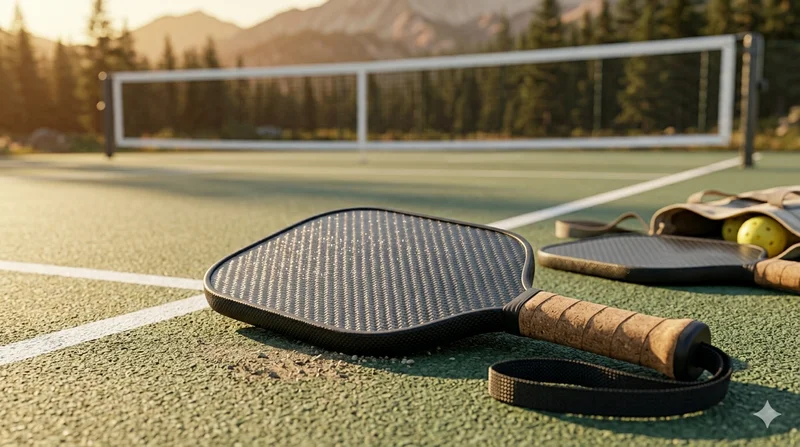
High-performance pickleball paddle with Toray T700 carbon fiber face and polypropylene honeycomb core. Delivers excellent power-to-weight ratio, spin generation, and vibration dampening for competitive play.

Square Carbon Fiber Tube — 3K Twill T700
Square cross-section carbon fiber tube manufactured with 3K twill weave for torsional strength. Preferred for structural frames, trusses, and support columns where rectangular geometry offers design flexibility.