
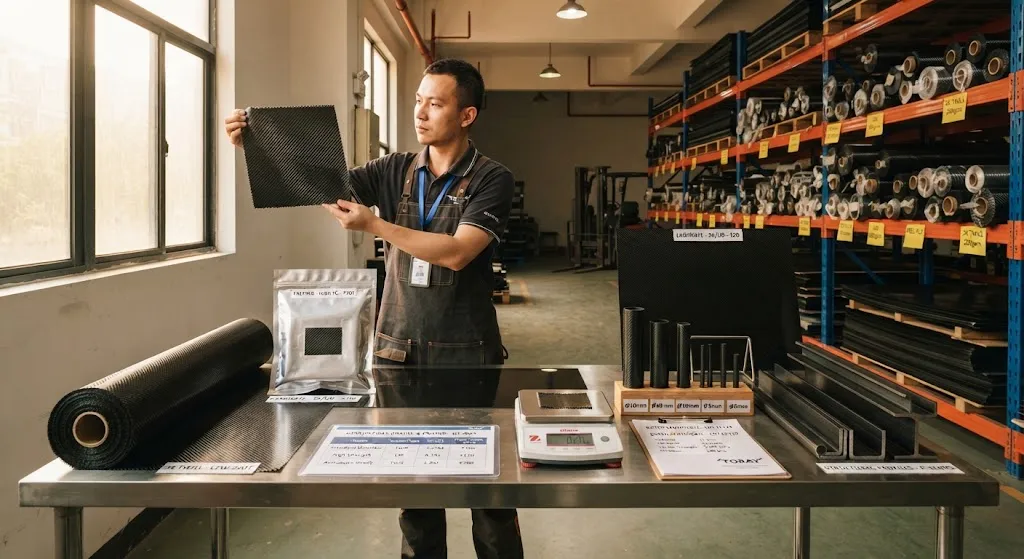
Carbon fiber material for sale comes in more forms than most first-time buyers expect, and the differences between them matter more than the brand name on the box. Woven fabric, unidirectional prepreg, solid laminate sheet, pultruded tube, rod and structural profile are different products with diffe
Introduction
Carbon fiber material for sale comes in more forms than most first-time buyers expect, and the differences between them matter more than the brand name on the box. Woven fabric, unidirectional prepreg, solid laminate sheet, pultruded tube, rod and structural profile are different products with different prices, handling requirements and applications. Ordering the wrong form means either paying for properties you do not need or discovering that the material cannot be processed with the equipment you have.
This guide maps the full range of carbon fiber material for sale, explains what each grade and product form is used for, gives realistic price benchmarks, and lists the verification steps that separate reliable carbon fiber material for sale suppliers from resellers who cannot document what they ship.
The Product Forms of Carbon Fiber Material For Sale
Six product forms dominate the market for carbon fiber material for sale. Each starts from the same raw fiber but diverges at a different stage of processing.
| Product Form | Typical Use | Price Benchmark | Handling |
|---|---|---|---|
| Woven fabric (3K/6K/12K) | Wet layup, infusion, decorative parts | $15-45 per m² | Easy, room-temperature storage |
| Unidirectional prepreg | Aerospace and high-performance laminates | $25-80 per kg | Frozen storage, -18°C |
| Solid laminate sheet | Machined parts, panels, covers | $60-150 per panel (1 m², 1.5 mm) | Easy, stable |
| Pultruded tube and rod | Frames, shafts, structural members | $4-15 per meter | Easy, cut with abrasive tooling |
| Structural profiles | Channels, angles, flat bars | $8-30 per meter | Easy, stable |
| Chopped fiber and molding compounds | Injection and compression molding | $6-18 per kg | Easy, sealed bags |
Woven fabric is the entry point for wet layup and resin infusion work, and the most forgiving form for a shop that is new to composites. Prepreg carries a resin system already impregnated into the fiber and must be stored frozen, but it delivers the highest fiber volume fraction and the tightest process control, which is why aerospace work specifies it almost exclusively. Solid laminate sheet is cured flat plate stock intended for CNC machining, and it is the form most often ordered when the buyer plans to cut parts rather than lay them up.
Grades and Specifications to Check Before You Buy
The specification sheet that comes with carbon fiber material for sale matters more than the marketing description. Five numbers define what you are actually buying.
- Fiber grade: T300 is the economy standard (tensile strength about 3,530 MPa, modulus 230 GPa); T700 is the most common intermediate grade (4,900 MPa, 230 GPa); T800 and higher offer strength above 5,800 MPa. Higher grade always costs more, so match the grade to the load, not to the budget.
- Tensile modulus: Standard modulus (230 GPa) suits general parts; intermediate modulus (290-300 GPa) suits stiffness-critical structures; high modulus (390 GPa and above) is expensive and brittle, used only where stiffness per weight is the sole driver.
- Fiber areal weight: Fabric is sold by grams per square meter (200 g/m² is typical for 3K); the areal weight sets the cured laminate thickness per ply and the amount of resin you will add.
- Resin system and fiber volume fraction: For prepreg, the resin type and the nominal 60-65% fiber volume fraction determine the mechanical properties you can expect after cure.
- Shelf life and out-time: Prepreg has a frozen shelf life (typically 6-12 months) and a room-temperature out-time (7-30 days). A seller who cannot state both is not managing their inventory correctly.
Ask for a certificate of conformance or a batch data sheet on every order. Legitimate carbon fiber material for sale suppliers keep records of grade, lot number, areal weight and test values; a reseller who cannot produce documentation for the material you are buying is a risk regardless of price.
How Prices Compare Across Suppliers
Prices for carbon fiber material for sale vary by as much as 40 percent between channels, and the spread is not random. Manufacturer-direct sales and large distributors sit at the bottom of the range; specialty retailers and local stockists sit at the top because they carry small inventory and buy in small volumes themselves. Shipping and minimums change the comparison as much as the unit price does: a fabric price quoted ex-works becomes a different number once freight, duties and payment terms are added.
For B2B buyers the practical benchmark is total landed cost per kilogram of finished part, not the sticker price per square meter. A material that is 15 percent cheaper but arrives with a two-week lead time, a $250 minimum and no documentation may cost more than a mid-priced supplier with stock, same-week shipping and batch data included. When comparing carbon fiber material for sale suppliers, request the same specification from two or three of them, ask for landed cost including freight, and check whether the price holds at the quantity you actually need.
Carbon Fiber Material For Sale: Local Stock vs Direct Import
Whether carbon fiber material for sale near you or a direct overseas order is the better path depends on volume, lead time and application risk. Local stockists and distributors deliver quickly, sell in small quantities and usually accept card or small-order payment, which makes them the right choice for prototypes, R&D and maintenance purchases. Direct import from a manufacturer or large distributor becomes attractive at higher volumes, where the price difference of 20-40 percent outweighs the shipping cost, customs clearance and longer lead time.
For buyers in the United States, the balance usually tips to domestic suppliers up to a few hundred kilograms per year, then shifts toward direct import beyond that point. Two practical rules apply everywhere: order a small sample of any new grade or form before committing to volume, and keep the sample from the same production lot you plan to buy — a certificate that describes a different lot does not verify the material in your hands.
Frequently Asked Questions
What is the minimum order quantity when buying carbon fiber material for sale?
Fabric, chopped fiber and molding compounds are commonly sold from 1-10 kg or a few square meters; solid sheet is usually cut to order with a minimum of one panel; prepreg frequently carries a minimum of 5-10 kg because it must be kept frozen and shipped cold. Distributors sell below these levels, manufacturers rarely do. If a manufacturer insists on a minimum that is far above your need, a distributor or a group purchase with another buyer is the standard workaround.
How do I know if a supplier is selling genuine carbon fiber?
Check three things. First, request a certificate of conformance or batch data sheet with the fiber grade, areal weight and lot number. Second, weigh and measure a sample: 3K twill fabric at 200 g/m² should weigh within a few percent of that figure, and a 1.5 mm solid sheet should have a density close to 1.5-1.6 g/cm³. Third, burn-test a scrap in a well-ventilated area: genuine carbon fiber leaves a clean black fiber residue that does not melt, while glass fiber leaves a white residue and aramid does not burn cleanly. These checks take minutes and catch the vast majority of mislabeled material.
What is the difference between fabric, prepreg and solid sheet?
Fabric is dry woven fiber that you impregnate with resin during layup; it is flexible, inexpensive and suitable for wet layup and infusion. Prepreg is fiber pre-impregnated with a controlled resin system, stored frozen, and cured under heat and pressure; it delivers the best mechanical properties and process control. Solid sheet is cured, flat laminate stock ready for machining, drilling and cutting. Choose fabric for one-off laminating work, prepreg for performance-critical production, and solid sheet when your process is machining rather than layup.
Can I order custom widths, weaves or cut sizes?
Yes, within the limits of the weaving and slitting equipment. Fabric widths are usually available from 100 mm to 1,270 mm; custom slitting down to narrower widths is routine; and sheet suppliers cut panels to your dimensions with CNC or waterjet. Custom weaves and non-standard areal weights require a production run and are economical only at larger volumes. Ask for the price break at your exact width and quantity — the difference between stock and custom-width pricing is often the deciding factor.
Conclusion
Carbon fiber material for sale is a family of different products rather than a single commodity. Woven fabric suits layup work, prepreg delivers aerospace-grade performance, solid sheet feeds machining, and tubes and profiles cover structural framing. Match the form and grade to the application, verify the specification with documentation and quick tests, and compare suppliers on landed cost at your real quantity rather than on sticker price alone.
YongXian supplies carbon fiber fabric, prepreg, solid sheet, tube, rod and structural profiles with full data sheets, batch documentation and cut-to-size service. Browse our carbon fiber materials or send us your specification for a documented quote with grade, lot number and lead time.
Related Articles
Interested in Our Products?
Contact our team for competitive pricing and technical specifications.
Get a QuoteRelated Products

Carbon Fiber Plate — 3K Twill T700 3.0mm
Medium-thickness 3.0mm carbon fiber plate offering significantly higher load capacity while maintaining attractive 3K twill finish. Suitable for structural brackets, reinforcement plates, and load-bearing panels.

Carbon Fiber Plate — 3K Twill T700 1.5mm
Thin 1.5mm carbon fiber plate with 3K twill weave surface. Lightweight and stiff, commonly used for covers, panels, drone bodies, and applications requiring a premium aesthetic appearance.
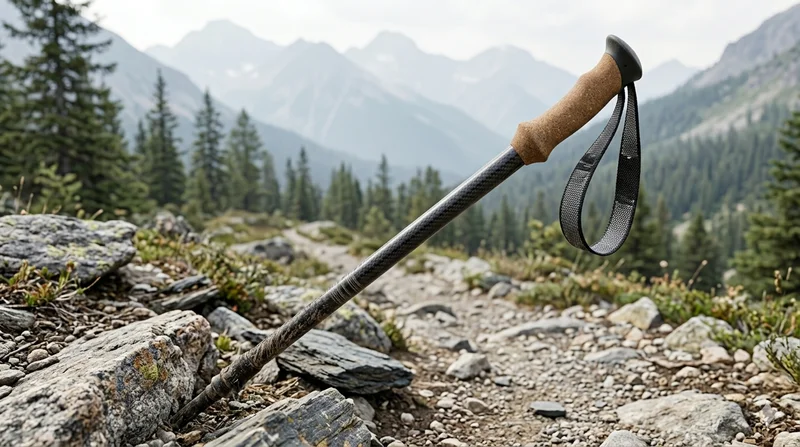
Carbon Fiber Trekking Pole
Lightweight carbon fiber trekking pole manufactured from high-grade carbon fiber tube. Weighs only 160g per pole while providing superior shock absorption and durability for hiking, trail running, and backpacking.
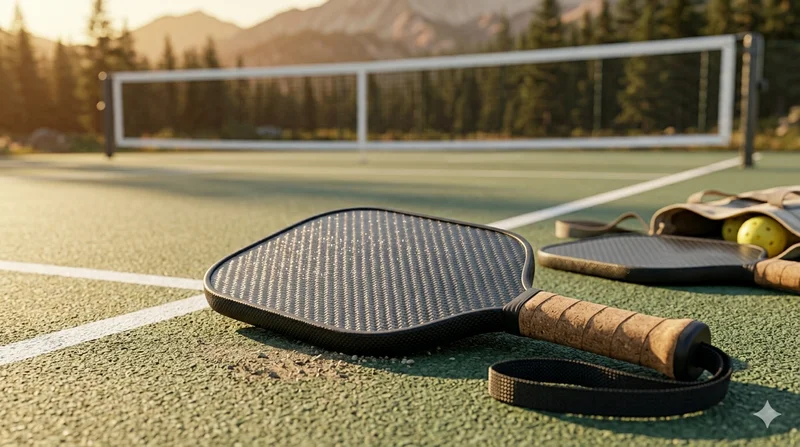
Carbon Fiber Pickleball Paddle
High-performance pickleball paddle with Toray T700 carbon fiber face and polypropylene honeycomb core. Delivers excellent power-to-weight ratio, spin generation, and vibration dampening for competitive play.

Square Carbon Fiber Tube — 3K Twill T700
Square cross-section carbon fiber tube manufactured with 3K twill weave for torsional strength. Preferred for structural frames, trusses, and support columns where rectangular geometry offers design flexibility.