
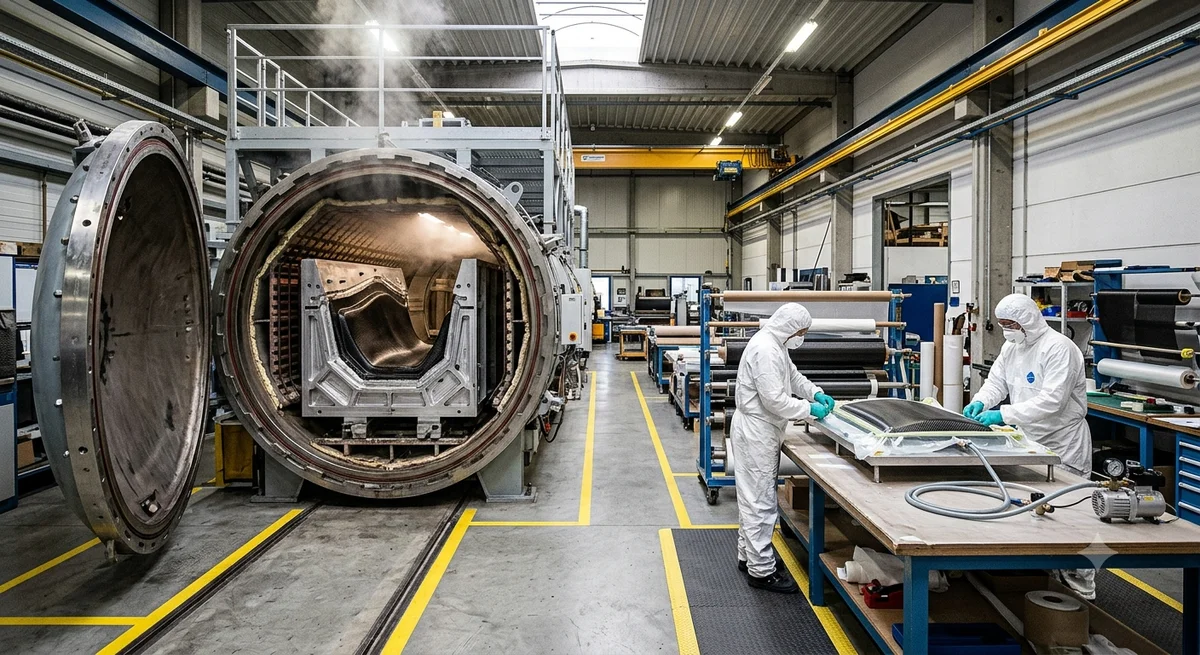
Compare autoclave, vacuum-bag-only (VBO), oven cure, and room-temperature cure processes for carbon fiber composites. Cost, cycle time, mechanical properties, and tooling implications for B2B buyers.
Why Cure Method Matters for Your Composite Parts
The curing process determines not only the mechanical properties of your carbon fiber parts but also your production cost, cycle time, and tooling investment. In 2026, the gap between autoclave and out-of-autoclave (OoA) processes has narrowed significantly, but the choice still depends on part geometry, production volume, and performance requirements. This article provides a data-driven comparison to help B2B buyers select the right process.
Process Comparison: Key Parameters
| Process | Pressure (MPa) | Max Temp (°C) | Tooling Material | Cycle Time | Equipment Cost | Fiber Volume Fraction | Void Content |
|---|---|---|---|---|---|---|---|
| Autoclave (prepreg) | 0.3–0.7 | 200–400 | Aluminum, Steel, Invar | 2–8 hours | €150K–€2M | 58–65% | < 1% |
| Vacuum-Bag-Only (VBO prepreg) | 0.08–0.1 (vacuum only) | 120–180 | Composite, Aluminum | 4–12 hours | €5K–€50K | 55–60% | < 2% |
| Oven Cure (wet lay-up) | 0.08–0.1 (vacuum only) | 60–120 | Wood, Composite, Foam | 6–24 hours | €2K–€20K | 45–55% | 2–5% |
| Room Temp Cure (wet lay-up) | 0.08–0.1 (vacuum only) | 15–35 | Wood, Foam, Plaster | 24–72 hours | €500–€5K | 40–50% | 3–8% |
| HP-RTM (High-Pressure RTM) | 3–12 (injection) | 120–160 | Steel (machined) | 2–6 minutes | €500K–€2M | 55–62% | < 1.5% |
When Autoclave Is the Right Choice
Autoclave curing remains the gold standard for aerospace primary structures. The combination of elevated pressure (0.3–0.7 MPa) and temperature (up to 400 °C) delivers the highest fiber volume fraction (58–65 %) and lowest void content (< 1 %). Typical applications include:
- Aerospace primary structures: Wing spars, fuselage frames, engine fan blades — where void content below 1 % is a certification requirement.
- High-performance automotive: Monocoques for supercars and racing applications where every gram matters.
- Thick laminates (> 10 mm): Autoclave pressure ensures uniform consolidation through the thickness, preventing dry spots and delamination.
- Complex geometries with tight radius: The pressure differential forces the prepreg into sharp corners and deep draw sections.
However, the capital investment (€150,000 to over €2 million for a production autoclave) and energy cost (approximately €80–150 per cycle for a 2 m diameter unit) make autoclave uneconomical for low-to-medium volume production unless the mechanical property requirements leave no alternative.
When Out-of-Autoclave Processes Make Sense
Out-of-autoclave (OoA) processes have matured significantly. Modern VBO prepregs achieve fiber volume fractions of 55–60 % with void content below 2 %, sufficient for 90 % of non-aerospace applications. Key scenarios where OoA is the better choice:
- Large parts with moderate structural requirements: Wind turbine blades, boat hulls, architectural panels — these parts are too large for any production autoclave.
- Prototyping and low-volume production (10–500 parts/year): VBO prepreg avoids the tooling cost of steel molds and the capital cost of an autoclave.
- On-site repair and field applications: Room-temperature wet lay-up allows structural repair without moving the part to a factory.
- Cost-sensitive commercial products: Sporting goods, automotive interior panels, consumer electronics — where the 5–10 % mechanical property premium of autoclave does not justify the cost.
Cost Comparison Per Part
For a typical 2 m × 1 m composite panel (4 plies, 1.5 mm thick, 100 parts/year):
| Cost Component | Autoclave Prepreg | VBO Prepreg | Wet Lay-Up Oven Cure |
|---|---|---|---|
| Tooling amortization (per part) | €85–150 | €35–60 | €8–20 |
| Material cost (per part) | €45–70 | €38–58 | €22–35 |
| Labor (per part) | €55–90 | €50–80 | €65–110 |
| Energy (per part) | €12–25 | €4–10 | €3–8 |
| Total cost per part | €197–335 | €127–208 | €98–173 |
| vs Autoclave saving | — | 30–38 % less | 42–50 % less |
Selecting the Right Prepreg for Your Process
At YongXian, we manufacture prepregs optimised for both autoclave and VBO processes. Our YX-300 series (autoclave grade, 177 °C cure) delivers 62 % fiber volume with 0.5 % void content for aerospace applications. Our YX-200VBO series (out-of-autoclave grade, 120 °C cure) is formulated with a controlled-flow resin system that achieves full consolidation under vacuum-only pressure, with a 21-day out-life at 21 °C. We also supply dry fabrics for infusion processes used in open-mold wet lay-up and HP-RTM.
Q: Can VBO prepreg achieve the same mechanical properties as autoclave-cured prepreg?
A: Not identical, but close. VBO prepreg typically achieves 90–95 % of autoclave tensile strength and 95–98 % of tensile modulus. The primary difference is in compressive strength after impact (CAI) — autoclave parts show 10–15 % higher CAI due to lower void content. For non-flight-critical applications, this difference is rarely design-limiting.
Q: What is the largest part size that can be cured in an autoclave?
A: Commercial autoclaves range from 0.5 m diameter × 1 m length to 6 m diameter × 20 m length (used for aircraft fuselage sections). The largest production autoclaves can accommodate parts up to 5 m in diameter and 15 m in length. Beyond this, VBO or oven cure is the only option. For reference, a 70 m wind turbine blade requires oven-cure or room-temperature infusion regardless of the material system.
Q: How do I choose between VBO prepreg and wet lay-up for my application?
A: Choose VBO prepreg when you need consistent fiber volume fraction (55–60 %), controlled resin content, and lower void content (< 2 %) — typical for structural parts with quality requirements. Choose wet lay-up for one-off parts, repairs, tooling, or when working with very large surfaces where prepreg shelf life would be problematic. Wet lay-up material cost is 40–50 % lower but labor cost is 20–40 % higher due to the manual resin application and debulking steps.
Part of topic
Related Articles
- Bio-Based Carbon Fiber Precursors: Lignin and Polyethylene for Low-Cost Production
- Large-Tow Carbon Fiber Cost Analysis: 48K vs 60K Price-Performance Comparison
- Carbon Fiber-Resin Interface Bonding: Surface Treatment and Coupling Agent Optimization
- Digital Twin for Carbon Fiber Manufacturing: Real-Time Process Monitoring and Defect Prevention
- Thermoplastic Carbon Fiber Welding for Automotive: Ultrasonic and Induction Welding Process Windows
- Large-Tow Carbon Fiber Wet Spinning: Process Optimization for 48K/60K Production Efficiency