
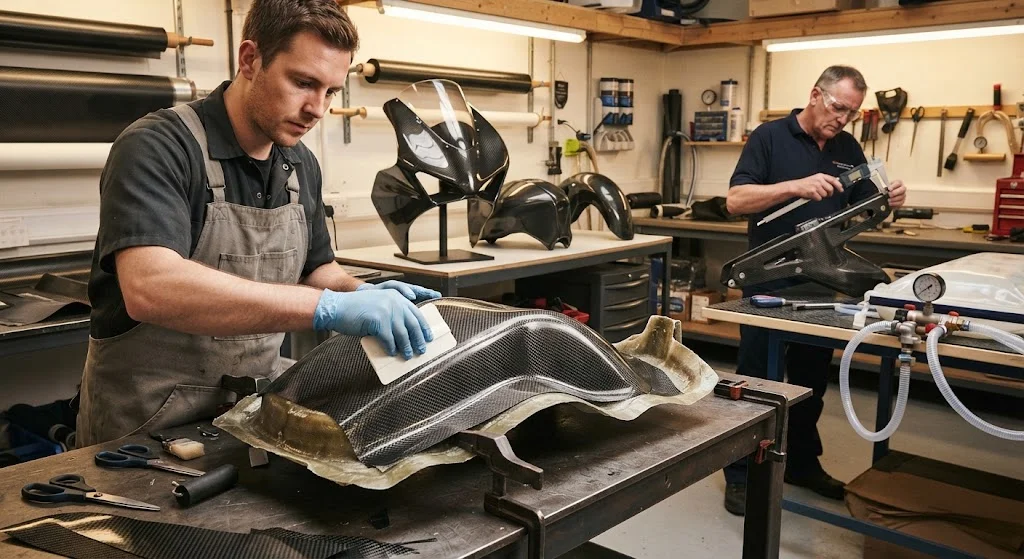
Custom carbon fiber motorcycle parts are no longer exotic race-only hardware. Fairings, fender eliminators, tank covers, heel guards, and chain guards are now standard aftermarket catalog items, while structural parts such as subframes, wheels, and swingarms remain the domain of specialist builders
Introduction
Custom carbon fiber motorcycle parts are no longer exotic race-only hardware. Fairings, fender eliminators, tank covers, heel guards, and chain guards are now standard aftermarket catalog items, while structural parts such as subframes, wheels, and swingarms remain the domain of specialist builders and race teams. The common thread is that all of them are built from the same handful of processes, and the process choice — wet layup, vacuum-bagged prepreg, or autoclave curing — determines the weight, the finish quality, and the price of the finished part.
This guide explains which parts make sense in carbon fiber, how each manufacturing process affects the result, and how to qualify a supplier so a custom part is genuinely lighter — and safe — rather than just covered in woven cloth.
Which Motorcycle Parts Make Sense in Carbon Fiber
Not every motorcycle part benefits from carbon fiber. The material pays off where weight is unsprung or high on the bike, where stiffness improves handling, or where appearance drives the purchase. The table below separates common custom parts by their role and typical weight saving:
| Part category | Examples | Typical weight saving vs OEM | Primary benefit |
|---|---|---|---|
| Cosmetic bodywork | Fairings, tank covers, fender eliminators | 20-40 percent | Appearance, minor weight |
| Light structural | Chain guards, heel guards, brackets | 30-50 percent | Weight, durability |
| Chassis components | Subframes, swingarm covers | 25-45 percent | Stiffness, handling |
| Wheels and swingarms | Full carbon wheels, structural swingarms | 30-60 percent | Unsprung mass, handling |
Two rules of thumb apply. First, the higher the part sits on the bike, the smaller the benefit: cosmetic weight near the center of gravity matters far less than unsprung weight at the wheels. Second, structural parts transfer load, so a poorly made carbon swingarm or subframe is a safety risk, not a styling upgrade. Buyers should treat wheels, swingarms, and subframes as engineered components with documented testing, not as catalog accessories.
How Custom Carbon Fiber Motorcycle Parts Are Made
The manufacturing route defines the part's weight, finish, and price. Four processes dominate the motorcycle aftermarket:
- Wet layup: Fabric is hand-saturated with resin over a mold and cured at room temperature. It is the cheapest route, fine for cosmetic parts, but produces higher void content and less consistent thickness than pressurized processes.
- Vacuum bagging: A sealed bag pulls air out of the wet layup, raising fiber content and reducing voids. It is the standard for quality aftermarket cosmetic and light structural parts.
- Prepreg vacuum bagging: Pre-impregnated cloth with controlled resin content is laid up and cured in an oven under vacuum. It delivers consistent fiber volume and is common for premium parts.
- Autoclave curing: Heat and pressure cure prepreg in an autoclave, producing aerospace-grade laminates with the lowest void content. It is used for structural parts and race components, and it is the most expensive route.
The visible weave is not a quality signal by itself. A 3K twill cosmetic part and an autoclave-cured structural part can look identical from the outside; the difference is in the fiber grade, the resin system, the layup schedule, and the cure process inside. A buyer paying for structural carbon should ask which process was used, not just admire the weave.
Fiber Grade and Layup for Motorcycle Parts
Fiber grade drives both performance and cost. T300-class fiber is the workhorse of the aftermarket: affordable, strong enough for cosmetic and light structural parts, and available in the 3K and 12K tow sizes that produce the familiar twill appearance. T700-class fiber adds roughly 30-40 percent more tensile strength at a higher price and is the common choice for structural motorcycle parts where fatigue and impact matter. High-modulus M-series fiber is rare in motorcycles outside racing because its stiffness comes with brittleness that suits track use more than street durability.
Layup matters as much as the fiber. Cosmetic parts can use a single layer of twill over a lightweight core. Structural parts need multiple plies oriented to carry load — 0, 45, and 90 degree directions — which is why a structural swingarm is a designed laminate, not a draped cloth. When comparing suppliers, ask for the layup schedule and the fiber and resin grade in writing; a supplier who cannot provide them cannot substantiate a structural claim.
Weight Savings, Finish, and Paint
A well-made carbon part saves weight through fiber content and resin control, not through thin walls. Vacuum-bagged and autoclave-cured parts typically run 55-65 percent fiber by volume, while a sloppy wet layup can fall below 40 percent — the latter is heavier and weaker than it looks. For cosmetic parts, a high-gloss clear coat is standard, and a part finished on one side only is cheaper than a double-sided cosmetic finish. For painted parts, carbon is often pointless: paint adds weight and hides the weave, so buyers who want color usually choose the cheapest adequate construction rather than visible carbon.
Fit is the practical quality metric for motorcycle parts. Aftermarket carbon bodywork is judged on panel gaps, fastener alignment, and durability under vibration. A part that fits well and survives thousands of kilometers of vibration is a good part regardless of its process; a part that cracks at a mounting point is a bad part even if it was autoclave-cured. Ask suppliers about their return and warranty policy on fitment, and check reviews from owners who actually run the part.
How to Choose a Custom Carbon Fiber Motorcycle Parts Supplier
Qualifying a supplier is a short, concrete checklist. First, confirm the process: wet layup is acceptable for cosmetic parts, prepreg or autoclave for structural ones. Second, confirm the fiber and resin grade in writing, with datasheets for structural parts. Third, check whether the supplier publishes weight data and test documentation — a structural wheel or swingarm should come with documented proof, not adjectives. Fourth, evaluate fitment through reviews and a return policy on fit issues. Fifth, compare lead times: custom parts are made to order, so a quoted 3-6 week lead time is normal, and rush service should cost extra rather than compromise the layup.
Buyers searching for custom carbon fiber motorcycle parts near me or custom carbon fiber motorcycle parts usa face a trade-off between local speed and overseas cost, and custom carbon fiber motorcycle parts suppliers in both camps quote differently on the same specification. Local suppliers offer faster turnaround, easier fitment disputes, and support, while overseas manufacturers often quote 20-40 percent lower for the same specification at the cost of lead time and shipping. For structural parts, prioritize documentation over price; for cosmetic parts, prioritize fit and finish reviews.
Frequently Asked Questions
How much weight do custom carbon fiber motorcycle parts save?
Cosmetic bodywork typically saves 20-40 percent versus OEM plastic, light structural parts 30-50 percent, and wheels and swingarms 30-60 percent. The saving comes from fiber content and resin control, not thin walls — a poorly made wet-layup part can be heavier and weaker than the plastic it replaces. Ask the supplier for measured weight data on the specific part.
Are carbon fiber motorcycle parts safe for street use?
Cosmetic and light structural parts are safe with proper fitment and mounting. Structural parts — wheels, swingarms, subframes — are engineered components and must be sourced from suppliers who document the fiber grade, layup schedule, and testing. A structural part bought on appearance alone is a risk. When in doubt, keep OEM structural parts and limit carbon to cosmetic and light structural upgrades.
Why are custom carbon fiber motorcycle parts so expensive?
Carbon parts are built by hand from expensive fiber, and the molds, layup labor, and curing cycles do not scale down to small batch sizes. A custom part also carries design and pattern work that a mass-produced plastic part spreads over thousands of units. Prices reflect material, labor, mold amortization, and the process — autoclave-cured structural parts cost the most.
Can I paint over carbon fiber motorcycle parts?
Yes, with the right prep — sanding the clear coat, applying an adhesion promoter, and using flexible primers and paints that tolerate vibration. Painted carbon is common for race liveries, but it adds weight and hides the weave, so if you want color anyway, a cheaper construction can deliver the same result at lower cost.
Conclusion
Custom carbon fiber motorcycle parts deliver real weight savings when the process, fiber grade, and layup match the part's role. Cosmetic bodywork is an appearance and fitment game; structural parts are an engineering and documentation game. Qualify suppliers on process, written fiber and resin specifications, and published weight and test data — and for street use, treat wheels, swingarms, and subframes as engineered components rather than style upgrades.
YongXian manufactures custom carbon fiber motorcycle parts in T300 and T700 grades, with documented layup schedules, consistent fiber content, and worldwide shipping. Browse our carbon fiber product range or contact our engineering team to discuss your custom part specification.
Part of topic
Related Articles
Interested in Our Products?
Contact our team for competitive pricing and technical specifications.
Get a QuoteRelated Products
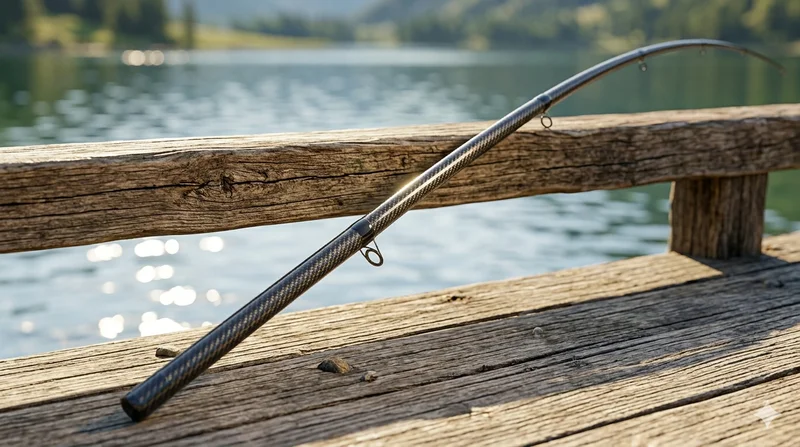
Carbon Fiber Fishing Rod Blank
High-quality carbon fiber fishing rod blank manufactured from multiple grades of Toray carbon fiber cloth. Available in a wide range of lengths, powers, and actions for freshwater and saltwater applications. Suitable for OEM rod building.

Carbon Fiber Plate — 3K Twill T700 3.0mm
Medium-thickness 3.0mm carbon fiber plate offering significantly higher load capacity while maintaining attractive 3K twill finish. Suitable for structural brackets, reinforcement plates, and load-bearing panels.

Carbon Fiber Plate — 3K Twill T700 1.5mm
Thin 1.5mm carbon fiber plate with 3K twill weave surface. Lightweight and stiff, commonly used for covers, panels, drone bodies, and applications requiring a premium aesthetic appearance.
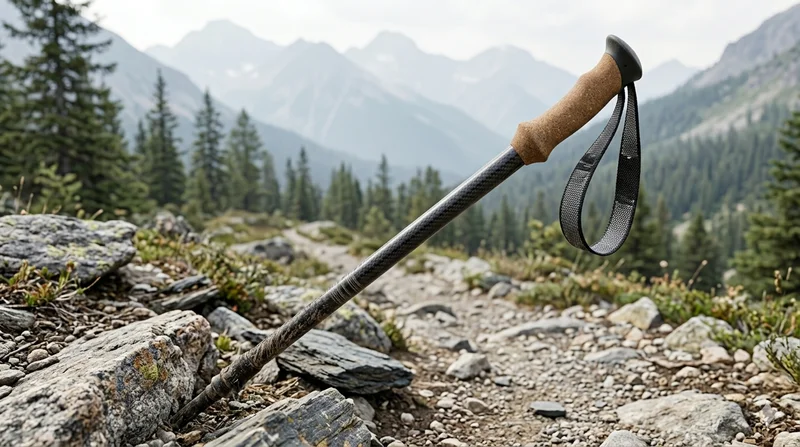
Carbon Fiber Trekking Pole
Lightweight carbon fiber trekking pole manufactured from high-grade carbon fiber tube. Weighs only 160g per pole while providing superior shock absorption and durability for hiking, trail running, and backpacking.

Square Carbon Fiber Tube — 3K Twill T700
Square cross-section carbon fiber tube manufactured with 3K twill weave for torsional strength. Preferred for structural frames, trusses, and support columns where rectangular geometry offers design flexibility.